
Astell&Kern Stella Review: A $3,900 Flagship With Tricky Treble

Where the Money Goes
Four thousand dollars for in-ear monitors. I keep typing that number and waiting for it to feel less ridiculous. It hasn't. But the segment exists, it's growing, and there's now a small constellation of products — Noble Kronos, Empire Ears Odin Mk2, Astell&Kern's own Luna, FATfreq Grand Maestro Anniversary — that all live in this stratosphere. The Stella, a co-development between Astell&Kern and the still-young Volk Audio with final voicing by mastering engineer Michael Graves, walks into that crowded summit at $3,900 and asks for your attention.
Here's the thing about Astell&Kern's IEM collaborations: the company has a consistent track record of pairing with builders who know their craft — 64 Audio, Campfire, Empire Ears, now Volk — and putting a polished industrial wrapper around someone else's acoustic vision. The Volk-designed Etoilé that preceded the Stella was a quietly impressive debut. So the question with Stella isn't whether it sounds good. The question is whether there's $3,900 of differentiation here, or just $3,900 of badge.
Quick Specs
| Spec | Detail |
|---|---|
| Price | $3,900 USD |
| Driver config | 12-driver quadbrid: 1 DD (Volk M9-R 9mm) + 5 Sonion BA + 2 Volk MP-2 planar + 4 Sonion EST |
| Crossover | 6-way, 5 sound tubes |
| Impedance | 7.17 Ω |
| Sensitivity | 103.8 dB SPL/mW |
| Frequency response | 10 Hz – 45 kHz |
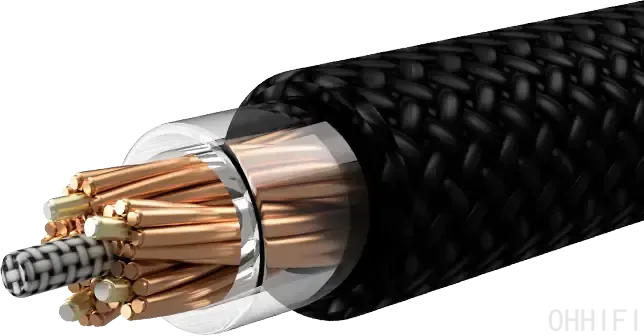
| Cable | 4-core hybrid (5N LCOFC copper, 4N silver, 24K gold), 0.78mm 2-pin → 4.4mm balanced |
| Materials | 6061-T6 aluminum chassis, 316 stainless steel frame, 9H sapphire glass faceplate |
| Tuning | Volk Audio with Michael Graves at Osiris Studio, Los Angeles |
Design & Build: Closer to a Mechanical Watch Than an Earphone
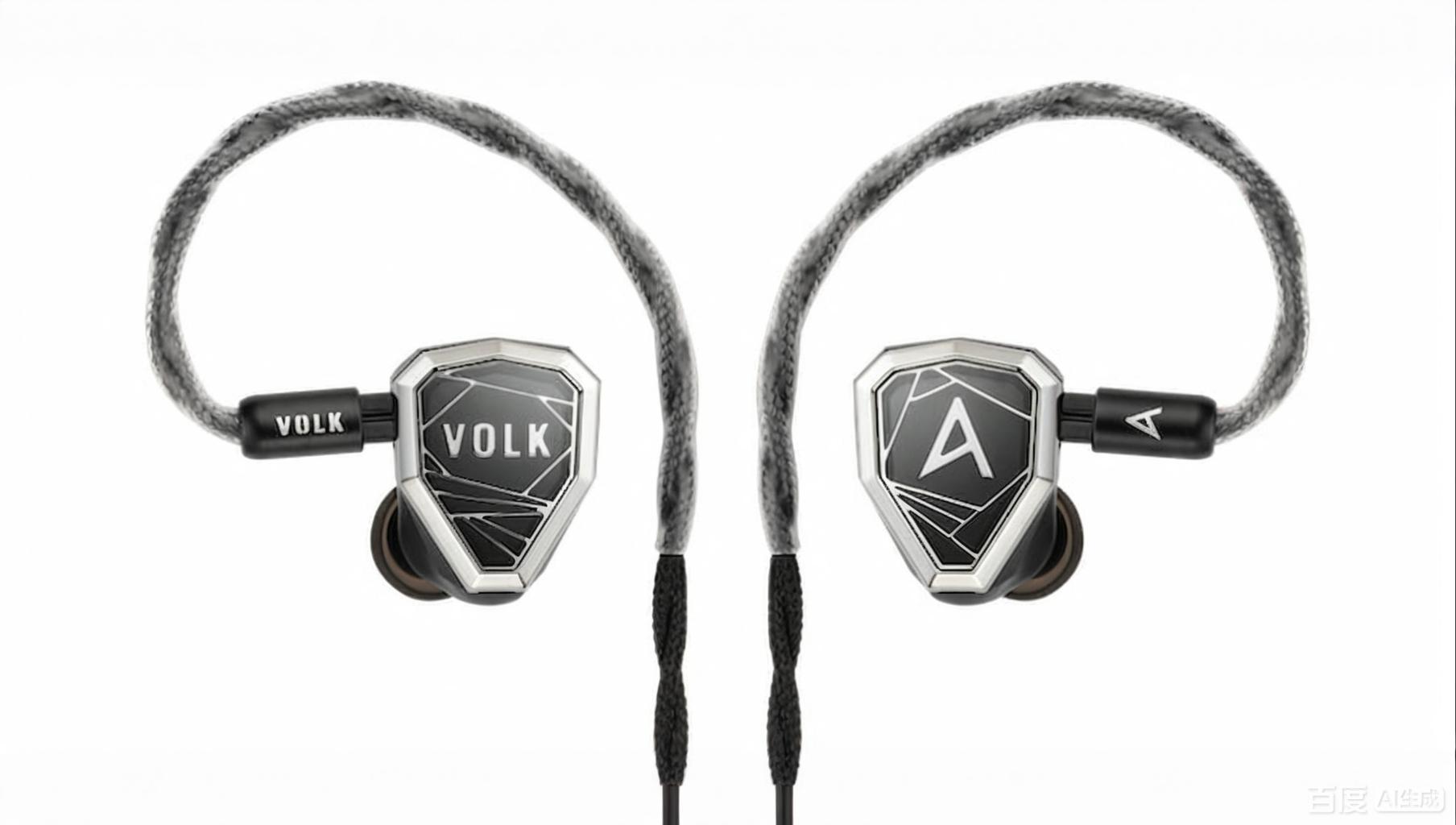
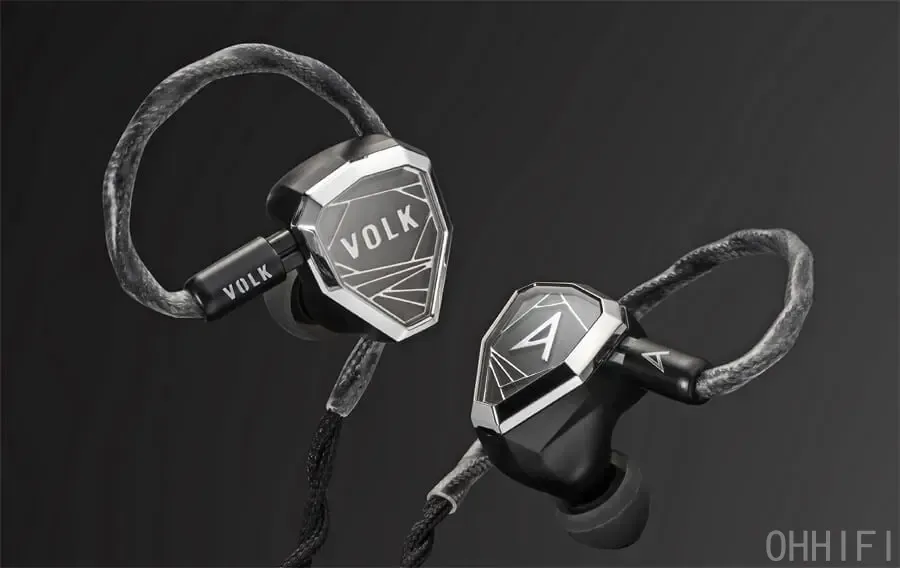
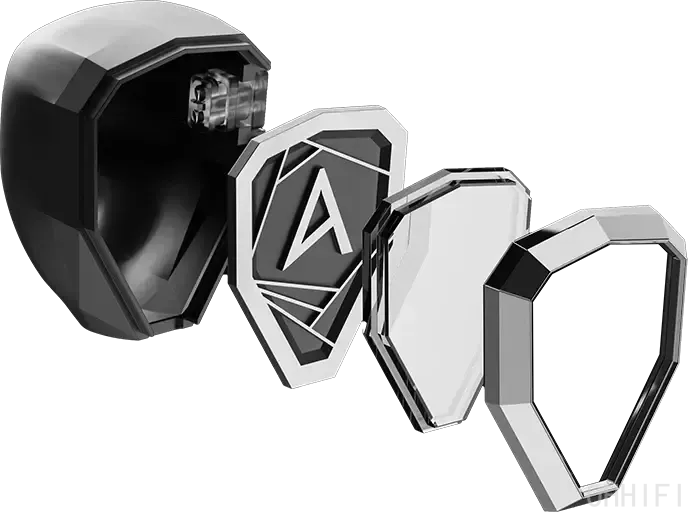
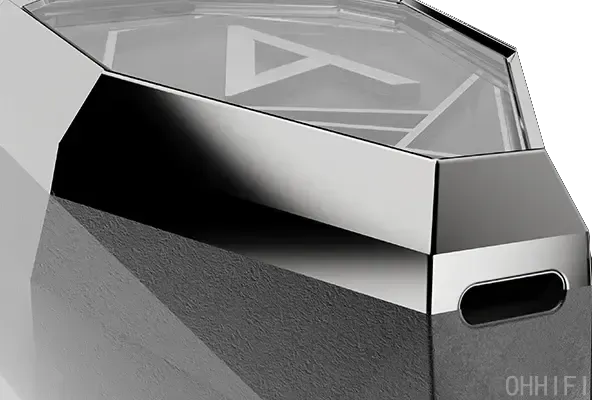
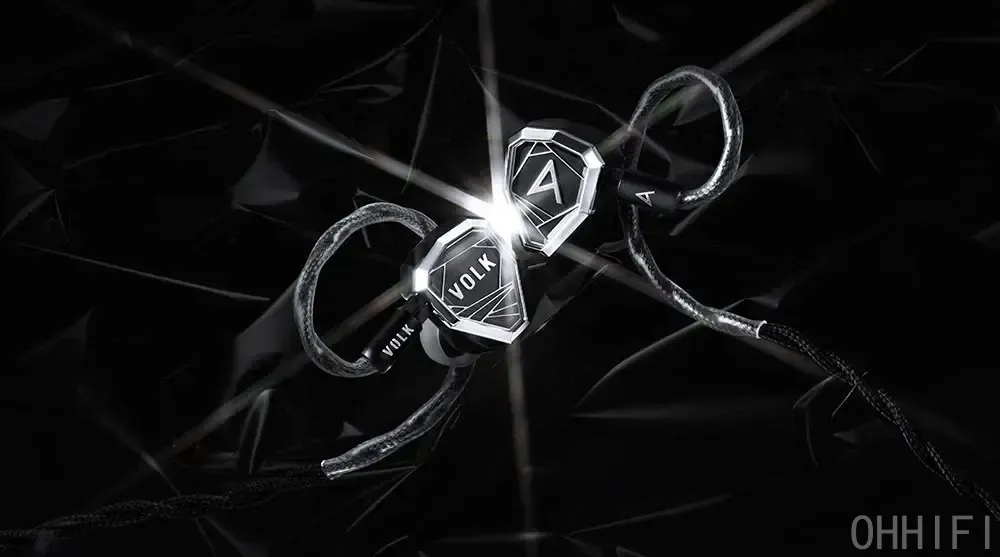
I've handled a lot of expensive earphones. Stella is the first one in a long while where I caught myself just turning it over in my hand instead of putting it in. The faceplate frame is mirror-polished 316 stainless — the same family of marine-grade steel that ends up in nice mechanical watches — wrapping a sapphire crystal panel and a satin-anodized 6061-T6 aluminum centerpiece etched with the Volk and A&K logos. The shell is more of the same aluminum, anodized matte black. It feels dense without feeling heavy. The fit and finish are, frankly, the new bar for the segment.
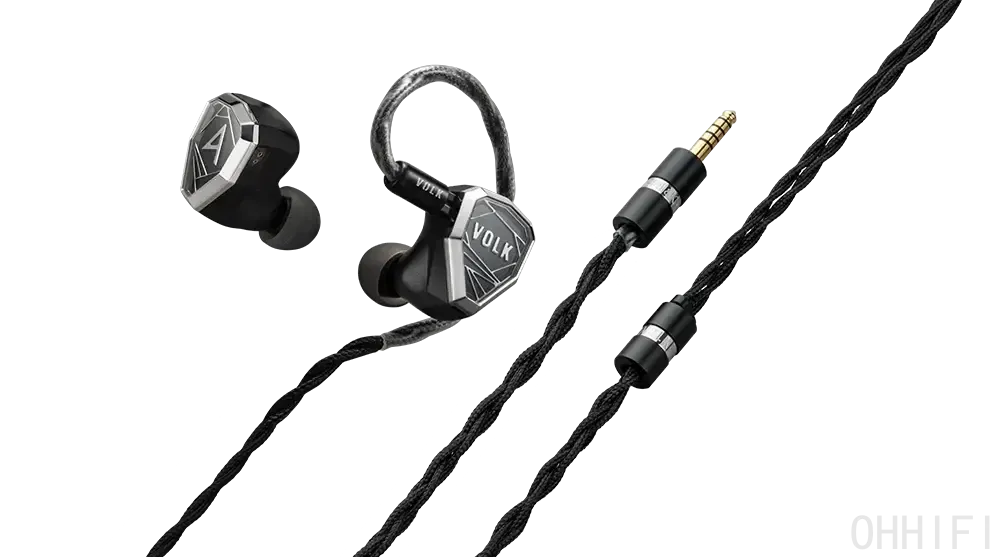
One small but real complaint, and I'm not the only reviewer flagging it: the cable's 0.78mm 2-pin connectors sit shallow. In the ear, they hold fine. But pulling the IEMs out of their case, I had a couple of disconnects that felt distinctly unflagship. An aftermarket cable with longer pins solves it instantly. You shouldn't be buying $200 of accessories to make a $3,900 product behave.
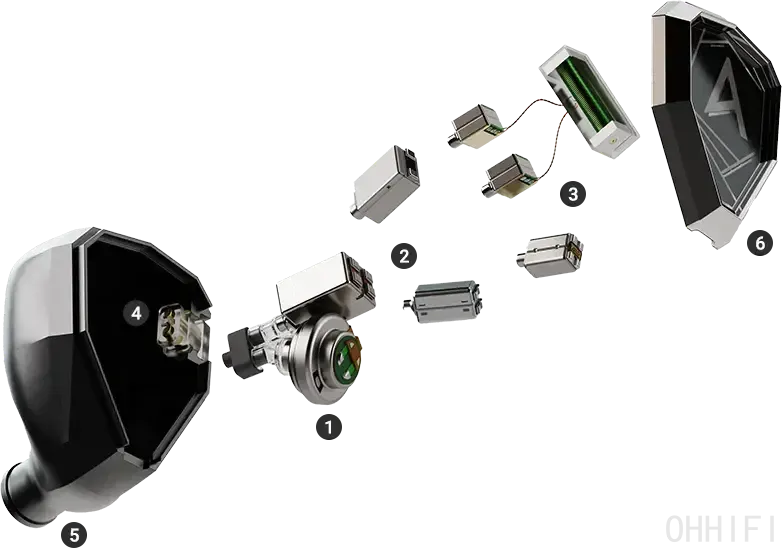
Five sound tubes for a six-way crossover is worth a quick note — Volk merged a couple of crossover bands into a shared nozzle path. Whether this matters acoustically is debatable; what matters is the tubes are metal rather than plastic, which the cheaper Etoilé got wrong.
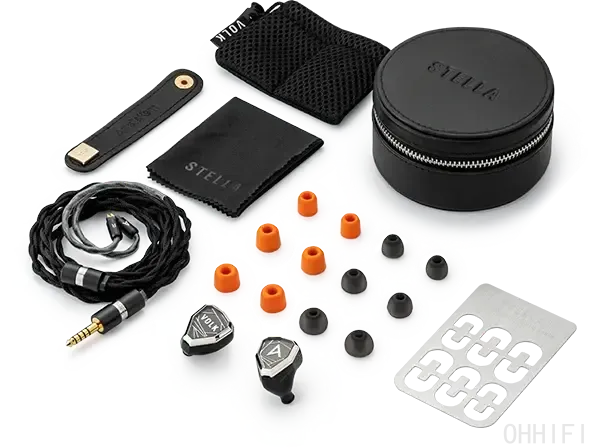
The accessory pack is the other restrained move. Three pairs each of foam and silicone tips, a leather pouch, a leather cable strap, a microfiber, and a leather carry case that's pretty but not actually protective enough for travel. At this price, you'd expect Comply tips, a second cable, and a Pelican-grade case. You don't get them. The included foams are excellent — Volk clearly cared about the right things — but a $400 IEM doesn't typically apologize for the case, so a $3,900 one shouldn't either.

The Sound: A V-Shape With Manners
Calling Stella "V-shaped" is technically right and rhetorically misleading. The bass is lifted, and the upper treble has presence, but neither move lives at the volumes you'd associate with a typical V-tuned consumer earphone. This is more like a reference-leaning tuning with two thumbs gently on the scale — a sub-bass thumb for body, a top-octave thumb for air. The midrange between them is largely undisturbed.
Bass: Sub-Bass First, Mid-Bass Polite
The Volk M9-R 9mm dynamic, paired with two Sonion balanced armatures in a dual-chamber low-end module, handles everything from 20 Hz to 600 Hz. The voicing prioritizes sub-bass extension over mid-bass slam. On James Blake's "Limit to Your Love," the gut-punch synth bass that comes in around the 1:30 mark digs deep and stays composed — no smear, no overhang, no upward bleed. The note shape is clean and the decay is fast.
Pull up something more rhythmically demanding and the trade-off becomes audible. The kick drum on Daft Punk's "Doin' It Right" lands with weight but not the chest-thump impact you'd get from a basshead set or, frankly, from something like the Empire Ears Raven. If you came here for slam, Stella will feel polite. If you came for layered, textured, well-controlled low end with genuine sub-bass authority, you'll be happy.
Midrange: Mostly Out of Its Own Way
This is where Stella earns most of its keep. The tri-armature midrange array — two BAs covering 600 Hz to 7 kHz with a third extending to 15 kHz — is voiced for tonal completeness rather than vocal hype. Lower mids aren't scooped to chase the fashionable "clean" presentation that turns acoustic instruments into specters. Body is preserved.
Norah Jones's "Don't Know Why" is the easy test, and Stella places her voice exactly where it should sit — slightly forward, intimate, full-bodied, not glossed. The Wurlitzer behind her has the right woody warmth. Switch to Chet Baker's "My Funny Valentine" from the 1956 sessions and Stella resolves the breath and lip noise without making it a feature. This is mature voicing.
Acoustic material like Paul Simon's "Diamonds on the Soles of Her Shoes" comes through with body in the lower strings and sparkle in the upper register without smearing the two together. Mark Knopfler's Strat tone on "Sultans of Swing" gets the right amount of bite without becoming a jangling mess. There's no obvious upper-mid spike at 3 kHz brightening everything artificially. Vocals don't shout, guitars don't fizz, pianos sound like wood and felt rather than glass and metal.
Treble: Where the Conversation Gets Complicated
The two Volk MP-2 planar drivers and four Sonion EST tweeters cover 9 kHz to 45 kHz. On well-mastered material — Steely Dan's "Aja," for example — the air around the cymbals is real, the brushwork on Steve Gadd's snare is pristine, and there's none of the metallic ring you sometimes get from bigger BA arrays trying to do an EST's job. The decay on the hi-hat is gorgeous.
But independent reviews split a bit on how aggressive the upper treble is, and after a weekend with the Stella I think I understand why. There's a region somewhere in the 8–12 kHz band where Stella has more energy than I'd call neutral. On a Stevie Wonder album mastered with restraint, you don't notice. On a 90s alt-rock record with the high-shelf cranked — pick almost anything off Smashing Pumpkins' Mellon Collie — that energy compounds with the recording's own brightness and starts to bite. The character isn't grain or harshness; it's emphasis. Refined emphasis, but emphasis.
Tip choice matters more than usual here. With the included silicones I found the top end occasionally splashy on bright recordings. Switching to the foam tips tames the resonance enough that I stopped pre-screening my library. If you're treble-sensitive — and at my age, I'll admit I drift that way — Stella will require conscious source and tip pairing. It's not a deal-breaker. It's a thing to know.
Soundstage and Imaging
This is the EST tier doing what it's supposed to do. Width is good, depth is better, and the layering is excellent. The Eagles' "Hotel California" from Hell Freezes Over puts you in the right seat — applause behind you, the percussion ring on the right, the second guitar slightly back-left. Stella doesn't manufacture a bigger stage than the recording contains; it just gets out of the way and lets the mix breathe.
On orchestral material — Hans Zimmer's "Time" from Inception, where the slow brass build is everything — Stella holds the layers without congealing them. The cellos at the bottom and the strings at the top stay separated. This is one of the things that's hard to do at any price and harder still in an IEM, and it's where the quadbrid topology actually pays off.
Test Setup
Stella is sensitive — 7.17 Ω, 103.8 dB per A&K's spec sheet — so source noise floor matters more than usual. I ran it from two ends of the chain on purpose: a small dongle DAC for portable use, and my desktop solid-state DAC into an OTL tube amp for the evaluation listening. Volume came up at the very lowest end of the dial in both cases. Any source hiss is going to be audible, so this is not an IEM that forgives a noisy laptop output.
Burn-in: I gave the dynamic driver about 40 hours of program material before critical listening. The bass tightened up modestly. Treble character did not change in any way I could honestly attribute to drivers rather than ears adapting.
Measured Performance
I haven't seen Crinacle, RTINGS, or any of the major measurement databases publish a Stella graph as of this writing. Volk and A&K publish a manufacturer frequency response of 10 Hz to 45 kHz with the EST array doing the work above 9 kHz, and the impedance/sensitivity numbers above come from official spec sheets. I'd love to see a third-party 5128 measurement to confirm where exactly the upper-treble energy concentrates — my ear says somewhere around 10 kHz, but ears are not coupler simulators. I'll update if a credible measurement surfaces.
The Competition
| Rival | Comparison | Verdict |
|---|---|---|
| Noble Kronos ($4,500) | 9-driver quadbrid flagship with bone conductor and titanium shell | More natural and balanced through the mids; less sub-bass weight; fit is more demanding. Kronos for tonal naturalness on jazz and classical. Stella for modern genre versatility. |
| Astell&Kern Luna ($2,700) | A&K's own predecessor flagship; lower impedance, simpler topology | More linear and warmer in the lower register but lacks Stella's treble extension and technical capability. Luna is the alternative for buyers who want A&K build polish without EST detail-forwardness. |
| Empire Ears Odin Mk2 (~$3,400) | Veteran tribrid flagship with meta-style tuning | Bassier, more theatrical, less mature in the midrange. Odin Mk2 is the fun-tuned summit-fi piece; Stella is the reference-leaning one. |
| Campfire Audio Andromeda 10 ($1,799) | All-BA flagship at half the Stella's price | Warmer, more relaxed top end, easier with bright recordings. Andromeda 10 is what you buy if you love Stella's general balance but find the treble too active. Stella has clear technical advantages; Andromeda is more forgiving. |
The Verdict — 8.5/10
Stella does the things that justify expensive IEMs: it sounds technically excellent, it's built to last decades, and it's voiced by someone — Michael Graves — who actually listens to music for a living. The mature midrange and the EST top-end speed are the real engineering wins. The luxury build is the obvious one.
What keeps it from a higher mark is a combination of small annoyances at a price where annoyances aren't acceptable. The cable pin connection is loose. The case is decorative rather than functional. And the 8–12 kHz region will bother some non-trivial fraction of buyers, particularly those listening to brighter modern productions on noisier mid-tier sources. None of these is a catastrophe. Together, they're the difference between a genuinely sublime product and a very-good-with-asterisks one.
Pros
- Watch-grade build that holds up to its closest segment rivals and beats most of them
- Mature, neutral midrange that doesn't chase the cold-and-clean fashion
- EST treble extension is fast, clean, and free of the metallic edge that plagues lesser arrays
- Sub-bass authority without sloppy mid-bass overhang
- Soundstage and imaging genuinely flagship-tier
- Included foam tips are excellent — second only to Comply
Cons
- Upper treble emphasis (8–12 kHz region) requires careful source and tip matching
- 0.78mm 2-pin sockets accept the stock cable too loosely; disconnects in the case are real
- Carry case is not protective enough for actual travel
- Mid-bass slam is restrained — bassheads should look elsewhere
- Accessory pack is thin for the price; no spare cable, no liquid-silicone tips
Who Should Buy
This is for you if you've spent enough time in summit-fi to know that 12 drivers don't automatically equal good sound, and you want a confidently voiced IEM with a real reference-engineering pedigree. It's for the listener who already owns a low-noise source, wants a single set of IEMs that handles vocal jazz, modern pop, and orchestral material without obvious weakness, and values build longevity. Stella will outlast its electronics.
Who Should Skip
Look elsewhere if you're treble-sensitive and unwilling to fight with tips and sources to find synergy — a Campfire Andromeda 10 or a Noble Kronos will make your life easier. Skip it if you want chest-thumping mid-bass slam — Odin Mk2 and Empire Ears Raven are voiced for that. And skip it if your source is anything noisier than a clean dongle DAC. Stella's sensitivity does not forgive sloppy electronics.



Comments