
The Alchemist’s Transport: Goldmund Eidos Excellence and the Renaissance of the Silver Disc

Editorial: The Persistence of the Physical
It is late 2025. The world of high-fidelity audio has largely migrated to the ether. We live in the age of the invisible—libraries of millions of tracks summoned by a voice command, streamed from servers in Iceland to a glass rectangle in your pocket, and beamed wirelessly to speakers that adjust themselves to the acoustics of your room. It is miraculous. It is convenient. And for a specific breed of audiophile, it is entirely insufficient.
There is a stubborn resistance that persists in the high-end community. A belief that music, to be truly felt, must possess mass. It must have a physical form. You must be able to hold it, inspect its liner notes, and engage in the deliberate, tactile ritual of loading a disc. This is not merely nostalgia; it is a rejection of the ephemeral nature of the digital stream. It is a declaration that this album matters.
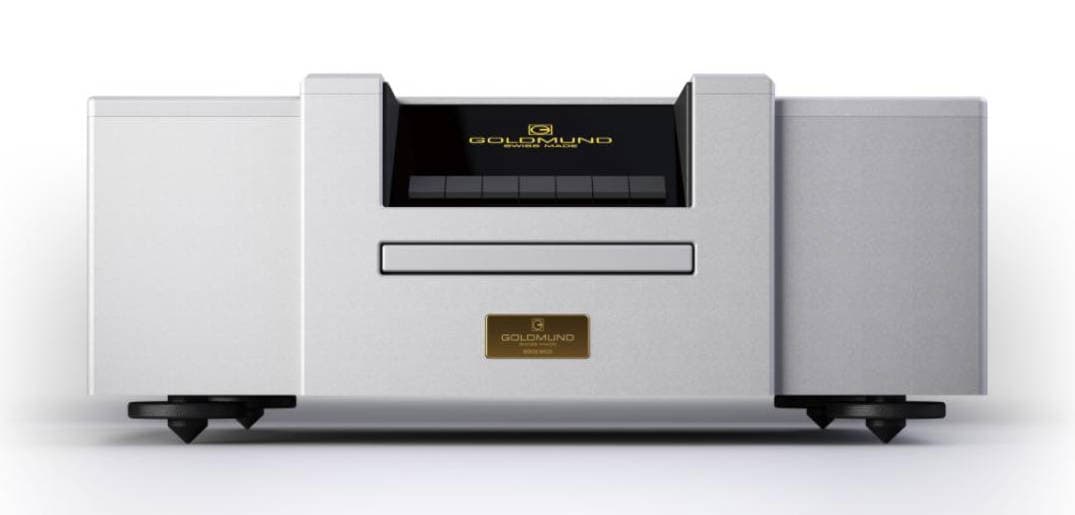
Into this landscape, Swiss audio titan Goldmund has dropped a monolith: the Goldmund Eidos Excellence SACD Player.
It’s a bold move. Releasing a five-figure (or perhaps six-figure—pricing remains discreetly "on application") optical disc player in 2025 is the audio equivalent of releasing a new grand complication mechanical watch in the era of the Apple Watch Ultra. It doesn't just have to be good; it has to be transcendent. It has to justify the very existence of the medium it serves.
As an editor who has watched the rise, fall, and zombie-like resurrection of various formats, I find the Eidos Excellence to be one of the most significant digital sources of the decade. Not because it reinvents the wheel, but because it perfects it with a level of obsessive, almost pathological engineering that only Goldmund can muster. It sits in a fascinating middle ground in their hierarchy—below the colossal, table-like Eidos Reference, yet significantly evolved from the single-chassis Eidos SACD.
This report is not just a review of a machine; it is an autopsy of the current state of extreme digital playback. We will tear down the Eidos Excellence to its atomic components—its mechanical grounding, its dual-chassis power architecture, its D&M heart. We will then throw it into the ring with the heavyweights of the industry: the dCS Vivaldi Apex, the Esoteric Grandioso K1X SE, and the CH Precision D1.5.
Buckle up. We are going deep.
Part I: The Goldmund Ethos — Physics as Religion
To understand the Eidos Excellence, you have to understand the company that built it. Goldmund is not a "hi-fi" company in the traditional cottage-industry sense. They are a physics laboratory that happens to sell luxury goods. Founded in 1978 and based in Geneva, Goldmund has always operated with a certain detached arrogance—a belief that they aren't competing with other audio brands, but rather with the laws of physics themselves.
1.1 The Doctrine of Mechanical Grounding
The central pillar of Goldmund’s philosophy—and the defining characteristic of the Eidos Excellence—is Mechanical Grounding.
Most audio manufacturers treat vibration as something to be damped. They add rubber, Sorbothane, or mass to absorb energy. Goldmund treats vibration as something to be evacuated. Their research, dating back to the early 1980s, posits that damping materials simply store energy and release it later, causing time-smearing and coloration (blurring) of the sound.
Goldmund’s solution is the Mechanical Diode. By using materials of increasing hardness and density, coupled with extreme structural rigidity, they create a path of least resistance for vibrations to flow out of the device and into the floor. It is analogous to electrical grounding, where excess current is drained to earth.
In the Eidos Excellence, this isn't just marketing fluff. It’s the reason the player exists. An optical disc player is a mechanical device. It spins a plastic disc at high RPM. It moves a laser sled on rails. It creates vibration. If that vibration shakes the lens, the servo mechanism has to constantly correct the focus. This servo activity draws fluctuating current from the power supply. That fluctuating current modulates the ground plane of the DAC. The result? Jitter. Timing errors. The collapse of the soundstage.
Goldmund’s approach is to lock the mechanism in a "mechanical vice," drain the vibration instantly, and allow the servo to work almost passively. This, they claim, is the source of their "Musical Truth"—a sound that is fast, transparent, and utterly devoid of the "digital glare" caused by jitter.
1.2 The "Excellence" Hierarchy
The "Excellence" moniker is a relatively new stratification in Goldmund’s lineup, sitting between the "Reference" (the absolute state of the art, cost-no-object) and their standard high-end lines.
The Ancestor: The Eidos Reference SACD (released ~2021) is a 110kg beast. It’s not just a player; it’s a piece of furniture, built on a dedicated stand that is integral to its mechanical grounding.
The Sibling: The standard Eidos SACD (released ~2023) is a compact, single-chassis unit weighing around 20kg. It brought the Reference tech into a rack-friendly size.
The Newcomer: The Eidos Excellence (Nov 2025) bridges the gap. It takes the rack-friendly form factor of the standard Eidos but splits the architecture into two chassis, separating the power supply from the signal path. This is a massive upgrade, moving it closer to the performance of the Reference without the 110kg logistical nightmare.
Part II: Anatomy of the Eidos Excellence
Let's get technical. What exactly are you getting for your investment?
2.1 The Two-Box Revolution: Power Supply Architecture
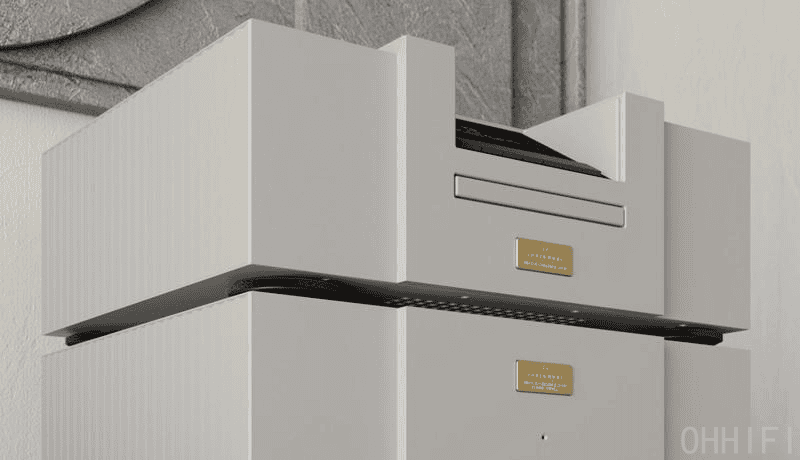
The headline feature of the Eidos Excellence is its Dual-Box Design.
In the world of ultra-high-end audio, the power supply is often the dirtiest part of the component. Transformers hum. They vibrate. They throw out electromagnetic fields (EMI) that can induce noise in sensitive analog circuits. Rectifiers create switching noise that can bleed into the digital clock.
By physically amputating the power supply into a separate chassis, Goldmund achieves two things:
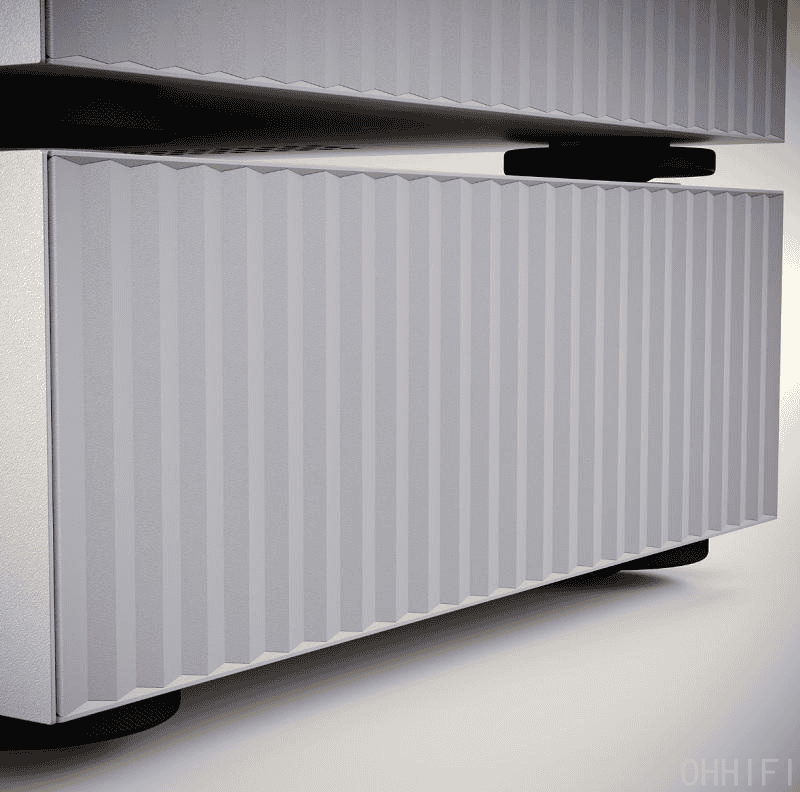
Mechanical Isolation: The vibration of the heavy transformers is kept away from the delicate optical transport mechanism.
Electrical Isolation: The EMI is contained within a shielded aluminum bunker, far away from the DAC chips.
Goldmund describes this PSU as being "born of decades of research". It generates voltages independently for the left and right channels. This is a crucial detail. In a shared power supply, a heavy bass transient in the left channel can momentarily suck current, causing the voltage rail to sag for the right channel. This collapses the stereo image. By separating the regulation stages, the Eidos Excellence ensures that the left channel has no idea what the right channel is doing. They are essentially two mono players sharing a chassis.
Connecting the two boxes is a bespoke shielded cable, derived from the same technology used in the Mimesis Excellence preamplifier. This isn't just a wire; it's a component in itself, designed to transfer high-current energy without acting as an antenna for Radio Frequency Interference (RFI).
2.2 The Heart: The D&M Mechanism
Lift the hood (metaphorically—Goldmund chassis are sealed like bank vaults), and you find a mechanism based on D&M technology.
Some audiophiles might sneer at this. D&M (Denon & Marantz) makes mass-market players. Why is a luxury Swiss brand using a Japanese OEM part?
The answer is pragmatism. D&M makes arguably the most reliable, robust SACD mechanisms in the world. But Goldmund doesn't just drop it in. They strip it down. They reinforce the loader mechanism with a Goldmund damper to increase rigidity. They integrate the entire assembly into their mechanical grounding system.
They call this the Suppress Vibration Hybrid mechanism. The goal is "whisper-quiet operation" and "uncompromising precision." The mechanism is compatible with a vast array of physical media: SACD, CD, CD-R, CD-RW, and even DVD-R/RW containing audio data files. This last point is a nod to the dedicated audiophile who may have burned high-resolution DSD or PCM files onto DVDs in the pre-streaming era.
2.3 The Brain: Digital Processing and DAC
Goldmund has historically been secretive about their DAC chips, preferring to focus on their Alize digital filter algorithms. While the specific chip in the Excellence isn't named in the press release, the specs give us clues.
Resolution: It supports PCM up to 384 kHz and DSD up to DSD512. This is "state-of-the-art" territory, surpassing the standard Red Book CD (44.1kHz) and even standard SACD (DSD64) by orders of magnitude.
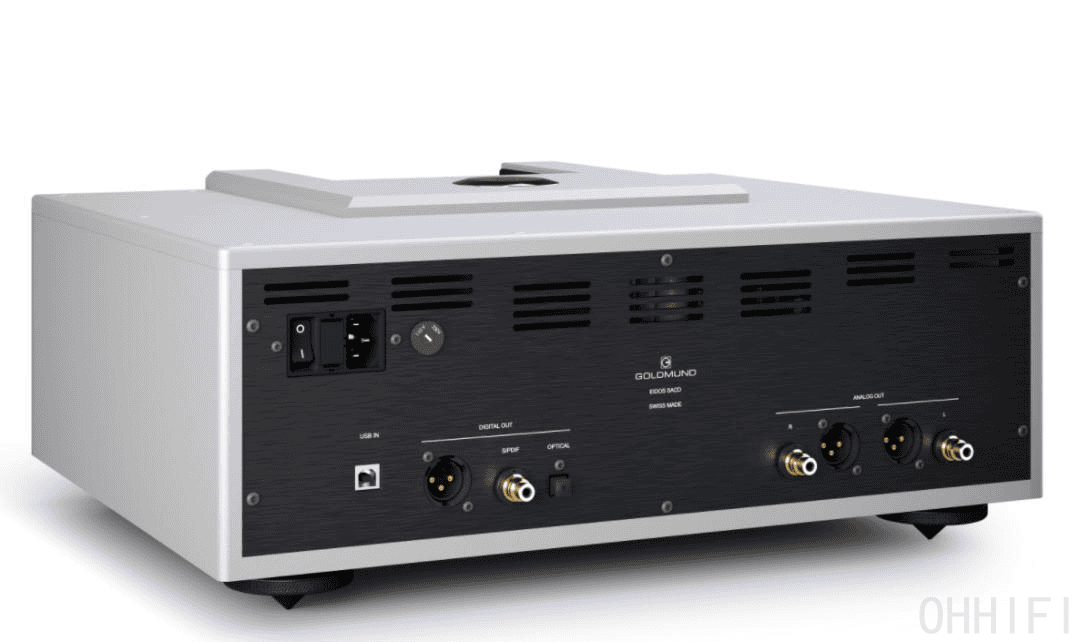
The USB "Backdoor": The Eidos Excellence is not just a player; it is a DAC. It features a USB input on the rear panel. This allows you to connect a computer, a dedicated streamer, or a server.
Insight: This is a strategic move. It allows the owner to transition to streaming without buying a separate DAC. You can spin discs for serious listening and stream Tidal/Qobuz via USB for casual listening, utilizing the same world-class conversion engine for both.
Compatibility: It requires a driver for Windows but is plug-and-play for macOS and Linux.
2.4 Aesthetics and Build
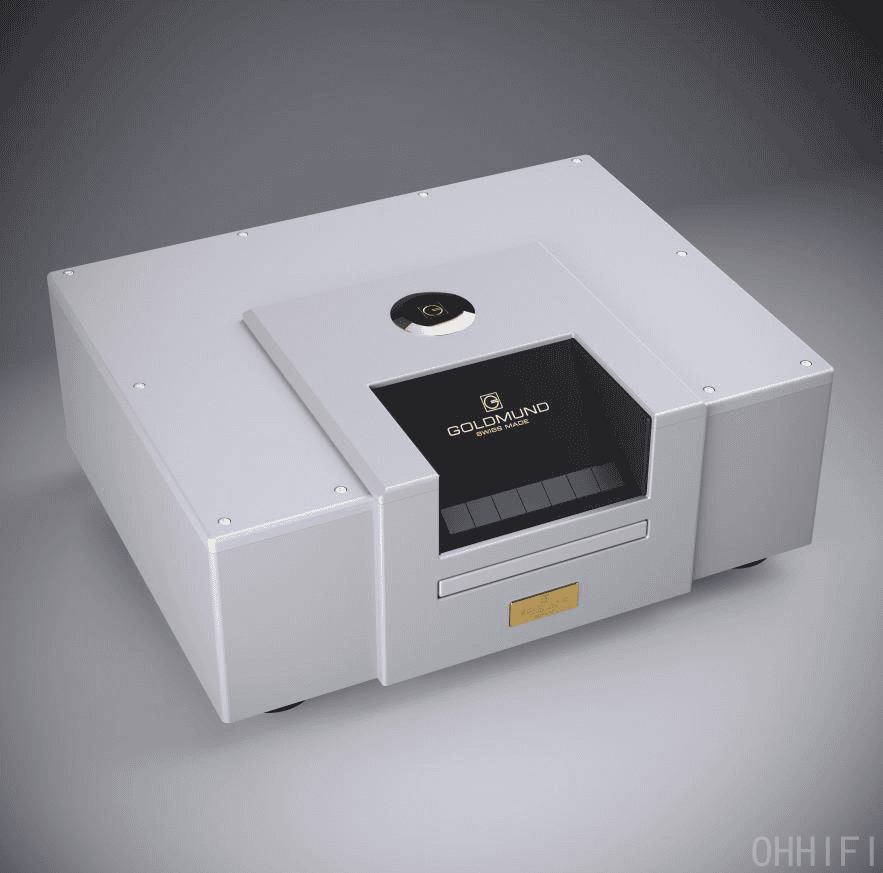
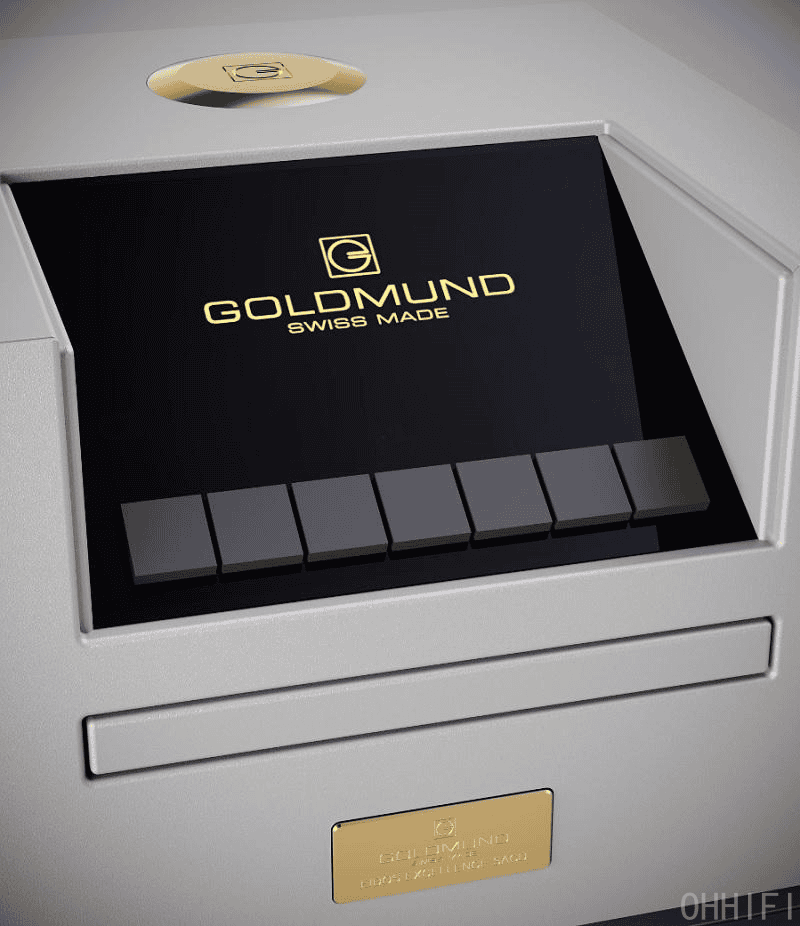
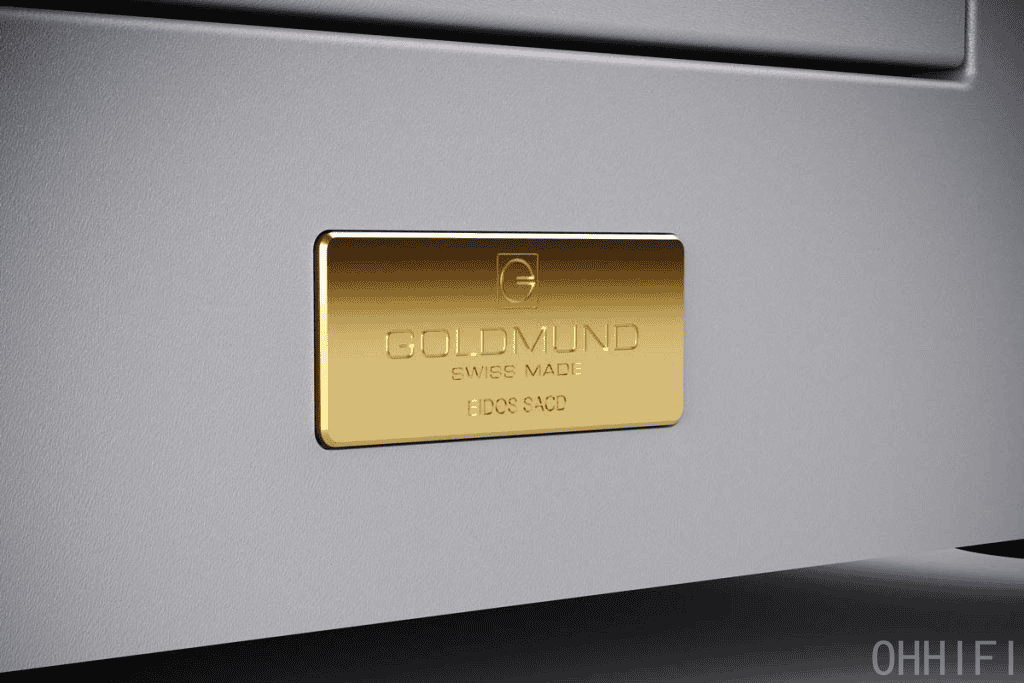
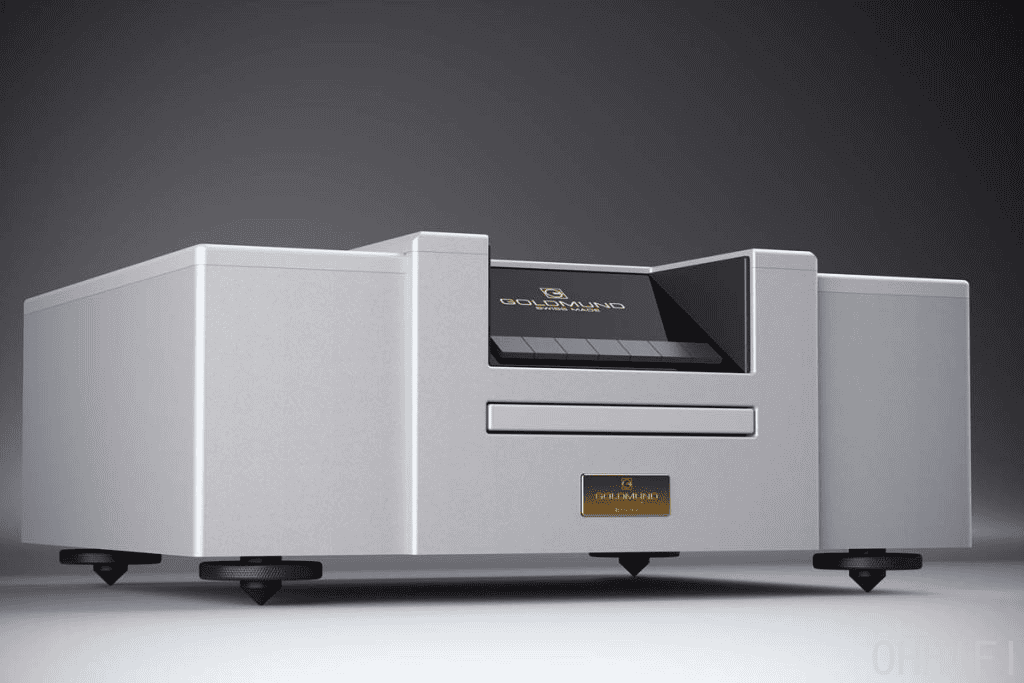
The Eidos Excellence is initially available in Goldmund’s signature grey aluminum finish, with a black version to follow.
The aesthetic is stark, Bauhaus-influenced minimalism. No dancing VU meters. No oversized touchscreens. Just a precise, milled faceplate, a "control keyboard" (buttons), and the mechanism drawer. It is designed to look timeless—a monolith that could have been made in 1995 or 2035.
Dimensions: While exact specs for the Excellence specifically (vs the standard Eidos SACD) are elusive in the snippets, the standard Eidos is 44cm W x 18.3cm H x 37cm D and 20.6kg. With the external PSU, expect the Excellence to occupy two shelves and weigh significantly more—likely pushing 30-40kg total.
Part III: The Competitive Landscape — A War of Philosophies
The Eidos Excellence does not exist in a vacuum. The ultra-high-end digital market ($50,000+) is a battlefield occupied by entrenched powers, each with a radically different engineering philosophy. To understand the Goldmund, we must contrast it with its rivals.
3.1 The British Technocrats: dCS Vivaldi Apex & Rossini Apex
If Goldmund is Physics (mechanical grounding, speed), dCS is Mathematics.
Based in Cambridge, UK, Data Conversion Systems (dCS) comes from a background in military radar. Their approach to D/A conversion is unique.
The Ring DAC: Unlike Goldmund (who likely uses high-end delta-sigma chips from ESS or AKM with custom filters), dCS builds their own DACs from discrete resistors and FPGAs. They write their own code. They control the conversion process at the bit level.
The Sound: With the recent Apex upgrade, dCS has moved away from a "sterile" analytical sound to a richer, more organic presentation. Users report a "stunningly good" performance that is addictive.
The Contrast: dCS is for the "Tweaker." It offers endless settings: filters, mappers, upsampling options. It is a computer scientist’s dream. Goldmund is for the "Purist." You insert the disc. You press play. There are no filters to select. Goldmund believes they have calculated the correct way to play the file, and they don't burden the user with choices.
The Verdict: Choose dCS if you want to explore the nuances of DSP and have a system that sounds ethereal and airy. Choose Goldmund if you want "slam," transient speed, and a set-and-forget reference.
3.2 The Japanese Heavyweights: Esoteric Grandioso K1X SE
If Goldmund is about removing vibration, Esoteric is about crushing it.
The Grandioso K1X SE is the Godzilla of players.
VRDS-Atlas: This is the best transport mechanism in the world, period. It uses a massive turntable to clamp the disc and correct any warpage physically. It is built like a bank vault door.
Discrete DAC: Like dCS, Esoteric now uses its own "Master Sound Discrete DAC," a 64-bit architecture.
The Contrast: The Esoteric is dense, heavy, and complex. Its sound is often described as "authoritative" with immense bass weight. Goldmund’s sound is typically lighter on its feet—faster, more agile.
The "Gold" Factor: The K1X SE Gold Edition features a champagne gold chassis, harking back to the 80s. Goldmund’s grey is strictly modern industrial.
The Verdict: If you believe mass equals quality, buy the Esoteric. If you believe in the "evacuation" of energy (the path of least resistance), buy the Goldmund.
3.3 The Swiss Cousins: CH Precision D1.5
Located just down the road in Switzerland, CH Precision offers a different take on Swiss luxury.
Modularity: The D1.5 is a card-cage design. You can buy it as a transport and add DAC boards later. You can add external power supplies. You can add clock sync boards. It is "future-proof" in a way the fixed-architecture Goldmund is not.
The Contrast: CH Precision is deeply engineering-focused but user-configurable. It integrates into a proprietary control ecosystem. Goldmund components are more standalone.
The Verdict: The CH Precision is for the system builder who wants a scalable path. The Goldmund Eidos Excellence is a singular statement of intent.
3.4 The American Contender: MSB Select / Reference
Briefly mentioned in comparisons, MSB Technology (California) uses R2R Ladder DACs. This technology is often cited as sounding the most "analog" and fluid. MSB’s modularity and passive volume control modules make them a direct rival to Goldmund’s "DAC + Preamp" philosophy. However, MSB has largely exited the transport market to focus on DACs, whereas Goldmund is doubling down on the physical spinning disc.

Part IV: Deep Technical Analysis — Why This Matters
Why does a two-box SACD player matter in 2025? Is it just jewelry for the ultra-rich?
The answer lies in the limitations of digital audio that we are only just beginning to understand.
4.1 The Jitter/Noise Paradox
For years, engineers thought "bits are bits." If the data reads correctly, the sound should be perfect. We now know that timing is everything.
The human ear is incredibly sensitive to time-domain errors (smearing).
The PSU Impact: By moving the power supply to a separate box (the Eidos Excellence strategy), Goldmund lowers the noise floor of the ground plane.
The Result: When the noise floor drops, you don't just hear "less hiss" (digital is already silent). You hear micro-dynamics. You hear the decay of a reverb tail in a cathedral. You hear the intake of breath before a singer starts. These sounds are usually buried in the low-level noise of the power supply rectifiers.
Specs: The Eidos Excellence boasts a Signal-to-Noise Ratio (SNR) > 128dB and THD+N < 0.00018%. These are figures that skirt the theoretical limits of physics.
4.2 The "Alize" Secret Sauce
Goldmund’s digital filtering (often marketed as Alize technology in their history) is famous for its Time Correction.
Standard digital filters (brick wall filters) look great on a frequency chart (flat to 20kHz) but terrible on a time chart (they "ring," creating pre-echoes).
Goldmund prioritizes the time domain. Their players often sound "fast" because the leading edge of the note—the transient—is preserved perfectly. This makes percussion sound explosive and guitar plucks sound visceral. The Eidos Excellence, with its high-bandwidth output stages (Goldmund electronics typically operate into the MHz range), is built to deliver this speed.
4.3 Connectivity and the Preamp Connection
The Eidos Excellence is designed to be paired with the Mimesis Excellence preamplifier.
Synergy: Both use the same dual-box philosophy and the same shielding cabling.
Gain Matching: The player offers switchable output levels (Standard vs. High). The "High" output (4V RCA / 8V XLR) allows the player to drive power amps almost directly (via a passive volume control) or to push a preamp to its optimal operating point. This is a pro-audio feature adapted for the home.
Part V: The Financial Reality & Conclusion
5.1 The Cost of Excellence
While the official retail price remains "unannounced", we can triangulate.
Eidos SACD (Standard): ~£80,000 / 50,000 CHF.
Eidos Reference: ~£175,000 / 125,000 CHF.
Eidos Excellence Estimate: It is safe to assume the Eidos Excellence, with its dual chassis and upgraded PSU, will land in the 70,000 CHF - 90,000 CHF range (approx $80,000 - $100,000).
This is rarefied air. For the price of this player, you could buy a Porsche 911. Or a small house in the Midwest.
But in the context of the system it belongs in—likely driving Goldmund Telos 3300 NextGen monoblocks and Gaia speakers ($600,000+)—it is simply the appropriate source component.
5.2 The Verdict: Silence is the Ultimate Luxury
In the end, the Goldmund Eidos Excellence SACD is a machine designed to disappear.
It doesn't have a "sound." It has a lack of sound.
By mechanically grounding the transport, it removes vibration. By isolating the power supply, it removes noise. By over-engineering the DAC, it removes jitter.
What is left is the disc.
In a world where music has become background noise—a compressed stream to be consumed while doing the dishes—the Eidos Excellence is a cathedral built for the sole purpose of worshiping the recording. It forces you to sit down. To listen. To pay attention.
For the wealthy audiophile who has amassed a library of SACDs over the last 20 years, this machine is not an expense; it is an insurance policy. It ensures that those discs will be played back with a fidelity that likely exceeds what the mastering engineer heard in the studio.
The disc is not dead. In Geneva, at least, it is spinning smoother, quieter, and more accurately than ever before.
Technical Specifications Summary
| Feature | Specification | Notes |
| Model | Goldmund Eidos Excellence SACD | Released Nov 2025 |
| Architecture | Dual-Box Design | Separate Power Supply Chassis |
| Disc Support | SACD, CD, CD-R, CD-RW, DVD-R/RW | Audio Data Files only on DVD |
| Digital Inputs | USB (Type B) | PCM up to 384kHz, DSD512 |
| Digital Outputs | SPDIF (Coaxial), AES/EBU (XLR), Optical | PCM up to 384kHz |
| Analog Outputs | RCA (Unbalanced), XLR (Balanced) | Switchable Output Levels (Std/High) |
| Transport | D&M Mechanism (Modified) | Integrated with Mechanical Grounding |
| Dynamic Range | > 128 dB | |
| THD+N | < 0.00018% | Stereo Output |
| Finish | Grey Aluminum | Black Matte to follow |
| System Match | Mimesis Excellence Preamplifier | Shares shielding/cabling tech |





Comments