
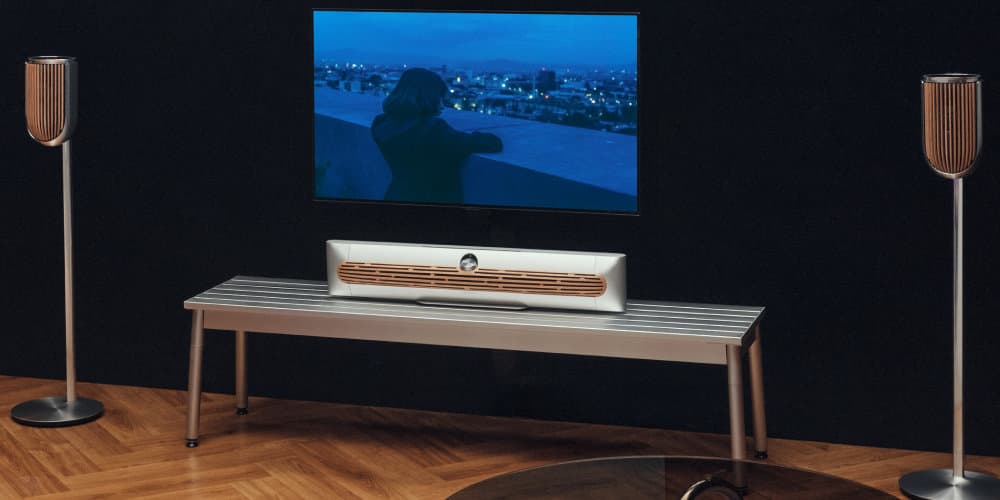
When Furniture Meets Dolby Atmos: B&O’s Beosound Premiere

Introduction: The "Missing Middle" in High-End Audio
If you have walked into a high-end audio showroom in the last three years, you have likely noticed a gaping hole in the market. On one side, you have the mass-market champions: the Sonos Arcs, the Samsung Q-Series, and the Sony Bravia Theatres. These are the workhorses of the modern living room—black plastic bars that do a commendable job of bouncing sound off your walls for under $1,000, or perhaps $2,500 if you add a subwoofer and rear speakers. They are practical, they are effective, and let’s be honest, they are usually ugly. They are designed to disappear into the darkness below your TV, not to be looked at.
On the far other side of the spectrum sits the ultra-luxury tier, dominated almost exclusively by Bang & Olufsen’s own Beosound Theatre. Launched in 2022, the Theatre is a marvel of engineering—a massive, transformable soundbar that can literally expand physically to match the width of your TV. It is powerful enough to crack plaster and smart enough to re-route bass frequencies to other speakers in the room. It is also, crucially, $13,600 before you even buy the stand. For 99% of the population, including many wealthy audiophiles, it is simply too much—too much money, too much physical bulk, and too much commitment.
For years, there has been nothing in between. If you wanted something better than a Sonos but couldn't justify the cost of a small car for a speaker, you were stuck. You could buy the older, smaller Beosound Stage, but it lacked the firing power for a large room and the up-firing drivers for true Dolby Atmos height effects. The gap was obvious.
This week, Bang & Olufsen finally filled it.
Meet the Beosound Premiere. Priced at $5,800 (£3,900 / €4,900), it is the bridge between the attainable and the aspirational. It is a statement piece that promises the spatial audio wizardry of 2025’s best tech, wrapped in an aluminium shell that reminds us why Danish design is still the gold standard. It is not cheap—let’s get that out of the way immediately—but for a specific type of buyer, it might just be the only soundbar that makes sense.
In this exhaustive report, we are going to tear down everything we know about the Beosound Premiere. We will look at its "Wide Stage Technology," its controversial lack of certain ports, its modular "Mozart" brain, and whether it can truly justify a price tag that is five times higher than the new Sonos Arc Ultra.
Section 1: The Design Philosophy – Furniture First
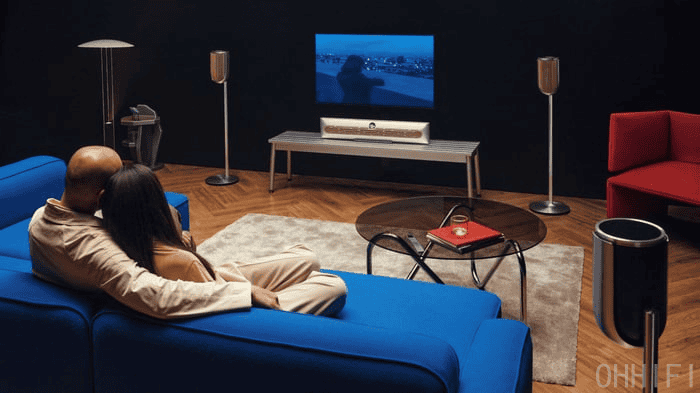
To understand the Premiere, you have to stop thinking of it as a consumer electronics product. Stop comparing it to a PlayStation or a Roku box. In the eyes of Bang & Olufsen, a soundbar is furniture. It occupies prime real estate in your home—center stage, right under the thing you stare at for four hours a day. It should be beautiful.
1.1 The Aluminium Monolith
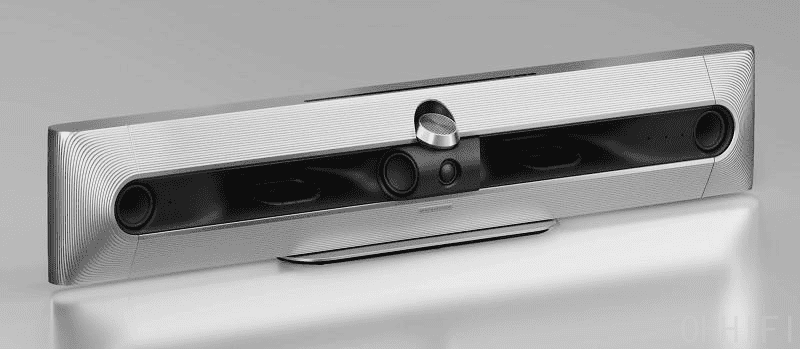
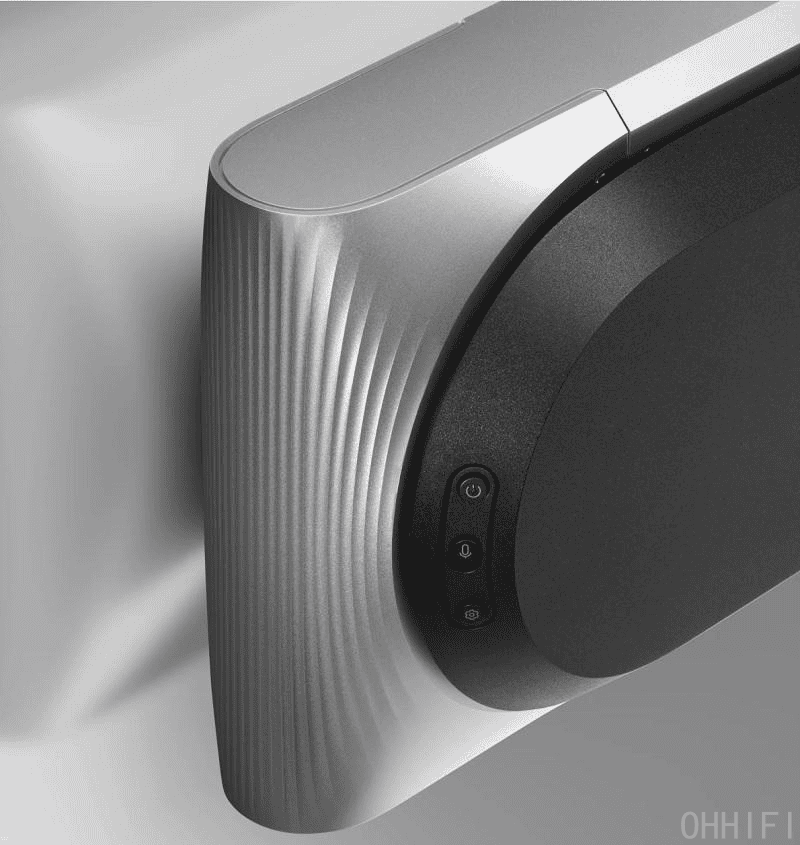
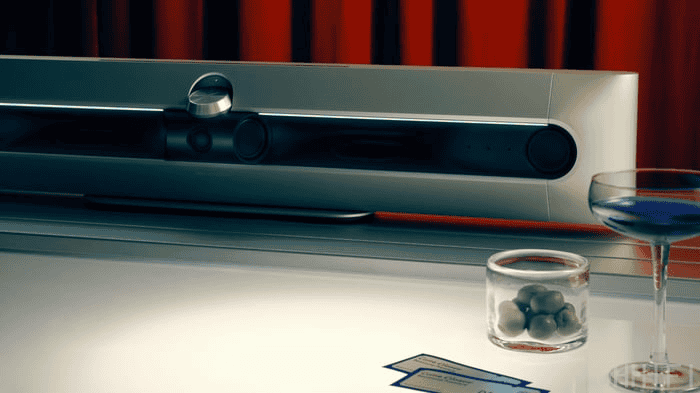
The Beosound Premiere is built around a single, continuous shell of extruded aluminium. This is not a veneer; it is a solid structural element. B&O’s Factory 5 in Struer, Denmark, is famous for its aluminium processing capabilities, and the Premiere is a showcase of their anodizing skills.
The bar measures 36.7 inches (93.2 cm) in width and 6.3 inches (16 cm) in height. This is a critical dimension. At 36.7 inches, it is significantly narrower than the Sonos Arc (which is 45 inches wide) and the Sennheiser Ambeo Max (which is nearly 50 inches wide). This compact footprint makes it surprisingly dense. It feels like a solid ingot of metal rather than a hollow plastic tube.
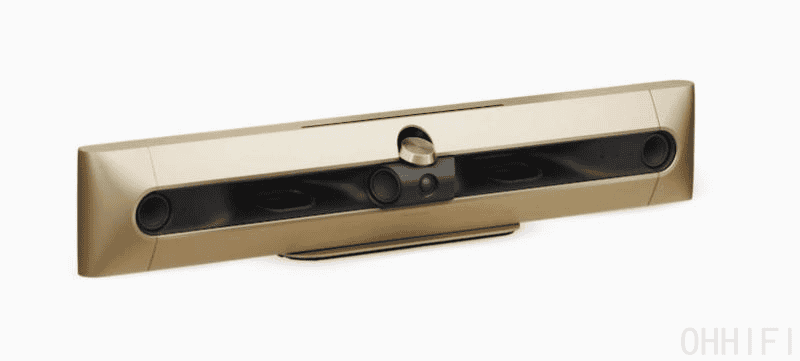
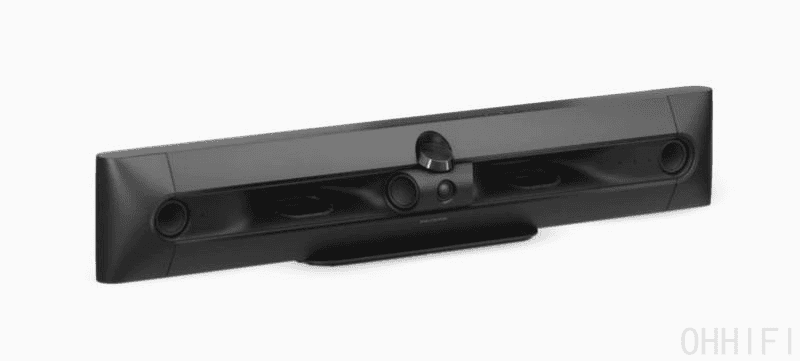
The finish options at launch are classic B&O:
Natural Aluminium: The "raw" look, available immediately in December 2025.
Gold Tone: A warmer, brass-like anodization coming in February 2026.
Black Anthracite: A stealthy, dark grey arriving in March 2026.
The texture is described as a "pearl-blasted matte satin finish". This is designed to catch the light from your TV without creating distracting reflections. It’s a subtle touch, but anyone who has had a glossy plastic soundbar reflect the subtitles of a movie knows how annoying the alternative can be.
1.2 The "Hole" Story: A Tribute to 1925
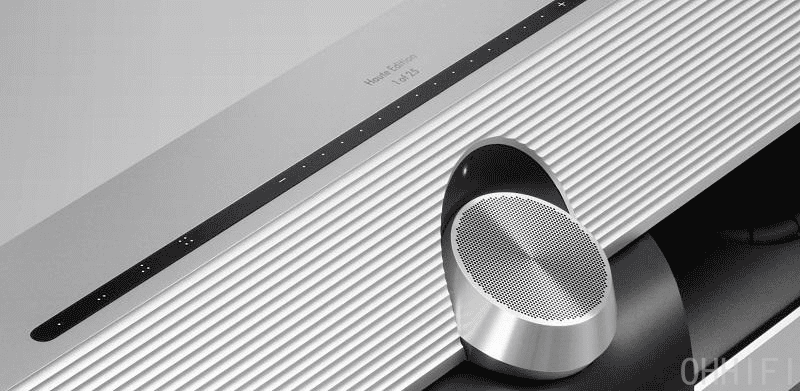
Perhaps the most striking design detail—and the one you’ll see in every press photo—is the top surface of the bar. It is perforated with exactly 1,925 precision-milled holes.
B&O claims this is a tribute to the year the company was founded, 1925. It’s a nice story for the marketing brochure, but it serves a vital acoustic purpose. These holes act as the grille for the up-firing driver buried inside the chassis. For Dolby Atmos to work, sound needs to shoot up, hit your ceiling, and bounce back down to your listening position. You can’t block that sound with solid metal. By milling these holes directly into the chassis, B&O avoids using a separate plastic or fabric grille on top, maintaining the seamless "monolith" aesthetic.
It is this integration of storytelling and engineering that separates B&O from its competitors. Sony would just put a metal mesh there. B&O counts the holes and ties it to their heritage. Is it pretentious? Maybe. Is it cool? Absolutely.
1.3 The "Haute Edition": When $5,800 Isn't Enough
For the 1% of the 1%, B&O has introduced the Beosound Premiere Haute Edition. If the standard $5,800 model is a BMW, this is the Rolls-Royce Phantom.
Limited to just 25 units worldwide, the Haute Edition features a custom milled pattern that B&O says takes 17 hours of machining time per unit. The price? $15,700.
Functionally, this bar is identical to the standard model. It has the same drivers, the same amps, and the same software. You are paying a $10,000 premium purely for the machining time and the exclusivity. It sounds absurd to the average person, but in the world of high-end interiors, where a sofa can cost $30,000, a $15,000 soundbar that doubles as a limited-edition sculpture is not actually an outlier. It serves as a "halo" product, reinforcing the idea that the Premiere is art first, and a speaker second.
1.4 Customization: The Modular Front
Like the larger Beosound Theatre, the Premiere features a swappable front cover. You can run it "naked," exposing the drivers for a technical look, or cover it with:
Fabric: Grey Melange (for a softer, Scandinavian textile look).
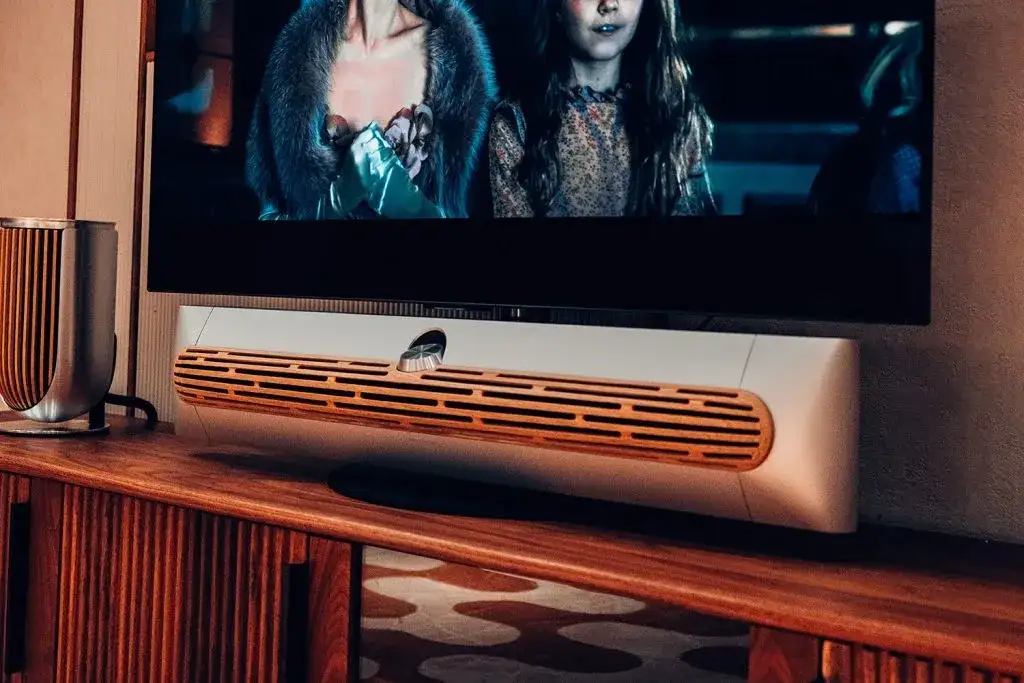
Wood: Oak or Dark Oak slats.
The wood covers are particularly significant. They allow the soundbar to blend into a room with hardwood floors or timber cabinetry. It stops looking like "tech" and starts looking like "joinery." This modularity also means that if you redecorate your living room in five years, you don't need a new speaker—you just buy a new $300 cover.
Section 2: The Acoustic Architecture – What Am I Paying For?
Okay, so it looks pretty. But does it sound $5,800 good? B&O has packed an astonishing amount of hardware into this relatively small box.
2.1 The Driver Layout
The Beosound Premiere utilizes a 10-driver array, and crucially, every single driver has its own dedicated Class-D amplifier. This 1:1 ratio is rare. Most soundbars share amplification channels, which can lead to muddiness when the action gets intense. Dedicated amps mean total control over every millimetre of cone excursion.
Here is the breakdown of the arsenal inside:
| Driver Type | Quantity | Purpose |
| Racetrack Woofers (4" x 3") | 4 | Handling the bass and lower-mids. "Racetrack" shape maximizes surface area in a slim profile. |
| Full-Range Drivers (2") | 4 | Two firing forward for clarity, two firing sideways for width. |
| Up-Firing Driver (1.5") | 1 | Shooting sound at the ceiling for Atmos height effects. |
| Tweeter (0.8") | 1 | Handling the high-frequency sparkle and detail. |
Wait, only one up-firing driver?
This is where it gets interesting. The spec sheet explicitly lists "1 x 1.5” full range (up firing)" in some detailed breakdowns, yet also mentions "7.1.4 Dolby Atmos decoding". A traditional 7.1.4 setup would imply four height channels (two front height, two rear height).
How does B&O achieve this with limited physical up-firing drivers? The answer lies in Beamforming.
2.2 The Magic of "Wide Stage Technology"
B&O calls their proprietary processing Wide Stage Technology™. This is not just a fancy name for "stereo widening." It is a complex manipulation of phase and timing.
Because the Premiere is relatively narrow (36 inches), it cannot rely on physical separation to create a wide soundstage. Instead, it uses the side-firing drivers to bounce sound off your side walls. By delaying the sound from the side drivers by a few milliseconds relative to the front drivers, the Premiere tricks your brain. You hear the reflection from the wall first (or coincidentally), making your brain believe the sound is coming from the wall, not the bar.
For the height channels, the single up-firing driver is likely aided by the upper-frequency range of the other full-range drivers being phased to steer sound upwards. This creates a "phantom" height layer.
Does it beat discrete ceiling speakers? No. Physics is physics. But compared to a standard soundbar, this beamforming tech creates a "bubble" of sound that is remarkably convincing, especially in the "sweet spot."
2.3 The Power Plant
The system pumps out a total of 580 Watts.
Bass Performance: Rated at 86 dB SPL.
Full Range Performance: Rated at 102 dB SPL.
Let’s contextualize that bass number. 86 dB is loud, but it isn't "shaking the foundations" loud. A dedicated 12-inch subwoofer can easily hit 105-110 dB in the bass region. The Premiere is designed to be a "one-box solution." B&O knows that the customer buying this probably lives in a luxury apartment or a design-conscious home where shaking the floorboards is not the priority—clarity and richness are.
However, if you do want more bass, the Premiere supports external subs (more on that in the Connectivity section).
Section 3: The "Mozart" Platform – The Brains of the Operation
Hardware is only half the story in 2025. The other half is software. The Beosound Premiere runs on B&O’s Mozart platform.
3.1 What is Mozart?
Mozart is B&O’s modular software and hardware architecture. It was designed to solve the biggest problem in luxury tech: obsolescence.
In the past, if you bought a $5,000 speaker, it became a paperweight when Spotify changed its API or Wi-Fi standards moved from 'g' to 'n'.
With Mozart, the streaming module is a replaceable card. If, in 2029, we are all streaming music via neural link or a new 6G standard, you can theoretically swap the Mozart card in the Premiere without throwing away the aluminium chassis and the drivers. This is key to the Cradle to Cradle Certified Bronze rating the product carries.
3.2 Streaming Capabilities
Out of the box, the Premiere is a fully connected smart speaker:
Apple AirPlay 2: For the iPhone ecosystem.
Spotify Connect: The universal standard.
Tidal Connect: For high-res audio streaming.
Bluetooth 5.4: The latest standard, supporting BLE and EDR. Codecs include SBC for Android and AAC for iOS.
B&O Radio: Integrated internet radio.
The Google Cast Controversy:
Early reports indicate that Google Cast (Chromecast) might be missing or limited. For Android users, this is a significant blow, as it is the primary way to beam high-quality audio from apps like YouTube Music. While Bluetooth is a backup, it compresses the audio. B&O has had a rocky relationship with Google in recent years due to changing requirements for Google Assistant integration, and it seems the Premiere might be a casualty of this friction. If you are a die-hard Android household, check this spec carefully before buying.
3.3 The App Experience
The Bang & Olufsen app is arguably the most beautiful companion app in the industry. It allows for granular control over the "Listening Modes."
Instead of a simple "Bass/Treble" slider, B&O uses a "Beosonic" wheel. You drag a dot between four quadrants: Warm, Bright, Relaxed, and Energetic.
Warm: Boosts lower-mids for a "radio voice" sound.
Bright: emphasizes treble for clarity.
Relaxed: rolls off the highs for background listening.
Energetic: boosts bass and treble (V-curve) for parties.
This intuitive interface makes it easy for non-audiophiles to tune the speaker to their taste.
Section 4: Connectivity – The Good, The Bad, and The Wired
The back panel of the Premiere tells a story of a company that is trying to bridge the gap between the analog past and the digital future.
4.1 The Ethernet Switch: A Stroke of Genius
One feature that deserves a standing ovation is the inclusion of a 3-port Gigabit Ethernet switch.
Most soundbars have zero or one Ethernet port. The Premiere has three.
Why this matters: In a modern AV setup, you have a TV, an Apple TV/Roku, and maybe a game console. They all need stable internet for 4K streaming. Wi-Fi is often crowded. With the Premiere, you can run a single Ethernet cable from your wall to the soundbar, and then use the soundbar as a hub to hardwire your TV and Apple TV. It cleans up the cabling mess behind your console significantly. It shows that B&O understands how people actually install these things.
4.2 HDMI eARC and Passthrough
The unit features one HDMI eARC input that supports 8K passthrough.
This means you can plug your PS5 or Xbox Series X directly into the soundbar, and it will pass the 8K (or 4K/120Hz) video signal up to your TV while stripping out the audio. This is crucial for gamers who don't want audio lag.
4.3 The Analog Adapter
There is a USB-C port that accepts an analog audio signal via a passive 3.5mm jack adaptor (Part no. 6271374).
Translation: Yes, you can plug your turntable into this soundbar. You just need a dongle. It’s not as elegant as a dedicated RCA input, but in a world where most soundbars have zero analog inputs, it’s a welcome feature for vinyl lovers.
4.4 The Glaring Omission: No DTS
Here is the bad news. The Beosound Premiere does not support DTS decoding.
Supported: Dolby Atmos, Dolby TrueHD, Dolby Digital Plus, PCM 7.1.
Not Supported: DTS:X, DTS-HD Master Audio, DTS Digital Surround.
If you watch mostly streaming services (Netflix, Disney+, Apple TV+), this does not matter one bit. They all use Dolby.
However, if you have a large collection of Blu-rays or 4K UHD discs, many of them use DTS:X. If you play one of these discs, the Premiere will remain silent unless you go into your Blu-ray player’s settings and tell it to convert the audio to "PCM" before sending it out. You will still get surround sound, but you lose the object-based spatial metadata of DTS:X.
For a $5,800 product called "Premiere," this is a disappointing omission that alienates the hardcore home theater enthusiast.
Section 5: The Competition – David vs. Goliath vs. The Rich Uncle
How does the Premiere stack up against the market leaders? Let’s look at the data.
5.1 Premiere vs. Sonos Arc Ultra ($999)
The Sonos Arc Ultra is the benchmark for the "normal" person.
Pros for Sonos: It’s $4,800 cheaper. It has excellent "Sound Motion" bass technology. The ecosystem is massive.
Pros for B&O: Build quality is in a different stratosphere (Plastic vs. Aluminium). The B&O looks like furniture; the Sonos looks like a vent. B&O has Bluetooth (Sonos Arc Ultra has Bluetooth only for setup/input, primarily relies on Wi-Fi). B&O supports high-res analog input.
Verdict: If you are hiding the bar in a cabinet, buy the Sonos. If the bar is visible, and you have the budget, the B&O wins on aesthetics and warmth.
5.2 Premiere vs. Sennheiser Ambeo Max ($1,699 - $2,500)
The Ambeo Max is widely considered the best sounding single-bar solution on earth.
Pros for Sennheiser: Bigger drivers, deeper bass (30Hz), arguably better 3D virtualization due to sheer size.
Pros for B&O: The Ambeo Max is huge, heavy, and frankly, ugly. It dominates a room. The Premiere is sleek and elegant. The B&O app is far superior to Sennheiser's often-glitchy software.
Verdict: The Ambeo is for the dark home theater room. The Premiere is for the bright, open-plan living room.
5.3 Premiere vs. Beosound Theatre ($13,600+)
The Theatre is the big brother.
The Difference: The Theatre is not just a soundbar; it's a sound manager. It has outputs for 16 external speakers. It has 800 watts of power. It has massive 6.5" woofers.
The Value: The Premiere gets you about 85% of the performance for 40% of the price. Unless you are building a full surround system with Beolab 90s as rears, the Premiere is the smarter buy.
| Feature | Beosound Premiere | Beosound Theatre | Sonos Arc Ultra |
| Price | $5,800 | $13,600+ | $999 |
| Material | Aluminium | Aluminium/Oak | Plastic |
| Drivers | 10 | 12 | 14 |
| Power | 580W | 800W | ~300W (est) |
| HDMI Inputs | 1 (Passthrough) | 3 | 1 (eARC only) |
| DTS Support | No | No | Yes (Basic) |
| Design Life | 10+ Years | 10+ Years | 5-7 Years |
Section 6: Installation and "Beolink" – Growing the System
One of the hidden superpowers of the Premiere is Beolink Surround.
While it is designed as a standalone bar, you can wirelessly pair it with other B&O speakers to create a true 5.1 or 7.1 system.
Rear Speakers: You could add a pair of Beosound Emerge (the book-shaped speakers) or Beolab 28s as wireless rears.
Subwoofer: While there is no dedicated "Beosound Sub" announced yet, you can pair it with a Beolab 19 subwoofer for earth-shattering bass.
The setup is done entirely in the app. The Premiere emits a "chirp," the other speakers listen, and they automatically calibrate their timing and phase to match the room. It’s Apple-like in its simplicity, but B&O-like in its price (a pair of Beolab 28s costs another $16,000).
Mounting:
The Premiere comes with a clever stand in the box.
Wall Mount: The stand flips to become a bracket. The soundbar detects its orientation and adjusts the "Wide Stage" beamforming to account for the wall boundary.
Table Stand: It sits low enough to clear most TV bezels.
Section 7: Who is This For? (And Who Should Avoid It)
After digesting all the specs, the pricing, and the design, we can narrow down the target audience.
The Perfect Customer
The Design Purist: You have a living room full of Vitra, Hay, or Herman Miller furniture. A plastic soundbar would ruin the vibe. You want something that adds to the room's aesthetic.
The Apartment Dweller: You live in a high-end condo in New York, London, or Shanghai. You can't have a giant subwoofer vibrating the floor, but you want crystal clear audio and a wide soundstage.
The B&O Loyalist: You already have a Beogram turntable or Beoplay headphones. You want to stay in the ecosystem.
Who Should Walk Away
The Bass Head: If your primary metric for audio quality is "does my chest hurt during explosions?", the Premiere's 4-inch woofers will disappoint you. You need a dedicated 12-inch sub.
The Physical Media Collector: If you own 500 Blu-rays with DTS-HD tracks, the lack of native decoding is a dealbreaker.
The Value Seeker: If you just want "better sound than my TV," spend $500 on a Samsung bar and take a vacation with the $5,300 you saved.
Conclusion: The Art of the Reasonable Splurge
$5,800 is a lot of money. In the world of consumer electronics, it is an astronomical sum. But Bang & Olufsen doesn't really sell consumer electronics. They sell luxury goods that happen to play music.
The Beosound Premiere is the most strategic product B&O has launched in a decade. It acknowledges that the Beosound Theatre was too expensive for most, and the Beosound Stage was too limited for enthusiasts. The Premiere hits the "Goldilocks" zone.
It offers genuine acoustic innovation with its Wide Stage beamforming. It offers peace of mind with its repairable, modular design. And most importantly, it offers a level of fit and finish that makes a Sonos look like a toy.
Is it five times better sounding than a Sonos Arc Ultra? Probably not. Maybe it’s 20% better. But is a Rolex ten times better at telling time than a Casio? No. That’s not the point.
You buy the Beosound Premiere because you want the best possible sound in the most beautiful possible package, and you are willing to pay for the privilege of not having to compromise on either.
For the first time in years, the "missing middle" of the high-end audio market has a champion. And it’s a beautiful one.
Score: 4.5/5 Stars
Highs: Stunning aluminium build, modular future-proofing, impressive width for a single bar, Ethernet switch is a pro move.
Lows: No DTS support, no Google Cast (TBC), expensive even for B&O, "Haute Edition" is pure vanity.



Comments