
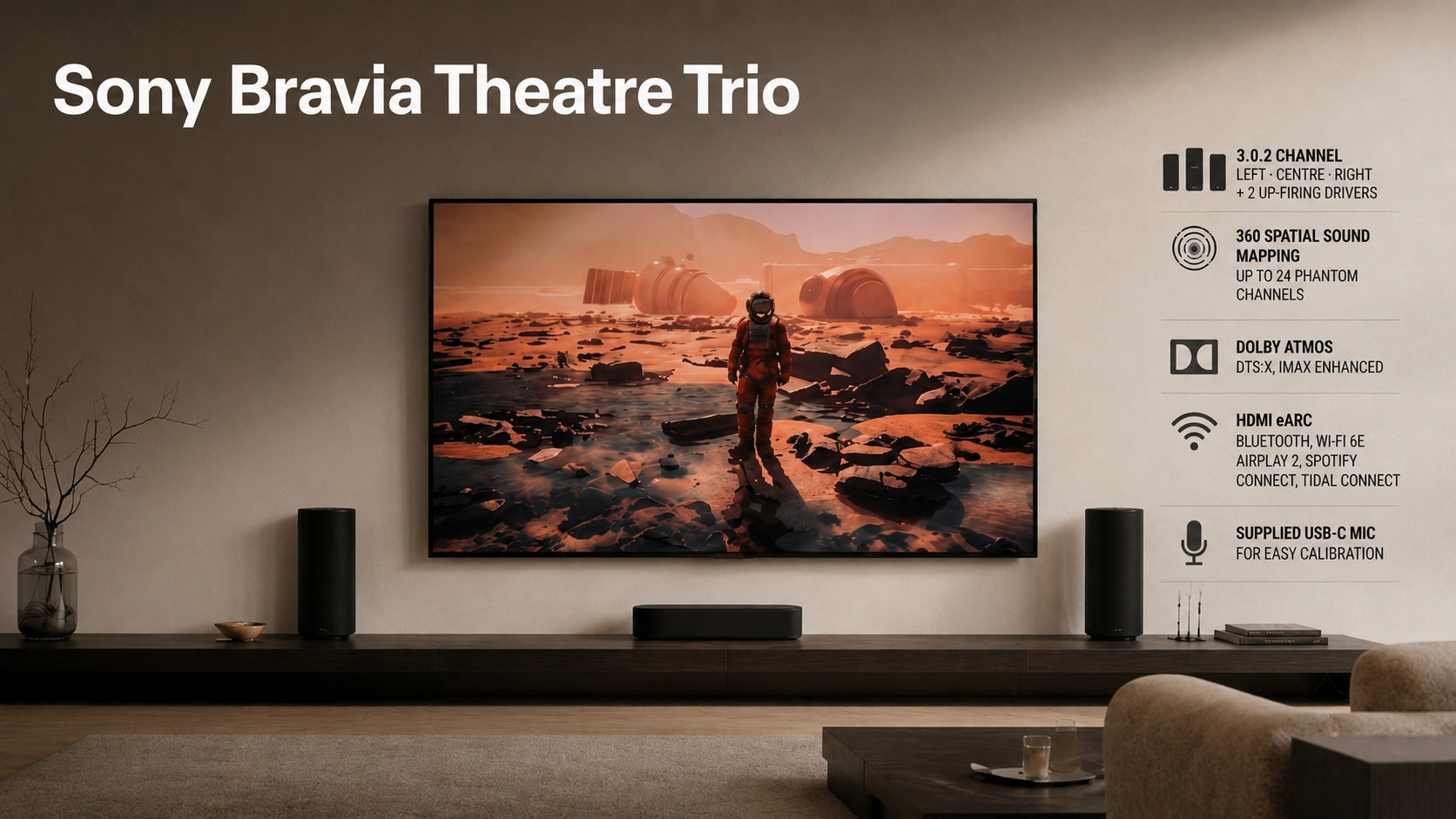
Sony Bravia Theatre Trio Review: Width Over Everything

Sony saws the soundbar into three and pushes the front channels out to the edges of your giant screen. Clever lateral thinking — but does it earn its premium-separates price?
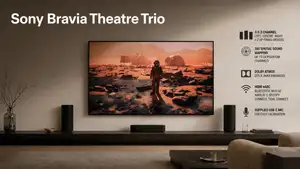
There's a recurring problem in modern living rooms that nobody likes to say out loud: the TVs got enormous, and the soundbars didn't. You hang an 85- or 98-inch panel on the wall, then park a 1.2-metre bar underneath it and wonder why the sound feels like it's leaking out of a letterbox in the middle of a cinema screen. Sony's answer with the Bravia Theatre Trio is almost gleefully literal: take the soundbar, saw it into three, and push the left and right channels out to the edges of that giant screen where they belong.
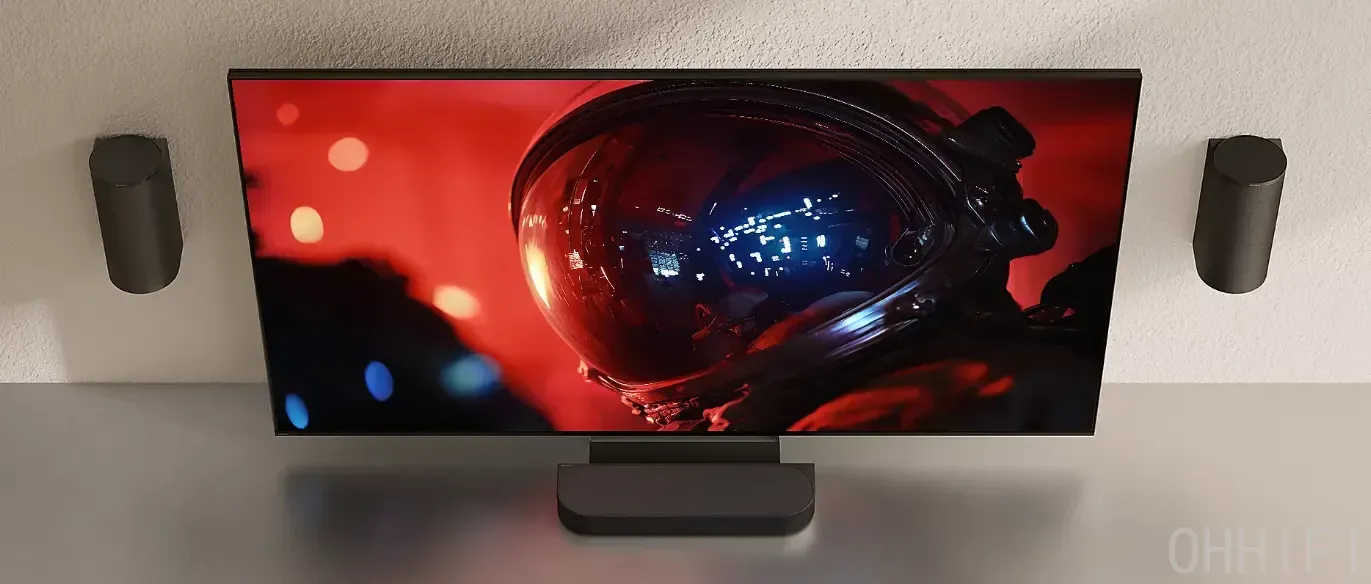
It's a clever bit of lateral thinking, and at $2,199 / £1,999 / AU$2,999 (the system carries the model code HT-A8), it's also asking premium-separates money for what is, on paper, a 3.0.2-channel lifestyle system. So the question that's worth chewing on isn't "does it sound bigger than a soundbar" — of course it does, that's the entire physics of the thing. The question is whether the deconstruction earns its keep, or whether you're paying a tax on a gimmick. Having dug through the spec sheet, the architecture, and the reviews that have piled up since launch, I think the answer lands mostly in Sony's favour — with a couple of caveats I'd want any buyer to hear first.
Quick Specs
| Price | $2,199 / £1,999 / AU$2,999 |
|---|---|
| Configuration | 3.0.2 (discrete left, centre, right + 2 up-firing) |
| Claimed power | 405W total |
| Drivers | Centre: 2× woofer + tweeter; each L/R: woofer + tweeter + up-firing driver |
| Formats | Dolby Atmos, DTS:X, IMAX Enhanced (rears + sub required) |
| Processing | 360 Spatial Sound Mapping (up to 24 phantom channels), Sound Field Optimisation |
| Connectivity | HDMI eARC, 1× HDMI in (4K/120Hz, VRR, ALLM passthrough), Bluetooth, Wi-Fi 6e |
| Streaming | AirPlay 2, Spotify Connect, Tidal Connect, DSEE Ultimate (no Chromecast, no 360 Reality Audio) |
| Calibration | Supplied USB-C mic + onboard speaker mics |
| Display | None (status lights only) |
| Dimensions (hwd) | Centre: 6.4 × 59 × 17cm / L-R: 34 × 16 × 17cm |
| Expansion | Rear 8/9, Sub 7/8/9 (up to two subs); legacy RS/SW models supported |
Design & Build: Familiar Pillars, a Divisive Little Centre
If you remember Sony's HT-A9, the left and right speakers here will look like old friends — the same cylindrical, substantial bodies, but dressed considerably better. Sony has swapped the older grey plastic for a black fabric wrap with a metallic ring up top, and the perforated crown hides the up-firing driver doing the Atmos heavy lifting. They're not small, but they read as modern objects rather than gear, which matters in the kind of room that can absorb a $2,200 audio system.
The centre unit is where opinion divides, and I'll side with the skeptics on this one. It's essentially a very short, narrow bar that lives under the screen, and its proportions look a little awkward beneath the super-sized panels this system is built to partner. It's low enough not to clip the bottom of the picture, and Sony bundles spacer feet and a wall bracket, plus a genuinely long set of power leads — small touches that tell you the company actually thought about installation. The flat backs on all three cabinets make wall-mounting clean.
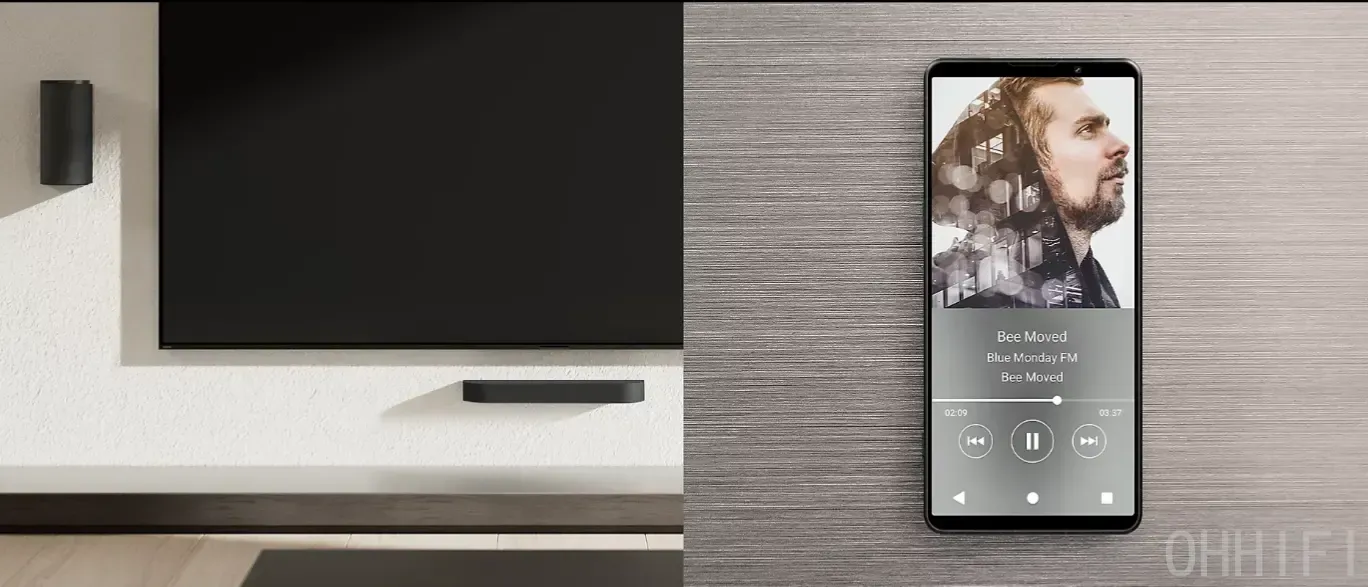
The big design compromise is the one every lifestyle system seems to make now: there's no display. You get status LEDs and the Bravia Connect app, and that's your lot — unless you own a compatible Bravia TV, in which case the system's settings surface in the TV's own menus, which is clearly the experience Sony wants you to have. I'll say what I always say about disappearing displays: minimalism is lovely until you're squinting at a blinking light trying to work out which input you're on. It's a livable omission, not a fatal one, but at this price it's fair to note it.
The Sound
Scale and Soundstage: This Is the Whole Point, and It Lands
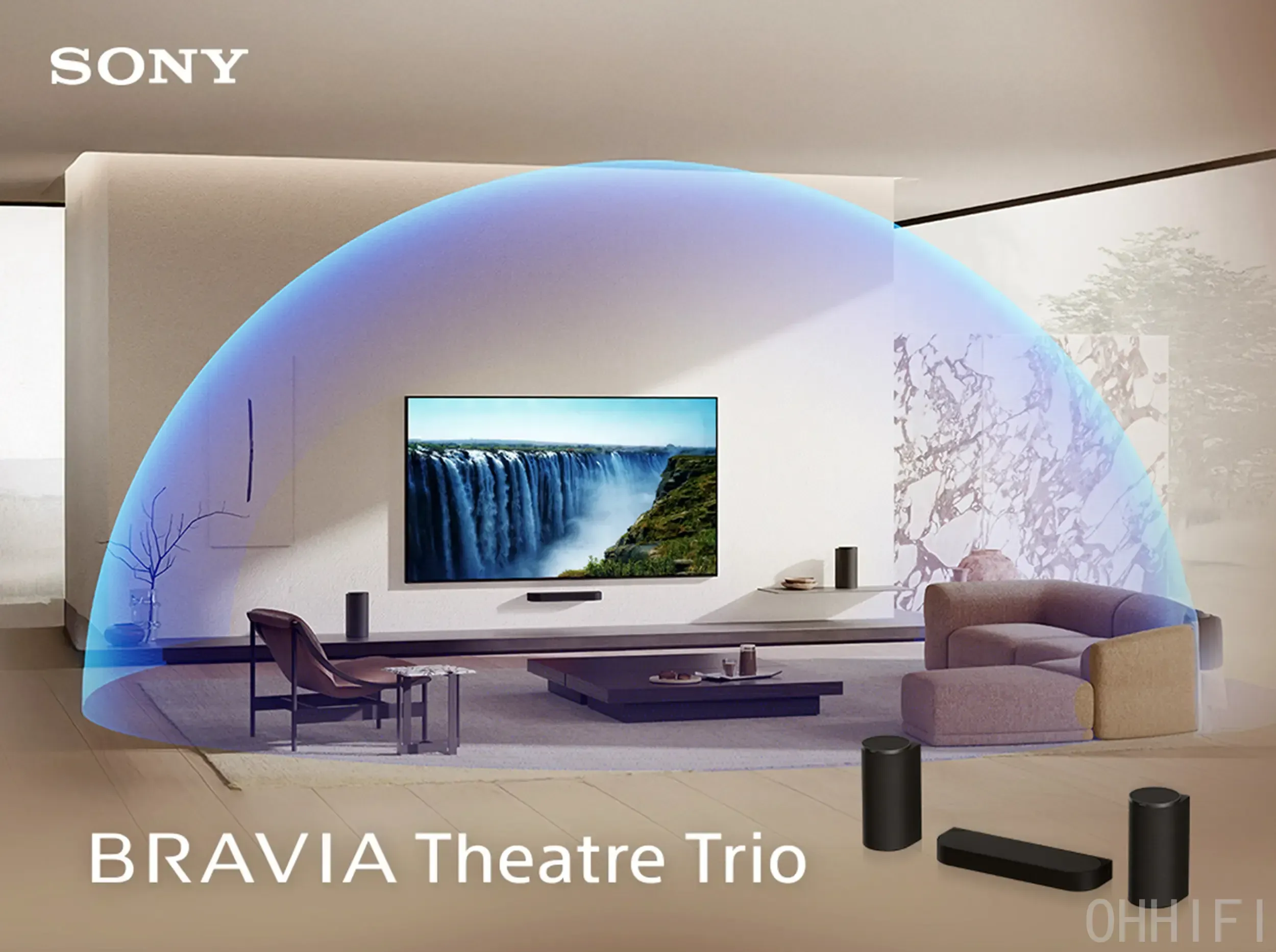
Splitting the front channels into three physical boxes has one overwhelming purpose — width and scale — and the consensus that's formed since launch is unambiguous here: the Trio sounds enormous. Effects stretch well beyond the speaker positions, the front wall of sound feels genuinely continuous, and there's a sense of audio being thrown into the room rather than dribbling out from under the TV. On the architecture alone you'd expect exactly this; real left-right separation is something no single bar can fake, no matter how many beam-steering tricks it throws at the ceiling.
What's more interesting — and what reviewers consistently single out — is the cohesion. The obvious risk with three separate boxes is that you hear three separate boxes. By most accounts that doesn't happen: Sony's processing knits them into one field, so you're not consciously tracking which cabinet made which noise. That's the hard part of this design, and it appears to be the part Sony nailed. My read is that the 360 Spatial Sound Mapping engine, with its two dozen phantom channels, is doing real work rather than marketing work here, because the failure mode of this concept is so obvious that getting it wrong would have been the headline.
Height and Atmos: Convincing, Not Just Present
The up-firing drivers in the left and right pillars are tasked with the Dolby Atmos layer, and the broad reaction is that the height effect reads as genuine rather than vaguely "up there." Overhead movement, environmental detail, the sense of a ceiling to the sound — reviewers describe it landing convincingly even in large rooms with a real distance between seat and speakers. That's not trivial; plenty of up-firing systems collapse the moment the room gets big or the ceiling gets uncooperative.
Dialogue: The One Place I'd Pump the Brakes
Here's where I want to be honest rather than promotional, because this is the most important caveat in the whole writeup. Sony's pitch is that a dedicated centre speaker fixes the dialogue-anchoring problem that bar-less systems like the Quad have always had with their phantom centre. In a controlled-room context the dialogue anchoring is reported as a strength — voices stay locked to the screen.
But where opinions split is on the centre channel itself. The consensus flags two things: the little centre can buzz when it's hit with very deep bass, and it's simply not as capable as the larger pillars flanking it. Independent hands-on impressions from launch demos went further, describing vocals as subdued and a touch muddy even with that dedicated centre in place. Now, demo conditions are demo conditions, and I'd weight a controlled-room review more heavily — but when two independent sources, under different conditions, both point at the centre as the weak link, that's a pattern, not noise. My judgment: the centre is the compromise in an otherwise ambitious design, and it's the first thing I'd audition critically if this is on your shortlist. Tellingly, the reported buzz vanishes once you add a subwoofer and hand the deep stuff off — which tells you exactly where the strain is coming from.
Music: A Real Stereo Pair Hiding in a Home Theatre System
This is the Trio's sneaky bonus. Switch the spatial processing off and the centre drops out, leaving you with discrete left and right speakers fed by discrete left and right channels — an actual stereo pair, which is something the overwhelming majority of soundbars physically cannot offer. Give them a little toe-in and the reports describe a focused, well-separated image with proper low-end heft. Sony's hi-fi pedigree is the easy thing to invoke here, and on this architecture it's credible: two real boxes with real spacing will always have a stereo advantage over drivers crammed into one enclosure. It's not going to retire a proper pair of powered speakers, and I wouldn't let anyone tell you it does — but as a home theatre system that moonlights as a competent music rig, it's a genuine point of difference.
Measured Performance
No independent lab — the usual suspects who publish full frequency-response and distortion plots for soundbars — has put out bench measurements of the Trio yet; independent measurements are pending. I'm not going to invent numbers to fill the gap, and you should be wary of anyone who does for a system this new. What can be said from the architecture and the consistent listening reports: bass extension from the standalone system is room-filling but has a floor, and the very lowest octave is where the standalone unit shows strain — hence the centre buzz on sub-bass transients, and the recurring recommendation to add a sub for serious low end. Treat the 405W total power figure as a manufacturer rating, not a measured output. Independent measurements are pending, and I'll update this section the moment credible third-party data lands.
The Competition
| Rival | Comparison | Verdict |
|---|---|---|
| KEF XIO $2,499 | One-box 5.1.2; the consensus calls it cleaner, crisper and more detailed, but it's a single enclosure with one HDMI and no passthrough | KEF for finesse and a tidy single box; Trio for scale and real stereo separation |
| Sonos Arc Ultra $999 | One-box 9.1.4; capable and far cheaper, but no DTS:X, no HDMI passthrough, and comparisons give the Trio substantially more scale and bass weight | The value play if you don't need the width; the Trio is in a different size class sonically |
| Samsung HW-Q990F ~$1,999 | True 11.1.4 with subwoofer and rear speakers included in the box | Better buy for full discrete surround out of the box; Trio counters with front-wall width and a true LCR layout |
| Sony Bravia Theatre Quad $2,499 | Bar-less four-speaker system with a phantom centre | Choose the Trio specifically because it adds a real centre speaker for dialogue |
The competitive picture tells you what the Trio actually is. Against the Sonos it's a scale monster at twice the money. Against the Samsung it trades a box of included rears and subs — i.e. genuine surround value — for front-stage width that nothing else in the class delivers. And against KEF it's the brawn to KEF's finesse. None of these is a clean knockout in either direction, which is the most honest thing I can tell you: Sony has built something distinct rather than just another premium bar, and "distinct" is exactly why it's hard to cross-shop.
Verdict: 8.5/10
A genuinely distinct lifestyle Atmos system that delivers scale, height and cohesion a one-box bar can't — held back by a weak centre channel, no display, and a price that escalates fast once you start adding rears and subs.
The Bravia Theatre Trio could have been an awkward middle child — neither as neat as a bar nor as complete as separates. Instead it mostly pulls off the trick, delivering scale, height and cohesion that a one-box solution simply can't, while keeping the plug-and-play convenience that makes lifestyle systems worth buying. The set-up and calibration are reportedly excellent, the music chops are a real and unusual bonus, and the upgrade path to rears and subs is there when your budget recovers.
It's not flawless. The centre channel is the weak link — corroborated from more than one direction — there's no display, and the standalone bass has a ceiling that practically begs for a subwoofer you'll have to pay extra for. Most damning is simple arithmetic: a fully loaded Trio with rears and dual subs creeps toward $5,000, at which point a receiver and real speakers are staring at you. But judged as the standalone package it ships as, this is one of the more genuinely interesting lifestyle home cinema products in a while, and it does the one thing it set out to do better than anything near it.
Pros & Cons
Pros
- Huge, room-filling scale with real left-right width no single bar can match
- Cohesive, convincing Atmos height from a deceptively small system
- Genuine stereo reproduction for music — a rarity in this category
- Excellent, thorough calibration with a supplied USB-C mic
- Sensible expansion path (rears + up to two subs)
Cons
- Centre speaker is the clear weak link; can buzz on deep bass and is reported as the least capable driver
- No display; you're reliant on the app unless you own a compatible Bravia TV
- Standalone bass extension is limited — a sub is almost essential for serious low end
- Fully expanded, the price gets perilously close to proper-separates territory
Who Should Buy It — and Who Should Skip
Buy it if…
You've bought (or are about to buy) a genuinely large TV — think 85 inches and up — and the mismatch between a vast picture and a narrow strip of sound is driving you mad. It's also for you if you want one system that does big-scale movies and credible stereo music, value plug-and-play simplicity over wiring a receiver, and like starting with the three-piece core and growing into rears and a sub later.
Skip it if…
Dialogue intelligibility is your single highest priority and you can't audition the centre channel first; your room is small enough that a one-box bar like the Sonos Arc Ultra would already overwhelm it; or you're chasing maximum surround-for-money, where the Samsung's in-box sub and rears — or a traditional receiver-and-speakers build — stretch your dollar further. Measurements-first buyers should wait for bench data before committing this kind of cash.


Comments