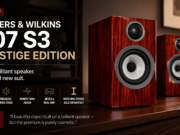













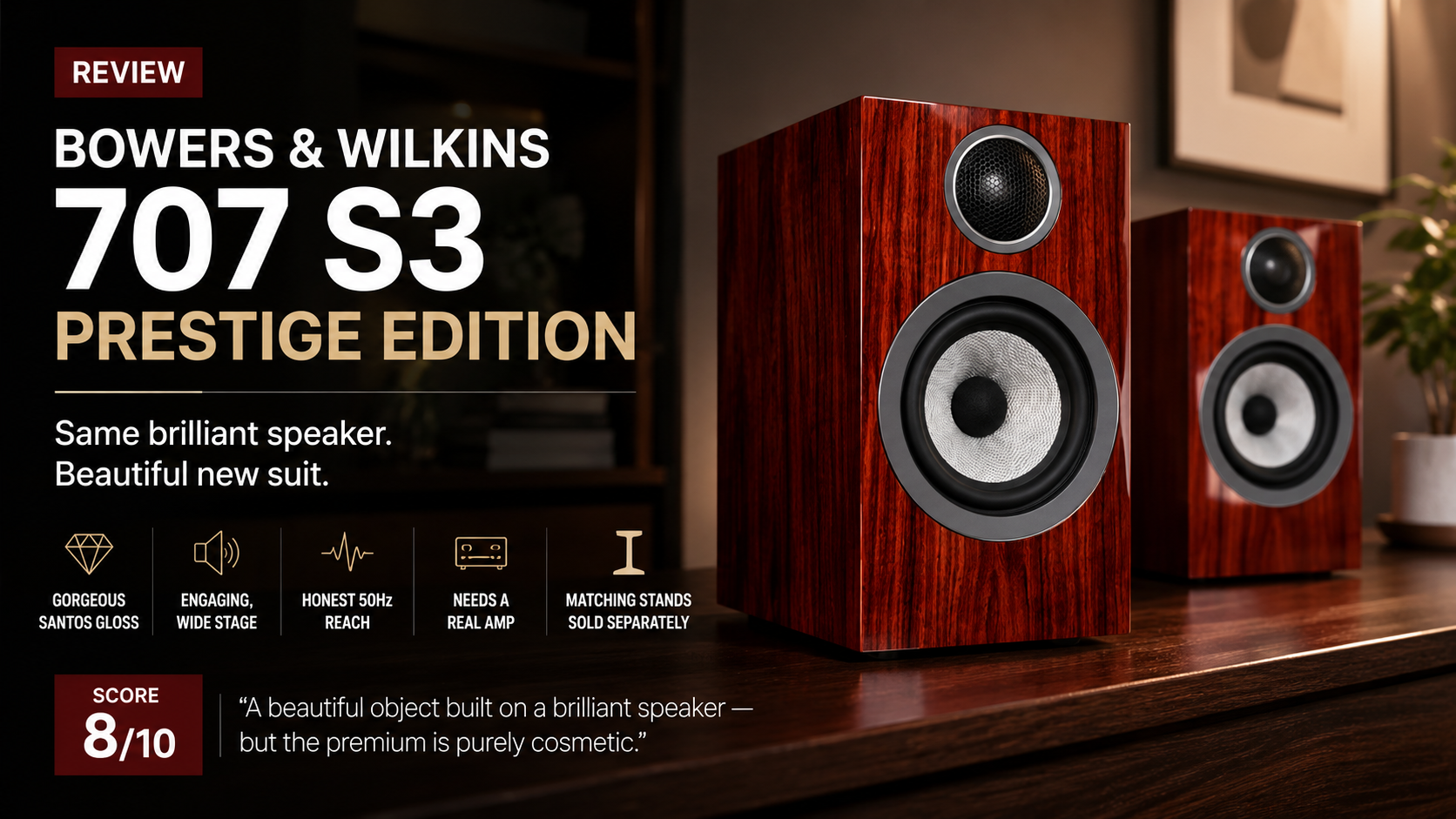
A decade ago you couldn’t move for grey and white speakers. Minimalism won, monochrome ruled, and anything with visible wood grain felt faintly retro. That’s reversed. Dark, glossy timber is back in interior design, and Bowers & Wilkins has read the room — literally — by wrapping its smallest 700 Series standmount in a deep, lacquered Santos Gloss and calling it the Bowers & Wilkins 707 S3 Prestige Edition.
Here’s the awkward bit a review has to confront straight away: underneath that gorgeous coat, this is a standard 707 S3. Same drivers, same crossover, same cabinet. The Prestige isn’t a Signature — it gets no acoustic re-engineering — so the entire pitch rests on a finish and a couple of cosmetic borrows. At £1,550 / €1,750 / $2,000 a pair, the only real question worth answering is whether the paint earns the premium. So that’s the question I’m going to chase.
Quick Specs
| Specification | B&W 707 S3 Prestige Edition |
|---|---|
| Type | 2-way, rear-ported standmount/bookshelf |
| Tweeter | 25mm Decoupled Carbon Dome (30µm aluminium dome, carbon coating + outer carbon ring) |
| Bass/mid | 130mm (5in) Continuum cone |
| Crossover | 3.5kHz |
| Frequency range (B&W) | 45Hz–33kHz; 50Hz–28kHz ±3dB |
| Sensitivity (rated) | 84dB (8Ω nominal) |
| Recommended amplifier | 30–100W per channel |
| Dimensions (HWD) | 300 × 165 × 247mm |
| Weight | ~6.2kg each |
| Finish | Santos Gloss only (12-layer paint/lacquer) |
| Price (pair) | £1,550 / €1,750 / $2,000 |
Design and Build: A Standard Speaker in a Special-Edition Suit
Let’s be precise about what the money buys, because B&W has been refreshingly upfront here and the press coverage has, for once, mostly resisted overselling it.
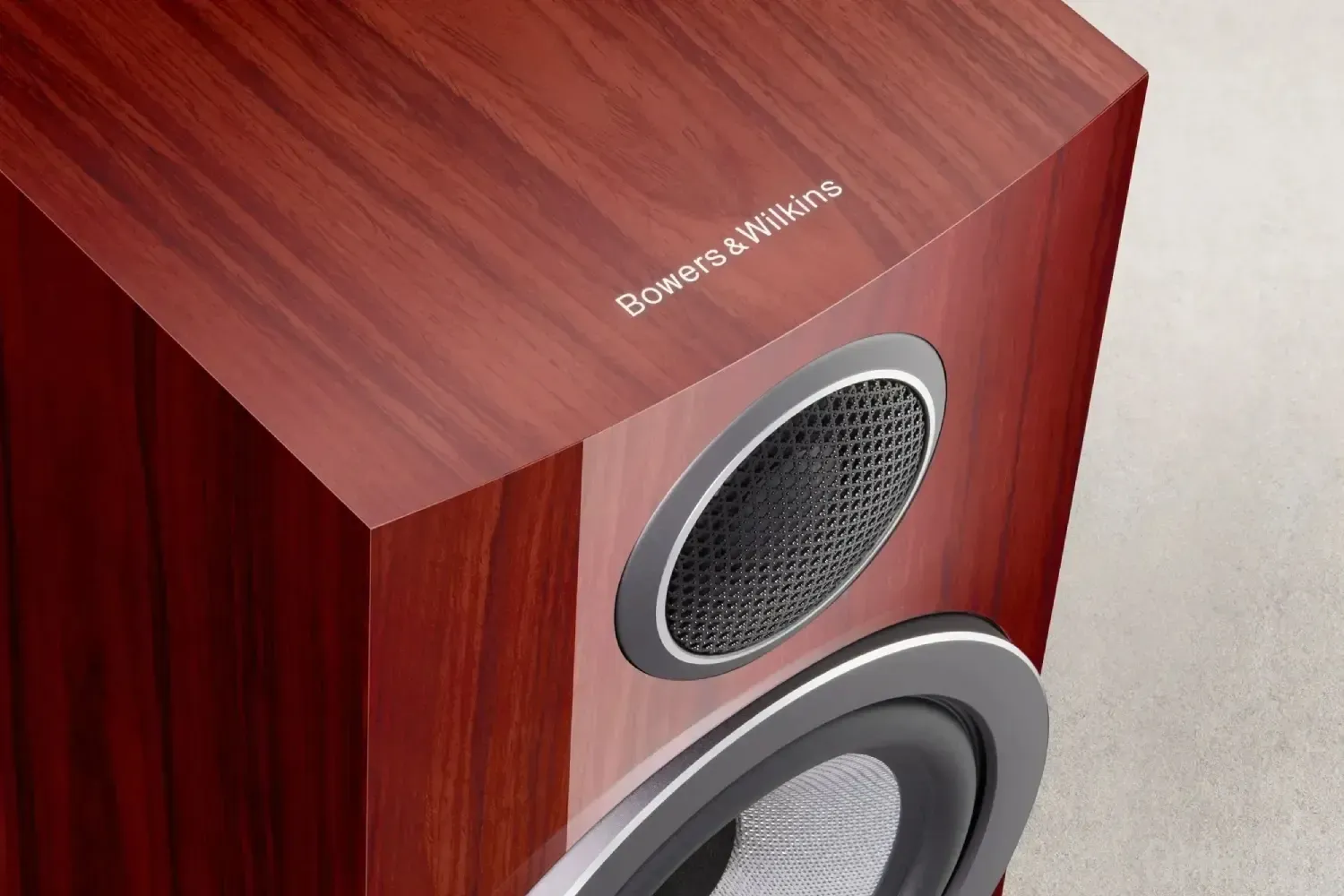
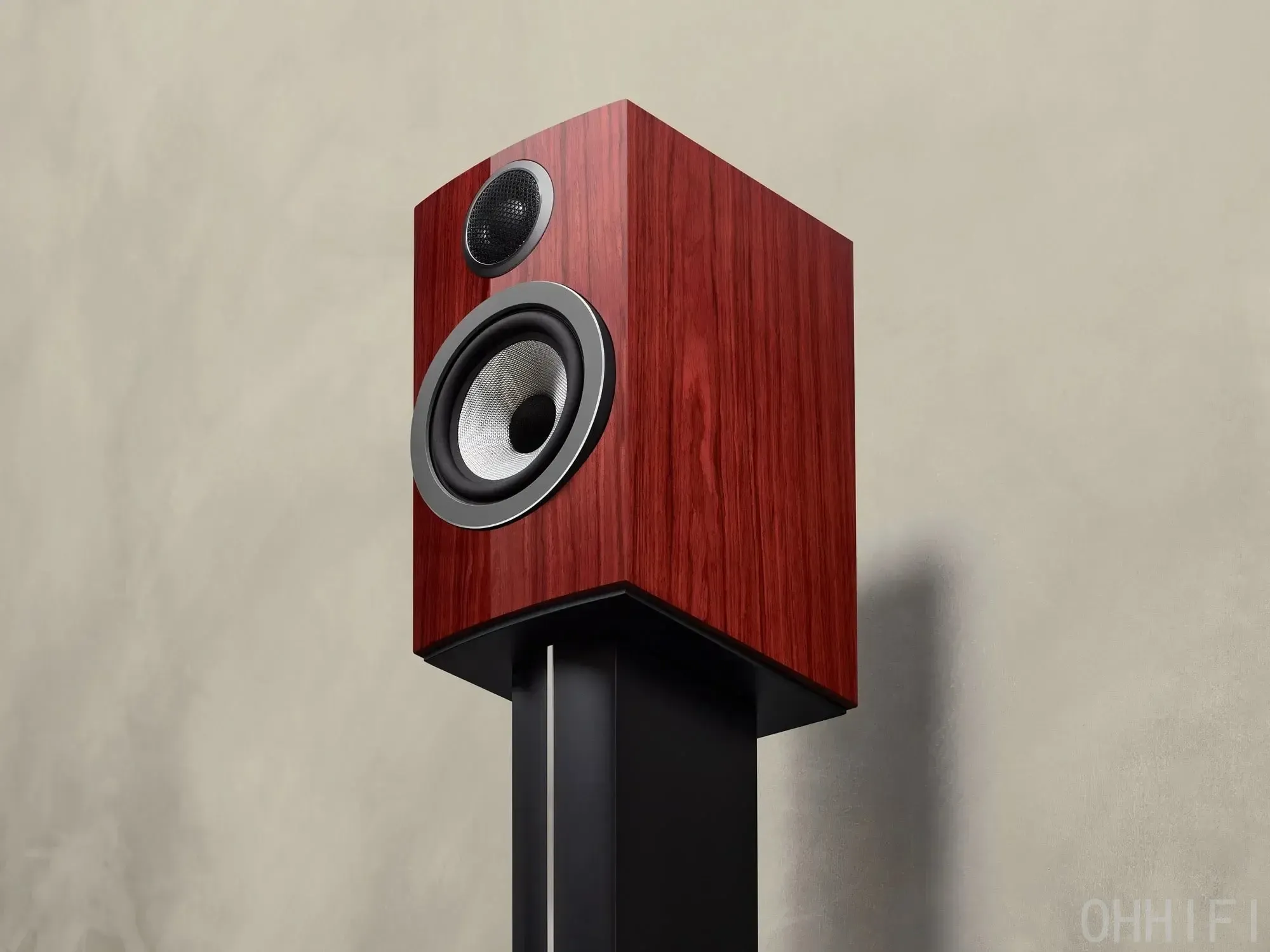
The headline is the Santos Gloss finish — twelve layers of paint and lacquer, a nod to the Santos Rosewood used on the old 805 D3 Prestige Edition. It’s the only colour the Prestige comes in, and by every account the application is immaculate, genuinely on a level with B&W’s far pricier Signature models. There’s also a small engraved aluminium nameplate to mark the model out. On looks and tactile quality, nothing else near £1,500 feels quite this expensive in the hand.
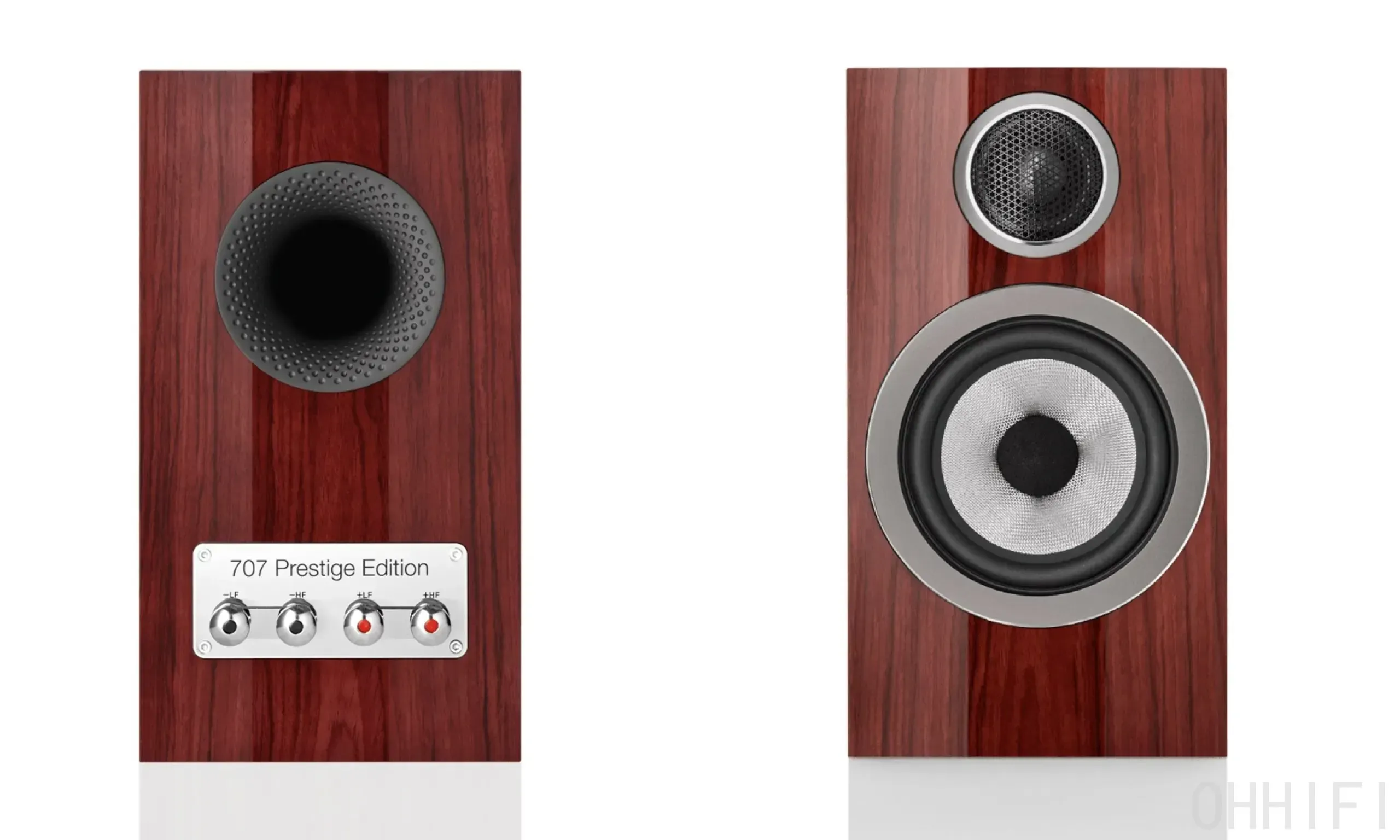
Beyond the cosmetics, two parts migrate down from the £5,000-ish 705 S3 Signature. The first is a re-profiled tweeter mesh grille — the design that first appeared on the 805 D4 Signature — which is there to tidy up high-frequency dispersion. The second is a set of low-loss, brass-cored Signature speaker terminals on a bespoke rear plate. Worth flagging clearly: B&W makes no performance claim for the terminals. They’re there because they look superb, and they do. The mesh grille is the only change with any plausible acoustic rationale, and even that is a subtle dispersion tweak, not a voicing change.
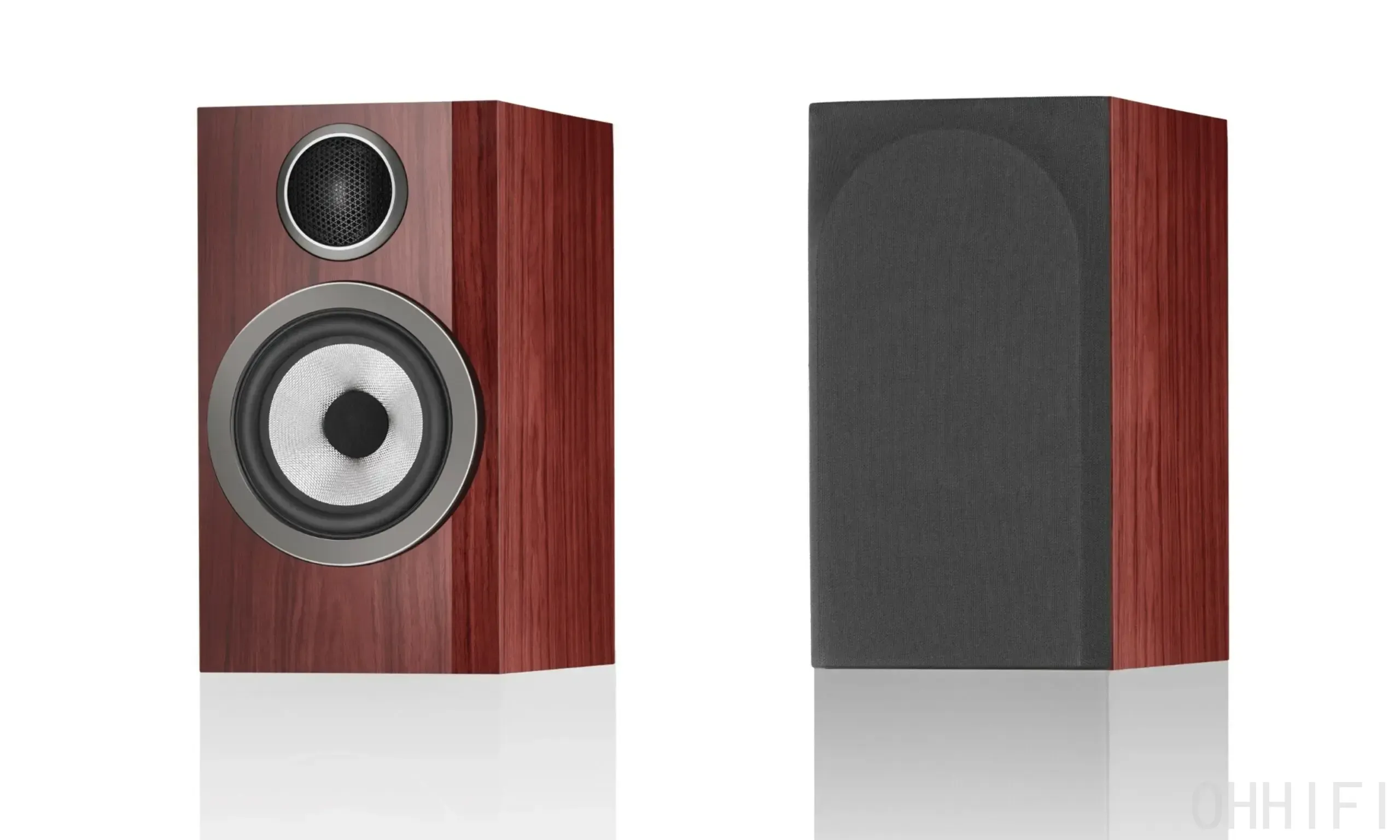
Everything else is carried over wholesale from the standard 707 S3. The 25mm Decoupled Carbon Dome tweeter sits in the cabinet — no Tweeter-on-Top housing at this end of the range — above the 130mm Continuum cone that’s been a B&W staple since the woven composite debuted in the 800 Series Diamond back in 2015. Bass is loaded by a rear-firing, dimpled Flowport, with foam bungs supplied for near-wall or shelf use, and the terminals support bi-wiring, which is increasingly a rarity at the price. The curved front baffle is pure B&W and helps the little cabinet look like a piece of furniture rather than a box.
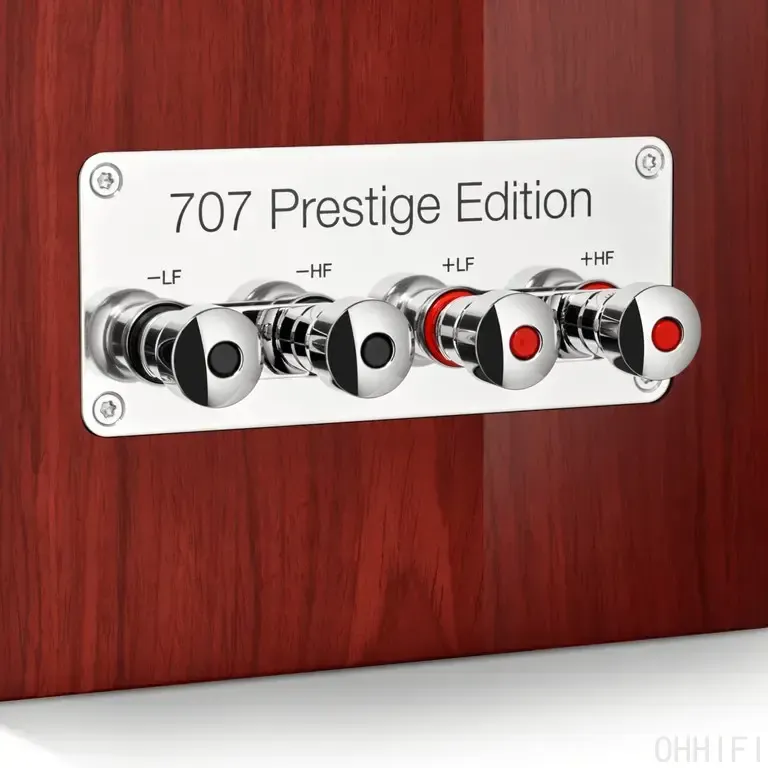
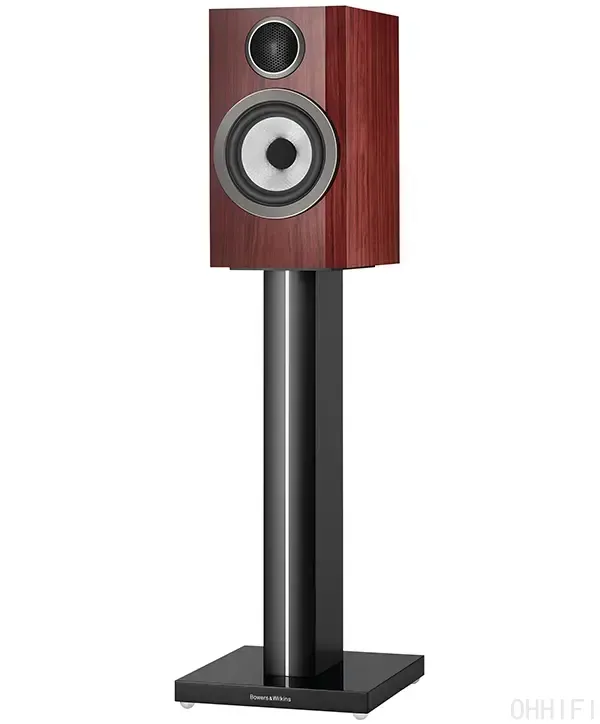
One practical note worth its own sentence: the matching FS-700 S3 stands are around £799 a pair. That’s not a footnote — it’s roughly half the price of the speakers again, and given how much a standmount’s performance depends on rigid, correct-height support, it’s a real part of the buying decision rather than an optional extra.
The Sound
Since the Prestige is acoustically the standard 707 S3, the body of critical reaction that’s built up around this little speaker applies directly — and it’s been consistent enough to draw firm conclusions from. Here’s how it breaks down by band, with the architecture and the measured behaviour doing the work that first-hand listening can’t.
Bass
A 130mm cone in a small rear-ported box tells you most of the story before anyone plays a note: this will be punchy and tuneful rather than deep. That’s exactly the consensus. Reviewers consistently describe a potent, up-and-at-’em low end that gives the speaker a lively, rhythmic flavour and makes it a natural fit for rock, pop and electronica. Where it stops is no surprise either — the deepest synth swells and sub-bass film effects are simply off the menu, and no foam bung will conjure them back.
What’s genuinely reassuring is that the quoted reach isn’t marketing fiction. On Paul Miller’s bench for Hi-Fi News, the 130mm driver rolls off at 84Hz (−3dB), with the 46Hz port tuning extending useful output to a real 50Hz (−6dB). The B&W literature quotes both a broad 45Hz–33kHz range and a tighter 50Hz–28kHz ±3dB figure; the lab basically backs the latter. So when B&W says 50Hz, it means it — which is more than you can say for a lot of small speakers.
Midrange
This is where Continuum earns its keep. The recurring word across reviews is “believable” — voices and instruments come through with a tonal honesty that doesn’t grab at your attention so much as simply never put a foot wrong. The general feedback is that it flatters mediocre recordings and rewards good ones without becoming a clinical, expose-everything monitor. For a sub-£1,600 standmount, that’s the most valuable trick in the box, and it’s the part of the 707’s character that’s least contentious.
Treble
Here’s the interesting one, and where a bit of synthesis actually pays off. The carbon dome is a fine tweeter — its break-up is pushed right out to a measured ~49kHz dome resonance, which is exemplary — and the consensus is that the top end is crisp, detailed and unexpectedly spacious for an in-cabinet tweeter. But that same consensus carries a caveat: some listeners find it bright, and there are reports of an occasional grainy edge on certain synth and keyboard parts.
I wouldn’t write that off as fussy ears, because the measurements explain it. The Hi-Fi News lab found a rising presence/treble balance on the listening axis, plus a causal resonance around 1.9kHz visible on the waterfall plot. More importantly, the response is unusually sensitive to listening height: on the tweeter axis the lab measured huge ±8.2dB response errors, falling to a far more civilised ±4.9dB when measured roughly 3in above the cabinet top — which, on the 26in FS-700 stands, lands at a normal seated ear height. Translation: a lot of the “brightness” people hear is a setup variable, not a fixed personality trait. Get the ear-to-tweeter geometry right, mind your toe-in, and you can dial a good chunk of it out. That’s actionable, and it’s the kind of thing that separates a speaker that “sounds bright” from one that’s simply unforgiving of casual placement.
Soundstage
For a cabinet this small, scale is the pleasant surprise. The reviews are unanimous that it throws a wide, well-organised stage with good central focus, and the in-cabinet tweeter — which you might assume would be the poor relation to B&W’s tweeter-on-top designs — apparently holds its own comfortably, balancing energy with air. The 0.8dB pair matching the lab recorded helps here; tight matching is exactly what lets a pair of speakers “disappear” and image precisely.
Methodology
A note on how I work, because it matters for what follows. This assessment pulls together the published B&W specifications, the independent bench measurements that are now on record, and the broad consensus from the reviews that have appeared since launch — combined with what a two-way of this architecture reliably does. It is a synthesis and an engineering read, not a write-up of my own listening sessions. Where I cite hard numbers, I name the lab they came from; where I describe sound, I’m reporting where critical opinion has landed and why the design and data support it.
Measured Performance
The numbers worth knowing all come from Paul Miller’s lab report for Hi-Fi News, and they’re a model of how rated specs should — and shouldn’t — be read.
Sensitivity is the honest headline: rated at 84dB, it measured 83.8dB (2.83V/1kHz/1m) and 83.7dB across 500Hz–8kHz. So the rating is, for once, essentially accurate rather than optimistic — but it’s also genuinely low. This is not a speaker you “posh up” a budget amp with. The flip side is that the load is benign: a 4.85Ω minimum at 200Hz and a very driveable EPDR of 2.2Ω at 130Hz mean it won’t frighten a sensibly specified amplifier. The catch is current and headroom — the broad agreement is that the 707 wants an amp that starts around its own price point, with the muscle to deliver, rather than something cheap and cheerful. THD is low and tidy (0.2% / 0.35% / 0.45% at 100Hz / 1kHz / 10kHz, 90dB/1m), and that 0.8dB pair matching is excellent.
The one number to internalise before you buy is the response variation with height: ±4.9dB on a correct listening axis is fine for the class, but it balloons if you sit too high or too low relative to the tweeter. Stand height and seating position are not optional with this speaker.
The Competition
| Rival | How it compares | Verdict |
|---|---|---|
| KEF LS50 Meta £1,000 / $1,499 |
The neutrality benchmark. KEF’s coaxial Uni-Q with Metamaterial absorption is the more even, transparent design and costs less — but it’s bass-light, fussy about wall proximity, and needs stands too. | Buy if accuracy beats fun, and you don’t care about wood. |
| Acoustic Energy AE1 40th Anniversary £1,499 / $1,999 |
The 707’s most direct rival. The reborn all-metal monitor is more immediate and intense, with famously tight bass, and its re-engineered 5Ω woofer is easier to drive. The B&W counters with a more refined, more spacious balance and a plusher finish. | Cross-shop these two. Pick by temperament: bite vs. polish. |
| DALI Menuet SE ~£1,499 |
The original “luxury compact” idea the Prestige is chasing. Beautiful cabinet, sweet voicing, room-friendly — but constrained on heavier material and happiest in smaller spaces. | The style-led alternative if you want warmth over energy. |
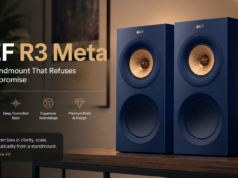
| KEF R3 Meta £1,900 / $2,200 |
The step up in box. A larger 3-way reaching to 38Hz with a bigger, more dynamic sound — but it’s physically much larger and harder to slot discreetly into a room. | Buy if you have the space and want real low-end weight. |
The Verdict
The speaker hiding under the Santos Gloss is excellent — a genuinely class-leading little standmount on sound and build, and the high marks it’s pulled elsewhere are deserved. If I were scoring the 707 S3 purely as a loudspeaker, it’d be knocking on 9.
But the Prestige Edition has to be judged as what it is: a finish-led special edition with no sonic advantage over the standard model, a low sensitivity that demands a proper amp, and a stand bill that adds £799 to the sum. The value maths also swings hard by region — and this is the detail buyers should weigh most. In the UK the Prestige is only about £150 over the standard 707 S3, which makes the upgrade close to a no-brainer if the wood speaks to you. In mainland Europe the gap is roughly €550 for the same cosmetic step, which is a much harder sell. Either way, you are paying for the paint, not the performance.
Score: 8/10. A beautiful object built on a brilliant speaker — but the premium is purely cosmetic, so the rational case depends entirely on how much you value the finish and where you’re buying it.
Pros and Cons
Pros
- Exceptional Santos Gloss finish — feels far above its price
- Lively, engaging, tonally believable sound with a wide stage
- Honest 50Hz reach and tidy distortion for the cabinet size, per the Hi-Fi News lab
- Tight 0.8dB pair matching and a driveable (if low-sensitivity) load
- Bi-wire Signature terminals and a re-profiled tweeter grille that look the part
Cons
- No acoustic advantage whatsoever over the standard 707 S3
- Low ~84dB sensitivity wants a capable, current-rich amplifier
- Response varies a lot with listening height — placement-sensitive
- Matching FS-700 S3 stands are pricey at ~£799
- The premium over the standard model is far steeper in Europe than the UK
Who Should Buy, Who Should Skip
This is for you if you’ve already decided you want a 707 S3, you fall for the Santos Gloss, and — crucially — you’re buying in the UK where the upgrade is cheap. It’s also for the listener who wants a small, beautiful speaker that earns its place in a living room on looks as much as sound, and who’ll pair it with a real amplifier and proper stands rather than treating either as an afterthought.
Look elsewhere if you’re chasing performance per pound — the standard 707 S3 is the rational buy and sounds identical. Skip it too if you want sub-bass slam (size forbids it), if you’re on a modest amp (the sensitivity will bite), or if you’re in a region where the Prestige premium runs to several hundred euros for what is, in the end, a coat of paint. And if neutrality is your religion, the KEF LS50 Meta does more of that for less.