
Focal Vestia N°4 Floorstanding Speaker Review

Focal is unusual among speaker makers for how wide its range runs — from entry-level to true high-end, and from stereo pairs to multi-channel and discreet in-wall designs. What's notable is that, unlike many brands with a range this broad, Focal hasn't shipped its more affordable lines off to Asia to save money; even its accessible models are still made in France.
Focal's home lineup spans six series that fall roughly into three tiers. At the top, the Utopia III EVO and Sopra share a sandwich-structured "W" cone and much of their design language. The Kanta and Aria EVO X form a middle group, both using Flax-fiber cones — though the Kanta keeps the beryllium tweeter of the higher-end models while the Aria EVO X uses an aluminum/magnesium tweeter. The most affordable tier is the Vestia and Theva, which use Slatefiber cones for their mid-bass drivers and a slightly backward-tilted stance built into the base.
The Vestia series itself has five models: the N°1 bookshelf, three floorstanders (N°2, N°3, and N°4), and a center channel, so you can build a system around your room and needs.
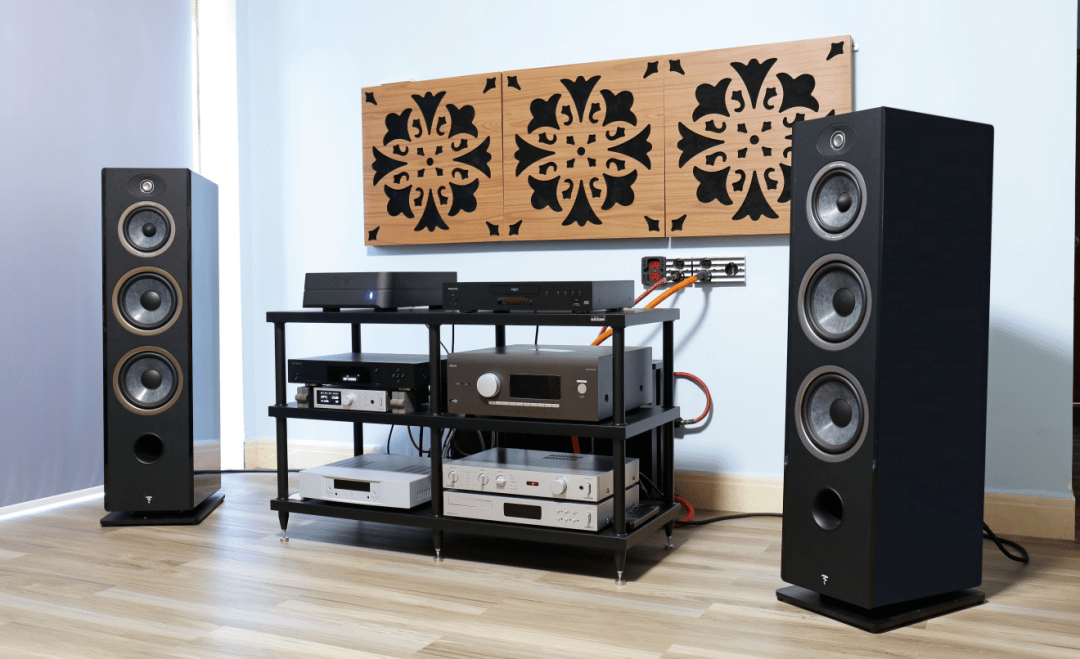
The N°4 is the flagship — a three-way, four-driver bass-reflex floorstander, priced at around $2,199 each (roughly $4,400 a pair). The first surprise was simply its size: a pair ships in two large boxes, a direct consequence of how big the speakers are.
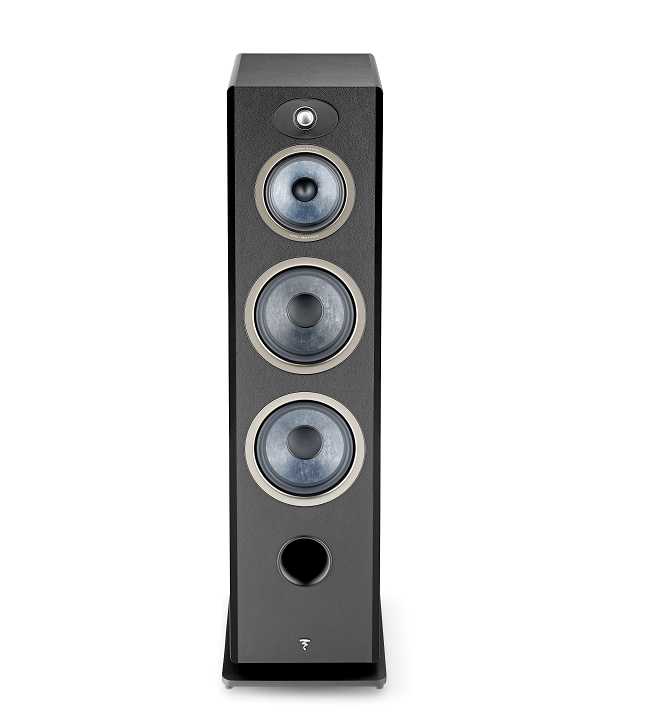
It carries a 1-inch TAM aluminum/magnesium "M"-shaped tweeter, a 6.5-inch Slatefiber midrange, and two 8-inch Slatefiber woofers. Its taller, broader cabinet — next to the slimmer N°3 and N°2, which use 6.5-inch woofers — comes directly from that pair of 8-inch drivers. Focal recommends it for rooms of at least about 269 sq ft (25 m²).
Drivers and technology
The TAM tweeter is Focal's own design. Rather than the conventional convex dome, Focal has long preferred an inverted dome, which increases the contact area between the voice coil and the diaphragm for better control. The "M"-shaped geometry is a further refinement aimed at optimizing high-frequency dispersion, and a rear chamber absorbs back-waves to reduce distortion. A waveguide around the tweeter helps control directivity and limit reflections off the floor and ceiling. The tweeter was first developed for Focal's car audio systems and reworked for hi-fi, with the Vestia line marking its debut in home speakers.
The 6.5-inch midrange and the 8-inch woofers are likewise made in France by Focal, using the Slatefiber cone that has become a signature of the brand's recent affordable models. Despite the name, there's no slate in it — the term comes from the cone's grayish-blue, slate-like color. It's actually a composite of recycled, non-woven carbon fiber sandwiched between two layers of thermoplastic polymer, with the carbon fibers aligned in one direction to add rigidity. Focal describes it as light, stiff, and well-damped, and was the first audio brand to use recycled carbon fiber in its drivers — the material first appeared on the Chora line in 2019 and has since spread to studio monitors and car audio.
Cabinet, finishes, and setup
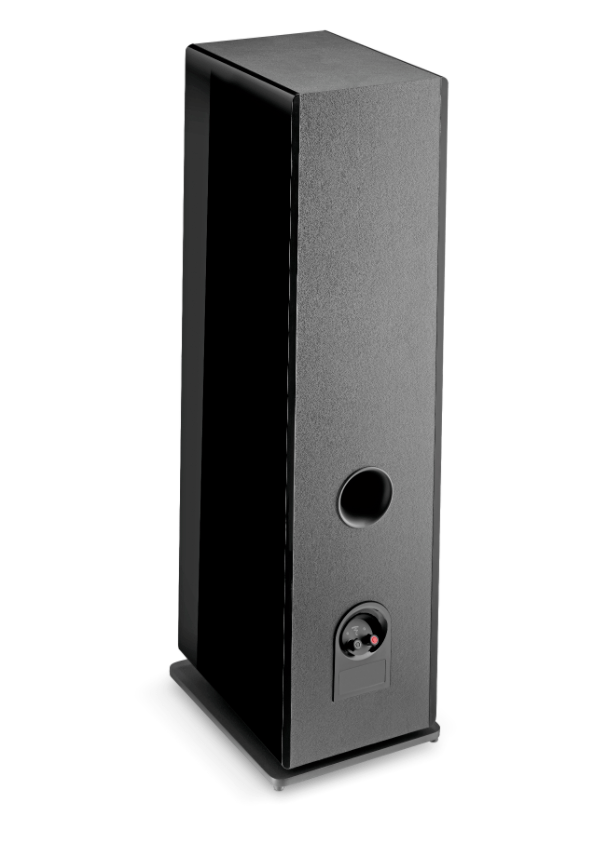
The cabinet is MDF, braced and shaped to raise rigidity and suppress resonance; Focal even runs its own furniture workshop dedicated to building speaker cabinets. The side panels come in three finishes — Black High Gloss, Dark Wood, or Light Wood — while a leatherette covering wraps most of the rest of the speaker (front panel available in black or white), which gives the Vestia line a clean, restrained look.
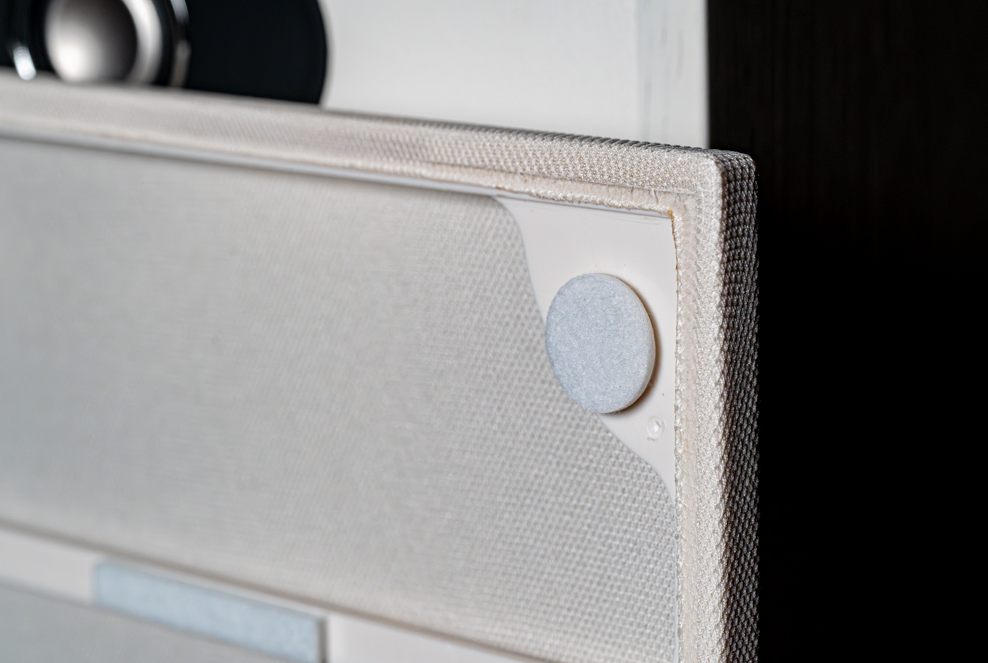
The bass-reflex ports sit low on the front baffle, one to each side. Magnetic grilles are included for anyone who wants to hide the drivers, and the magnetic mounting leaves no visible hardware on the baffle; Focal even adds felt pads where the magnets meet the cabinet to protect the leatherette. The base is die-cast aluminum and tilts the speaker slightly backward to help with time alignment. Adjustable metal spikes are supplied for isolation, along with rubber feet as a gentler option for delicate floors.
Listening
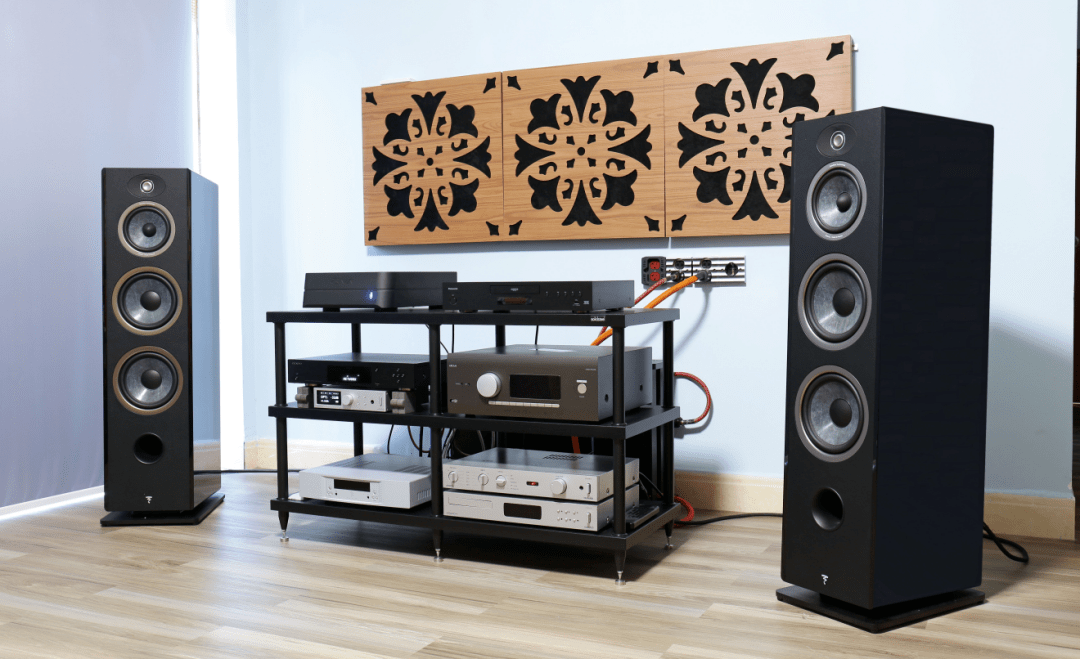
Because of the size and weight, unpacking is a two-person job — though the box includes clear instructions. Set up in the listening room with a rough initial position and some small tweaks to toe-in and spacing, the first impression was strong: a balanced, smooth sound with a slight lift in the upper bass that gave it a solid foundation. There was pleasing body, good midrange resolution, a sense of control, and an open, expansive soundstage.
On Ramírez's Misa Criolla — the "Kyrie" with José Carreras — depth and placement were immediately clear. The soft drum at the rear, Carreras out front, and the choir behind were all cleanly separated. The drum was subtle but full of texture, and together with the choir it built a convincing sense of space. Carreras's voice was clear and three-dimensional. The Slatefiber drivers give these affordable speakers a real solidity, sidestepping the thinness that sometimes comes with budget designs.
Switching to Musica Temprana's recording of the same work, the closer drum and the musicians' more linear arrangement emphasized width over depth. That more modern, clarity-focused recording brought out every detail in the drums, the male vocal, and the choral parts. In both cases the N°4 conveyed the distinct character of each recording rather than imposing its own.
With orchestral music, the N°4 delivered not just width but a clear sense of structure, helped by its rich bass and transparent midrange. Schubert's Symphony No. 8, under Herbert Blomstedt, made the point: the opening — murmuring low strings, then the first theme in strings and woodwinds — came through with clarity and depth, the low-string lines distinct and the highs expressive. The orchestral swells were surprisingly powerful, showing both the speaker's dynamic range and its even balance.
For all that it uses a metal tweeter, Focal's current designs sound sweet and bright rather than harsh. There's plenty of detail with no unwanted sibilance. On Yo-Yo Ma and Kathryn Stott's Songs of Comfort and Hope — "Shenandoah" in particular — the speaker rendered texture and fine detail while keeping a rounded, full tone; the strings were smooth and natural, and the piano had a warm brilliance.
The fone recording of "The Pink Panther" was a chance to roam across styles, and the N°4 caught the character of each take — the standard jazz-trio version, the vocal rendition, the guitar performance. The double-bass solo showed off ample, well-controlled bass. The N°4 is rated down to 40 Hz (with a –6 dB point around 34 Hz), and while the very lowest octave was slightly held back, the bass was rich, full, and elastic — entirely reasonable at this price.
Specifications
| Feature | Specification |
| Type | 3-way, 4-driver bass-reflex floorstander |
| Tweeter | 1-inch (25mm) aluminum/magnesium "M"-shaped inverted dome (TAM) |
| Midrange | 6.5-inch Slatefiber |
| Woofers | 2 × 8-inch Slatefiber |
| Frequency response | 40 Hz – 30 kHz (±3 dB); –6 dB point ≈ 34 Hz |
| Cabinet | Braced MDF; die-cast aluminum tilted base |
| Finishes | Side panels: Black High Gloss, Dark Wood, or Light Wood; black or white leatherette front |
| Recommended room | ≥ 269 sq ft (25 m²) |
| Made in | France |
| Price | ≈ $2,199 each (≈ $4,400 / pair) |
Verdict
As the flagship of the Vestia series, the N°4 earns the role. Its sound is balanced and natural, with no obvious bias; it resolves detail well and pairs that with real body and a touch of sweetness from the "M"-shaped tweeter. It's bulkier than its siblings, but the dual 8-inch woofers buy a more stable, substantial sound in return. For the money, it's a confident, well-rounded performer in its class.



Comments