
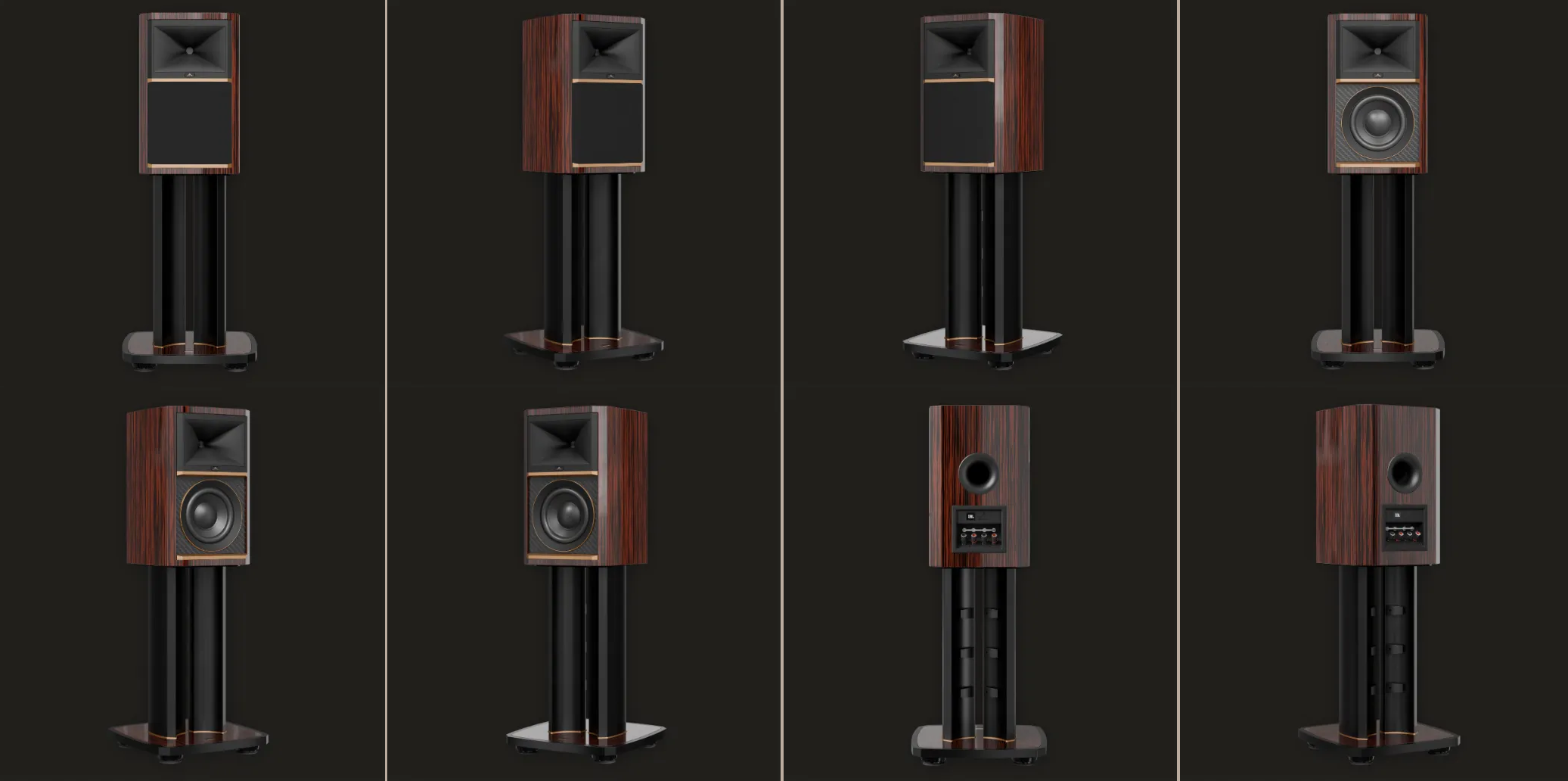
JBL Summit Ama Review: A $20,000 Standmount That Refuses to Sit Politely

There's a moment, about thirty seconds into any good recording with a real rhythm section, when the JBL Summit Ama stops being a two-way standmount speaker and becomes something closer to a weapon. Not in a shouty, look-at-me, home-theatre way — but in the way a good middleweight lands a body shot. Quiet, heavy, unarguable.
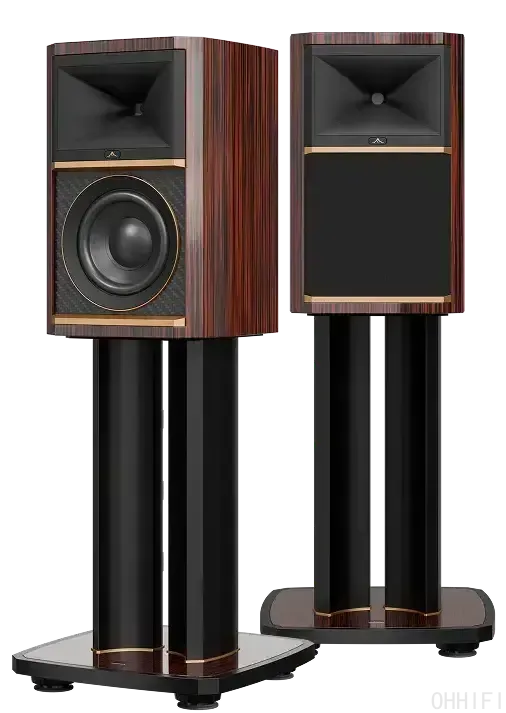
That's the strange thing about the Ama. On paper it's the entry point of JBL's new Summit Series — the $19,995 / £14,998 (pair, stands included) baby sibling to the Pumori and Makalu floorstanders, all launched at Munich High End 2025 and named after Himalayan peaks. In the JBL hierarchy, it sits well below the Project Everest DD67000 and the K2 S9900 flagships. In the real world, it's still a twenty-thousand-dollar two-way bookshelf. And after a few weeks with a pair, my honest read is this: most people at this price are buying soundstage width and soft edges. JBL has built a speaker that does the opposite. It buys you grip, scale, and a kind of pro-audio directness that your average "refined" audiophile standmount can't touch. Whether that's what you actually want is the real question.
Quick Specs
| Spec | Detail |
| Type | 2-way, bass-reflex standmount (rear port) |
| Woofer | 200mm (8") HC4 Hybrid Carbon Cellulose Composite, 64mm voice coil |
| Tweeter | D2815K 1.5" dual-diaphragm, dual-motor compression driver on Sonoglass HDI horn |
| Crossover | 1.6 kHz, 3rd-order, MultiCap low-ESR topology, bi-wire/bi-amp |
| Frequency response | 34 Hz – 25 kHz (−6 dB); 25 Hz – 33 kHz (−10 dB) |
| Sensitivity | 84 dB (1W/1m, rated) |
| Impedance | 4 Ω nominal |
| Dimensions (speaker) | 476 × 308 × 336 mm / 18.7 × 12.1 × 13.2 inches (H×W×D) |
| Weight | 26.3 kg each (speaker); stands ~20 kg each |
| Finishes | High-gloss ebony veneer w/ gold accents, or high-gloss black w/ platinum |
| Price | $19,995 / £14,998 / €17,490 per pair (includes stands) |
The Summit Lineage: Where the Ama Fits in JBL's History
The Ama doesn't exist in a vacuum — it's the latest entry in a bloodline JBL has been building since the 1950s, and the DNA is worth understanding before getting into the speaker itself. In JBL's own lexicon, the term "Project" is reserved for loudspeakers built as technological showcases, pushing the boundaries of what's feasible in transducer design. The Summit Series is effectively the sixth major "Project" initiative in the company's history.
The lineage begins in 1954 with Project Hartsfield, a corner-horn monaural system designed to compete with the Klipschorn and built around high efficiency, controlled directivity, and low distortion. That was followed in 1957 by Project Paragon, which used a curved radial refractor panel to create a stable stereo image — a direct ancestor of the dispersion philosophy behind the Ama's HDI horn today.
The more direct ancestor, though, is Project Everest — introduced in 1985 as the DD55000 and refined through the DD66000 and current DD67000 — which introduced "defined directivity" through complex horn geometries designed to reduce room interaction. Project K2 (the S9900) built on that further with a focus on imaging precision and vertical dispersion control. The Summit name itself nods to the L300 Summit of the 1970s, a domestic version of the 4333 studio monitor that brought 15-inch woofers and slot tweeters into the living room. The L300 was a brute; the Ama is something closer to a scaled-down, refined descendant of that same idea.
What makes the Ama significant in that lineage is that it's the first time JBL has packaged this level of "Project" technology — specifically the D2 compression driver and HDI horn — into a stand-mount chassis meant for the residential market rather than the studio or the "Project" flagship tier.
The Summit Trilogy
The Summit Series launched at Munich High End 2025 as three models, each named after a Himalayan peak, signaling their hierarchy:
- Summit Ama — the 2-way stand-mount, the subject of this review.
- Summit Pumori — a compact 3-way floorstander with a 10-inch woofer.
- Summit Makalu — the flagship 3-way floorstander with a 12-inch woofer.
If your room can accommodate a floorstander and your budget stretches past the Ama's, the Pumori and Makalu are worth auditioning in the same visit — they share the Ama's driver philosophy but trade the size constraint for more scale and, by most accounts, an easier amplifier load.
Design & Build: A Pro Monitor in a Dinner Jacket
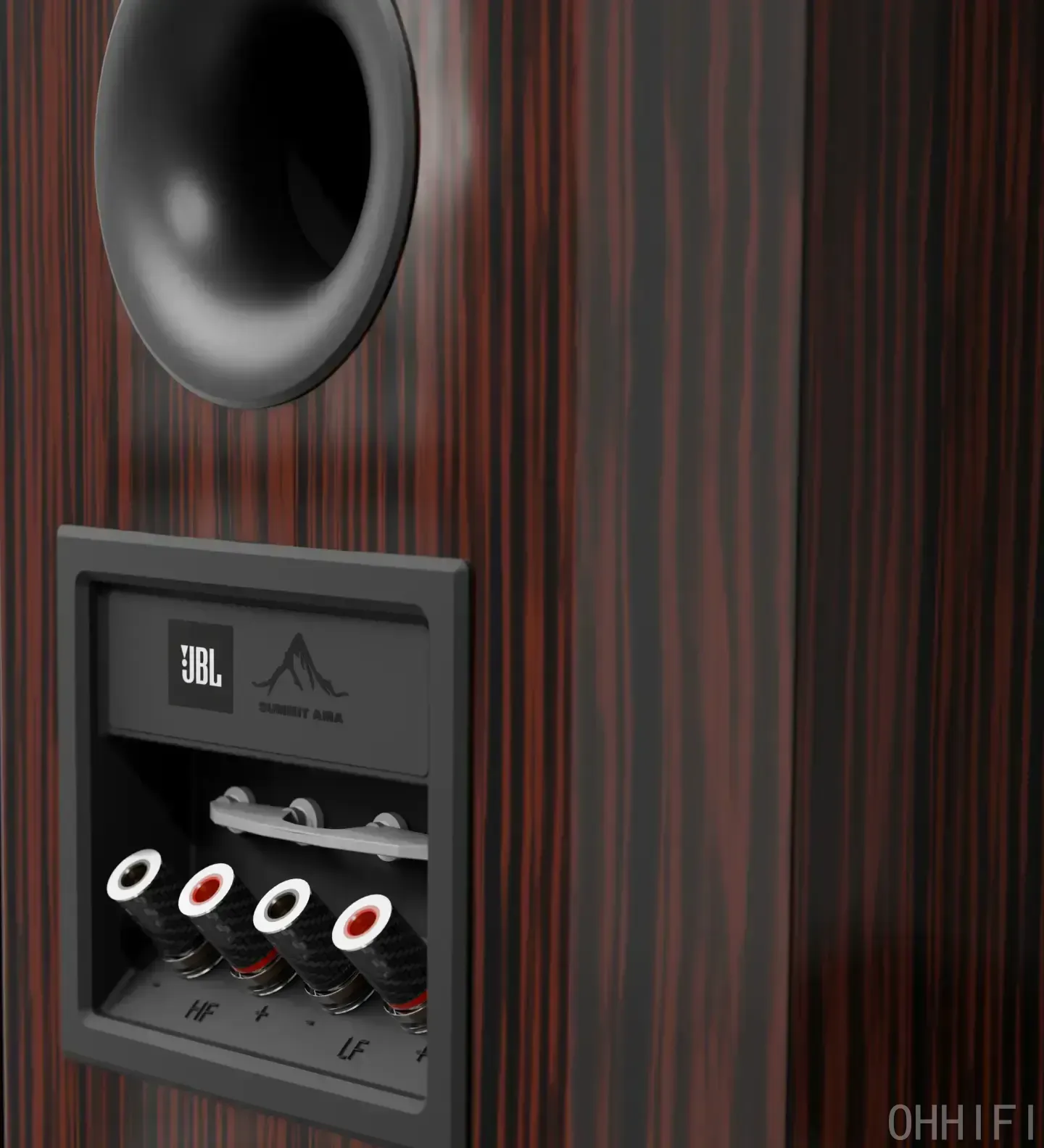
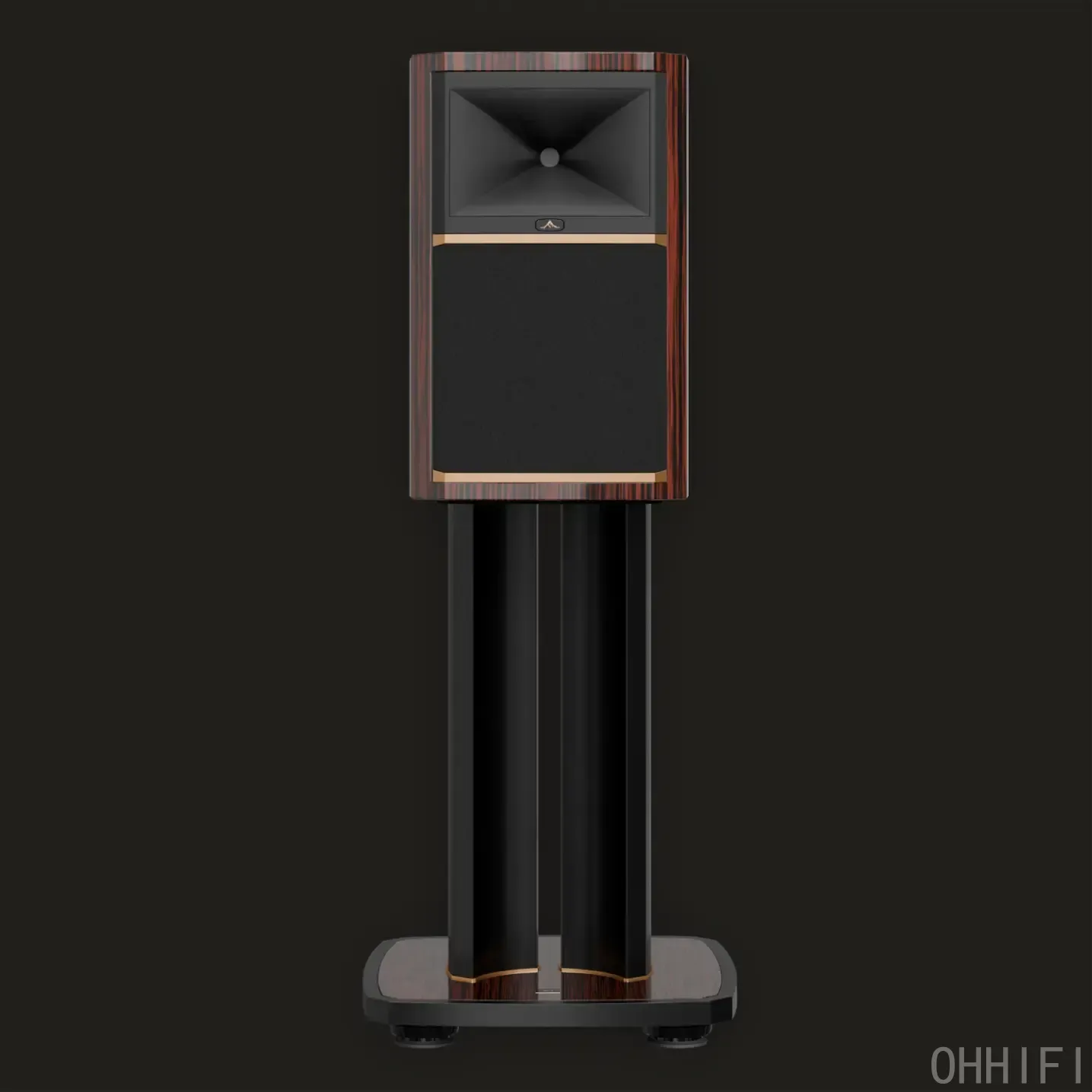
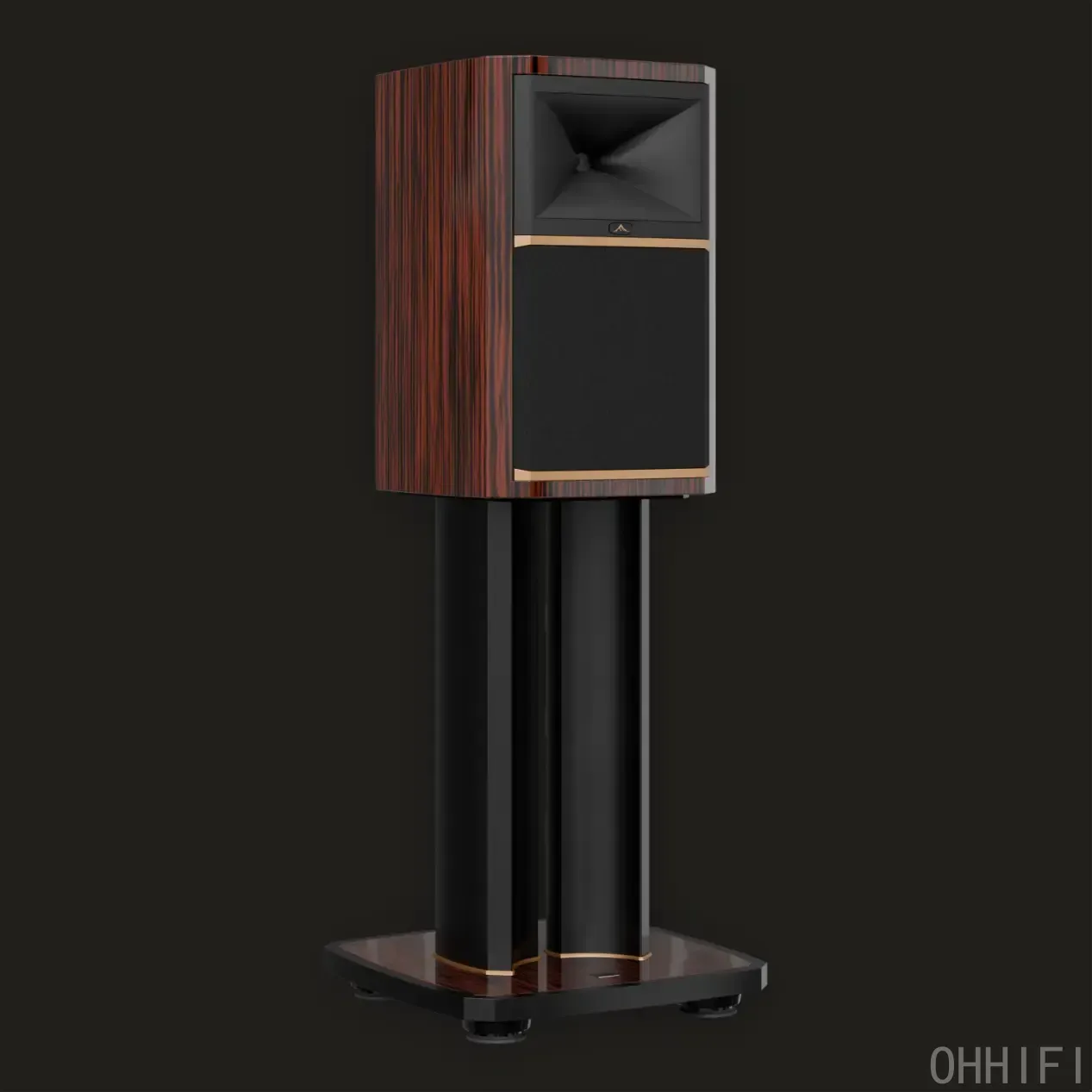
The Ama lands with the visual language of a JBL Studio Monitor — the horn is front and centre, the woofer is obviously not trying to hide behind a dust cap, and the proportions are chunky rather than elegant. Then you notice the veneer. The ebony wood finish with gold trim on my review pair is genuinely heirloom-grade; the black-and-platinum alternative is more austere. Carbon-fibre trim around the baffle, rhodium-plated binding posts, and an irregular octagonal cabinet cross-section all signal that JBL wanted this speaker read as luxury rather than lab kit. Fit and finish are on par with anything at the price.
The cabinet itself is sustainably-sourced engineered wood with offset multi-point internal bracing and heavy damping, and it feels it — a knuckle-rap gives back almost no resonance, just a dull thud. The matching steel-and-aluminium stands aren't optional in any meaningful sense — the speaker isn't sold without them, and at roughly 20 kg each with custom JBL/IsoAcoustics isolation feet and integrated cable routing, they're engineered as part of the system. Altogether, per Audio Advice's published figures, each speaker-plus-stand assembly tips over 45 kg. Install these yourself only if you enjoy pain.
The engineering story is the drivers, and it's worth spending some time on how they actually work. The D2815K compression tweeter uses two 38mm Teonex polymer diaphragms, arranged as annular (ring-shaped) rings rather than a single dome, each with its own motor, voice coil, and phase plug. A conventional single-dome tweeter has to do all the work with one moving surface — pushed hard, it can flex or "break up" at the edges, adding distortion, and the single voice coil heats up in a way that changes its resistance and flattens dynamics (thermal compression). Splitting the radiating surface into two lighter rings lowers the total moving mass, which helps transient speed, and doubles the thermal dissipation path, which is what lets the driver stay composed at high output instead of audibly compressing as it warms up. The two diaphragms can also be tuned to cancel out some of each other's resonances, smoothing the response without leaning on aggressive equalization in the crossover.
That driver is loaded by JBL's Sonoglass HDI (High-Definition Imaging) horn — a large-format waveguide molded from a dense, resin-based material filled with glass fibers rather than metal or plastic. The point of the material choice is that metal horns ring and plastic horns flex; Sonoglass is close to acoustically inert, so it isn't adding its own coloration on top of what the driver produces. The HDI geometry itself is designed to keep dispersion consistent both on- and off-axis — in a typical box speaker, high frequencies "beam" narrowly as they rise, so reflected sound off the walls ends up sounding tonally different from the direct sound. A wide, controlled dispersion pattern keeps those two in closer agreement, which is a meaningful part of what a horn-loaded design is chasing when it comes to stable imaging.
Below the horn, the 8-inch HC4 mid/bass driver uses a triple-layer sandwich construction: carbon fibre and pulp (paper) skins around a closed-cell foam core. The carbon adds stiffness so the cone moves closer to a true piston rather than flexing under load; the pulp layers add self-damping to keep that stiffer cone from ringing; the foam core adds rigidity without much extra weight. It's tuned with a large rear port to a claimed 34 Hz at −6 dB. JBL crosses the two drivers over at 1.6 kHz — unusually low for a compression driver of this size, since it means the horn is handling more of the vocal range than most designs in this class attempt. The MultiCap crossover network itself replaces the usual handful of large capacitors with many smaller ones, aiming for lower equivalent series resistance and cleaner transient behavior. Whether any single element of this is audible in isolation is hard to say — what I can say is that the finished product behaves like a coherent design rather than a parts-bin assembly.
The Listening Experience
Bass: The Best Reason to Buy This Speaker, and the Biggest Trap
The Ama's low end is the thing every reviewer fixates on, and rightly so. On Bonobo's "Cirrus" and the title track of Daft Punk's Random Access Memories, the speaker delivers sub-bass with a texture I usually associate with a well-integrated 10-inch floorstander. There's weight, there's extension, and more importantly there's speed — the HC4 cone starts and stops without the smearing that plagues most 8-inch drivers when pushed hard.
StereoNET noted that on drum'n'bass material, the Ama's low-end substance can border on oppressive, and that bass-light recordings still tilt toward the bottom. (StereoNET) That matches what I hear. This is not a speaker that evaporates against the rear wall — give it at least a metre of breathing room, ideally more, and don't even think about corners. In a lively room it will overdrive the space fast. In a well-damped room of reasonable size, though, it'll give you a kind of physical authority that almost no standmount can match.
Midrange: Unromantic, in a Good Way
Put on Norah Jones's "Don't Know Why" or Antonio Forcione's Meet Me In London and what you notice first is the absence of the usual standmount-midrange character — no BBC-monitor politeness, no upper-mid bloom, no "warmth" added to flatter vocals. The Ama just reproduces what's on the recording. Sabina Sciubba's vocal on "Caruso" hangs cleanly in space without the horn imposing any cupped, honky character I half-expected. The 1.6 kHz crossover point — low for a compression driver — means the D2815K is handling most of the human voice, and it's doing so without apology.
That directness is going to divide listeners. If you're coming from something like a Sonus Faber Guarneri, the Ama will sound bluntly honest at first. Give it time. The more you listen, the more you realise a lot of what you thought was "refinement" in those other speakers was colour.
Treble: Detail Without Harshness — Mostly
This is where horn scepticism usually kicks in, and I went in primed for it. It's not a problem. On Dire Straits' "Your Latest Trick", the brass has bite without glare; brushed cymbals on Chet Baker's Chet Baker Sings decay naturally rather than terminating in sizzle. Multiple reviewers have landed on roughly the same verdict — What Hi-Fi described the highs as not the sweetest, with no trace of unwanted tizz or edge and excellent resolution. (What Hi-Fi?) That's fair. There's a slight dryness, a pro-audio character where a Focal beryllium tweeter would sound airier and a B&W diamond would sound prettier. What you get instead is clarity and dispersion that stays consistent off-axis, and zero listener fatigue over long sessions. I'll take that trade.
Soundstage: Wide, Stable, Not Deep
The HDI horn's controlled dispersion delivers what I'd call a "social" soundstage — the image stays locked together whether you're in the sweet spot or two seats over. Lateral imaging is precise and the central image is rock-solid. What you don't get is the hyper-deep, holographic layering that something like a Magico S1 or a well-set-up Wilson TuneTot conjures. The stage here is wide and tall; it's not a cathedral. On large-scale orchestral material — Mahler's Second, say, or John Wilson's Sinfonia of London recordings — you get scale, layering, and weight, but not the sense of air behind the back row of the choir. Different priorities.
Test Setup
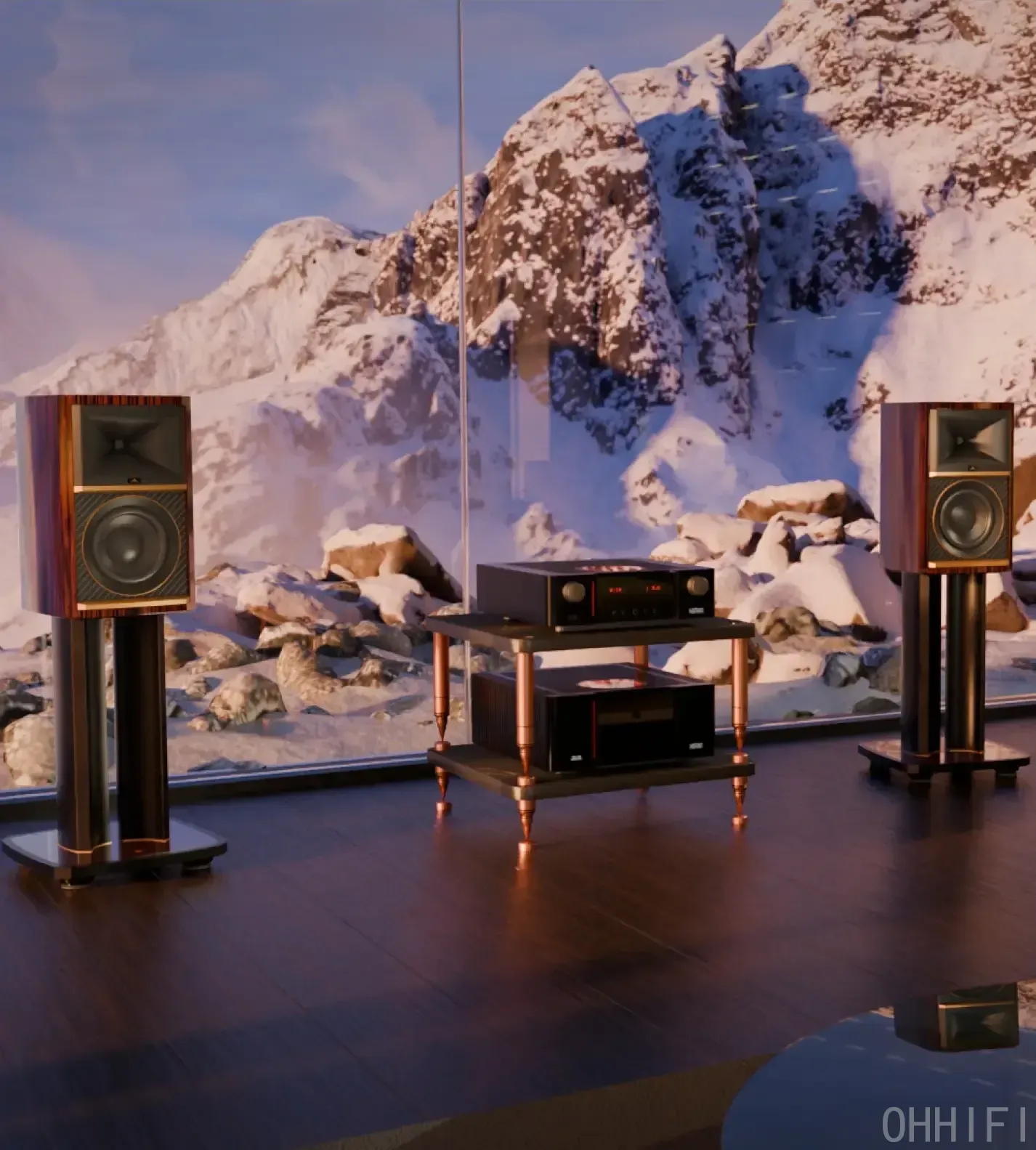
Auditioned in a treated listening space, driven by my reference mid-fi integrated amp with plenty of current on tap into a 4-ohm load — which, let me be clear, is the bare minimum this speaker needs. The stands are non-negotiable, so there's no setup variable there. Following JBL's own guidance, I ran the speakers with moderate toe-in, aiming at a point roughly two and a half metres behind the listening position. That, plus the grilles left on (JBL actually prefers this, and I agree — the difference is marginal and the visual integration improves), gave the best centre-image coherence. Positioning is the only fine-tuning you get: the Ama drops the treble/presence trim switches that K2 and Everest owners are used to.
Measured Performance
Full independent lab data wasn't published at the time of writing — Frieve's audio review database notes that complete measurements including frequency response, sensitivity, impedance, and distortion are not yet available from independent measurement sources. (Frieve) I wouldn't quote numbers I haven't seen corroborated. What's clear from JBL's own published specs and from multiple reviewer reports is that the 84 dB sensitivity is real, and the 4 Ω nominal impedance means this speaker actually draws more current than its size suggests. As Hi-Fi News pointed out, horn loading normally improves sensitivity; the mere 84 dB rating here reflects the capability of the 200mm bass/mid unit rather than the horn. (Hi-Fi News) Translation: JBL traded efficiency for extension. That trade is audible, and it shapes every downstream decision you'll make about amplification.
The Competition
Real competitors at or near the $20K standmount tier, based on pricing I've verified at current retail. Cross-shop these.
| Rival | Comparison | Verdict |
| Dynaudio Confidence 20 (~$24k) | Esotar3 tweeter, Compex mid/bass in a Jet-shaped cabinet. Sweeter top end, rounder midrange character, still needs real power. | More polished, less visceral. Dynaudio for acoustic and jazz at sane volumes; JBL when the volume goes up. |
| Sonus Faber Guarneri G5 (~$18–20k) | Lute-shaped walnut cabinet, silk-dome DAD tweeter. Famously beautiful tone, less bass extension, easier load. | The Italian speaker for listeners. The Ama is the American speaker for musicians. Pick your mood. |
| Wilson TuneTot (~$15k) | Compact X-material cabinet, intended for untraditional placements, genuinely room-flexible. | More forgiving in rooms where the Ama would boom. Less scale, less bass, less jump. |
| B&W 805 D4 Signature (~$9.5k) | Diamond tweeter, Continuum cone, Turbine head. Different price tier but iconic comparison. | Prettier, more romantic, considerably less authoritative. Not in the same weight class dynamically. |
The Ama's closest real sparring partner, philosophically, is TAD's ME1 — another pro-monitor-derived standmount around $15k with a coaxial beryllium driver. The TAD is more surgical; the JBL hits harder.
The Verdict: 8.5 / 10
The Summit Ama is one of the most capable standmounts I've spent serious time with — genuinely outstanding at dynamics, bass extension, and macro-scale delivery in a cabinet the size of a bedside table. It's also one of the most demanding, both in the amp it needs and the room it wants, and that 84 dB sensitivity means small-tube-amp owners should not apply. At $19,995 it's punishing value on paper against full-range floorstanders at similar money — but none of those floorstanders do what this little brute does in a 25-square-metre room. Half a point comes off for the low sensitivity, the positioning fussiness, and a bass tuning that demands real discipline from your room. Everything else is exceptional.
Pros
- Dynamic scale and speed genuinely unusual for a standmount
- Bass extension and control well beyond what the size suggests
- HDI horn delivers detailed, non-fatiguing treble with wide usable listening window
- Build, finish, and included stand package are properly high-end
- Honest, uncoloured midrange that doesn't flatter-and-fade
Cons
- 84 dB / 4 Ω load demands serious, high-current amplification — budget for it
- Bass can dominate in smaller or untreated rooms; needs space to breathe
- Aesthetic is polarising; the horn-and-box look won't land in traditionalist homes
- No HF or presence trim controls, unlike the K2 and Everest above it
- Price puts it up against formidable full-range floorstanders
Who Should Buy / Who Should Skip
This is for you if… you've got a properly sized room with some treatment, a muscular solid-state amp (think Mark Levinson, Pass Labs, Luxman, McIntosh MC462), and you care more about dynamic realism and scale than about airy soundstaging. Rock, big-band jazz, electronica, large-scale orchestral, film scores — this is its natural habitat. If you've owned JBL Studio Monitors before and loved the directness but wanted genuine refinement, the Ama is the grown-up version of that sound.
Look elsewhere if… you listen at low-to-moderate volume in a small or lively room, you're coming from a low-power tube setup, or your taste runs toward the romantic, bloomy, holographic end of audiophile sound. The Dynaudio Confidence 20 or a Sonus Faber Guarneri will make you happier. And if your budget stretches to $20k–$30k and your room can take a floorstander, the Summit Pumori is the more logical move within JBL's own range.


Comments