
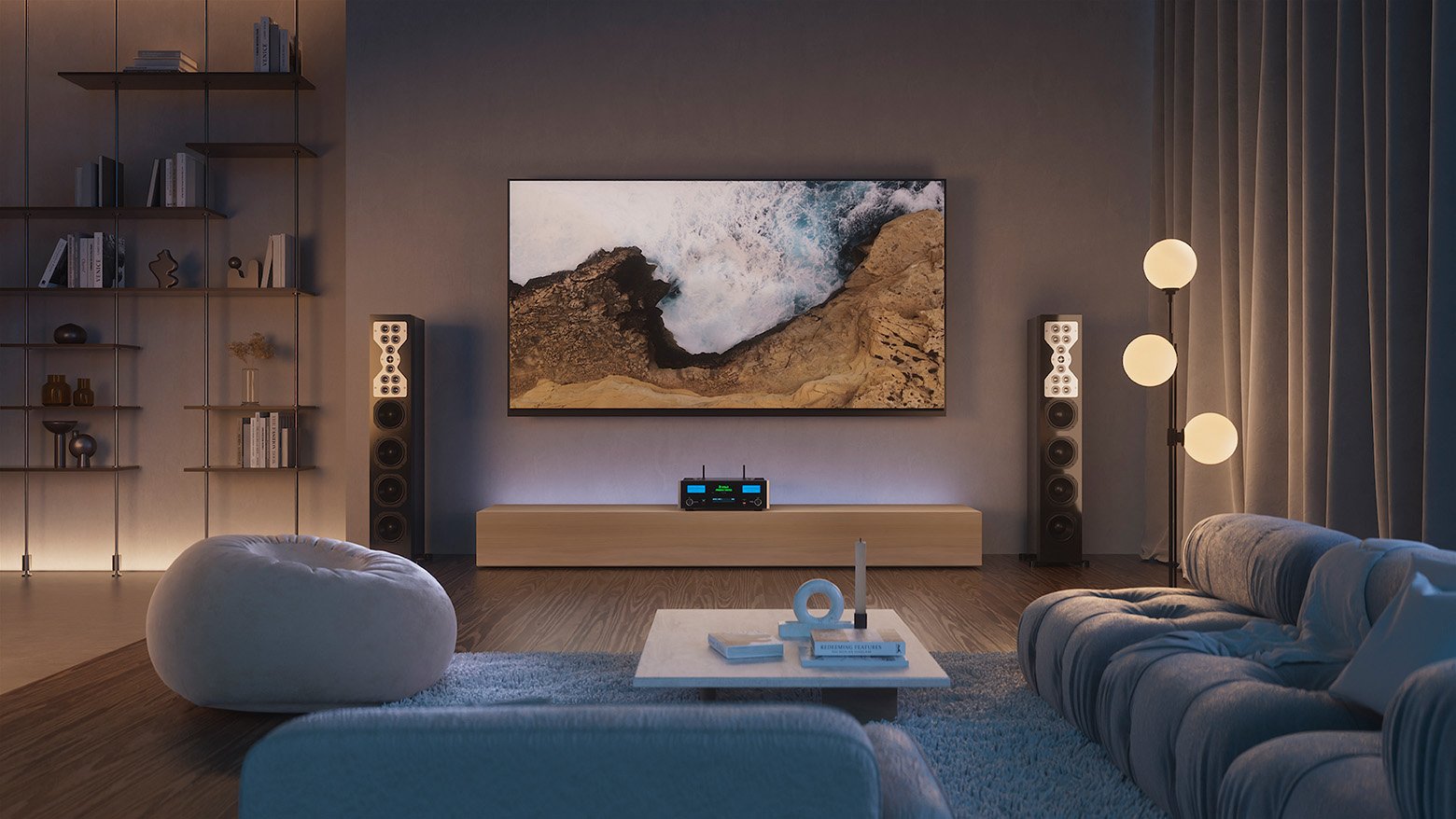
McIntosh MSA5500 Review: An Icon for the Streaming Age

Introduction: The Modern McIntosh Proposition
The contemporary audiophile exists at a fascinating crossroads, caught between the venerated traditions of high-fidelity audio and the undeniable allure of digital convenience. On one hand lies the purist's path: a carefully curated stack of separate components, each optimized for a single task, promising unparalleled sonic purity. On the other, the siren call of the modern era: a world of infinite music, streamed effortlessly from the cloud, demanding elegant, integrated solutions. Into this dynamic enters the McIntosh MSA5500 2-Channel Streaming Integrated Amplifier, a significant statement from the venerable Binghamton, New York, institution. Founded in 1949, McIntosh Laboratory, Inc. has built a legacy on uncompromising power and heirloom quality. The MSA5500 is positioned as the company's definitive answer to the modern paradigm, a component designed to serve as the "cornerstone" of a high-fidelity system for a new generation of listeners. This review will rigorously examine whether this amplifier successfully delivers the quintessential McIntosh experience—sonic authority, superlative build, and iconic aesthetics—within a single, comprehensively featured chassis, and whether it does so without meaningful compromise.

An Icon Reimagined - Design, Build, and Philosophy
The Unboxing and First Impressions
The experience of the MSA5500 begins before it is ever powered on. The disparity between its shipping weight of 55.5 lbs (25.2 kg) and its unit weight of 38 lbs (17.2 kg) speaks volumes about the meticulous care taken in its packaging—a level of protection befitting a premium instrument. Once revealed, the amplifier's physical presence is formidable. While some descriptions suggest a "compact" form factor for modern living, this is a relative term; measuring a substantial 17.5 inches wide, 6 inches high, and nearly 19 inches deep, it is by no means a diminutive component. This heft is not incidental; it is a direct consequence of McIntosh's "no compromise" approach to engineering, where robust power supplies and resonance-damping chassis construction are paramount.
A Tour of the Fascia
The front panel is a masterclass in brand identity, a collection of iconic elements that are inseparable from the McIntosh name. The signature dual-scale "Blue" Watt meters dominate the view, serving a dual purpose. They are, at once, a precise, real-time monitor of power being delivered to the loudspeakers and a mesmerizing visual spectacle that is instantly recognizable to any audio enthusiast.
The meters are set into a lustrous black glass front panel, flanked by substantial rotary control knobs that offer a satisfying, tactile feel for input selection and volume adjustment. This deliberate choice of materials and mechanical feedback stands in stark contrast to the minimalist or purely functional interfaces of many competitors. The illuminated McIntosh logo, glowing in its signature green, provides the final, definitive touch of brand heritage.
Chassis and Internal Engineering
The amplifier's considerable weight is rooted in its dual-layer chassis, finished in black painted steel, which provides a rigid, non-resonant foundation for the sensitive electronics within. Visible along the sides are the McIntosh Monogrammed Heatsinks™, which are not merely cosmetic flourishes. These heatsinks are directly coupled to advanced high-current output transistors, designed to minimize thermal equilibrium lag—or warm-up time—and ensure the amplifier runs cool, promoting consistent performance and long-term reliability.
This meticulous attention to physical design transcends mere functionality. It is a deliberate evocation of heritage, a tangible link to a storied past that includes powering the Grateful Dead's legendary Wall of Sound. Where competitors often embrace a stark, minimalist aesthetic, McIntosh presents an object of desire, a "centerpiece" engineered to be seen and admired as much as it is heard. This elevation of the amplifier from a utility to a luxury artifact is central to the ownership experience, creating an emotional resonance that a specification sheet alone cannot convey. It is this very quality that helps justify the premium investment, appealing to a desire for permanence and sophistication in a world of disposable electronics.

The Universal Hub - Features and Connectivity
At its core, the MSA5500 is engineered to be the single, intelligent hub of a modern audio system, bridging the worlds of high-resolution digital streaming and classic analog sources with effortless grace.
The Streaming Core
The amplifier's most prominent modern feature is its comprehensive and seamlessly integrated streaming platform. It offers native support for a host of the most popular services, including Apple AirPlay, Google Cast, Spotify Connect, and TIDAL Connect, the latter of which includes support for HiFi Lossless Quality. Crucially, these are "Connect" services, meaning the user streams directly from their familiar smart device applications, requiring no proprietary McIntosh control app and ensuring an intuitive user experience.
For the serious digital music collector, the unit's certification as a Roon Ready endpoint is a key feature. This allows for flawless integration into the Roon ecosystem, celebrated for its rich metadata interface and high-performance network audio capabilities. Network stability, a critical factor for high-resolution streaming, is addressed through the inclusion of dual Wi-Fi 6 antennas for a robust wireless link and a traditional Ethernet port for the most reliable wired connection.

The Digital Brain: The DAC Section
Digital signals are handled by a state-of-the-art, next-generation Digital-to-Analog Converter (DAC). The architecture is a Quad Balanced, 8-channel, 32-bit/384kHz design capable of processing both PCM and DSD files. The use of an 8-channel DAC in a stereo (two-channel) configuration is a hallmark of high-end design; by running four DAC channels for each side of the stereo signal, the noise floor is significantly lowered and the dynamic range is enhanced, resulting in greater clarity and resolution. This advanced digital brain supports a vast range of high-resolution formats, including DSD512 and DXD up to 384kHz via its USB input, and 24-bit/192kHz audio through its coaxial and optical inputs.
A notable point of divergence from some of its stablemates is the MSA5500's integrated digital architecture. While other McIntosh amplifiers feature the brand's modular DA1 or DA2 Digital Audio Modules, promising a path for future hardware upgrades, the MSA5500's digital board is fixed. This appears to be a calculated design choice that defines the amplifier's role as a supremely capable, yet self-contained, "all-in-one" solution. The focus is on delivering an exceptional current digital experience out of the box, prioritizing integrated simplicity for a user who may value a single, elegant component over the long-term prospect of modularity. This positions the MSA5500 distinctly within the McIntosh hierarchy, offering a different value proposition than its more expensive, upgradeable siblings.

A Nod to the Analog World
Despite its digital prowess, the MSA5500 pays full respect to traditional analog sources. It features a dedicated Moving Magnet (MM) phono input with fixed loading, a crucial inclusion for the resurgent community of vinyl enthusiasts. The amplifier is also equipped with a generous array of line-level inputs, including one balanced (XLR) pair and four unbalanced (RCA) pairs, accommodating a wide range of source components. The only notable omission for some high-end analog users is the lack of a built-in Moving Coil (MC) phono stage.
Bridging Audio and Video
Recognizing the central role of the television in modern living spaces, McIntosh has included an HDMI (ARC) input. This simple, single-cable connection allows the MSA5500 to receive the audio signal from a compatible TV, delivering a sound experience with a level of depth, clarity, and power that internal TV speakers or typical soundbars simply cannot match. The amplifier's processing expertly converts popular multi-channel formats from Dolby® and DTS® into high-quality two-channel audio for proper playback through a stereo speaker system.

The Voice of the Machine - A Sonic Exploration
The McIntosh Sound Signature
Ultimately, a McIntosh amplifier is judged by its sound, and the MSA5500 delivers the brand's signature sonic character with authority. The presentation is consistently described as "clear and detailed," yet simultaneously "substantial and full even at low volume levels," possessing an ability to sound increasingly "expansive as you turn it up". This points to a presentation that is at once powerful, controlled, and tonally rich.
A key element of this experience is the "black background" from which the music emerges. This is the audible result of a very low noise floor, evidenced by impressive signal-to-noise ratio specifications of 95dB for high-level inputs and 110dB for the power amplifier section. This profound silence between notes allows fine musical details to "burn brightly," revealing textures and nuances in familiar recordings with newfound clarity.
Tonal Balance and Timbre
The MSA5500 strikes a masterful balance between resolution and musicality. Its sound is one of "exceptional refinement with enough energy and attack to avoid sounding dull or safe". For music collections where not every recording is of audiophile quality, the amplifier is able to "gently smooth off the rough edges without the whole presentation ever becoming soporific". This indicates a character that is inherently musical and forgiving, rather than ruthlessly analytical or sterile. It delivers the full-bodied, slightly warm, and deeply satisfying tonal character that has been the hallmark of the McIntosh house sound for decades.
Soundstage and Imaging
When paired with capable loudspeakers, the MSA5500 creates a soundscape of impressive proportions. The system generates a "superb soundstage" defined by its "scale" and "low end heft". Listeners report that it reveals "fresh details" in familiar music, creating an engaging experience that keeps one "glued to the couch". This ability to render a believable, three-dimensional acoustic space with precise placement of instruments and voices is a testament to the amplifier's excellent channel separation and phase coherence.
Dynamics and Power Delivery
On paper, the MSA5500 is rated to deliver a robust 100 Watts per channel into 8 Ohms, and 160 Watts per channel into 4 Ohms. In practice, this power rating is said to feel "extremely conservative". This generous power, combined with a dynamic headroom of 1.8dB, allows the amplifier to handle demanding, dynamically rich recordings—such as full-scale orchestral works—with "effortless heft" and without any sense of strain.
This effortless dynamic capability is underpinned by McIntosh's proprietary protection technologies. Power Guard® continuously monitors the output signal and makes real-time micro-adjustments to prevent the harsh, speaker-damaging distortion known as clipping. Sentry Monitor™ is a fuse-less short-circuit protection circuit that disengages the output stage before current can exceed safe levels, automatically resetting when conditions return to normal. These are not merely failsafes; they are integral to the sonic performance, ensuring that the power delivered is always clean and composed, even when the amplifier is driven hard.

Performance Across Sources
The MSA5500 maintains a remarkably consistent and high-quality sonic character across its diverse range of inputs.
Digital: Thanks to the high-quality DAC section, streamed music sounds "very special indeed," with even lossy sources like Spotify being rendered in a way that is "genuinely good".
Vinyl: The built-in MM phono stage is lauded as "exceptional," demonstrating a "complete absence of background noise" and a tonal balance that is "uncannily similar to the digital section". This is a significant achievement, ensuring a cohesive and seamless listening experience when switching between modern and classic formats.
Headphones: For private listening, the MSA5500 includes a High Drive headphone amplifier featuring Headphone Crossfeed Director (HXD®). This technology is designed to create a more open, dimensional, and speaker-like soundstage, moving beyond the typical "in-head" localization of headphone audio.
Contenders in the Arena - A Comparative Analysis
In the competitive landscape of high-end integrated amplifiers, the MSA5500 faces rivals that each embody a different philosophy of sound reproduction. The most notable competitors include the Naim Uniti Nova, the Hegel H190, and the Lyngdorf TDAI-3400.
The Naim Uniti Nova from the UK champions musicality, with a focus on pace, rhythm, and timing (PRaT).
The Hegel H190 from Norway is a powerhouse of technical precision, known for its neutrality and immense speaker control.
The Lyngdorf TDAI-3400 from Denmark represents a paradigm shift as a fully digital "Power DAC," defined by its world-class RoomPerfect™ room correction technology.
Specifications at a Glance
The following table provides an objective, at-a-glance comparison of the four amplifiers, highlighting their core technical differences and setting the stage for a more nuanced discussion of their sonic philosophies.

Philosophical and Sonic Showdown
McIntosh vs. Naim: This comparison highlights a difference in sonic priorities. The MSA5500's sound is characterized as "rich, powerful, and expansive," focusing on scale, tonal beauty, and authoritative control. The Naim Uniti Nova, by contrast, is praised for its "immediacy," "aliveness," and a "fast, punchy, lively rhythmic sound" that prioritizes musical energy and engagement. Where the McIntosh sound is smooth and enveloping, the Naim can exhibit a slight "hardness" in its pursuit of rhythmic drive. The choice here is between the grand, cinematic presentation of the McIntosh and the infectious, toe-tapping energy of the Naim.
McIntosh vs. Hegel: Here, the battle is between tonal richness and clinical neutrality. The Hegel H190 is lauded for its "very neutral," "clean," and sometimes "analytical" presentation. Its defining characteristic is its vice-like grip on the speakers, a result of an exceptionally high damping factor of over 4000, which creates a sound of pinpoint precision emerging from a "dark void". The MSA5500, while highly detailed, leans more towards a musically satisfying tonal richness and a grand, immersive soundstage, rather than the Hegel's stark neutrality.
McIntosh vs. Lyngdorf: This is the most profound philosophical divergence. The MSA5500 is a superb traditional analog amplifier augmented with a state-of-the-art digital front-end. Its sound is a product of its inherent design and componentry. The Lyngdorf TDAI-3400, a "Power DAC," keeps the signal in the digital domain until the final output stage. Its defining feature, RoomPerfect™, actively measures and corrects for the acoustic anomalies of the listening room. Therefore, the McIntosh aims to deliver its signature character to the room, while the Lyngdorf aims to deliver ultimate neutrality in the room by digitally removing the room's influence from the equation. This represents a fundamental choice between embracing the inherent character of a legendary amplifier and pursuing a technologically corrected version of acoustic reality.

The Final Accounting - Strengths, Weaknesses, and The Ideal Listener
Summary of Strengths (Pros)
Quintessential McIntosh Sound: The MSA5500 delivers a powerful, rich, detailed, and non-fatiguing sonic presentation that excels at conveying musical scale and dynamic authority.
Comprehensive All-in-One Solution: It seamlessly integrates a high-performance streamer, a versatile DAC, a quality MM phono stage, and robust amplification in a single, elegant chassis.
Superlative Build Quality and Aesthetics: It is an iconic, heirloom-quality product that offers immense pride of ownership and serves as a visual centerpiece for any high-end audio setup.
Future-Ready Connectivity: A vast array of modern inputs, including HDMI ARC for enhanced TV sound and high-resolution USB, ensures its relevance for years to come.
Adaptable Upgrade Path: The inclusion of preamplifier outputs allows the unit to serve as a premium streaming preamp for a more powerful external amplifier, protecting the initial investment and allowing the system to grow.
Acknowledged Weaknesses (Cons)
Premium Price Point: With a retail price of $8,000, it exists in a highly competitive market segment where rivals may offer more raw power or different feature sets for a similar or lower investment.
Fixed Digital Module: The lack of an upgradeable DAC module, a feature found in other McIntosh products, may be a concern for audiophiles focused on the absolute longest-term evolution of digital technology.
No Moving Coil (MC) Phono Stage: This limits its out-of-the-box appeal for users with high-end turntables equipped with MC cartridges, who would require an external step-up transformer or phono preamp.
Size and Weight: While marketed for "modern living spaces," its substantial dimensions and weight may not be suitable for all environments or equipment racks.
The Ideal Listener Profile
The ideal owner of the McIntosh MSA5500 is an audiophile who seeks more than just a collection of specifications. This individual deeply values the McIntosh brand heritage, its iconic aesthetic, and the tangible sense of quality that comes from its American craftsmanship. They prioritize a rich, powerful, and musically engaging sound over absolute clinical neutrality or aggressive rhythmic drive. They desire a simple, elegant, high-performance single-box solution that can masterfully handle both the latest high-resolution streams and their cherished vinyl collection. For this listener, an audio system is a long-term investment and a centerpiece of their living space, and they are willing to pay a premium for the intangible yet profound qualities of brand prestige and pride of ownership.
Concluding Verdict
The McIntosh MSA5500 is not merely an amplifier; it is an experience. It represents a masterful fusion of the company's seventy-five-year legacy of amplification excellence with the full spectrum of modern digital convenience. While competitors may challenge it on specific technical fronts—be it the clinical precision of Hegel, the rhythmic drive of Naim, or the acoustic wizardry of Lyngdorf—none can match its unique synthesis of iconic design, authoritative sound, and the profound sense of owning a piece of audio history. For the discerning listener who seeks a true soulmate for their audio system, not just another component, the MSA5500 makes an undeniably compelling and emotionally resonant case. It is, in every sense, a modern classic.





Comments