
Audiolab 8300XP Review: The Reality of British Steel

Design and Engineering: "Laboratory" Precision
Industrial Design
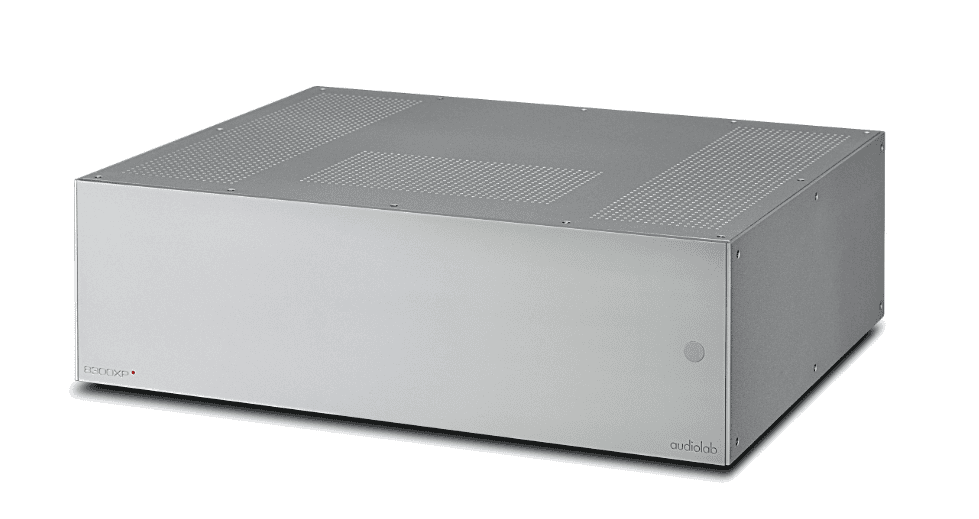
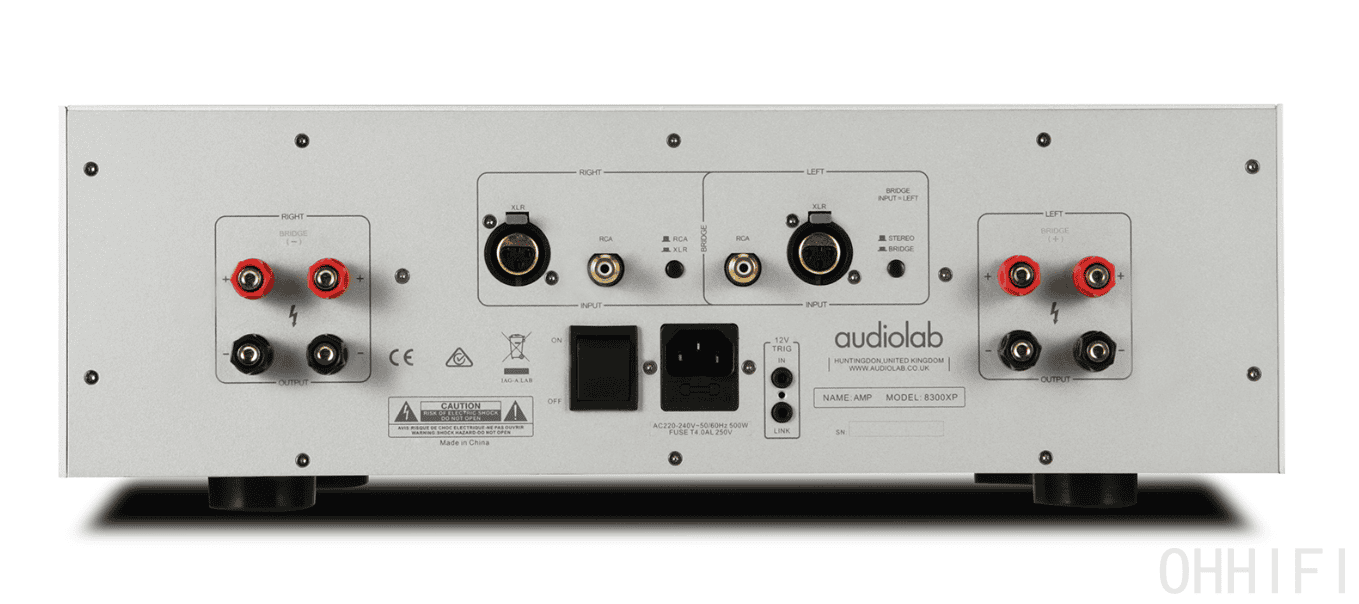
The 8300XP follows Audiolab’s "functional elegance" philosophy. The chassis, available in blast-treated silver or matte black, is heavy (16kg) and rigid. The front panel is stark, housing only a power button and a status LED. There are no VU meters or superfluous displays; this is an engine, not a dashboard.
Internal Topology
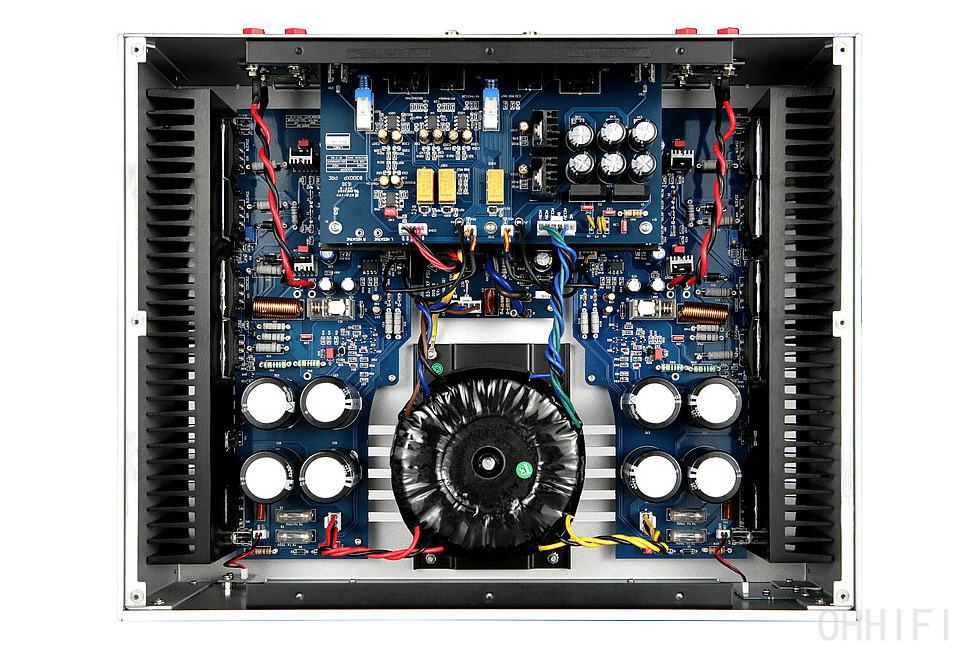
Under the hood, the 8300XP employs a dual-mono topology with a shared power supply.
Power Supply: A massive toroidal transformer dominates the interior. While it shares a single magnetic core, it utilizes independent secondary windings and rectification stages for the left and right channels. This design significantly reduces crosstalk compared to single-supply designs, though it is distinct from a "true" dual-mono setup that would use two separate transformers. This design strategy maximizes channel separation within a sensible cost and form factor, laying the foundation for precise soundstage imaging.
Wiring: The signal path utilizes OCC (Ohno Continuous Cast) copper wiring to minimize resistance and crystal grain boundaries.
Class AB Operation: The output stage uses bipolar transistors biased into Class AB. This ensures the linearity of Class A at low power levels while maintaining the efficiency required for high dynamic peaks.
Specifications and Performance Data
The following specifications represent the manufacturer's rated performance:
| Specification | Value | Notes |
| Power Output (Stereo) | 140W RMS per channel | @ 8 Ohms, 1kHz |
| Power Output (Stereo) | 230W RMS per channel | @ 4 Ohms, 1kHz |
| Power Output (Bridged) | 480W RMS (Mono) | @ 8 Ohms, 1kHz |
| THD (Distortion) | 0.004% | @ 20W, 1kHz |
| Signal-to-Noise Ratio | 113dB | A-weighted, ref. 140W |
| Damping Factor | 160 | Indicates good woofer control |
| Gain | 29dB (Stereo) / 36dB (Bridged) | Balanced XLR & RCA |
Clarification on Bridged Mode
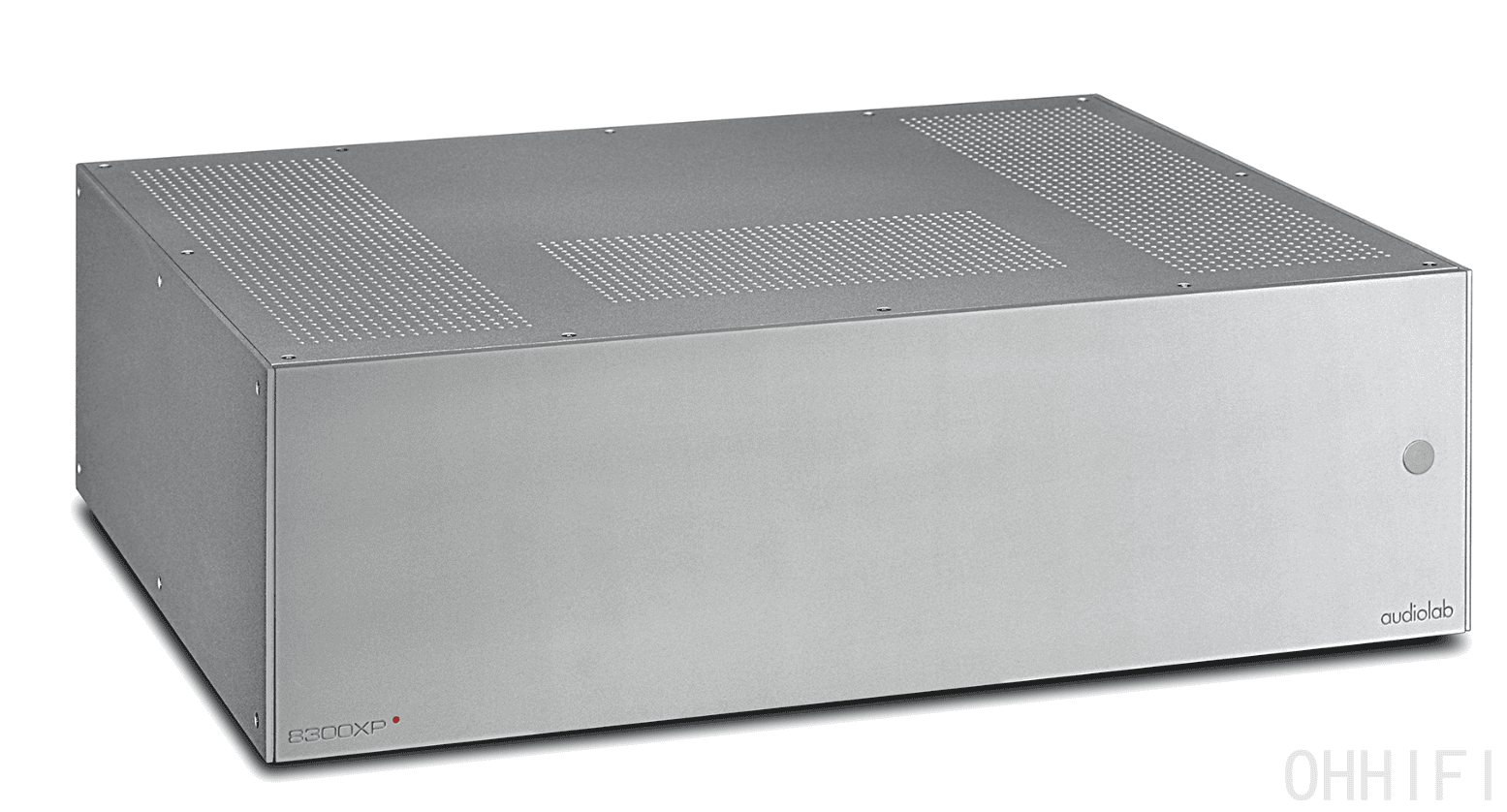
A standout feature is the ability to bridge the stereo channels into a single mono output. When switched to bridged mode, the amplifier combines the voltage swing of both channels. This increases the output power into an 8 Ohm load to approximately 480W. Note that in this mode, the amplifier effectively "sees" half the speaker impedance; therefore, bridging is recommended primarily for speakers with a nominal impedance of 8 Ohms. Driving 4 Ohm speakers in bridged mode can strain the protection circuits.
Sound Quality: The "Wire with Gain"
The 8300XP characterizes the traditional "British Hi-Fi" sound: neutral, precise, and uncolored.
Tonality: It is neither artificially warm nor clinically bright. The midrange is open and transparent. Vocals, such as those on Nina Simone’s "Strange Fruit", are rendered with texture and immediacy but without added "bloom."
Bass Control: With a damping factor of 160 and high current delivery (230W into 4 Ohms), the amp exerts tight grip over woofers. Bass lines in electronic tracks like Massive Attack’s "Angel" start and stop instantly, avoiding the "muddy" overhang common in lesser amplifiers.
Dynamics: The 140W headroom allows for excellent macrodynamics. Orchestral crescendos are handled with ease. In the pursuit of absolute precision, some listeners may find its micro-dynamics, while precise, slightly less fluid or rhythmically compelling compared to amplifiers that prioritize musical "swing" over absolute control. It favors accuracy and control over rhythmic coloration.
Comparative Analysis
| Competitor | Character Comparison | Verdict |
| Rotel RB-1582 MkII | The Rotel is bolder and slightly more aggressive with a bigger, looser bass presentation. | Choose Rotel for rock/impact; Choose Audiolab for detail/accuracy. |
| Arcam PA240 | Arcam offers a warmer, richer, and more "organic" sound but at a higher price point. | Arcam is better for relaxed musicality; Audiolab is better for studio-like neutrality. |
| Class D (Purifi/Hypex) | Modern Class D amps measure better (lower THD) and run cooler. | Class D is cleaner but can sound "dry." The 8300XP retains a bit more "fleshy" Class AB weight. |
User Guide and Practical Considerations
1. System Matching
Preamps: The natural partner is the Audiolab 8300CDQ or modern streamers like the Eversolo DMP-A8. The XLR connections are highly recommended to utilize the fully balanced circuit and lower the noise floor.
Speakers: Ideal matches include the Wharfedale Linton 85th (adds control to the warm speaker) or KEF R Series (provides necessary current for low-impedance dips). Avoid overly bright speakers (like some older B&W models) if you are sensitive to treble, as the 8300XP will not hide sibilance.
2. Addressing "The Hum"
A known characteristic of large toroidal transformers—found in the 8300XP as well as amps from Naim and Rotel—is mechanical hum. This is usually caused by DC offset on your home's AC mains (often from LED dimmers or appliances).
Symptoms: A physical buzz from the amp chassis (not the speakers).
Solution: If audible, use a dedicated DC Block device (Audiolab manufactures one specifically for this) or a high-quality power conditioner. It is worth noting that this hum is typically only perceivable in extremely quiet environments when close to the unit, and it does not affect the audio signal quality or speaker output.
3. Ventilation
The 8300XP dissipates heat through convection via internal heatsinks. It runs warm. Ensure at least 3-4 inches of clearance above the unit and do not stack other hot components directly on top of it.
Conclusion
The Audiolab 8300XP is a rational amplifier for the rational audiophile. It does not aim to replicate the romantic warmth of tube amps, nor does it prioritize the vanishingly low distortion specs of the latest Class D modules. Instead, it finds an ideal balance on the solid foundation of traditional Class AB: combining powerful drive capability, reliable engineering, and highly transparent sound reproduction. For the rational enthusiast seeking to drive real-world speakers with unquestionable authority, the Audiolab 8300XP remains a class benchmark.





Comments