
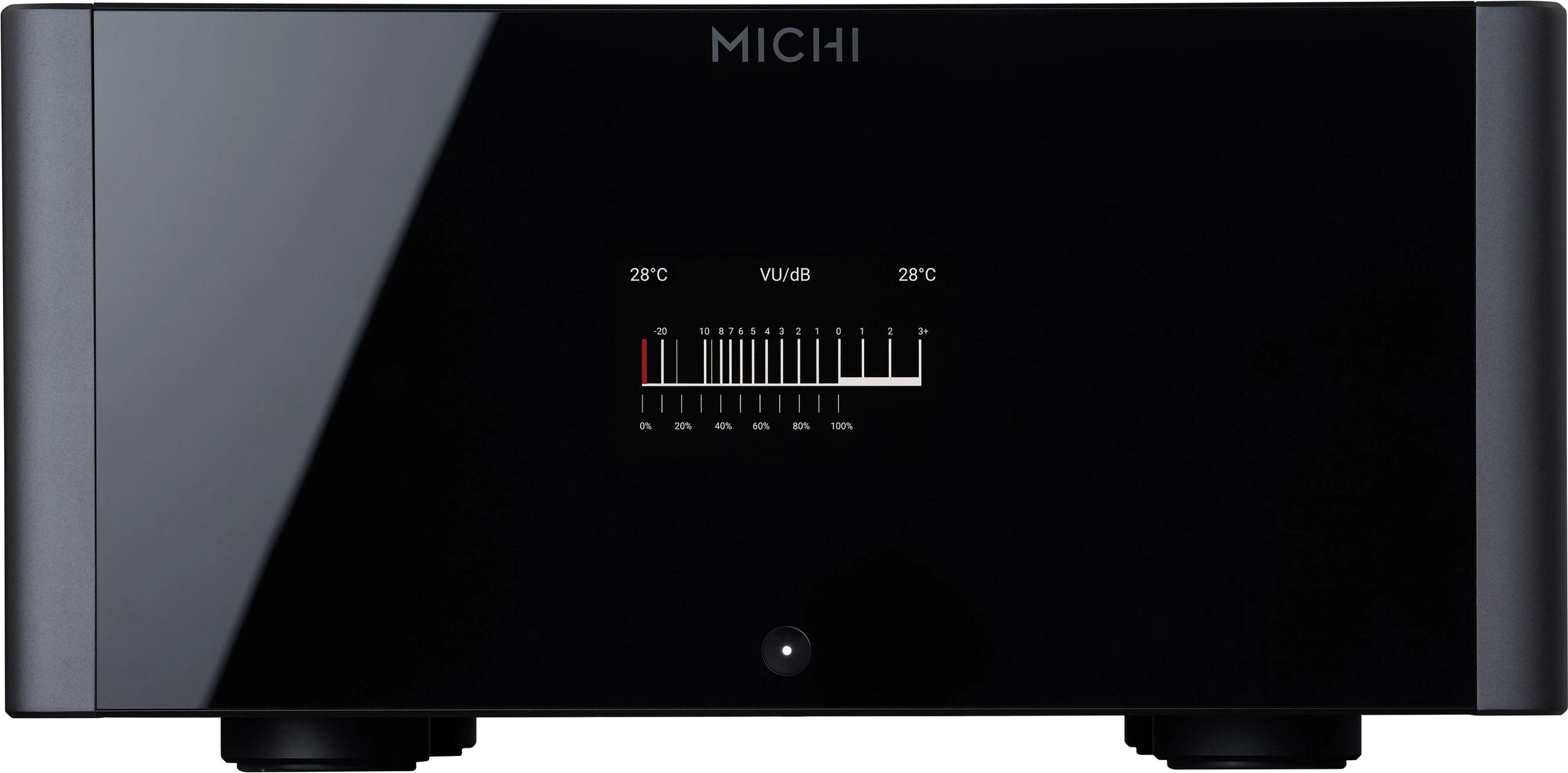
Rotel Michi M8 Review: Absolute Power and Control

In the high-stakes arena of ultra-high-end audio, the name Rotel has long been synonymous with "affordable excellence." For decades, the brand dominated the middle-market shelves, offering robust, Class AB engineering that punched well above its weight class. However, the true connoisseurs remembered a different beast altogether: the Michi series of the 1990s. Those legendary components, with their distinctive red-stained side panels and uncompromising circuitry, were a statement of what Rotel could achieve when the shackles of "budget-friendly" targets were cast aside. In 2019, Rotel decided the time was ripe for a resurrection. The modern Michi lineup was not a mere exercise in nostalgia but a wholesale reimagining of flagship performance for a new generation of audiophiles. Standing at the very pinnacle of this revival is the Michi M8 Monoblock Amplifier—a 59-kilogram behemoth designed to deliver nothing less than absolute authority over any loudspeaker ever created.
The Resurrection of a Legend: The Michi Philosophy
To understand the M8, one must understand the vacuum it was designed to fill. The high-end audio market has increasingly bifurcated. On one side, we have the "lifestyle" high-end—products that look like jewelry but often lack the raw power to drive difficult loads. On the other, we have the "cost-no-object" tier, where prices have spiraled into the stratosphere, leaving many serious listeners behind. Rotel’s Chief Technical Officer, Daren Orth, and his team saw a gap: an opportunity to deliver world-class performance and build quality at a price point that, while significant, remains within the realm of the attainable.
The new Michi identity is a sharp departure from the 1990s aesthetic. Gone are the rosewood accents, replaced by a "quiet luxury" aesthetic that emphasizes minimalist industrial design. The M8 is a "silent giant," wrapped in a chassis of deep black glass and extruded aluminum that whispers confidence rather than shouting for attention. This is an amplifier built for those who value system synergy, tonal balance, and transparency over flashy ornamentation.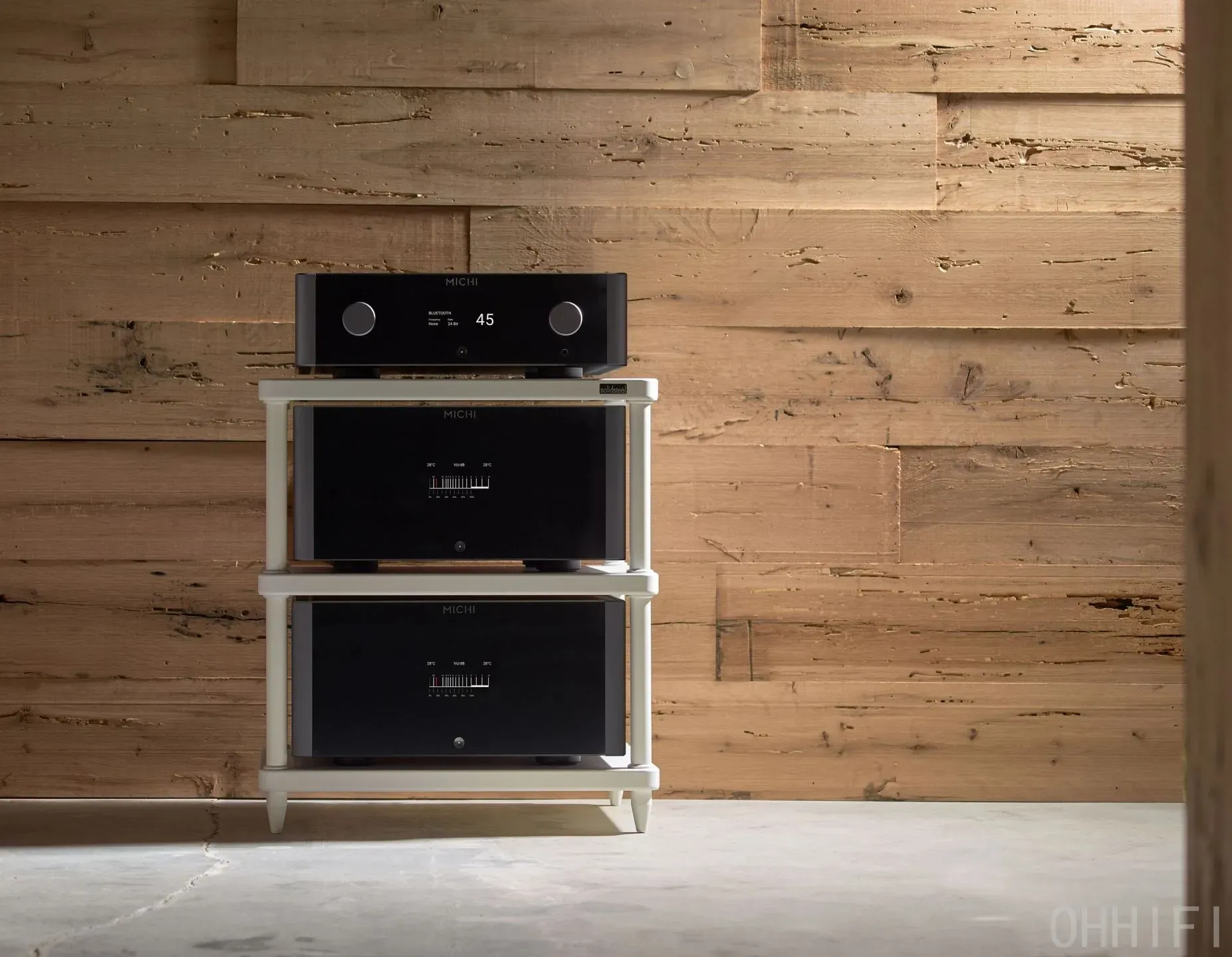
The Strategic Engineering Shift
The development of the M8 took over three years, involving an exhaustive study of modern supporting technologies and a "no-compromise" approach to the power supply. Unlike many competitors who might bridge a stereo amplifier to create a monoblock, the M8 was the primary blueprint. Interestingly, the stereo Michi S5 was actually derived from the M8’s architecture, ensuring that the monoblock remained the purest expression of the design team's ambition. This architectural choice is critical. A dedicated monoblock design allows for total channel separation and a power delivery system that is completely unencumbered by the needs of a second channel.
| Feature | Rotel Michi M8 Monoblock Specification |
| Amplifier Type | Class AB Monoblock |
| Power Output (8 Ohms) | 1,080 Watts (Continuous) |
| Power Output (4 Ohms) | 1,800 Watts (Continuous) |
| Peak Dynamic Power (4 Ohms) | > 3,100 Watts |
| Frequency Response | 10Hz - 100kHz (+0dB, -0.5dB) |
| Total Harmonic Distortion | < 0.018% |
| S/N Ratio (A-weighted) | 120dB |
| Damping Factor | 200 |
| Weight (Net) | 59.1 kg (130.3 lbs) |
Engineering Excellence: What Lies Beneath the Glass
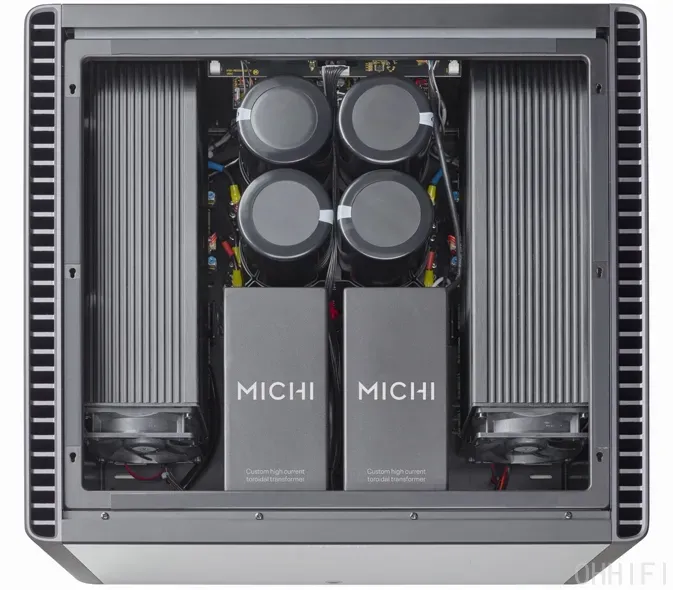
The sheer physical presence of the M8 is the first thing that strikes you. Weighing in at over 130 pounds, it requires a sturdy rack—and perhaps a sturdy friend—to install. This weight is not for show; it is the direct result of a power supply that defines the term "overbuilt."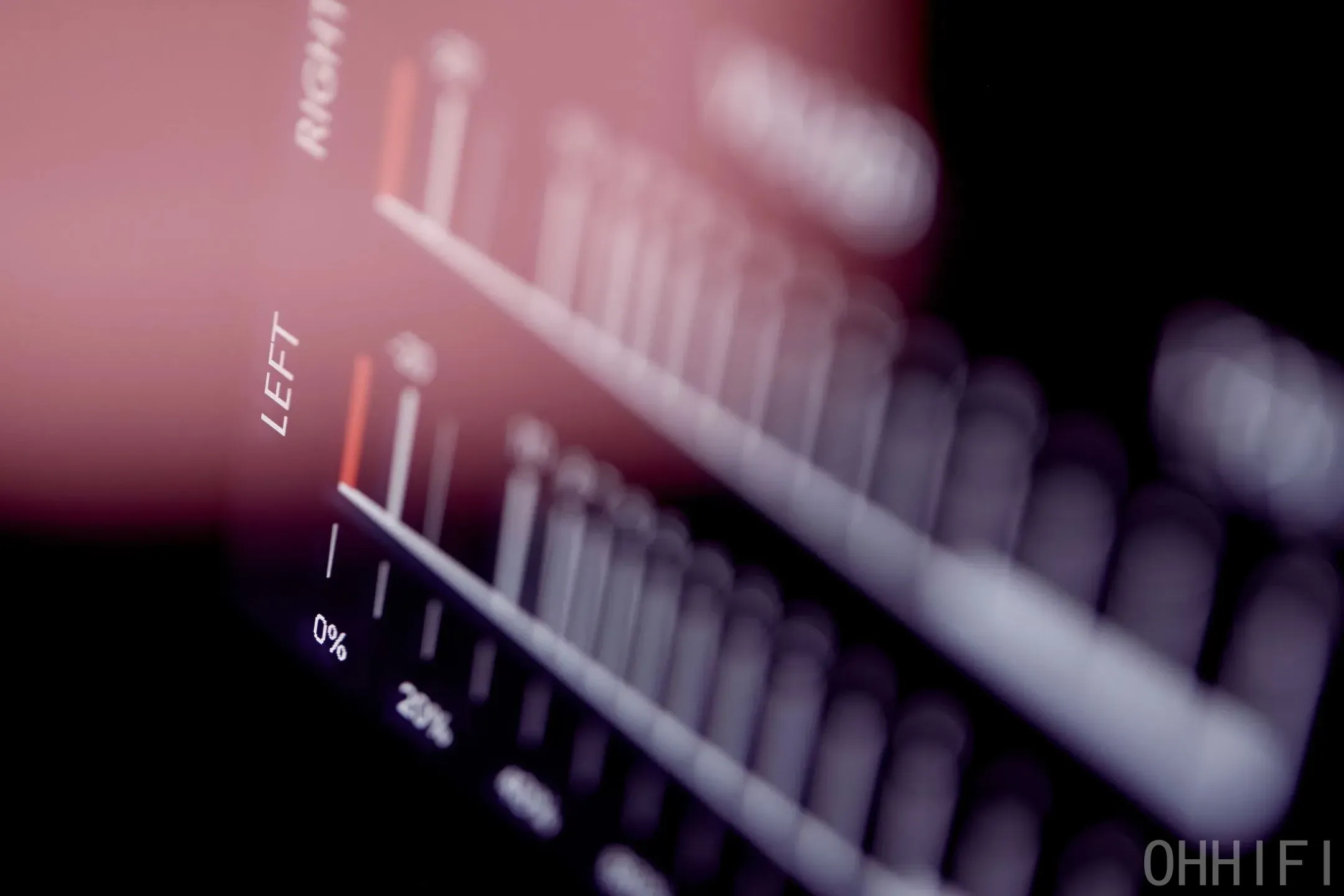
The Power Supply: A Dual Toroidal Heart
At the center of each M8 are two massive, custom-engineered toroidal transformers, manufactured in-house by Rotel. These are low-noise units designed to provide a massive reservoir of current without the mechanical hum often associated with high-wattage transformers. These transformers are supported by four British-patented BHC "slit foil" bulk storage capacitors. These capacitors are a centerpiece of the Michi design. The "slit foil" design is intended to minimize the eddy currents that can accumulate in standard capacitor foils, leading to lower Equivalent Series Resistance (ESR) and faster discharge rates. In practical terms, this means the M8 can respond to transient musical peaks with lightning speed while maintaining a rock-solid foundation in the bass. The total storage capacitance reaches a staggering 188,000$\mu$F.
Thermal Management and Transistor Array
Heat is the enemy of performance in high-power Class AB designs. To combat this, the M8 utilizes a sophisticated internal thermal management system. Rather than having sharp, external fins, the amplifier uses a chimney-effect internal heat sink design. The circuitry is equipped with an array of 32 high-current output transistors. By distributing the workload across such a large number of devices, the M8 reduces the thermal and electrical stress on any single component. This ensures that even when the amplifier is delivering its rated 1,080 watts, it maintains its timing, rhythm, and structural integrity.
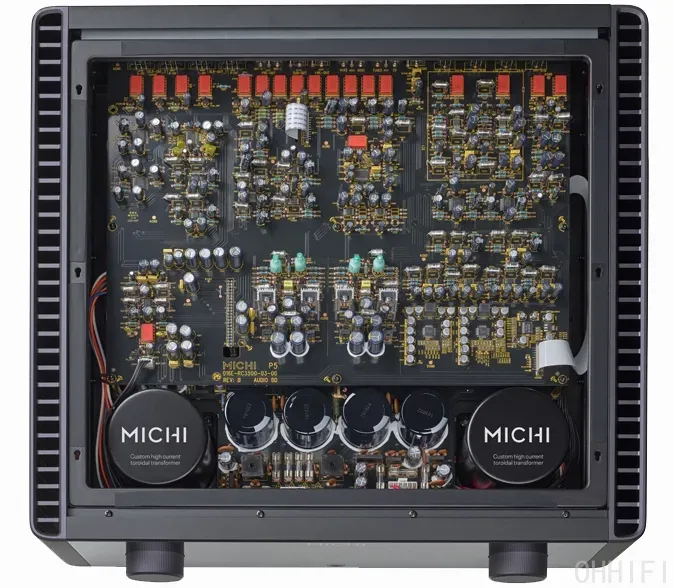
The internal layout is a masterclass in symmetry. From the balanced circuit design to the signal path optimization, every element has been scrutinized through countless hours of listening and bench testing. This meticulous attention to detail is what allows the M8 to achieve an "unsurpassed performance" that balances raw science with the art of musicality.
The Bench Test: Power and Precision in Numbers
While many manufacturers are optimistic with their power ratings, Rotel has a history of conservative specifications. The Michi M8 is no exception. While the official rating is 1,080 watts into 8 ohms, independent laboratory testing has shown the M8 "bursting" past these figures.
Real-World Output Analysis
Lab reports indicate that the M8 can deliver 1,322 watts into 8 ohms and a massive 2,250 watts into 4 ohms at less than 1% THD. This provides a massive amount of headroom for dynamic peaks. When pushed with dynamic signals, the M8 has been measured at 1,640 watts into 8 ohms and over 3,100 watts into 4 ohms. This kind of "clout" is what allows the amplifier to drive even the most notoriously difficult speakers—such as large planars or multi-driver towers—with total ease.
| Impedance | Rated Power (W) | Lab Measured Power (W) | Dynamic Headroom (W) |
| 8 Ohms | 1,080 | 1,322 | 1,640 |
| 4 Ohms | 1,800 | 2,250 | 3,130 |
| 2 Ohms | N/A | N/A | 1,790 |
However, it is important to note the M8’s current limiting characteristics. While it offers massive voltage swing for 8 and 4-ohm loads, its peak current is limited to approximately 31A. This means that into extremely "torturous" loads of 1 or 2 ohms, the power output does fall back significantly—to around 960 watts into 1 ohm. For the vast majority of high-end speakers, including the Bowers & Wilkins 800 D3 often paired with Michi, this is a non-issue, but it is a relevant detail for those driving exotic loads that dip into sub-2-ohm territory.
Noise Floor and Distortion
The Signal-to-Noise Ratio (SNR) of 120dB is a testament to the cleanliness of the M8’s internal architecture. In a high-gain system, a low noise floor is critical for preserving the low-level spatial cues that define a wide and deep soundstage. Distortion levels are equally impressive, with THD staying below 0.018% throughout the audible range. Interestingly, lab testing shows that distortion rises slightly at higher frequencies (up to 0.038% at 20kHz), which is often a byproduct of a design that uses limited high-frequency feedback to preserve a more natural, "tube-like" musical flow.
Industrial Design and User Interface
The Michi M8 is not just a power plant; it is a sophisticated piece of modern technology. The front panel features a high-resolution TFT display that can be customized to suit the listener's mood. You can opt for a high-tech spectrum analyzer, showing the energy distribution across the frequency range, or a classic peak power meter that mimics the look of high-end analog VU meters.
Ergonomics and Integration
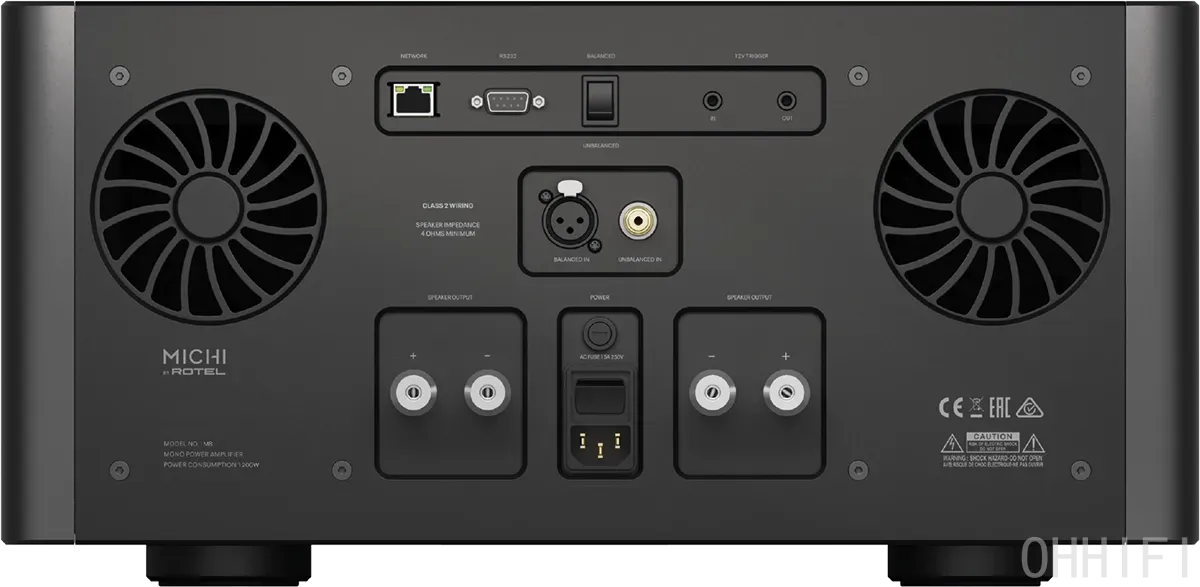
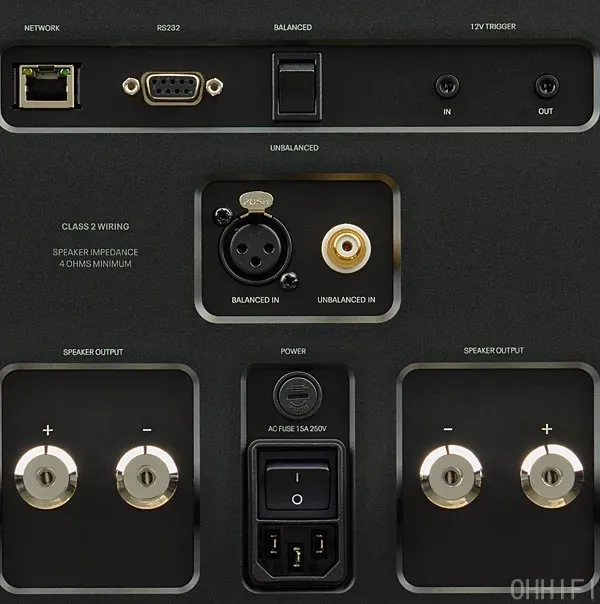
The display is fully dimmable, which is a welcome feature for those who find bright LEDs distracting in a dedicated listening room. Connectivity is comprehensive, featuring both balanced XLR and unbalanced RCA inputs. It is worth noting that the XLR input has a sensitivity of 3V and a gain of 30dB, while the RCA input is more sensitive at 1.85V with a 34dB gain. For professional installers, the inclusion of RS232 and Ethernet ports allows for seamless integration into home automation systems like Control4 or Crestron.
Each M8 comes with its own dedicated remote control, machined from solid aluminum. At 179 grams, it feels substantial in the hand and provides direct access to display settings and volume (if using a Michi preamp), reinforcing the sense of a cohesive, high-end ecosystem.
Listening Impressions: The Sonic High
When the M8s are connected and powered up, the first thing you notice is the "confidence" they impart to the system. There is a sense of "unlimited power" that translates into a relaxed, yet incredibly nimble presentation. The M8 doesn't just hit hard; it has a "rhythmic swagger" that makes the music feel physically present in the room.
Soundstage and Imaging
The M8s are masters of holographic imaging. In orchestral recordings, such as the Staatskapelle Berlin/Barenboim recording of Elgar's First Symphony, the amplifiers describe a "holistic soundscape" that extends well beyond the speakers. The thunder rolls "high and wide," and the rain falls in the background with startling clarity. Instruments are placed in a 3D space with a level of focus that is "breathtaking". The soundstage has a depth and height that makes you feel as though you are sitting in the fifth row of the concert hall.
The Midrange: A Kiss of Warmth
Unlike many high-power solid-state amplifiers that can sound clinical or "etched," the Michi M8 has a "hint of lushness" in the midband. This subtle voicing—so subtle it takes a keen ear to detect—makes string sections sound full-bodied and "lush". Vocals, particularly in intimate jazz recordings like those by Sabina Sciubba, are delivered with an "openness" and "finely delivered" texture that captures the human element of the performance. The M8 manages to achieve this "sweet disposition" without sacrificing transparency or the sharpness of transients.
Bass Authority and Control
This is where the M8 truly earns its keep. The bass is not just powerful; it is "grounded, controlled, and realistic". When the drums crash in a recording, the M8 unleashes a "real hit of power" that you feel in your chest, yet it maintains a "dynamic, clean drive" without any sense of the sound hardening up. The "crack" of a snare drum and the "pop" of a conga are delivered with startling realism. The M8 provides an "impactful bass" with total control, even when driving speakers like the B&W 800 D3 at high volumes.
High-Frequency Refinement
The top end of the M8 is balanced and refined. Cymbals are "brightly lit but finely delivered," avoiding the "searingly thin" or edgy quality that can plague some high-resolution designs. The amplifier maintains the "crucial energy, rhythm and timing" throughout the frequency range, ensuring that high-frequency detail serves the music rather than distracting from it.
The Competitive Landscape: Michi vs. The World
The Michi M8 sits in a unique position. While it is undeniably a high-end product, its price point makes it a "serious bargain" when compared to the ultra-exotic competition.
Michi vs. McIntosh
The most common comparison is with McIntosh. When matched against the McIntosh MC611 or the C53/MC312 combination, the Michi is often seen as winning on "value, overall sonics, and control". While McIntosh offers a "romance and legacy brand charm" with a "sweeter/softer" presentation, the Michi M8 provides more "precision and brute force". For those who want the absolute grip of a modern high-power amp without the "bling" of the classic blue meters, the Michi is the move.
While the M8 emphasizes raw authority and modern transparency, it's insightful to see how the legendary American brand approaches integration in the modern era. For a deeper look into the McIntosh design philosophy and its signature "Most Musical Sound," you can find our detailed analysis in the McIntosh MSA5500 Review: An Icon for the Streaming Age, where classic heritage meets the demands of high-fidelity streaming.
Michi vs. Bryston
Bryston's 28B3 is another natural rival. Bryston amplifiers are legendary for being "built like brick houses" and offering a "100% transparent" sound. In many systems, the two can sound nearly identical, reflecting the fact that both are "competently designed audio components". However, the Bryston tends to be more "neutral and punchier" in the bass, while the Michi adds that "kiss of midband lushness" that some listeners find more engaging for classical and vocal music. Bryston’s 20-year warranty is a major selling point, but Michi’s industrial design and GUI are far more modern.
Michi vs. Pass Labs
Pass Labs amplifiers, such as the X600.8, are celebrated for their "timeless design" and a sonic quality that mimics "flea-watt" tube amps but with massive power. The Pass Labs presentation is often more "organic" and "sweet" than the Michi. However, the Michi M8 offers significantly more raw power (1,080W vs 600W) at a more competitive price point. The Michi is for the listener who needs "stable current delivery" for notoriously difficult speakers, while the Pass Labs is for the listener seeking the ultimate "musical nirvana" in tonal richness.
| Brand | Model | Power (8$\Omega$) | Style | Sonic Priority |
| Michi | M8 | 1,080W | Minimalist | Control & Authority |
| McIntosh | MC611 | 600W | Classic/Retro | Romance & Warmth |
| Bryston | 28B3 | 1,000W | Professional | Transparency & Grip |
| Pass Labs | X600.8 | 600W | Modern/Industrial | Organic Flow & Detail |
System Synergy: The B&W Connection
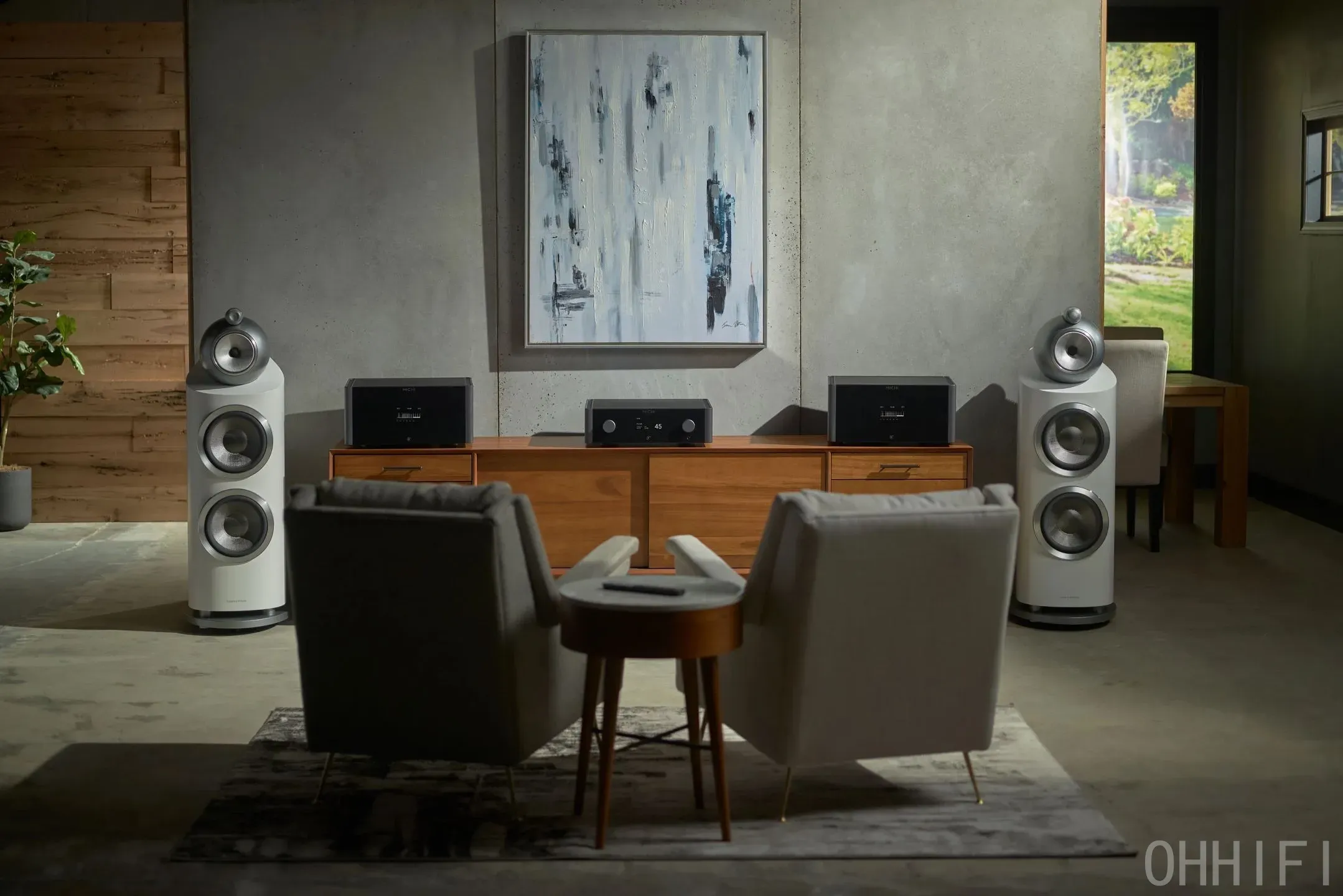
It is no secret in the industry that Rotel and Bowers & Wilkins share a deep history, with B&W serving as Rotel's international distributor. This synergy is evident when you hear the M8s driving the B&W 800 D3 reference speakers. The M8s drive these large speakers with "total ease," presenting the music in a "stately yet fluid manner". The "obvious synergy" results in a sound that is grander in scale and more detailed than when using the stereo S5 amplifier. Even at high levels, the M8s run "barely warm," showing that they are barely breaking a sweat under the load of one of the world's most demanding loudspeakers.
Second-Order Insights: Why the M8 Matters
The Michi M8 is more than just a successful product; it is a strategic repositioning of the Rotel brand. For years, Rotel was the "smart choice" for the budget-conscious audiophile. With Michi, Rotel is proving it can compete at the highest levels of the "High-End" without losing its commitment to value.
The Value Proposition in a Luxury Market
The M8 monoblocks cost a fraction of what boutique brands like darTZeel or Boulder charge for similar power output. Yet, as reviewers have noted, it is easy to avoid the "for the price" fluff because the M8 simply sounds like a world-class amplifier, period. It is "sonically together" in a way that suggests it was tuned as much by ear as it was by test gear.
The Future Outlook
The relaunch of Michi is a "mission accomplished" for Rotel. By delivering "uncompromised quality in every aspect"—from the in-house manufactured transformers to the custom-designed binding posts—Rotel has created a flagship line that earns its place on "must-have" lists. Whether you are stepping up from a standard Rotel system or trading in gear from a much "bigger" (and more expensive) badge, the Michi M8 offers a compelling alternative that prioritizes "tonal balance, control, and composure".
Final Thoughts: The Authority of the M8
The Rotel Michi M8 Monoblock Amplifier is a triumph of industrial design and electronic engineering. It manages to deliver a staggering amount of power while remaining "warm, pleasant, and genuinely easy to listen to". It provides the "dynamic slam" and "authoritative power" required for large-scale orchestral works and aggressive rock, yet it has the "delicate refinement" to handle solo vocalists and small-ensemble jazz with grace.
For the audiophile who wants "flagship-grade build and sound without the bling," the M8 is a "serious bargain". It is a "silent giant" that brings a sense of "confidence and substance" to any system. While ultimate surgical precision might be found elsewhere, the M8’s blend of "authority and control with genuine texture and soul" makes it one of the most compelling power amplifiers on the market today. If your speakers are crying out for power, and your ears are crying out for musicality, the Michi M8 is the answer. It is, quite simply, power amplification at its best.




Comments