
Accuphase E-700 Review: The Class A Holdout That Still Doesn't Care About Streaming

The integrated amp market has spent the last few years swallowing streamers, DACs, room correction and companion apps like a python eating a gazelle. Accuphase looked at that trend, shrugged, and built the E-700. No Roon endpoint. No Wi-Fi. No app. If you want digital or a phono stage you buy the optional plug-in boards. Otherwise what you get is fifty-five pounds of Japanese metalwork running pure Class A, waiting for whatever signal chain you've committed to.
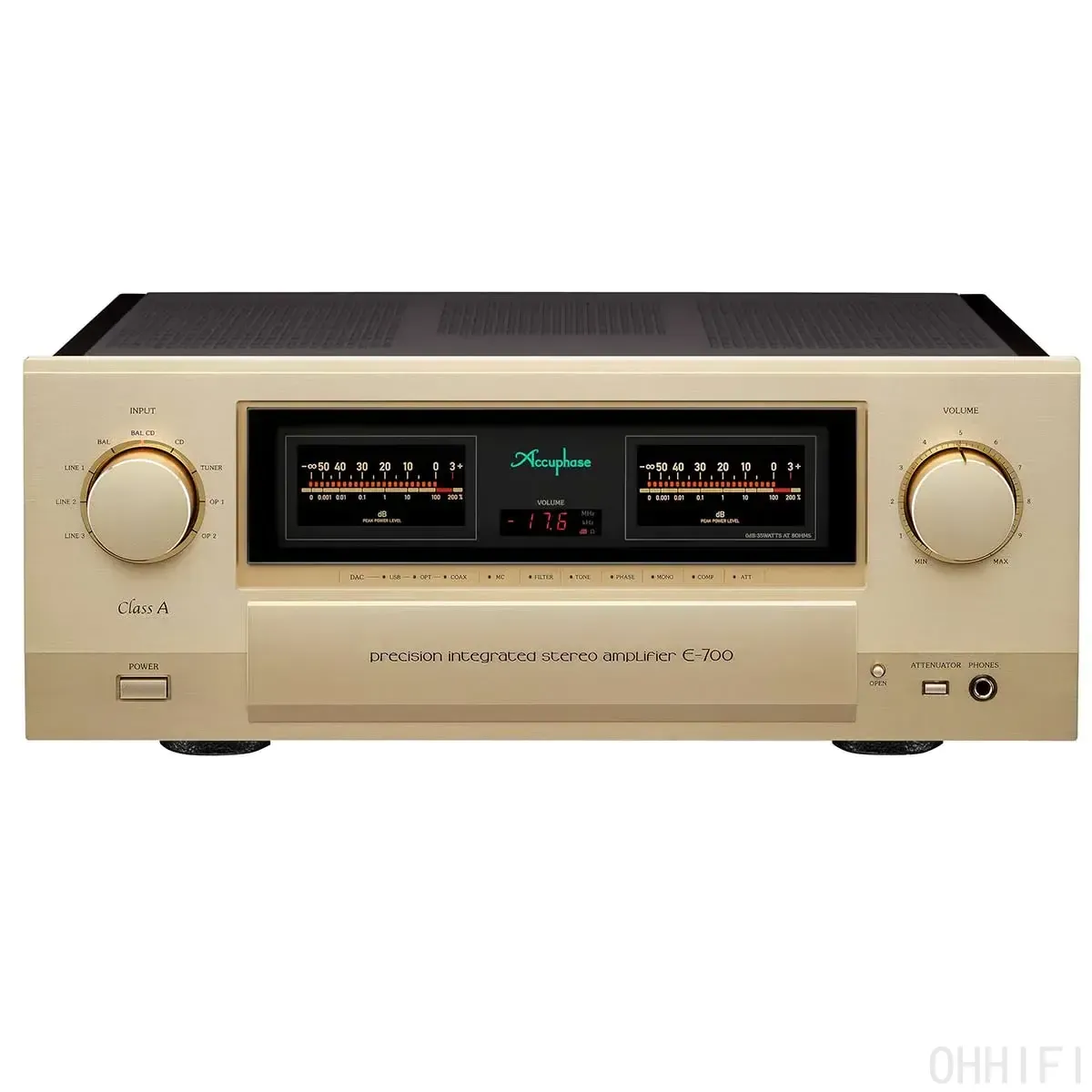
At $16,975 in the US (£10,500 in the UK), the E-700 sits between the Class AB E-4000 and the flagship E-800S. It's also the successor to the much-loved E-650, a model that spent years on everybody's short list. Power climbs from 30 to 35 watts per channel into 8 ohms, still Class A, with all the current-doubling behaviour Accuphase buyers expect. On paper that's a modest update. In practice there's more under the lid than the spec sheet suggests.
Quick Specs
| Spec | E-700 |
|---|---|
| Topology | Pure Class A, MOSFET push-pull (4-fold parallel) |
| Power (8 / 4 / 2 / 1 Ω) | 35 / 70 / 140 / 160 W |
| Damping factor | 1,000 |
| Volume control | Balanced AAVA with ANCC, 65,000+ steps |
| Inputs | 5× RCA, 2× XLR, tape loop, pre-in (RCA + XLR) |
| Outputs | Pre-out (RCA + XLR), 2 pairs speaker posts |
| Optional boards | DAC-60 (digital), AD-60 (phono) |
| Idle power draw | ~178 W |
| Dimensions | 465 × 191 × 428 mm |
| Weight | 24.9 kg (55 lb) |
| Price | $16,975 / £10,500 |
Design & Build
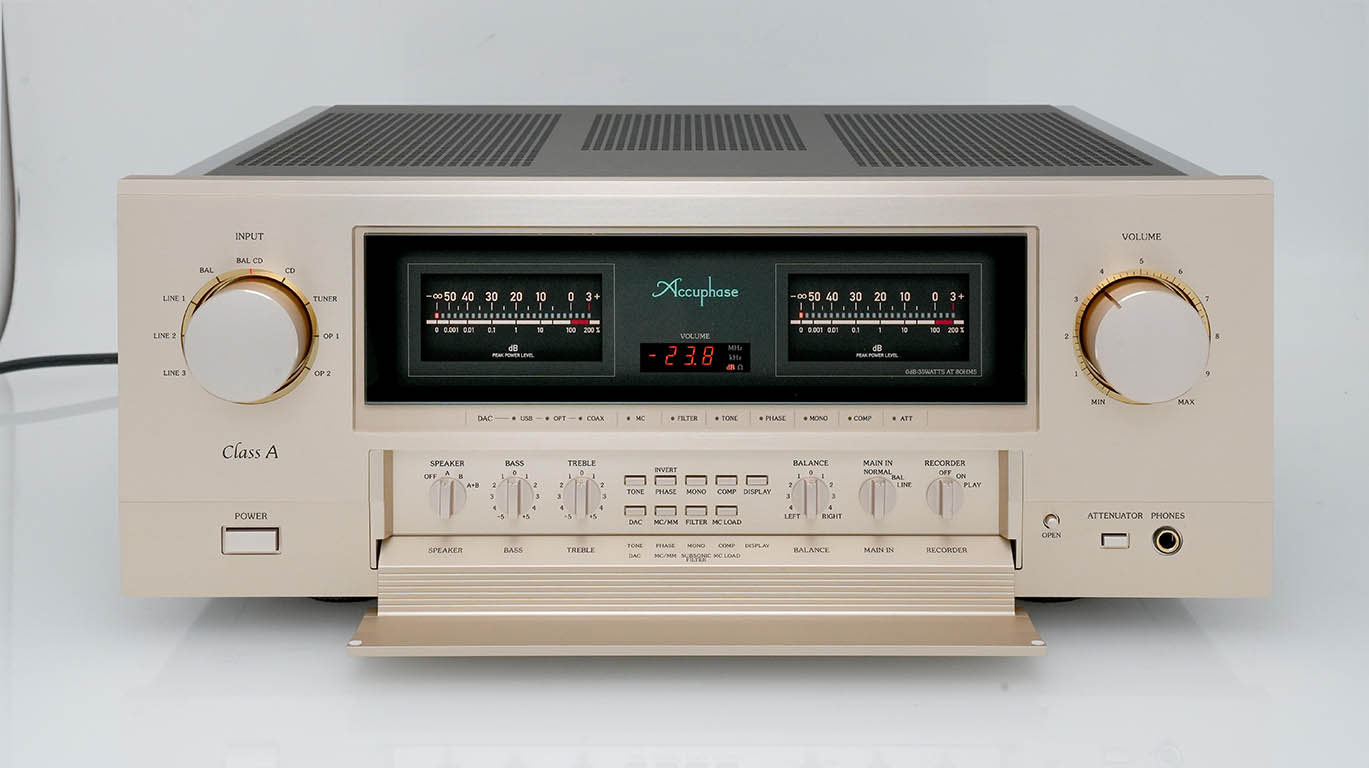
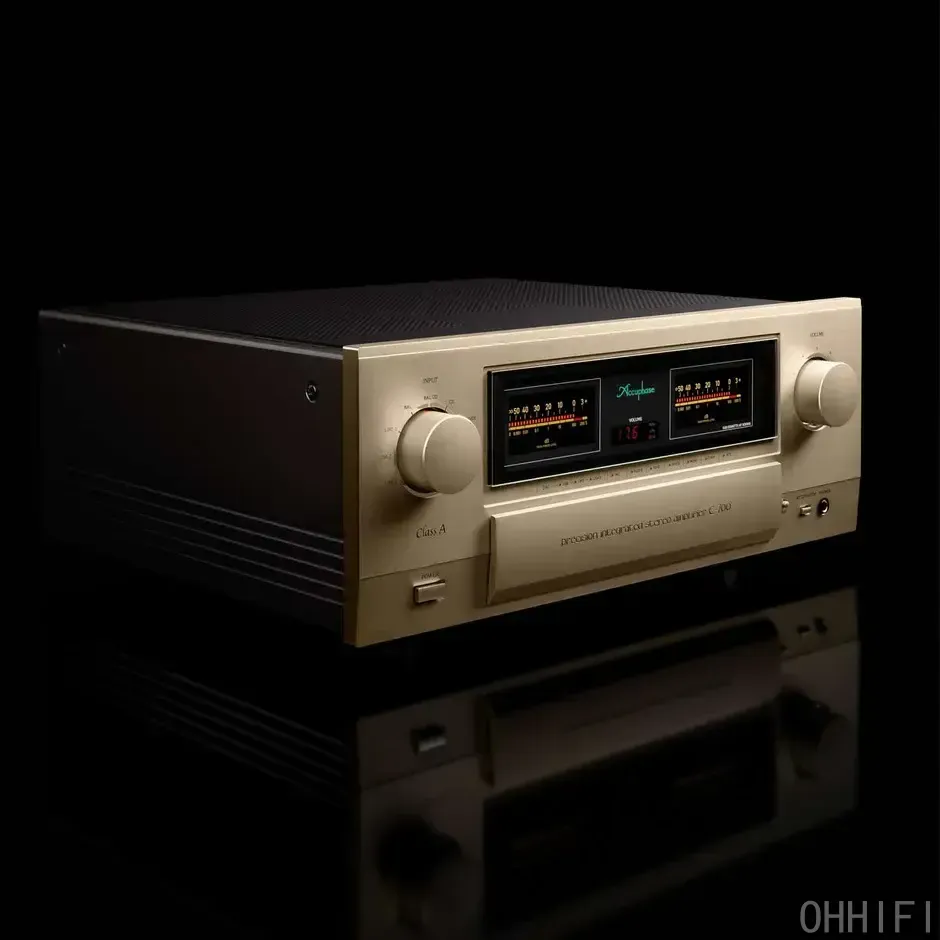
Accuphase has been soldering together the same visual language since I was playing cassette tapes in a Honda Civic. The champagne-gold faceplate, the symmetrical dial layout, the VU meters with their slightly reluctant needle throw — all of it looks as if it's been pulled out of 1984 and lightly modernised. It's an acquired taste. Luxman wears similar vintage charm; Accuphase takes it further and does not apologise.
What the photos don't convey is how well the thing is put together. The chassis doesn't flex when you grip it. The top panel doesn't ring when you tap it. The main volume encoder turns with a weighted, damped feel that tells your fingers this was engineered rather than shopped from a parts catalogue. Drop the hinged flap under the meters and a second control bay appears — speaker A/B, balance, tone, subsonic filter, phono load, 20 dB attenuator — all mechanical, all feeling like they'll outlive the warranty by several decades.
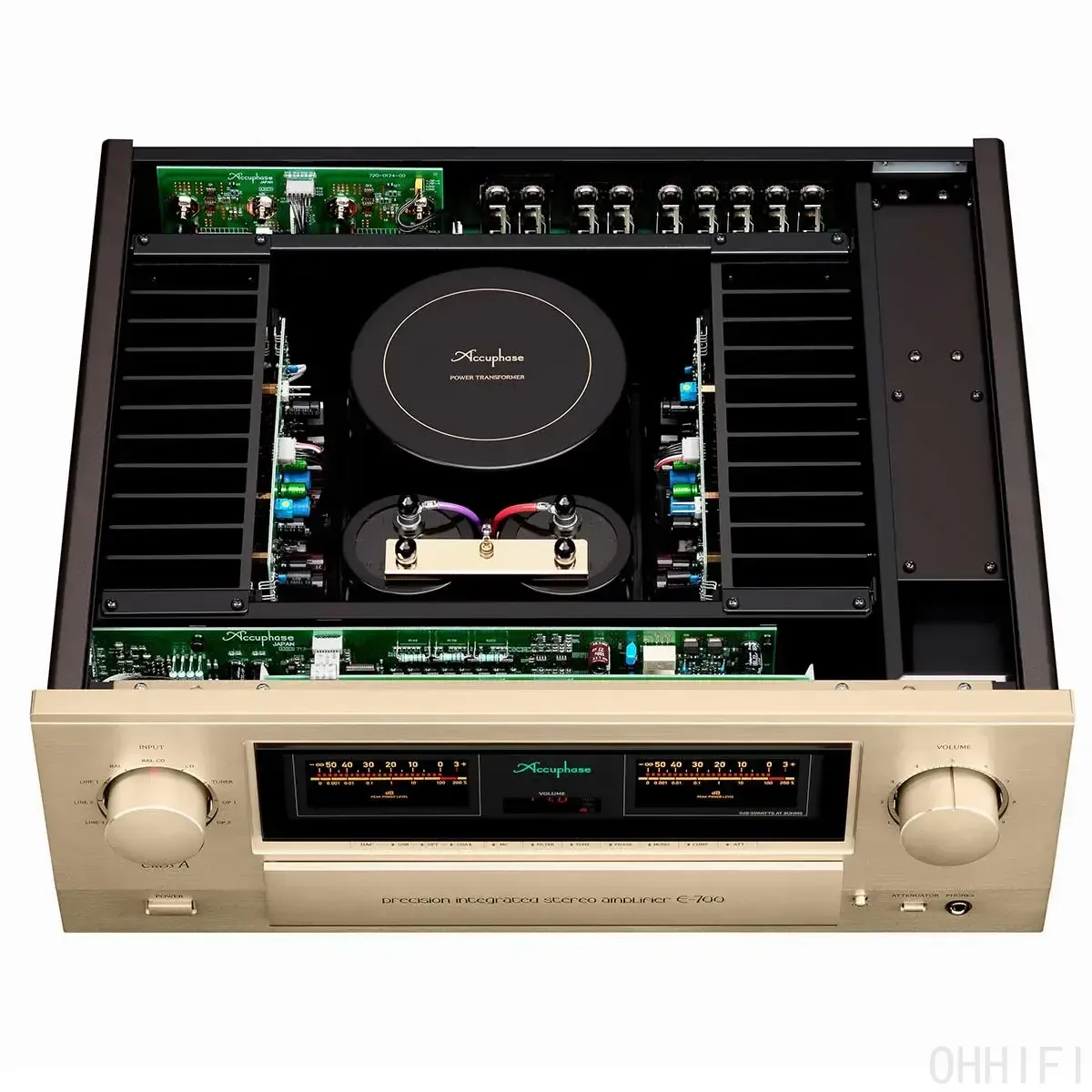
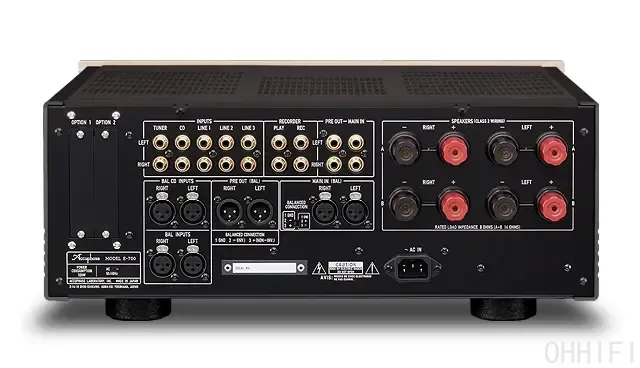
The rear panel is similarly dense: five RCA inputs, two balanced pairs, pre-out and power-in, tape loop, two sets of speaker binding posts. You can bi-wire, bi-amp, run it as pre or power only, slot in a DAC or phono card if you want. It's a proper, old-school integrated in the way Marantz and Luxman used to understand the term — a hub, not a black box.
Worth flagging for anyone who cares about electricity bills or room temperature: this amp pulls roughly 178 W from the wall at idle, because Class A output devices are biased on whether music is playing or not. In a small room in summer, you'll notice. In a Canadian basement in February, you'll appreciate it.
The Listening Experience
Before getting into the frequency extremes, one point worth making up front: the E-700 does not sound like the lazy caricature of "Class A." It isn't syrupy. It isn't soft. It isn't a tube amp in solid-state clothing. Anyone expecting velvet-blanket warmth is going to be mildly disappointed for the first ten minutes and then quietly converted.
Bass
The low end is the first thing that separates the E-700 from most of what you can buy under ten grand. Paul Chambers' upright on Miles Davis's Kind of Blue has that dry, woody "thump-and-sustain" profile that reveals damping control the moment you start paying attention — and the Accuphase gets it. Each pizzicato has a defined leading edge, a body, and a decay that stops when the recording says it stops rather than hanging around politely. A damping factor of 1,000 (manufacturer-quoted, and I haven't found a rigorous independent measurement of it) tracks with what the ears report: the amp has an iron grip on a woofer.
Swap to something with deeper, more modern low end — Massive Attack's "Teardrop", or Flying Lotus's denser work — and the 35 watts never felt like a limitation at sensible levels in a normally-sized room. The Class A current doubling into lower impedances does real work here. This is not a 35-watter in the way a single-ended triode is a 15-watter.
Midrange
This is where Accuphase's reputation lives and dies, and the E-700 doesn't embarrass itself. Chet Baker's phrasing on Chet Baker Sings — the breath before the note, the way he lets a syllable trail off — comes through with the spacing intact. What I like most is that the voice is in the room, neither pushed forward into your lap nor recessed into the back wall. It's sat where the microphones placed it.
Cellos and violins behave themselves in a similar way. The Takács Quartet playing Beethoven's Op. 132 has both the astringency of the bow on string and the body of the instrument's wood, and the E-700 doesn't trade one for the other. If I have a nit to pick, it's that the amp can feel slightly composed — there's a grown-up refinement here that some listeners read as "a touch polite." I don't think it is, but I can hear why someone moving off a Pass Labs INT-25 might say that out loud.
Treble
Cymbals are the treble test I still lean on hardest — the ride pattern on a Billy Higgins kit, say, or the brushes on anything from the Blue Note back catalogue. The E-700 keeps them metallic rather than hissy and gives each strike a sense of location on the kit. Mastering engineers who load the top octaves with air and reverb tails — Dire Straits' Brothers in Arms, Steely Dan's Gaucho — get rewarded with extension that never tips into glare.
Brightness-phobes will like this amp. People who want the forward, silver-edge presentation that some solid-state designs chase should look elsewhere. This is a refined top end, not a spotlight one.
Soundstage
The stage pulls slightly behind the speaker plane rather than pushing forward, which is consistent with the rest of the voicing. Width is appropriate to the recording. Depth is genuinely good — orchestral recordings layer front-to-back in a way that lesser amps flatten into a wall of sound. Image focus is precise without being etched. A violin in the left third of the stage has a consistent size and location note-to-note; it doesn't wander.
If you want a demonstration of the E-700's spatial chops, put on something live and well-captured — Keith Jarrett's The Köln Concert, the Blue Coast recordings, anything from 2L in Norway. The room around the performance is audible. That's not something every integrated at this price does.
Test Setup
Evaluated through my main listening room chain — a mid-fi integrated normally driving my reference floorstanders was stepped aside for this review, with the E-700 fed from a solid-state DAC over balanced XLR, plus occasional runs off a belt-drive turntable through an external phono stage. Speaker cable and interconnects kept consistent throughout. The room is moderately treated, with first-reflection absorption and bass traps in the corners. No digital room correction in use.
I gave the amp a solid half-hour warm-up before any critical listening — Class A needs it, and anyone claiming otherwise hasn't lived with one.
A Note on Measurements
Accuphase's published figures — 35/70/140/160 W into descending impedance loads, damping factor of 1,000, 178 W idle draw, 65,000+ AAVA volume steps — are consistent with what's reasonable to expect from a four-fold parallel MOSFET output stage with a transformer and filter bank of this size. I haven't been able to find rigorous independent bench data for this specific model yet (no ASR review at the time of writing), so treat the brand spec at face value but don't quote it as gospel. What I can say from listening: the amp's low-impedance behaviour is clearly real, not marketing. It drives harder-to-drive speakers without the top end shrinking or the bass bloating.
The Competition
Integrated Class A at this price is a genuine three-way fight, with a couple of honourable mentions on the flanks.
| Rival | Approx. Price | Comparison | Verdict |
|---|---|---|---|
| Luxman L-595A SE | $9,995 | 30 W Class A; slightly warmer, more overtly "golden" midrange; lower damping factor; arguably more romantic on vocal jazz | Better if your speakers lean neutral/bright and you want tone-first presentation |
| Pass Labs INT-25 | ~$7,750 | 25 W Class A (single-ended output stage); more treble sparkle and air; smaller feature set (no tone controls, no balance, etc.) | Better if you have efficient speakers and prize transient snap over refinement |
| Gryphon Diablo 300 | ~$21,500 | 300 W Class AB with Class A bias; much more muscular, explicitly dynamic presentation | Better if you run demanding speakers and want drama over composure |
| Sugden Masterclass IA-4 | ~$8,500 | British pure Class A; warmer, woodier tone; less extended top and less grip | Better as a sentimental Class A purchase; not a technical match |
If forced to pick the E-700's closest aesthetic rival, it's the Luxman — same Japanese engineering culture, same price neighbourhood, similar build ethos, slightly different voicing. Buy on dealer audition, not on forum wars. I've A/B'd variants of these camps over the years and the honest answer is that speaker pairing will drive the decision more than any inherent winner.
The Verdict
Score: 9/10
The Accuphase E-700 is not the most exciting integrated amplifier you can buy for sixteen grand, and I suspect Accuphase would take that as a compliment. It's a long-haul tool. It's engineered to a standard you can feel through your fingertips, voiced with the kind of composure that reveals itself over months rather than minutes, and built to drive nearly anything with a pair of binding posts. The bass control, in particular, makes it a smarter match for harder-to-drive speakers than the modest 35-watt sticker suggests.
Deductions: the price is stiff, the idle heat and power draw are real, and there's no digital or phono on board unless you buy the modules. If you want features-per-dollar, you're shopping in the wrong aisle.
Pros
- Grown-up, fatigue-free voicing with real resolution — not lazy "warm Class A"
- Bass control genuinely reflects the 1,000 damping factor figure
- Build quality and long-term reliability reputation are among the best in the industry
- Drives difficult loads (down to 1 Ω) in a way 35 W solid-state competitors can't match
- Fully analogue signal path with meaningful feature set (tone, balance, tape loop, pre/power split)
Cons
- Eye-watering price for what is, at core, 35 W
- No DAC or phono as standard; modules cost extra
- 178 W idle power draw and meaningful heat output
- Slightly reserved presentation won't suit listeners who want a front-row, high-contrast sound
- Visual styling is love-it-or-leave-it
Who Should Buy the Accuphase E-700
This is for you if you've already cycled through Class AB integrateds, want a genuinely long-term reference amplifier, own speakers that reward current rather than raw wattage, and value composure and low-level resolution over surface-level excitement. It's also the right pick if you run an all-analogue or vinyl-first system and don't want a digital board anywhere near your signal path.
Look elsewhere if you need streaming or DAC features built in, you live somewhere hot without air conditioning, you run efficient speakers that don't need the low-impedance current delivery (a Pass INT-25 will do the job for less), or you want an amp that announces itself on first listen. The E-700 is a slow-burn product, and slow-burn products aren't for everyone.


Comments