
Kerr Acoustic K400 First Look: £4,695 Studio DNA Stand-Mount

Lead
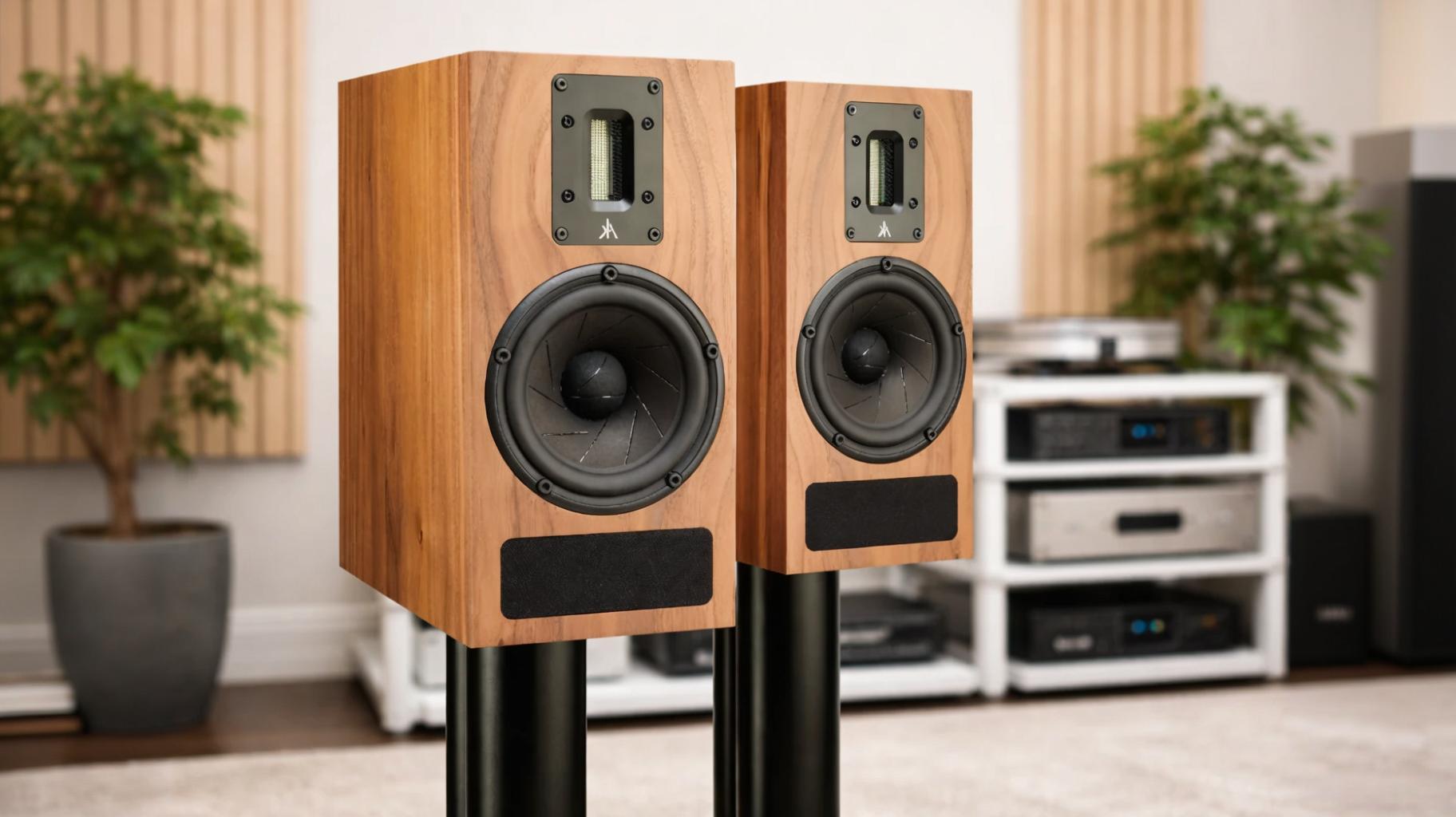
Kerr Acoustic is not a household name outside the UK, and that's part of why the K400 is worth paying attention to. Unveiled at Bristol in February and now officially lined up for pre-order on 8th May 2026, the K400 is the smallest, most living-room-friendly speaker the Cambridge outfit has ever built — £4,695 per pair in real-wood veneer, scaling up to £5,345 in high-gloss veneer. It's a compact two-way stand-mount aimed at people who can't put a pair of K300s in the room but still want the house recipe: Scanspeak cone, ribbon tweeter, Baltic birch cabinet, proprietary transmission-line loading.
What's New
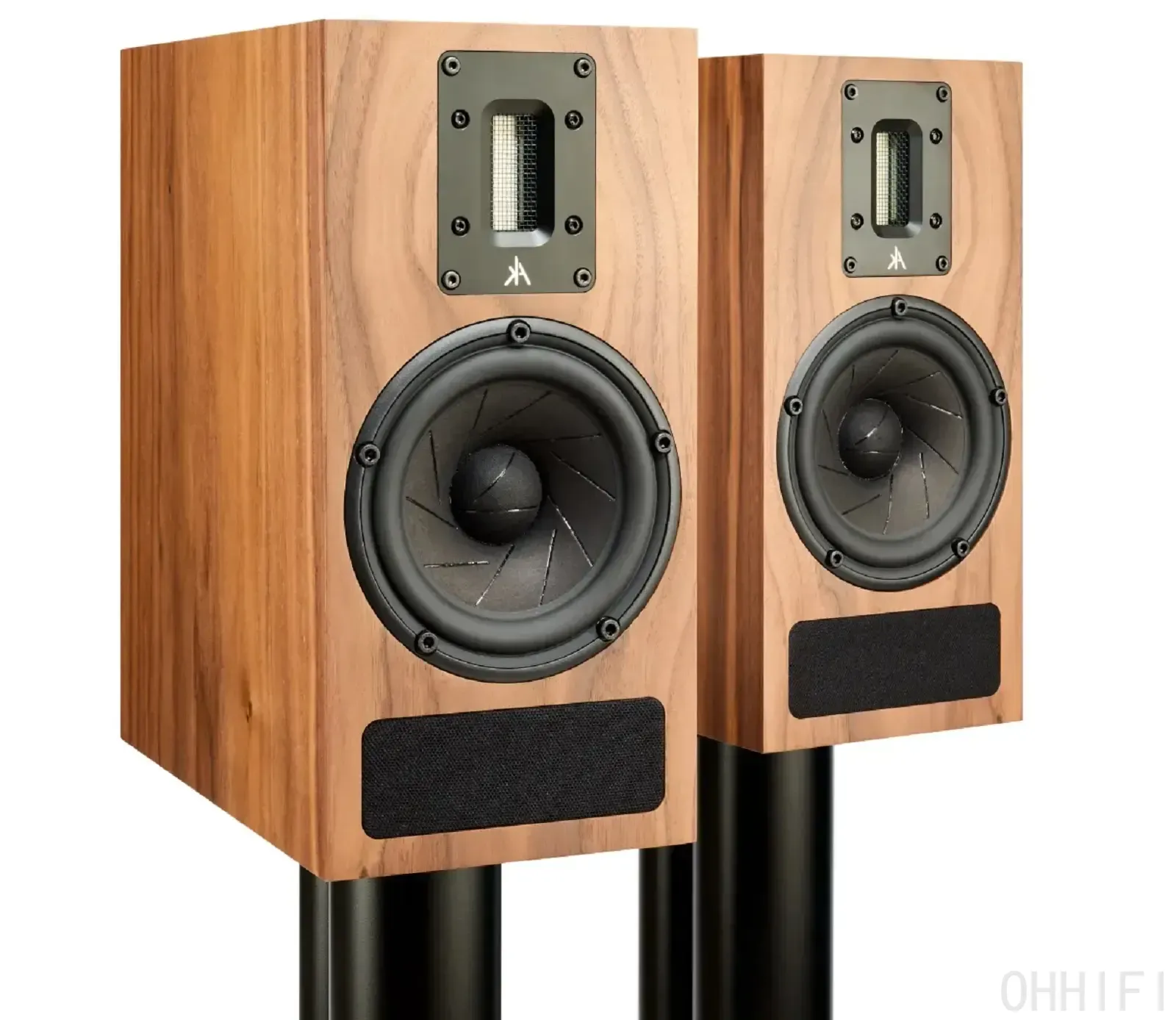
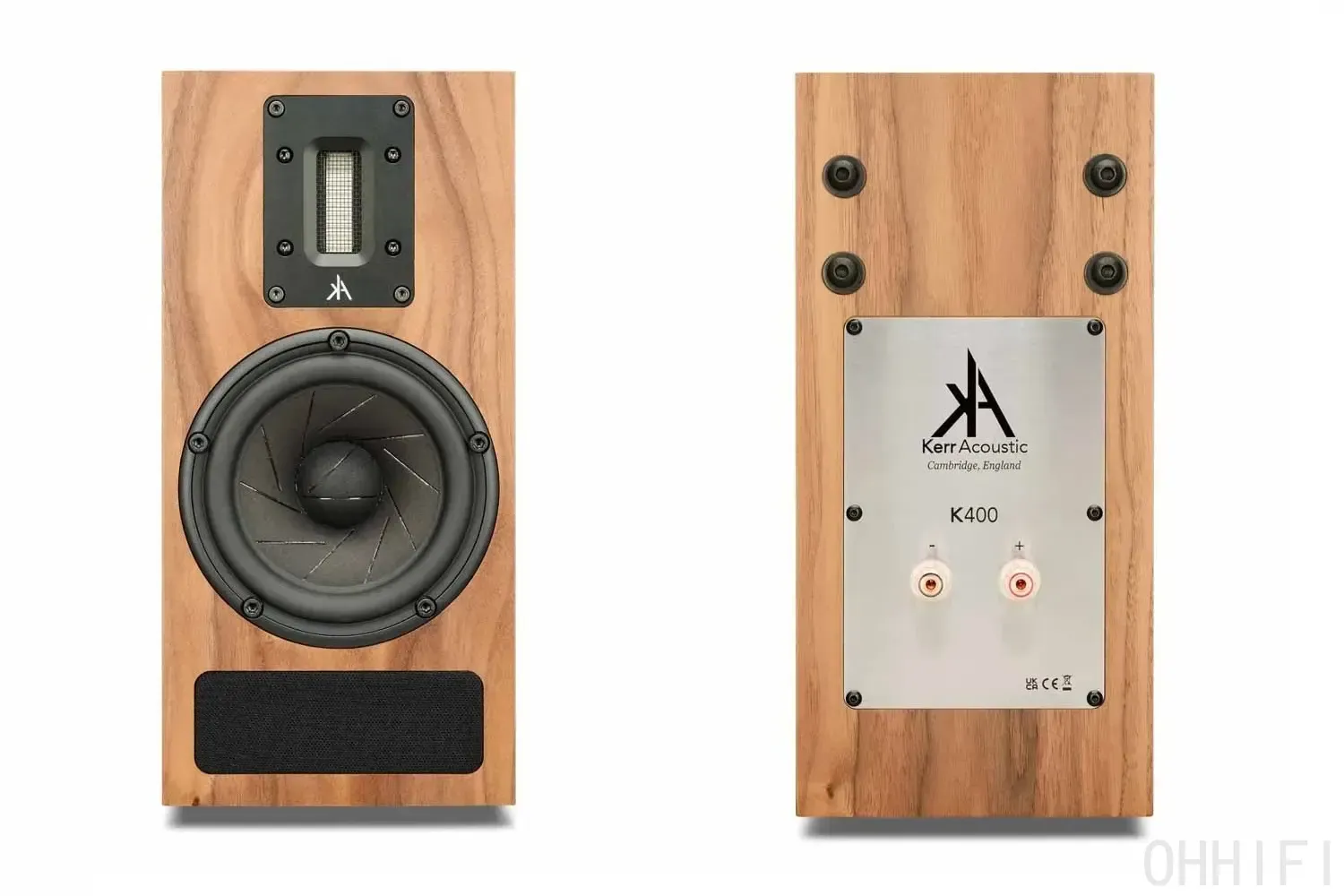
The headline numbers: 341 x 164 x 310mm, 7.5kg per cabinet, a 150mm Scanspeak mid-bass paired with a 45mm true ribbon tweeter, handed over at a 1.95 kHz second-order (12dB/octave) crossover. Claimed frequency response is 39 Hz to 45 kHz, sensitivity 88dB/2.83V/1m, nominal impedance 6 ohms. The enclosure is 24mm Baltic birch plywood for the baffle, 18mm for the sides, top and bottom, and 12mm for the internal bracing — no MDF anywhere. Crossover parts are above what you'd typically expect at this price: Clarity Cap film capacitors, hand-wound air-core copper inductors, carbon film resistors.
The genuinely new thing isn't the driver line-up — it's the four M8 mounting points on the rear panel. This is the first Kerr that can be bolted to a wall or ceiling, which is a clear wink toward Atmos and immersive installations. You can read this as a pro-monitor company remembering its roots, or as an acknowledgement that multichannel hi-fi is where a surprising amount of money is actually being spent now. Both are probably true.
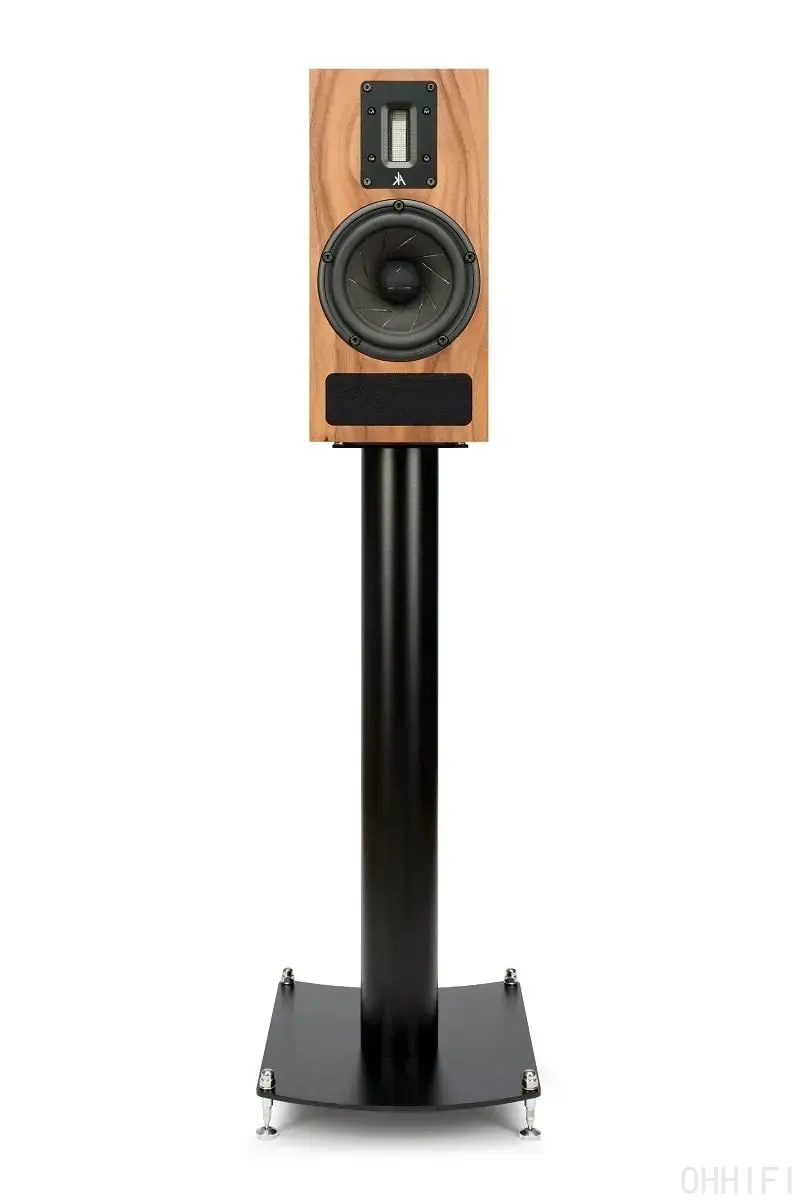
Finishes are real wood veneer, satin lacquer, high-gloss lacquer, or high-gloss veneer in any RAL colour, all with magnetic grilles included. Dedicated stands are £595 per pair.
Context: Where the K400 Sits
Kerr Acoustic was founded in 2017 by Jes Kerr, a drummer-turned-speaker-engineer who started out making passive studio monitors and only relatively recently reoriented the business toward domestic hi-fi. The K300 Mk3 has been the halo product for home reviewers — five stars at What Hi-Fi?, widely admired for its transmission-line bass and ribbon tweeter — while the K100 Mk2 floorstander sits above it.
The K400 now slots in at the bottom of the range and the positioning is obvious: K300 buyers who don't have the floor space, plus pro and installation customers who need a proper-sounding compact monitor with flexible mounting. Nothing else in the Kerr catalogue does that.
Compared to Predecessors and Rivals
Against the K300 Mk3, the K400 gives up meaningful bass extension on paper — 39 Hz versus 33 Hz — and uses the smaller 150mm Scanspeak cone rather than the 180mm Revelator. The cabinet is also noticeably smaller. You're paying roughly the same money for less bass reach, with the trade-off being placement flexibility and a form factor that actually fits normal rooms.
Against external competition at £4,500–£5,500, the K400 walks into a crowded room:
| Rival | Approx. Price (pair) | Character | vs K400 (paper) |
|---|---|---|---|
| ATC SCM19 v2 | ~£4,200 | Pro-monitor DNA, soft dome | Similar accuracy brief; ATC is less bass-extended but proven |
| ProAc Response DB3 | ~£3,500–£4,000 | Warm, ribbon tweeter | Ribbon character territory, but smaller scale |
| Harbeth Super HL5 Plus XD | ~£5,500 | BBC-style warmth, thin-wall cabinet | Totally different philosophy — warmth vs accuracy |
| Dynaudio Heritage Special | ~£6,500 | Rich, dynamic, Esotar 2 tweeter | Pricier; more classical Dynaudio voicing |
| KEF Reference 1 Meta | ~£7,500 | Uni-Q coaxial, neutral | Pricier; coincident driver vs discrete ribbon approach |
The K400's differentiator is the true-ribbon tweeter — nobody else at this bracket runs a genuine ribbon (AMTs and soft domes dominate) — plus the transmission-line bass approach, which is rarer still at this size.
My Take — Forward Analysis Only
I haven't heard the K400. Nobody outside the Bristol demo room and a handful of dealers has. What follows is paper-and-priors analysis, not a listening impression.
On paper it's interesting. The Scanspeak-plus-ribbon combination has been the defining Kerr fingerprint since the original K300, and independent reviewers who've spent serious time with that platform have come away saying broadly the same things: the bass is tight rather than fat, the midrange is honest, and the top end is fast — sometimes a little too fast depending on the room and the amp driving it. Shrinking the cabinet and dropping to a 150mm mid-bass shouldn't disrupt that tonal recipe meaningfully. What I'd be cautious about is the 39 Hz spec in a typical room. Transmission-line loading does buy extension for the enclosure size, but a 150mm driver in a 341mm-tall box is still a 150mm driver in a small box. I'd expect useful output to maybe 45–50 Hz in most rooms, with the line contribution taking it lower than a reflex peer of equivalent volume rather than rewriting physics.
What concerns me is the pricing gradient. £4,695 for a small two-way at launch puts the K400 against some of the most road-tested stand-mounts in Britain — speakers with a decade of reviewer familiarity and proper dealer networks. Kerr has the engineering story to justify the ticket, but the K300 Mk3 exists at similar money with more bass extension and a longer track record. The K400 has to sell on room-fit and installation flexibility, not purely on sound.
What I'll be watching when independent reviews land: how much bass actually makes it into a typical room below 50 Hz; whether the ribbon is voiced more evenly than the original K300's sometimes-hot top end; and how the speaker behaves when bolted to a wall versus sat on stands, which is the whole point of the M8 mounts and also where most small speakers fall apart.
Until real measurements and proper in-room listening sessions exist, all of the above is theoretical. Treat it that way.
Who Is This For?
If you have a smallish room (under ~20m²), a clean amp — ideally something with a bit of body to balance the ribbon — and you've been eyeing the K300 Mk3 but don't have the floor space, put the K400 on your shortlist. If you're building an Atmos or immersive system and actually care about the height and surround channels rather than treating them as decoration, the M8 mounts and the pro-monitor lineage make it one of the few genuinely credible compact options here.
If you want a big, generous, warm presentation or you're looking to replace floorstanders, this probably isn't the right speaker. And in either case: wait for independent reviews and measurements before pre-ordering. They should land over the next two to three months, and I'll revisit at that point.



Comments