
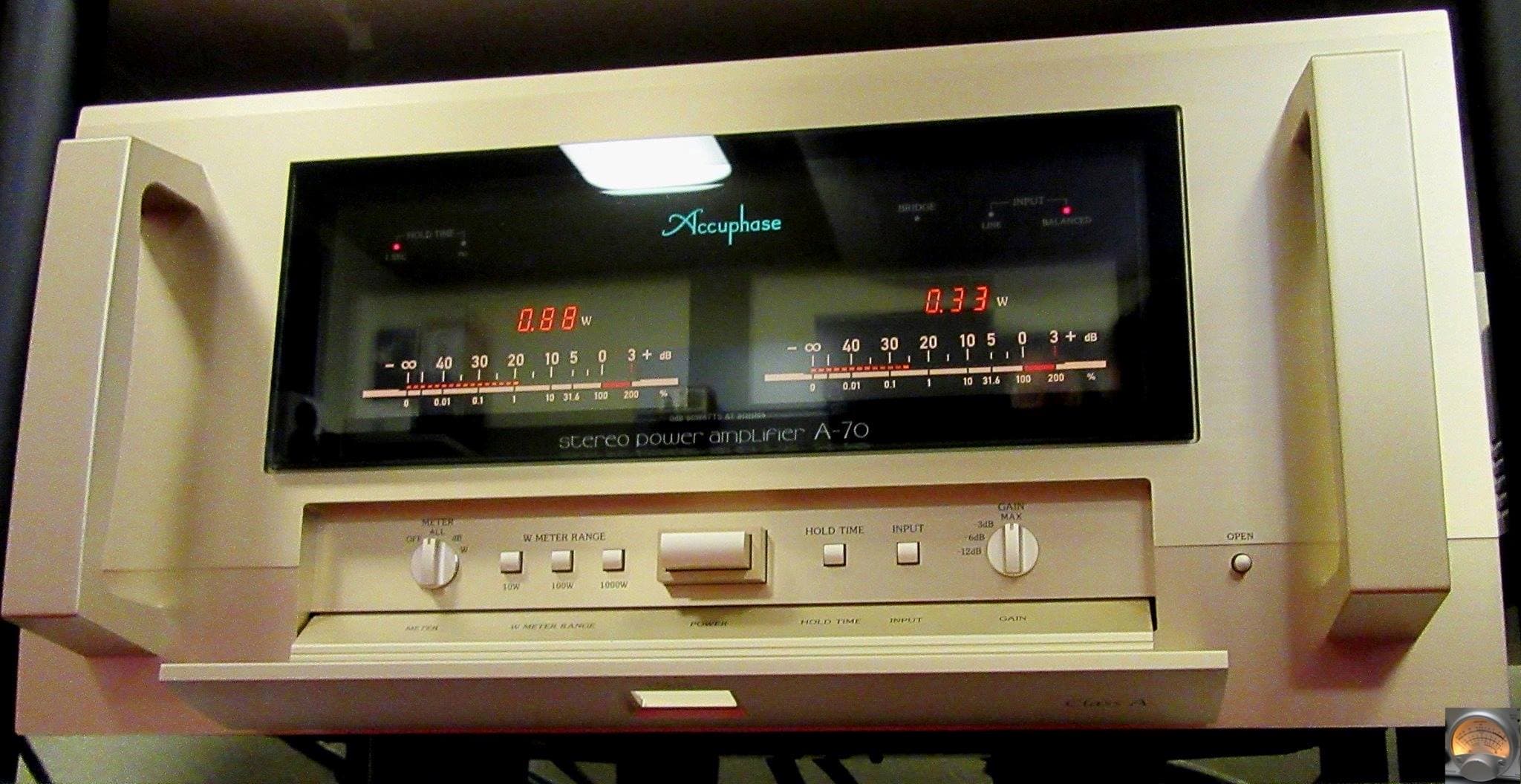

Accuphase A-70: 60 Watts of Pure Class A Power
On paper, 60 watts per channel looks modest for a flagship amplifier. The detail that changes the picture is that the Accuphase A-70 delivers all of it in pure Class A. This review looks at how the company's flagship stereo Class A power amplifier performs in practice.
Accuphase and the value of continuity
Building a high-end system is usually a long process of trial and error. Listeners swap components, compare specifications, and chase the sense that a system is finally reproducing more of the music. Against the audio industry's constant churn of new technologies and trends, Accuphase has taken a noticeably steadier path.
For around half a century, the Japanese manufacturer has built its reputation on continuity rather than reinvention, and it is often described as one of the last makers of traditional, high-end Japanese audio. The brand carries a certain luxury status, but it is also widely respected for its engineering and for a service policy that keeps older products supported for many years.
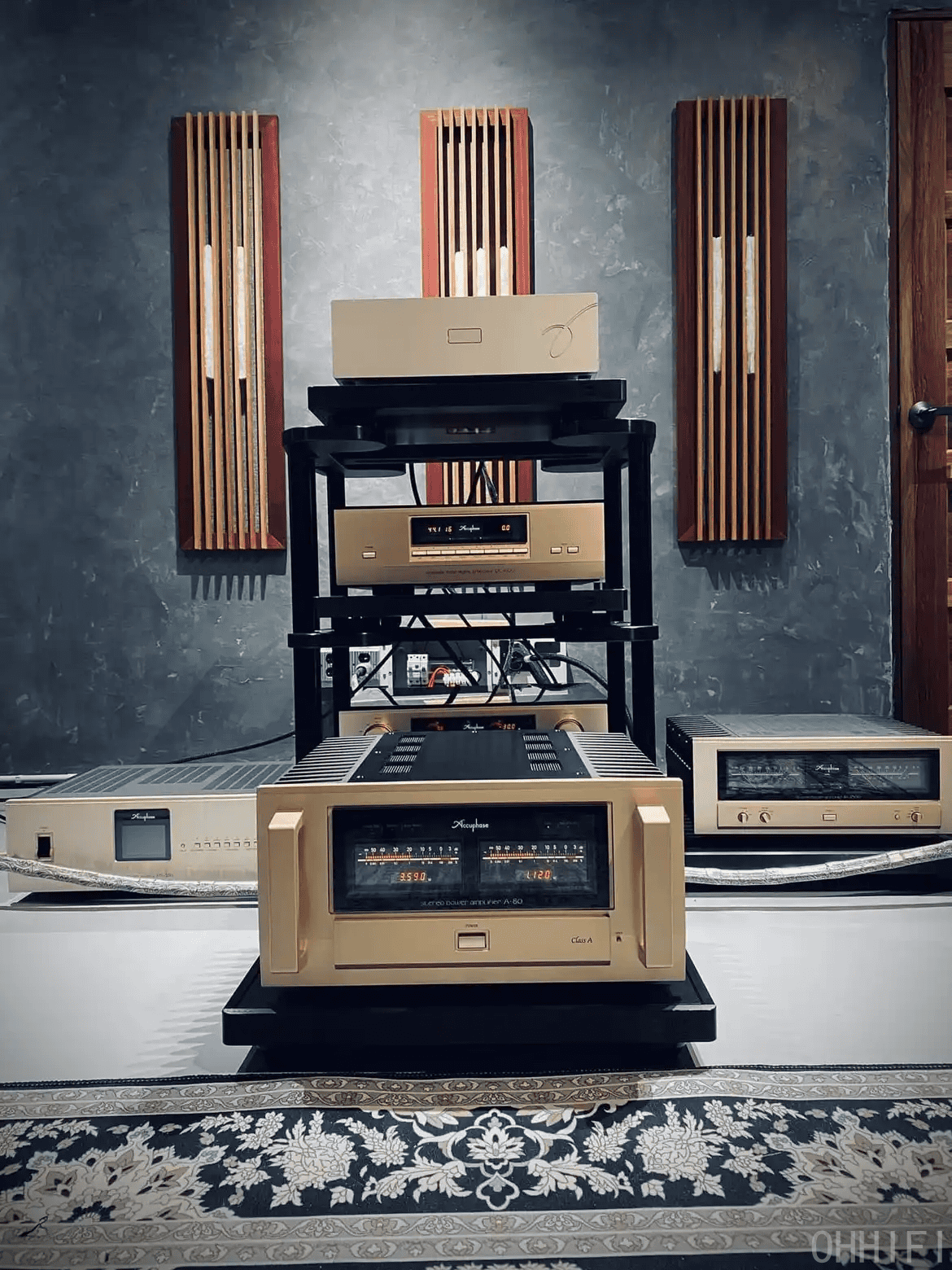
The A-70 reflects that philosophy. When it launched, it was Accuphase's flagship stereo Class A power amplifier, developed directly from the more expensive A-200 monoblocks. Accuphase's own technical documentation describes the A-70 as essentially a stereo version of the A-200.
The result is a component intended to last. With its champagne-gold front panel, heavy-duty construction, and the manufacturer's commitment to long-term servicing, it is the kind of amplifier owners tend to keep for decades — an approach that competitors such as McIntosh also follow.
Engineering and build
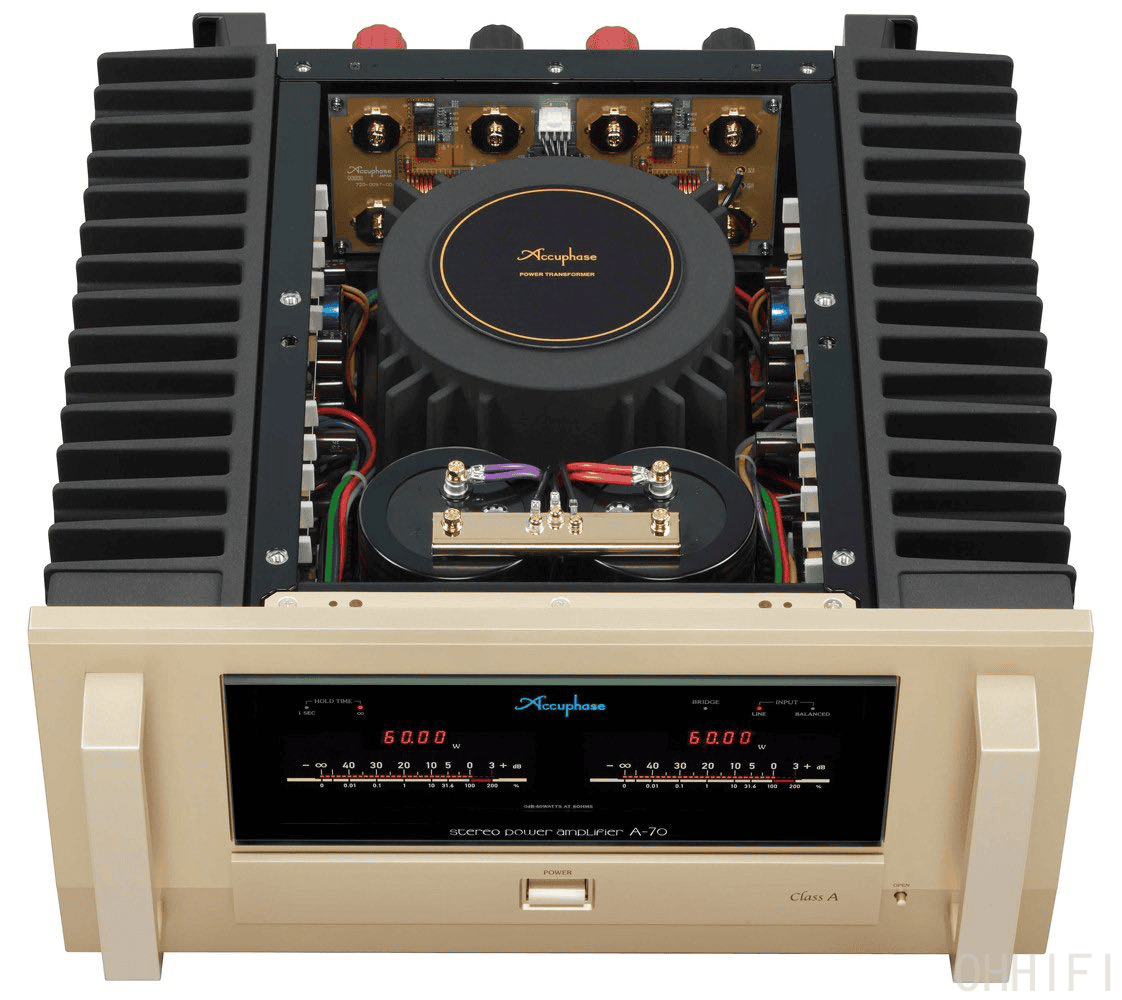
The A-70 is a substantial piece of equipment, weighing 44.3 kg (97.7 lbs). Reviewers, including Positive Feedback, have consistently praised its fit and finish. A reinforced chassis and a non-resonant aluminium housing provide a stable, low-vibration platform for the electronics.
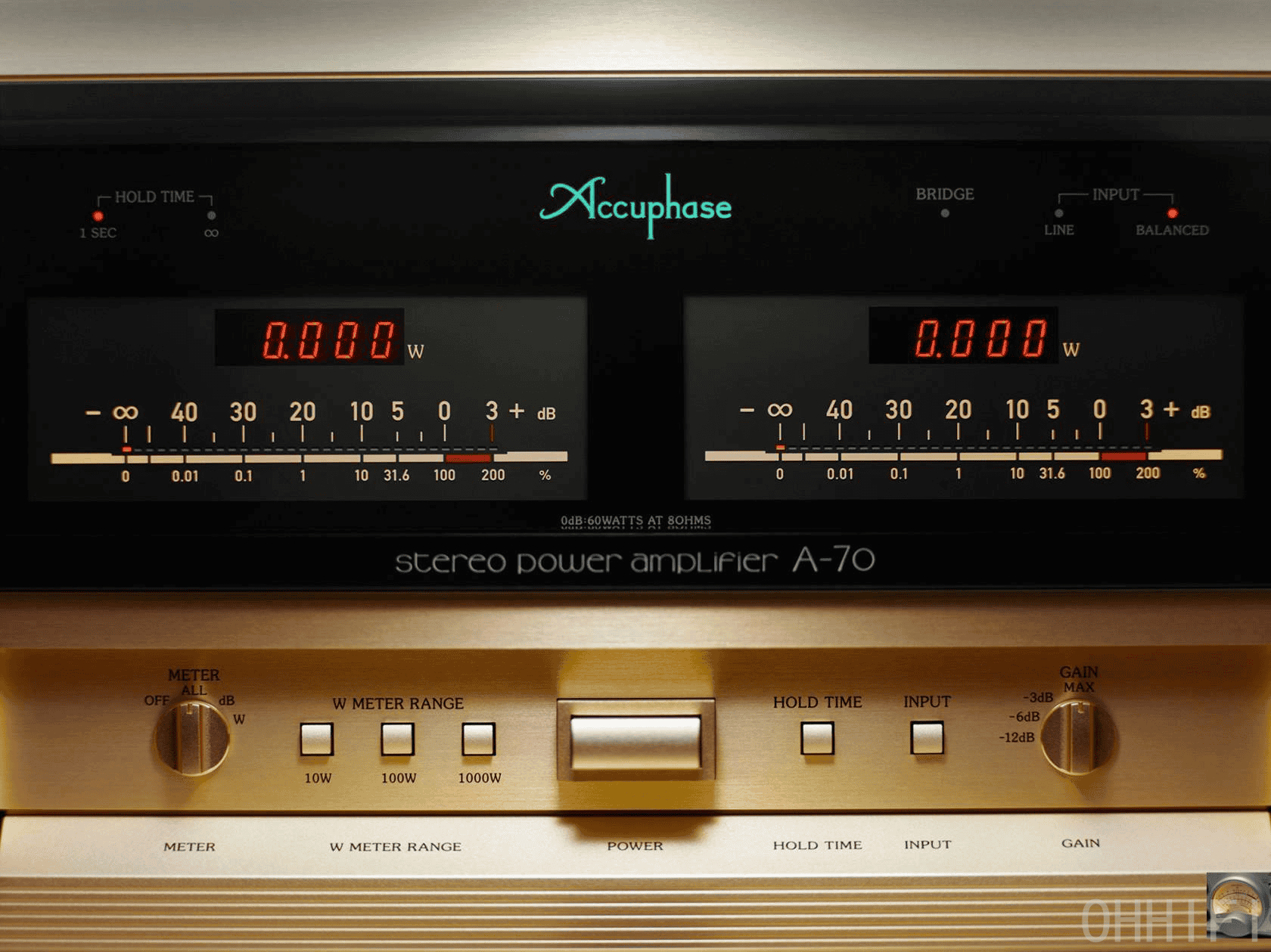
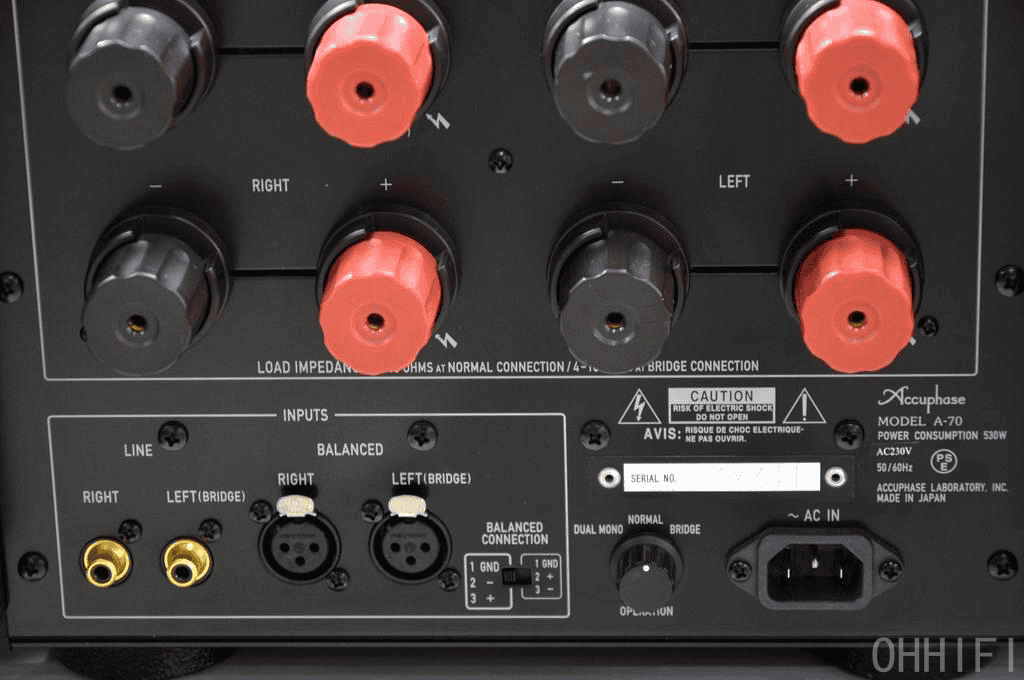
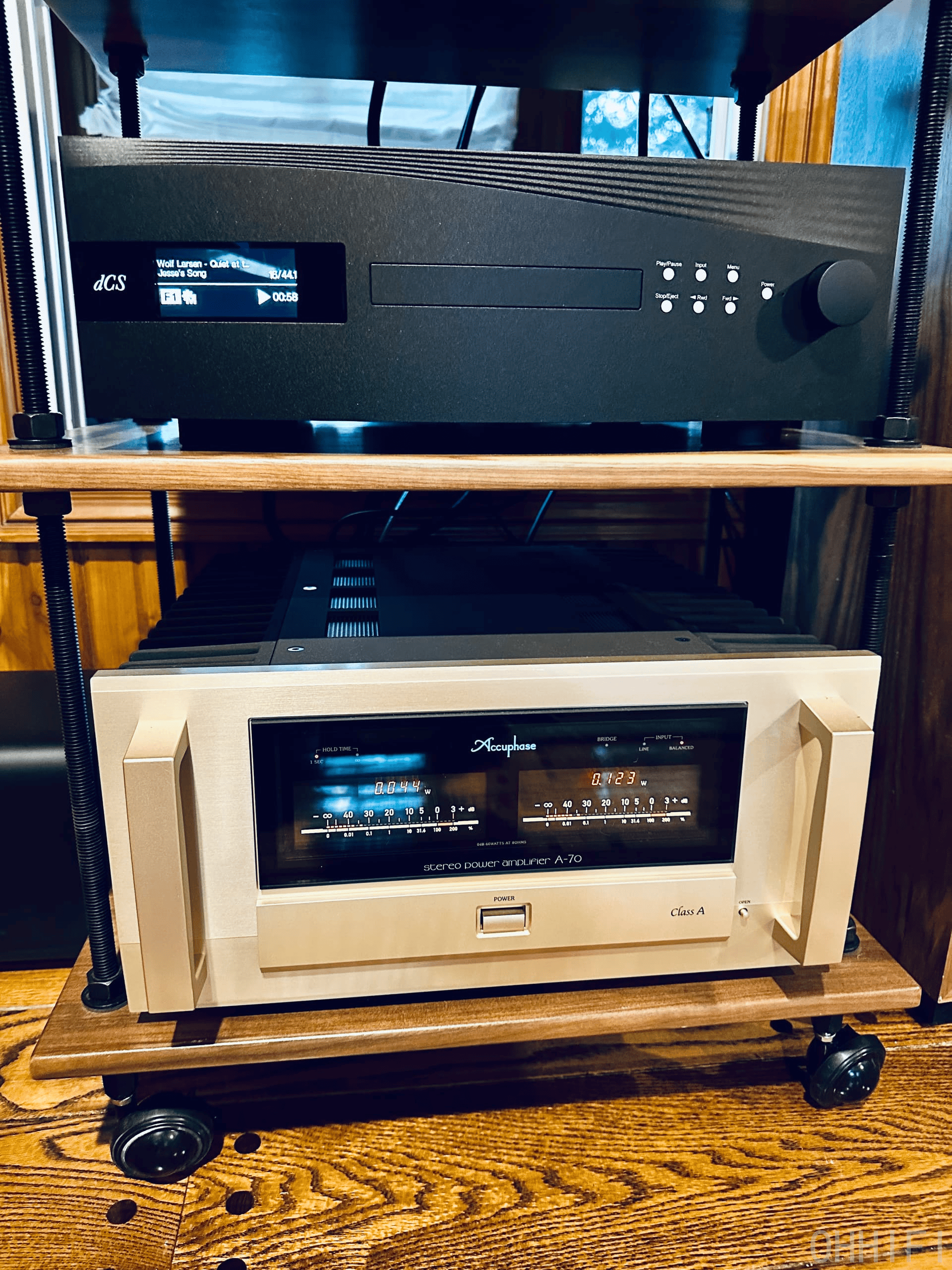
The front panel offers two selectable meter displays: a 32-point LED bar graph and digital power meters. The digital meters show true output power in real time and are unaffected by speaker impedance. The design priorities throughout are straightforward — deliver stable power with very low noise.
Power supply and output stage
The A-70's output capability rests on a large power supply. It uses a high-efficiency toroidal transformer big enough to require its own heat-radiation fins, paired with two custom 82,000 µF filter capacitors. This supply feeds an output stage with a 10-parallel push-pull configuration of power MOS-FETs per channel, all operating in pure Class A.
The 60-watt rating is worth explaining, because it can be misleading. A Class AB amplifier at half the price might advertise 125 watts, but the A-70's behaviour into lower impedances tells a different story. It delivers 60 W into 8 Ω, 120 W into 4 Ω, 240 W into 2 Ω and 480 W into 1 Ω. This near-perfect doubling of power as impedance halves points to a power supply with large current reserves; Accuphase rates the peak output at 547 watts into 1 ohm. In practice, that allows the A-70 to drive demanding loads, such as Magico speakers, with ease.
Noise and damping
At launch, Accuphase described the A-70 as having the lowest noise of any of its stereo power amplifiers up to that point, with a signal-to-noise ratio of 127 dB (at -12 dB gain). Three design elements contribute to this:
- A fully balanced, discrete-component instrumentation amplifier at the input stage, intended to reject incoming noise.
- Accuphase's MCS+ (Multiple Circuit Summing) topology, which runs several identical amplification circuits in parallel so that random noise and distortion are averaged out and largely cancelled.
- A current-feedback design, which supports stable operation across a wide bandwidth.
The A-70 also has a guaranteed damping factor of 800 — double that of its predecessor, the A-65. A key reason is the removal of the mechanical output relay. Mechanical relays add contact resistance and moving parts that can wear out and limit an amplifier's control over the woofer. Accuphase replaced it with a contactless MOSFET switch, which lowers impedance while improving reliability and sound quality. This change is a significant factor behind the amplifier's sense of easy, confident control.
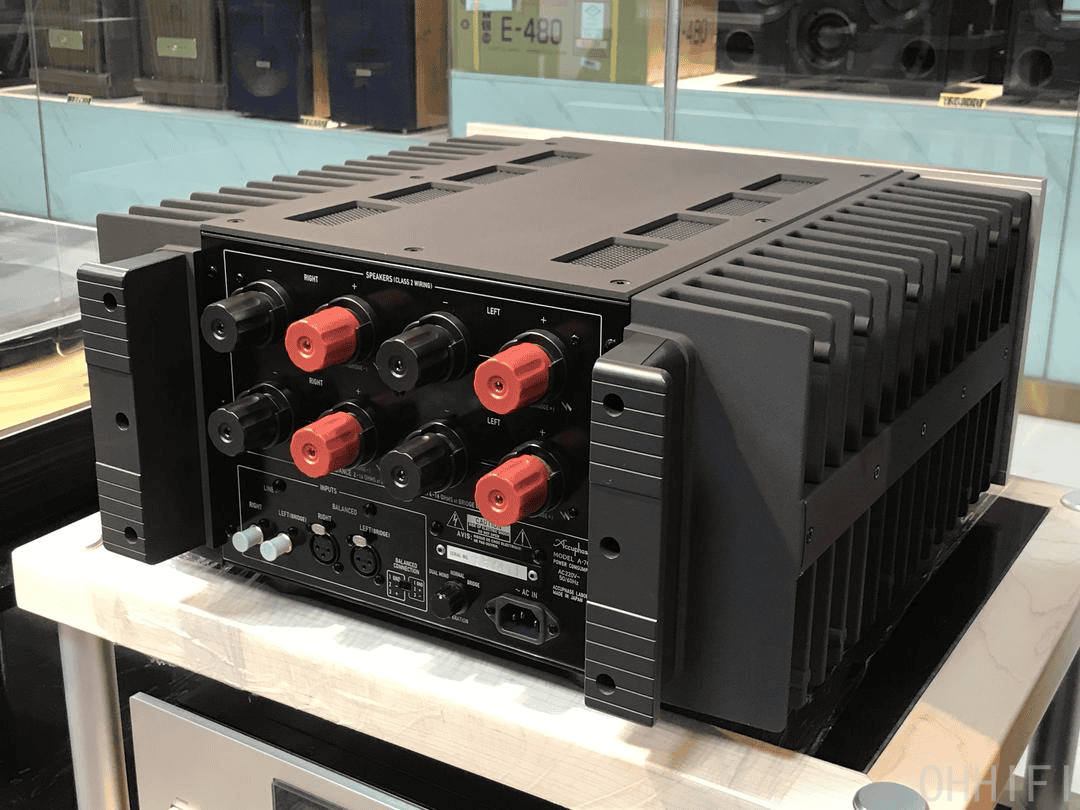
| Parameter | Specification |
|---|---|
| Power operation | Pure Class A |
| Output power (stereo) | 60 W/8 Ω, 120 W/4 Ω, 240 W/2 Ω, 480 W/1 Ω |
| Output power (bridged mono) | 240 W/8 Ω, 480 W/4 Ω, 960 W/2 Ω |
| Output stage | 10-parallel push-pull power MOS-FETs |
| Topology | MCS+ and current feedback |
| Damping factor | 800 (guaranteed) |
| S/N ratio (A-weighted) | 127 dB (at -12 dB gain); 121 dB (guaranteed, max gain) |
| Weight | 44.3 kg / 97.7 lbs |
Listening impressions
For these sessions the A-70 was used in a reference setup comparable to those in other professional reviews, paired with an Accuphase C-3850 preamplifier and driving demanding speakers including the Magico S3 and Dynaudio Confidence C4.
The A-70 does not announce itself with an obviously impressive first impression. Instead, it tends to integrate quietly into a system, drawing out detail that is already in the recording and presenting it in a relaxed, unforced way rather than imposing a strong character of its own.
Its main strength is the midrange. This is the quality most often associated with the "Accuphase sound": a slightly warm, well-balanced tone with good texture and nuance. It is not a dark or rolled-off presentation; reviewers more often describe it as rich and full-bodied while remaining detailed and relaxed. On vocal recordings, the result is natural and rarely strident.
This tonal character has a practical benefit. Many highly resolving solid-state amplifiers can make older recordings — particularly those from before 1990 — sound bright or hard, exposing every flaw in the production. The A-70's fuller midrange is more forgiving of such material, without the soft, slightly blurred quality of some older Class A designs. It does not hide detail so much as avoid emphasising harshness, which makes a wider range of recordings enjoyable to listen to. One reviewer described reaching for almost any album with confidence that it would sound good.
Soundstaging is spacious, with large, well-defined images and an easy sense of authority typical of a powerful amplifier. The bass benefits from that damping factor of 800: rather than the punchy, fast attack favoured by many Class AB designs, the A-70's low end is more about precision and weight, staying controlled and full-bodied even at lower volumes.
How the A-70 compares
vs. A-65 (the predecessor)
The A-70 was not a minor update to the A-65. It was a new design based on the A-200 monoblocks, with a reinforced chassis, roughly half the noise of the A-65 and double the damping factor (800 versus 400). The improvements were most noticeable in background silence and bass control.
vs. A-75 (the successor)
The A-75 was a more incremental refinement. It offered the same rated power with larger filter capacitors (100,000 µF versus 82,000 µF), about 11% lower noise and a damping factor of 1,000. In that sense the A-70 was the model that established this performance benchmark, which the A-75 then built on.
vs. A-200 (the monoblocks)
The A-70 inherited a great deal from the A-200. According to Positive Feedback, it does not fall far behind the monoblocks. The roughly twice-as-expensive A-200s offer better definition at the frequency extremes and sound more sophisticated overall, conveying more subtle detail, wider spacing and more air between instruments. Even so, the A-70 reaches a large share of that performance in a single, more affordable chassis.
vs. Accuphase Class AB models
For many buyers, the most important decision is between the Class A A-70 and a Class AB model such as the P-7300 — in some ways a "tubes versus solid-state" choice within a single brand.
- A-70 (Class A): the tonal character most associated with Accuphase — warm, detailed and relaxed, with strong midrange texture. It suits listeners who prioritise tone and timbre.
- P-series (Class AB): a more dynamic, punchy and fast presentation, with tighter bass control and sharper, more sharply outlined images.
Neither is objectively better. The P-series prioritises dynamics and grip, while the A-70 prioritises tonality and texture. The right choice depends on the listener's preferences and system.
Verdict
The Accuphase A-70 is not the amplifier for listeners who want the sharpest imaging or the most aggressive, punchy bass. What it offers instead is a warm, relaxed and well-balanced presentation that reflects deliberate engineering choices rather than any shortcoming.
It is the kind of component that encourages you to stop thinking about equipment and simply listen — including to older or imperfect recordings that less forgiving amplifiers can make hard work. Combined with Accuphase's build quality and long-term service support, the A-70 remains one of the most accomplished Class A stereo power amplifiers the company has produced, and a sensible end point for listeners who have spent years searching for the right amplifier.
Frequently asked questions
Is the Accuphase A-70 a Class A or Class AB amplifier?
The A-70 is a pure Class A stereo power amplifier, rated at 60 watts per channel into 8 ohms.
How much power does the Accuphase A-70 deliver?
It delivers 60 W into 8 Ω, 120 W into 4 Ω, 240 W into 2 Ω and 480 W into 1 Ω, with a rated peak output of 547 watts into 1 ohm.
What is the difference between the Accuphase A-70 and A-75?
The A-75 is an incremental update with the same rated power but larger 100,000 µF capacitors, about 11% lower noise and a damping factor of 1,000 (versus 800 on the A-70).
Should I choose the Class A A-70 or a Class AB Accuphase amplifier?
It depends on preference. The Class A A-70 favours warm tone and midrange texture, while Class AB models such as the P-7300 favour dynamics, grip and tighter bass.



Comments