
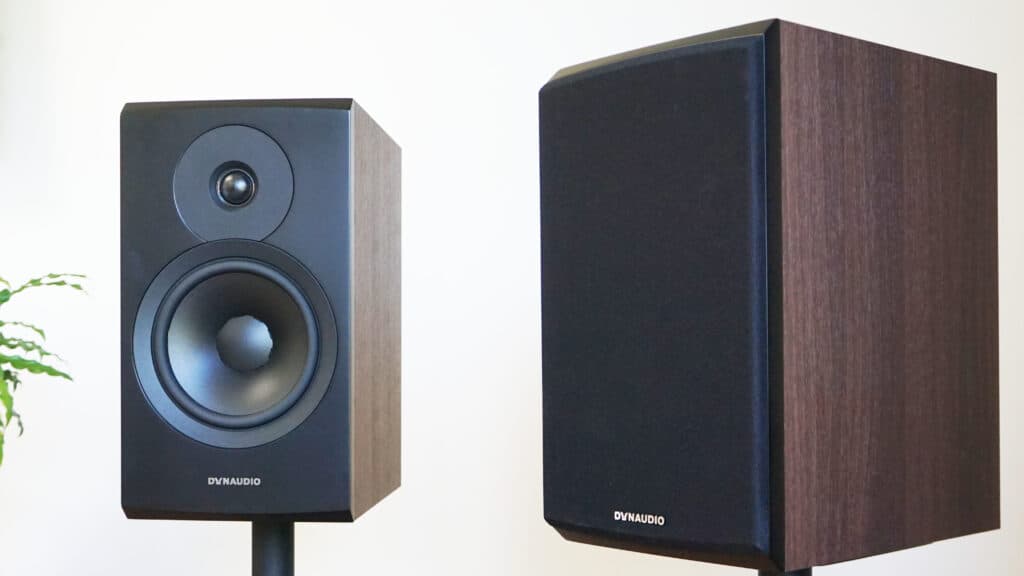
Dynaudio Emit 20 Review: The New Gatekeeper

The New Gatekeeper
The stand-mount speaker market, specifically the $1,000 to $1,500 "sweet spot," is arguably the single most competitive space in high-fidelity audio. This is the battleground where legacy brands, internet-direct darlings, and budget giants fight for the discerning audiophile's first serious purchase.
Into this fray steps the Dynaudio Emit 20.
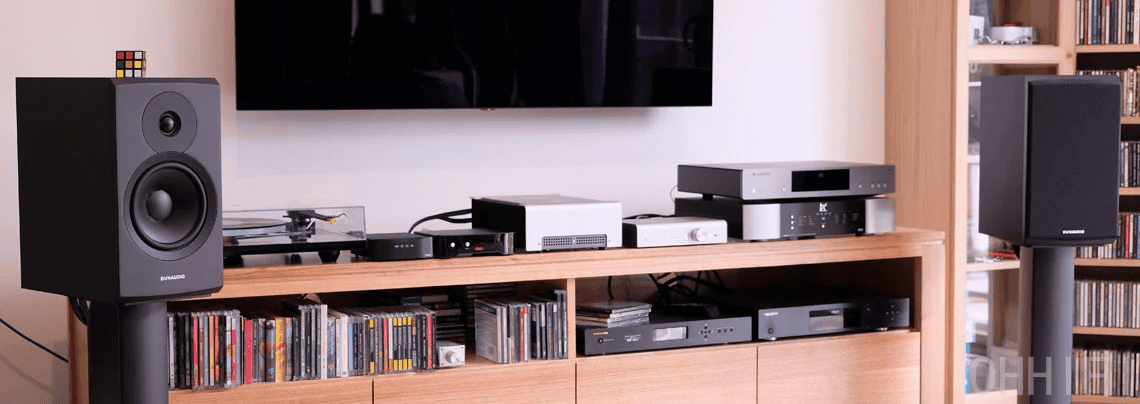
According to Dynaudio, "Hi-fi starts with Emit". This series is the invitation to their "entry-level club," and the Emit 20 is the largest stand-mount in the lineup. But this is not just another budget box. Dynaudio's strategy is clear: this is a "trickle-down" gambit. The Emit 20 is "crammed with technology" from the brand's far more expensive lines, including Evoke, Contour i, Confidence, and even the Core professional reference monitors.
This is a model-for-model replacement for the previous, and highly decorated, Emit M20—a What Hi-Fi? Award winner in its own right. But this new version is a different beast, developed with the aid of Dynaudio's massive "Jupiter" acoustic measurement facility in Denmark.
The central question, then, is a simple one. With a price tag sitting around $1,049 / £825 / €1,005, does the Emit 20 deliver on its high-end promise? Is it, as some claim, "the real deal"? Or does it, as others counter, just fall short of "the very best at this level"?
Let's dig in.
The Tech: More Evoke Than Emit?
A quick look at the spec sheet reveals that the "trickle-down" promise is more than marketing. The Emit 20’s core components are lifted directly from its more expensive siblings.
The Cerotar Tweeter
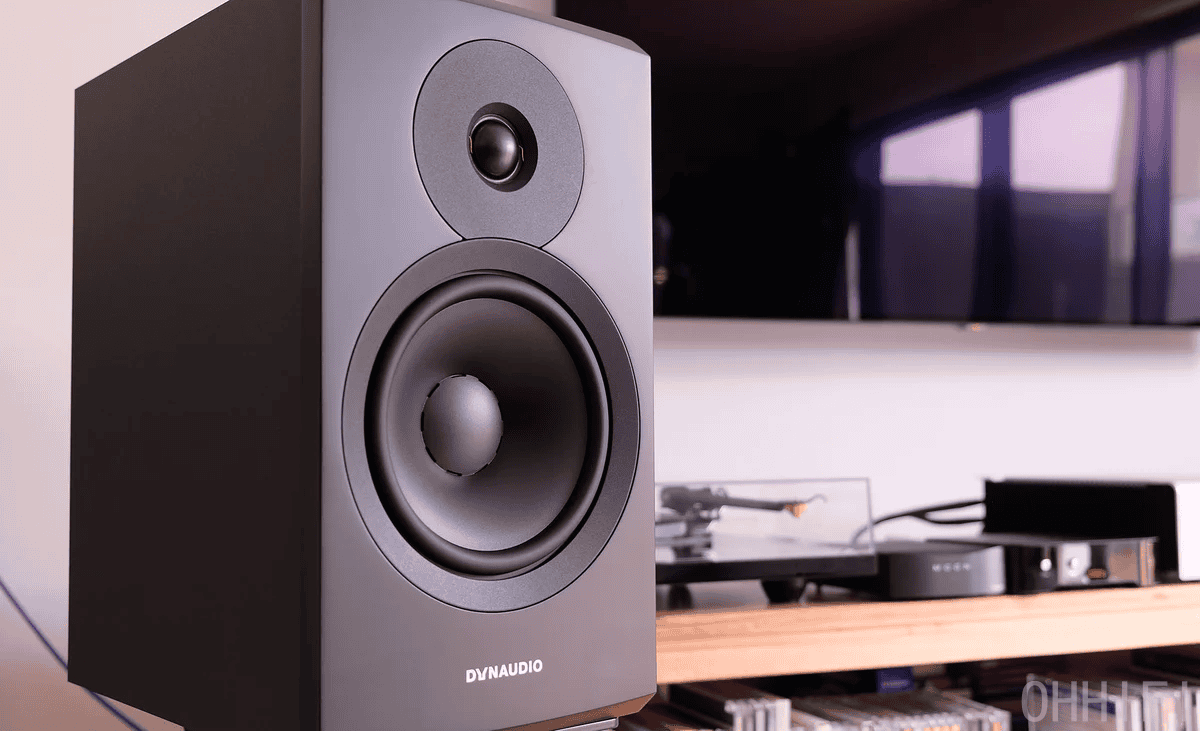
The star of the show is the tweeter. The Emit 20 uses the "highly regarded Cerotar tweeter," pulled directly from the more expensive Evoke series. This is not a new-for-this-model, cost-reduced soft dome. Its genealogy traces back to the celebrated Esotar Forty tweeter from the brand's Anniversary speaker and is inspired by the top-tier Confidence and Heritage Special speakers.
The key technology here is the "innovative resonance-defeating Hexis inner dome". While one reviewer jokingly called it a "Star Trek McGuffin", its job is deadly serious: it sits just behind the soft-dome diaphragm, controlling airflow and breaking up unwanted resonances. This is what flattens the frequency response and eliminates the "glare" or "edginess" that can plague lesser tweeters, especially with challenging tracks. This is all driven by a powerful strontium carbonate ferrite+ ceramic AirFlow magnet.
The 18cm MSP Woofer
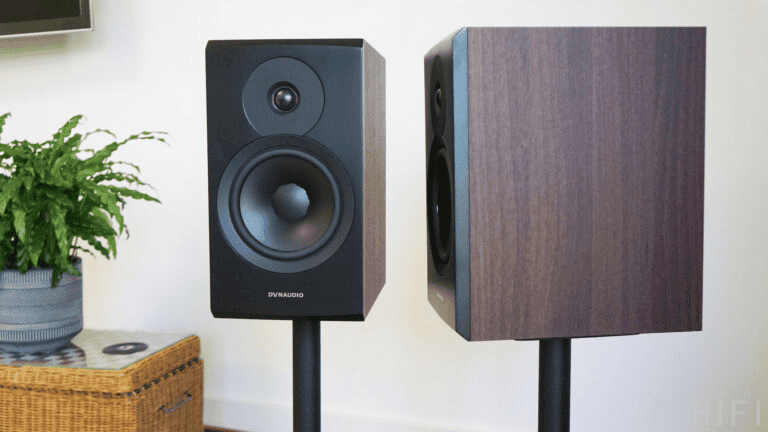
The heavy lifting is handled by a large 18cm (7-inch) mid/bass driver made from Dynaudio's proprietary MSP (Magnesium Silicate Polymer). This is the material Dynaudio has been refining since its first models in 1977. It's prized for its ideal combination of lightness, stiffness, and internal damping.
The cone itself is a "one-piece design," meaning the dust-cap is not a separate, glued-on part but is molded as an integral part of the cone's playing surface. This creates a "solid connection to the voice-coil", which directly translates to "supreme control and detail" in the critical bass and midrange frequencies.
The "motor" behind it is just as impressive. It's a "long-throw" voice-coil made from lightweight aluminum, which is then wound onto a two-layer glass-fibre former. Dynaudio uses aluminum for its low mass and then coats it in copper, a clever trick to boost the magnetic power (or "BL"). This, combined with a "dual ferrite-ceramic magnet system," is what gives the driver its "punch" and "even greater control".
The Crossover and Cabinet
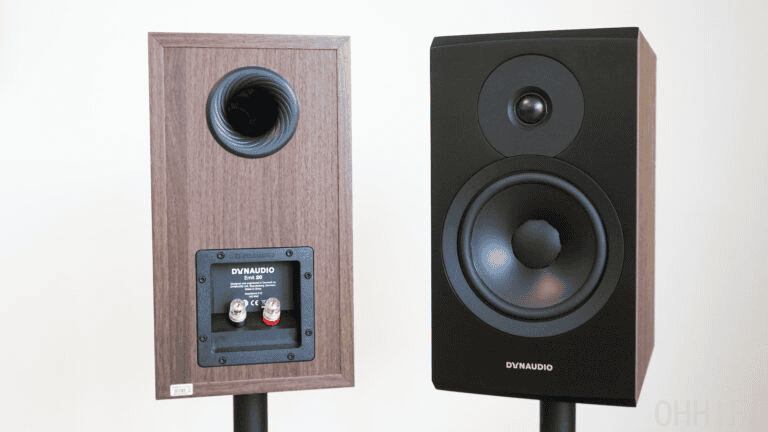
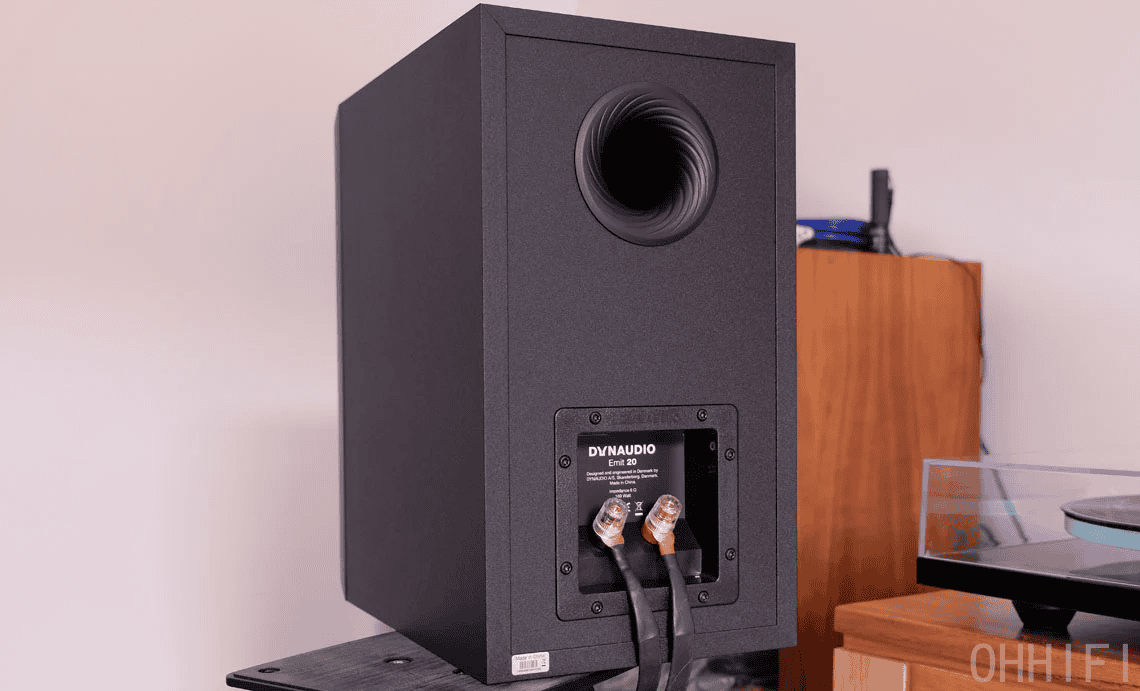
Holding it all together is a cabinet built from 18mm MDF, available in black, white, or walnut vinyl finishes. It features "nicely curved front baffle edges" and a new "dual-flared bass-reflex port" on the rear, which has been optimized to reduce air turbulence. The speakers also ship with "laudable and unusual" magnetic tweeter protectors for transit, as well as foam port bungs for taming bass in difficult placements.
But the most critical, and defining, technical choice is the crossover. The Emit 20 uses a custom hybrid first- and second-order design. The critical number? The crossover frequency is 3800 Hz.
This is extremely high for a two-way speaker with a 7-inch driver. Most competitors cross over between 2-3kHz. This decision by Dynaudio's engineers is a massive gamble. It aims to achieve "seamless driver integration" by keeping the crossover point far away from the 1-3kHz range where human hearing is most sensitive. But it also places the entire burden of the midrange—everything from 53Hz all the way to 3.8kHz—squarely on the shoulders of that single 18cm MSP driver. This is a defining trade-off, and one that, as we'll see, has a direct impact on the speaker's sound.
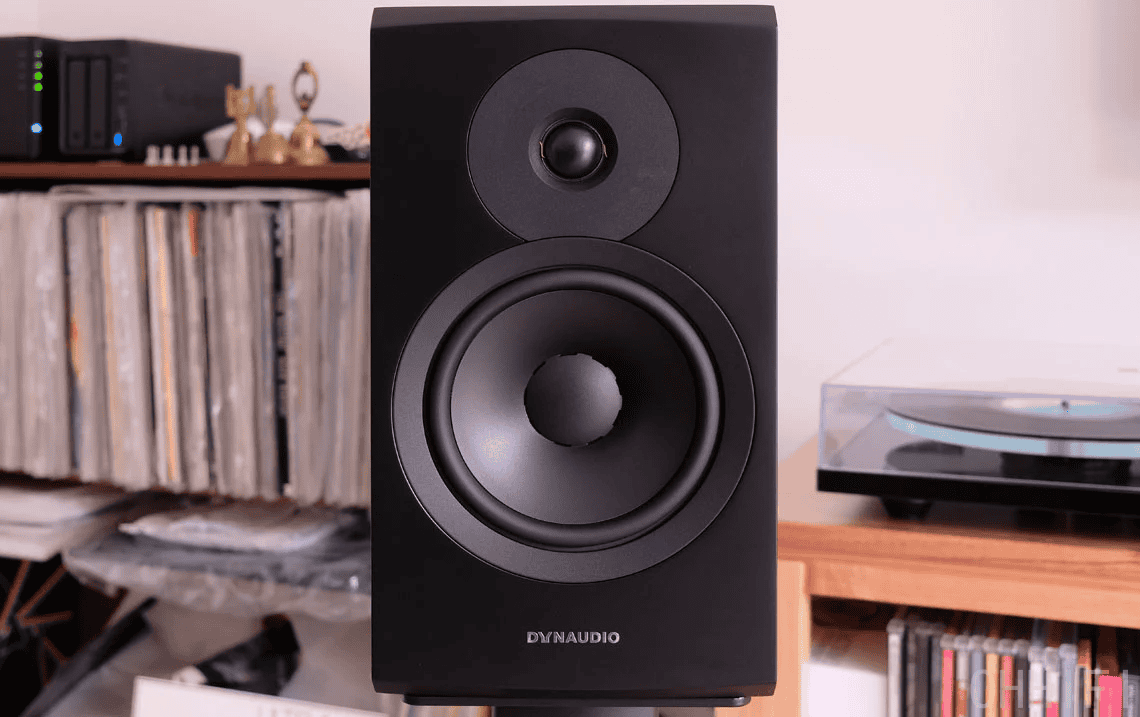
Table 1: The Tale of the Tape
| Specification | Dynaudio Emit 20 |
| Type | 2-way stand-mount, rear-ported |
| Tweeter | 28mm Cerotar soft-dome with Hexis |
| Mid/Woofer | 18cm (7-inch) MSP |
| Frequency Response ($\pm$ 3dB) | 53Hz – 25kHz |
| Frequency Response (-6 dB) | 42Hz – 35kHz |
| Sensitivity (2.83V/1m) | 86dB |
| Impedance (Nominal) | 6 $\Omega$ |
| Crossover Frequency | 3800 Hz |
| Crossover Topology | 1st order (Tweeter) / 2nd order (Woofer) |
| IEC Power Handling | 160W |
| Dimensions (W x H x D) | 205.1 x 370 x 311.5 mm |
| Weight (each) | 10.32 kg / 22.8 lb |
Setup and System Synergy: A Critical Warning
Let's be blunt. This is not a "plug-and-play" speaker. Its greatest strength—its transparency—is also its greatest hurdle for the unprepared.

The Placement Mandate
First, there's that large, rear-firing, dual-flared port. This design needs space to breathe. Multiple reviews warn in no uncertain terms: do not shove the Emit 20s "up against a back wall" or "in a corner" unless you are actively trying to get an exaggerated, boomy, one-note bass.
Dynaudio includes foam bungs to help, but these should be seen as a last resort. While they can tame the worst of boundary-related bloat, "port bungs do not generally enhance dynamics". You're fixing one problem by creating another.
The most important setup tip, however, comes from objective lab analysis. These speakers are not designed to be pointed directly at your head. Technical reviews found that "on-axis they can be bright". The solution? They "sound best turned slightly off-axis (10-15°)". A "little toe-in" helps focus the stereo image, but do not aim them at your ears like laser beams.
The Partnering Mandate
This brings us to the "grown-up" test: your electronics. The Emit 20 is "extremely revealing of partnering equipment". It is "more neutral than many loudspeakers at their price" and has "minimal character of its own".
This means it's a chameleon. It will tell you, with brutal honesty, exactly what your amplifier and source sound like. One review put it perfectly: "Where coarse-sounding electronics might be able to 'hide' behind a woolly sounding loudspeaker, that lack of high-frequency finesse has no safe harbour here."
A cheap, harsh, or "below-par" amplifier will sound exactly like a cheap, harsh amplifier.
This is not a flaw; it's a feature. The Emit 20 is a loudspeaker that "will grow with a system, revealing the benefits of upgrades to source and amplifier". This isn't a "starter" speaker you'll discard in a year. It's a foundation. It's an "entry-level" price for a speaker that demands a mid-level (or higher) system to truly sing.

The Listening Sessions: Neutrality, Depth, and Dynamics
When you get the setup right, the Emit 20's character reveals itself. It's not a "wow-factor" speaker that assaults you. The first impression is one of "calm clarity". The sound is "articulate and open," "crisp, rhythmically coherent, and unhurried". It's this "unhurried" quality that signals its underlying "sophistication".
Bass Performance: Tuneful, Not Tumultuous
Let's talk about the bass. The Emit 20 is not trying to "impress" you with "prodigious" or boomy low-end. Dynaudio has clearly opted for a "more sensible balance".
The result is bass you can "feel," but that "remains controlled and is thus tuneful". This is a "quality over quantity" presentation. The bass is "clean and well extended", "robust" down to 40Hz, and provides a solid foundation without ever turning to mud.
Midrange and Treble: The Cerotar's Class
The real benefit of this controlled bass is what it does for the rest of the music. Because the bass is so well-manned, it "doesn't mask what's going on in the midrange".
This means "lyrics are clear and there's plenty of detail too". That high-end Cerotar tweeter and its Hexis-powered refinement truly shine. As one reviewer noted, "I rarely find affordable speakers that can do saxophone well... but these delivered the power without any added glare". That "glare" is the high-frequency distortion and resonance that the Emit 20's design so fastidiously eliminates.
And that risky 3.8kHz crossover? It pays off. The "seamless driver integration in the midrange" is a highlight, creating a fluid, coherent, and "fluent" presentation.
Soundstage and Imaging: It's All About the Depth
When positioned correctly, the Emit 20s "simply disappeared acoustically". But the soundstage they throw is not just wide. The "more noticeable dimension is the depth of the soundstage, which is substantially deeper and denser in texture than... most rival standmounts in this price bracket".
This "deep" and "dense" stage is built on one of the most compelling qualities of the speaker: the "inky black silences" between notes. This, as the review notes, is a "pure Dynaudio trademark". This isn't just poetic license. It's the subjective perception of the speaker's objective performance. Lab reports confirm "low levels of distortion" and "low subjective coloration". The "blackness" is the absence of "grain" or a noisy, resonant "floor." The speaker simply stops when the note does, revealing the space and texture of the original recording.
The Objective View: Lab Notes and the Off-Axis 'Fix'
This subjective praise must be balanced by objective data. Lab measurements reveal the precise nature of the trade-offs the designers made.
The 700Hz Resonance (The "Thwack" Deficit)
The measurements confirm a "woofer resonance at 700Hz". What does this sound like? It's perceived as "some muffled midrange" that "lacks some 'thwack'". This means on fast, percussive material—a sharp snare hit or a staccato guitar riff—the leading-edge "attack" can feel slightly rounded or blunted.
This is the exact, measurable price paid for that seamless 3.8kHz crossover. The 18cm driver, working so hard across such a vast range, Hhas a small resonance. The trade-off is clear: you lose a bit of "thwack" to gain "fluency" and "seamless integration".
The On-Axis Treble (The "Brightness" Problem)
The labs also confirm what our setup section warned about: the high-frequency response "$> 10$kHz is too heavy" and "sharp" when measured on-axis. This can make "synth/cymbals" sound "bright".
But this isn't a fatal flaw. It's an instruction. The speaker is clearly voiced for off-axis listening, where the "Predicted In-Room Response" smooths out. The "best compromise" is that 10-15° off-axis placement. This isn't a "broken" speaker; it's one that's designed for how people actually listen in real rooms, not in an anechoic chamber.
When set up this way, the speaker settles into its true character: an "overall 'warm' sound up through 10kHz" with "reasonably wide but consistent" dispersion, making it an "easy-listening speaker" in the best sense of the term.

The Contenders: Emit 20 vs. The $1,000 Champions
No speaker exists in a vacuum. The Emit 20 (c. $1,049) goes head-to-head with some of the most established champions in the category.
vs. KEF LS50 Meta (c. $1,600)
This is the icon. The KEF's strength, thanks to its Uni-Q driver, is "precise imaging and focus" and a stunning "3D soundstage". Its universally acknowledged weakness? "A lack of low bass". The choice here is stark. The Emit 20 offers the "excellent bass extension" and "dynamic range" that the KEF lacks. The KEF, in turn, offers a pinpoint, "point-source" imaging that the traditional 2-way Emit 20 can't quite match. For "scale" and "bass," it's the Dynaudio. For a "sparkly top end" and holographic imaging in a smaller room, it's the KEF.
vs. Bowers & Wilkins 606 S3 (c. $1,100)
This is the other "grown-up" speaker in the class, and a What Hi-Fi? Awards 2024 winner. The 606 S3's strengths are a "Bigger, punchier, more open sound" with "stunning clarity, detail and refinement". Its cons? A "staid, deliberate nature" means it "could sound a bit more fun". This is a battle of "mature" speakers. The B&W offers a "larger scale of sound", while the Emit 20 offers a more refined, "sweet" tweeter and a more "fluent" midrange. It’s B&W's scale versus Dynaudio's sweetness.
vs. Monitor Audio Silver 100 7G (c. $799)
This is the "bass" champion. The MA 100 7G brings a massive 8-inch driver to the fight, claiming "floorstander troubling credentials" with bass down to 35Hz. This is a "Quality vs. Quantity" war. The MA has the bigger driver and (on paper) deeper extension. However, in a direct, subjective comparison, one listener auditioned both and concluded the Emit 20 had "more controlled bass then the MA SILVER". The MA is for those who are "craving" raw bass. The Emit 20 is for those who want "tuneful" bass that doesn't "mask the midrange".
Table 2: Key Competitor Comparison
| Feature | Dynaudio Emit 20 | KEF LS50 Meta | B&W 606 S3 | Monitor Audio Silver 100 7G |
| Price (Approx. USD) | $1,049 | $1,600 | $1,100 | $799 |
| Driver Config | 7-in 2-Way | 5.25-in Coaxial | 6.5-in 2-Way | 8-in 2-Way |
| Key Strength | Bass Control & Midrange Fluency | Pinpoint Imaging & "Sparkle" | Scale, Openness & "Punch" | Bass Quantity & "Floorstander" sound |
| Key Weakness | Needs careful setup/partners | Lack of low bass | "Could sound a bit more fun" | Bass can be less "controlled" |
The Verdict
The Dynaudio Emit 20 is a "very grown-up speaker" that offers "amazing value for money". It's a "refined, sophisticated" speaker with a "sensible balance" and fantastic, "tuneful" bass.
So why did some reviews, like What Hi-Fi?, give it 4/5 for sound, stating it "can't quite match the very best at this level"?
The Emit 20 is a speaker with two verdicts.
Verdict One (The 4-Star "Plug-and-Play" Verdict): If you buy these speakers, treat them like a "budget" box, shove them near a wall, and hook them up to a "below-par" amplifier, you will get the 4-star version. You will hear the on-axis brightness, you'll notice the lack of "thwack", and you'll conclude it's "not as fun" as some of its rivals.
Verdict Two (The 5-Star "Audiophile" Verdict): If you treat the Emit 20 like the high-end speaker it's pretending to be... If you give it power—"a bit of a beast" for an amplifier... If you pull it 50cm from the wall... And if you toe it "10-15° off-axis"... you will unlock the 5-star, "real deal" speaker. This is where you get the "deep, dense" soundstage, the "inky black silences", and the "glare-free" refinement.
This is not a speaker for everyone. It is not a quick fix. But it may be the best value on the market for an aspiring audiophile. It is a speaker you buy for $1,000 but build a $5,000 system around. It's a long-term investment, a "sensible" choice in the best possible way, and a stunning example of what happens when high-end engineering trickles all the way down.
This is the new gatekeeper to true high-fidelity.



Comments