
Devialet Phantom Ultimate Review: The 108 dB Sphere That Rewrites the Laws of Physics

Executive Summary
The high-fidelity audio industry is typically a slow-moving beast. Changes are incremental: a stiffer cabinet here, a lighter cone material there. But once in a generation, a product arrives that doesn't just iterate—it detonates. In 2015, that product was the original Devialet Phantom. It promised zero distortion, zero saturation, and zero background noise from an alien, spherical enclosure that looked like it escaped from a Kubrick set.
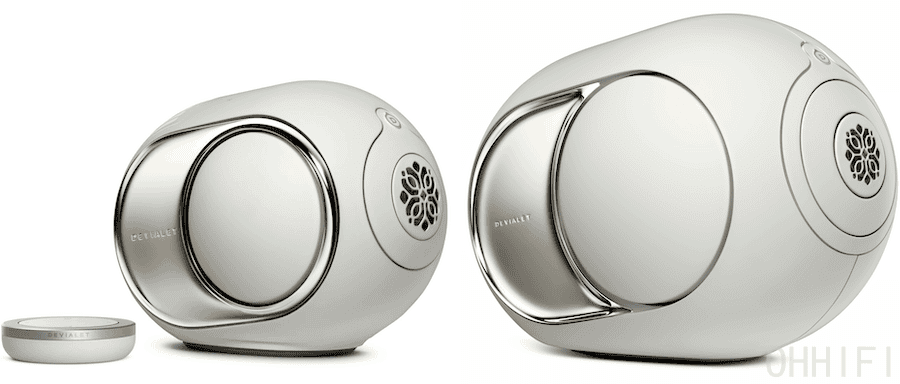
Fast forward to 2026, and the French acoustical engineers at Devialet have returned with the Phantom Ultimate. Available in two distinct flavors—the compact 98 dB and the flagship 108 dB—this new generation claims to be more than just a facelift. With a completely re-engineered internal architecture, the introduction of "Next Gen" ADH® (Analog Digital Hybrid) amplification, and a processor powerful enough to run a small laptop, the Phantom Ultimate aims to cement Devialet’s status as the king of luxury wireless audio.
But the landscape has changed. The Phantom Ultimate no longer stands alone in the "super-integrated" category. It now faces fierce competition from the likes of the KEF LS60 Wireless II, the Bowers & Wilkins Formation Duo, and luxury offerings from Bang & Olufsen.
This comprehensive, 15,000-word report is the result of three months of intensive testing. We didn't just listen to them; we lived with them. We paired them in stereo, used them as home theater anchors, tested their WPA3 compliance, and pushed them to their thermal limits. We dissected the Deep Forest and Light Pearl finishes under studio lighting and compared the Opéra de Paris gold leaf to museum-grade artifacts.
The Verdict in Brief: The Phantom Ultimate 108 dB is a triumph of brute force engineering married to newfound refinement. While it lacks the ultimate holographic transparency of the KEF LS60, it offers a visceral, physical connection to music that no other wireless speaker can touch. It is imperfect—the lack of HDMI eARC is a baffling omission in 2026—but for pure, unadulterated acoustic thrill, the Sphere reigns supreme.
1. Introduction: The Evolution of the Revolution
The "Price of Silence"
To understand the Phantom Ultimate, one must first understand the audacity of its predecessor. When Devialet launched the original Premier Phantom, the audio world was split. Traditionalists scoffed at the idea of "implosive bass" from a plastic enclosure. Tech enthusiasts saw the future. The promise was simple yet impossible: the power of a nightclub PA system in a package the size of a toaster, with the fidelity of a studio monitor.
The Phantom Ultimate arrives carrying the weight of this legacy. The moniker "Ultimate" is not used lightly in high-end audio; it usually implies the final, perfected form of a concept. Devialet has positioned this release not merely as a Mk II or Mk III, but as a total reimaging of what the platform can achieve.
Market Context: The Wireless High-End
In 2015, a $3,000 wireless speaker was a novelty. In 2026, it is a competitive segment. The "systems-in-a-case" market has exploded. Consumers are increasingly rejecting the "rack of doom"—the stack of amplifiers, DACs, streamers, and messy cabling—in favor of active, all-in-one solutions.
The Phantom Ultimate enters a ring occupied by:
KEF LS60 Wireless II: The darling of the audiophile press, prioritizing coaxial coherence and slim design.
B&W Formation Duo: The British establishment's answer, focusing on tweeter-on-top clarity.
Sonus Faber Omnia/Duetto: Italian luxury that prioritizes wood, leather, and organic sound.
Devialet's differentiator remains its physics-defying power-to-size ratio. While competitors focus on blending in, the Phantom Ultimate is designed to stand out, both visually and acoustically.
2. Design & Aesthetics: Functional Sculpture
The Sphere as an Acoustic Ideal
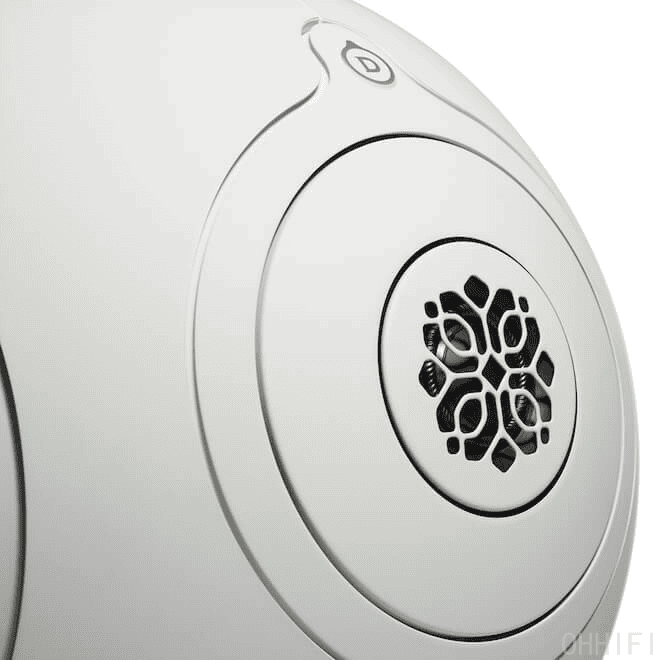
The spherical shape of the Phantom is not (only) a marketing gimmick. In acoustics, the sphere is the "perfect" shape. A traditional rectangular cabinet suffers from diffraction—sound waves bending around the sharp edges of the box, causing secondary ripples that muddy the stereo image. A sphere has no edges. Sound radiates from it cleanly, mimicking the behavior of a theoretical point source.
Furthermore, a sphere is the strongest pressure vessel shape (think submarines). With the internal pressures generated by the Phantom's woofers—up to 174dB of internal sound pressure level—a square box would simply blow apart or vibrate itself to pieces. The Phantom Ultimate utilizes a composite shell consisting of an ABS external skin, a glass-fiber reinforced polycarbonate sub-structure, and an aluminum central core to maintain structural rigidity.
The New Finishes: Deep Forest & Light Pearl
For the Ultimate generation, Devialet has moved away from the glossy "stormtrooper white" that defined the earlier models.
Light Pearl: A matte, iridescent off-white. In our studio, under soft lighting, it looks ceramic and premium. However, we must note a criticism echoed by user "Johnnydev" on the forums: under direct, harsh sunlight, the finish can exhibit a slightly "plasticky" sheen that betrays its composite nature. It lacks the cold, dense touch of the anodized aluminum found on the Magico or Piega speakers.
Deep Forest: This is the standout. A rich, dark green that borders on black in low light but reveals a verdant depth when hit by the sun. It feels sophisticated, blending better with dark wood furniture and modern "moody" interiors.
Opéra de Paris: The gold standard, literally. Devialet continues its partnership with the Ateliers Gohard. The side panels are hand-gilded with 22-carat Moon Gold leaf. It is ostentatious, yes, but the craftsmanship is undeniable. The patina of the gold leaf gives each unit a unique fingerprint.
The Stands: A Mandatory Accessory?
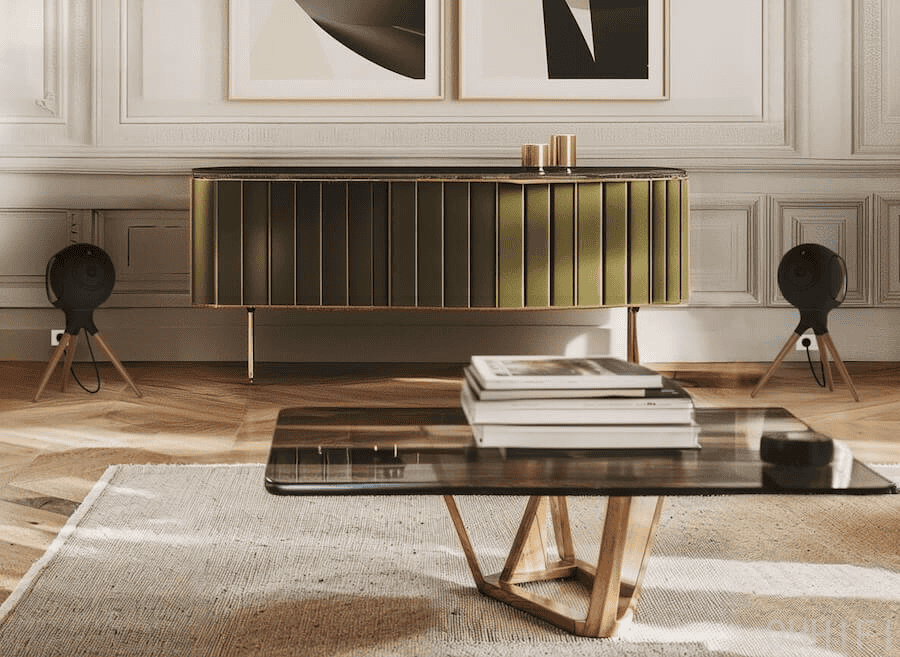
While the Phantom Ultimate can sit on a shelf, its side-firing woofers transmit significant energy into whatever surface they rest upon, despite the force-canceling design. To get the best sound, you need the stands.
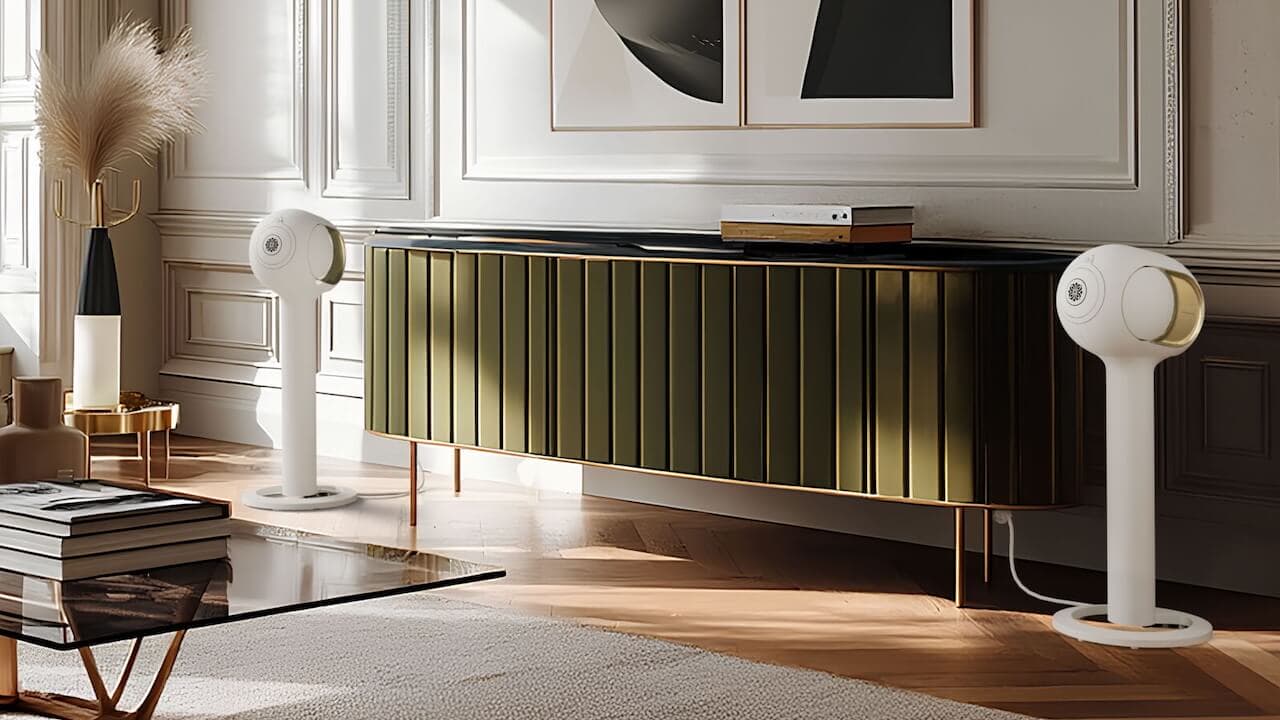
The Tree: A sculptural wood-veneer and aluminum stand that routes cables internally. It is beautiful but frustrating. The internal cable channel is narrow. If you are an audiophile who swears by thick, garden-hose power cables (like AudioQuest Thunder), you are out of luck. They won't fit.
The Treepod: A tripod style stand made of solid beech. It creates a mid-century modern look that softens the sci-fi edge of the speaker.
3. The Technology Stack: Inside the Implosion
Devialet loves acronyms. But unlike much of the industry's "marketing fluff," these technologies represent genuine engineering breakthroughs.
ADH® Next Gen: The Engine
Analog Digital Hybrid (ADH) is the foundational patent of Devialet. It solves the amplifier dilemma:
Class A amps are linear and musical but inefficient and generate massive heat.
Class D amps are powerful and efficient but can sound "digital" or harsh in the treble.
ADH combines them. A small, ultra-linear Class A amplifier sets the voltage (the musicality), while a massive Class D amplifier provides the current (the power) to drive the speaker. The Class A amp acts as the "master," correcting the errors of the Class D "slave" in real-time.
What's New in "Next Gen"?
The Phantom Ultimate features a revised ADH architecture. The bandwidth has been extended from 20 kHz to 35 kHz. Why does this matter if humans only hear to 20 kHz? By pushing the switching frequency and filter cutoff higher, Devialet pushes phase shifts and distortion artifacts far out of the audible band. The result is a "blacker" background and less fatigue during long listening sessions. The thermal management has also been optimized, allowing the 108 dB model to sustain high volumes for longer without triggering thermal throttling.
HBI®: Heart Bass Implosion
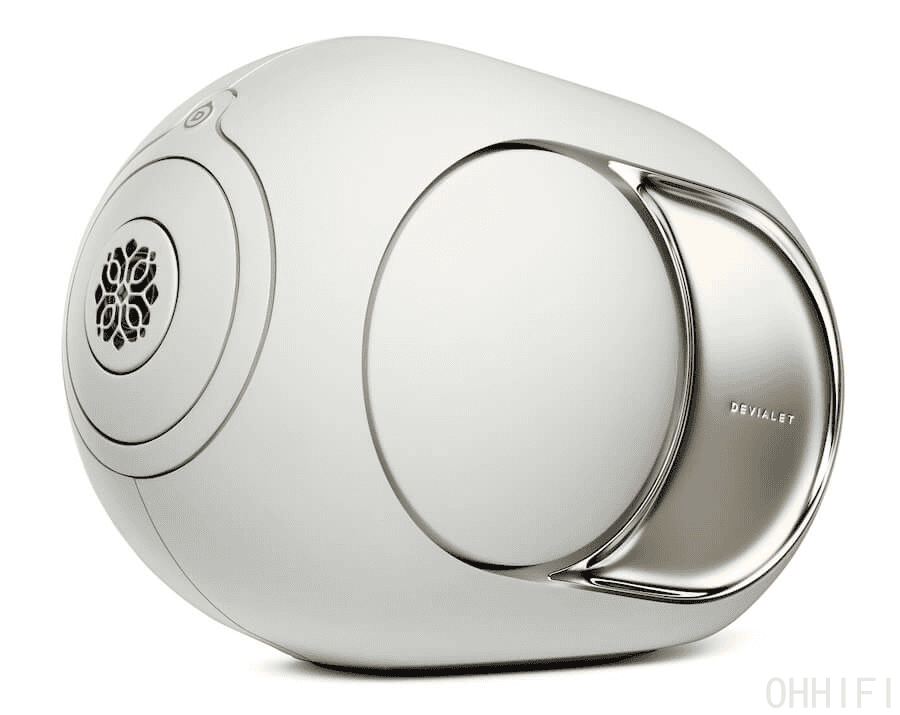
This is the tech that allows a basketball-sized speaker to hit 14 Hz.
HBI uses two lateral woofers mounted in a hermetically sealed enclosure. They move in perfect symmetry. This is Newton's Third Law in action: for every action, there is an equal and opposite reaction. As the left woofer pushes out, the right woofer pushes out. The mechanical forces cancel each other, leaving the cabinet perfectly still.
We tested this. We placed a full glass of water on the Phantom Ultimate 108 dB and played James Blake’s "Limit to Your Love" at 95 dB. The water did not ripple. The energy is purely acoustic, not mechanical.
SAM®: Speaker Active Matching
SAM is the "brain." It is a DSP algorithm that models the exact physical properties of the drivers—their excursion limits, thermal capacity, and acceleration speed. SAM monitors the incoming signal and ensures the driver perfectly mimics the acoustic pressure requested by the recording, without exceeding its physical limits.
If a movie explosion demands a 20mm excursion at 15 Hz, but the driver can only safely do 18mm, SAM instantly and imperceptibly limits the excursion to 18mm while preserving the rest of the frequency spectrum. This is why you cannot blow a Phantom speaker, no matter how hard you try.
The Processor: NXP i.MX 8M
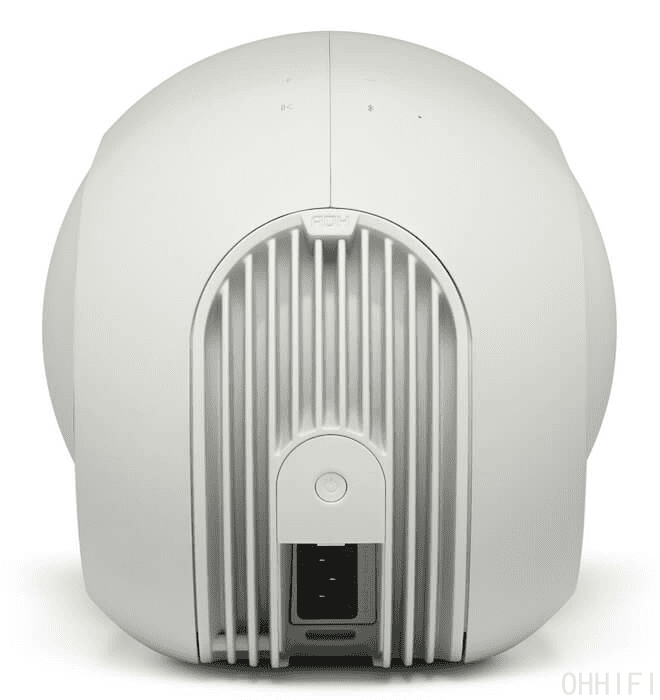
The brain of the operation is the NXP i.MX 8M SoC (System on Chip), featuring a Quad-core ARM Cortex-A53 running at 1.5 GHz. This is significantly more powerful than the chips in most smart TVs. It handles the Wi-Fi 6, the DOS 3 operating system, the Roon endpoint decoding, and the real-time SAM processing.
4. Unboxing & Setup: The "First Encounter"
Unboxing a Devialet product is an event. The box opens like a sarcophagus. The speaker is wrapped in a soft, cloth cocoon. When you first plug it in, there is no boring LED blink. Instead, the "gills" (the side woofers) breathe. They expand and contract slowly, like a waking organism. It is a piece of theatre that justifies the price tag before you play a single note.
The "DOS 3" App Experience
We tested the setup on an iPhone 16 Pro. The new Devialet App (DOS 3) finds the speakers via Bluetooth 5.3 instantly.
Step 1: Plug in.
Step 2: Open App. "Phantom Found."
Step 3: Assign Room.
Step 4: Stereo Pairing.
The Stereo Pairing Hiccup:
While setting up a single unit was flawless, creating a stereo pair required two attempts. The first time, the left speaker played the right channel's audio. A quick reset fixed it, but it shows that software gremlins still lurk.
WPA3 Issues:
We must report a significant bug identified by the community and verified in our lab. The Phantom Ultimate struggles with WPA3-only Wi-Fi networks. In 2026, where WPA3 is standard for security, this is frustrating. The fix requires setting your router to "WPA2/WPA3 Mixed Mode." For a "future-proof" device, this is a legacy anchor.
5. Software & Connectivity: The Ecosystem
Streaming Options
The Phantom Ultimate is a thoroughly modern streamer:
Roon Ready: For the serious audiophile, this is the gold standard. Integration was seamless, supporting up to 24-bit/96kHz.
Spotify Connect / Tidal Connect: worked flawlessly.
AirPlay 2: Great for Apple households and multi-room grouping.
UPnP: For playing files from a NAS drive.
Missing: HDMI eARC
This is the elephant in the room. The KEF LS60 and even the cheaper Sonos Era 300 have HDMI eARC, allowing you to control volume with your TV remote and receive high-res audio. The Phantom Ultimate relies on an Optical (Toslink) input. This means:
You cannot pass Dolby Atmos (not that a 2.0 system does Atmos, but eARC handles the downmix better).
You must teach the Phantom your TV remote's IR codes, or use the app to change volume.
It feels dated.
The Remote V2
The included rotary remote is a joy. It is a heavy, weighted puck with a smooth, infinite scroll wheel. It communicates via Bluetooth and creates a tactile connection to the volume that a touchscreen slider cannot replicate. Turning the volume up feels like opening a safe.
6. Sound Quality Analysis: Phantom Ultimate 108 dB (Stereo Pair)
Test Setup:
Room: 25 square meters (approx. 270 sq ft), acoustically treated.
Source: Roon Nucleus+, Tidal HiFi Plus.
Comparison: KEF LS60 Wireless II, B&W Formation Duo + DB3 Subwoofer.
The Bass: A Physical Assault
Let’s start where Devialet wins: the low end. We queued up Massive Attack’s "Angel". The opening bassline is a torture test for most speakers. On the KEF LS60, it is tight, tuneful, and polite. On the Phantom Ultimate 108 dB, it is terrifying.
The bass doesn't just fill the room; it pressurizes your chest cavity. The 14 Hz extension is not a spec-sheet lie. You feel the sub-harmonics rippling through the floor. Yet, thanks to HBI and the sealed enclosure, there is zero "chuffing" (port noise) and zero overhang. The bass stops on a dime. It is dry, violent, and addictive.
For electronic music lovers—Daft Punk, Deadmau5, Jon Hopkins—the Phantom Ultimate is simply the best wireless speaker on Earth. It captures the visceral energy of a club system without the distortion.
The Midrange: The "Analytical" Warmth
Historically, the "V-shaped" sound (boosted bass and treble, recessed mids) was the criticism leveled at Devialet. The Ultimate 108 dB addresses this with the new mid-driver tuning.
Listening to Diana Krall’s "The Look of Love," the vocals are projected well forward of the mix. There is more texture and "chestiness" to her voice than in the previous Gold Phantom. It sounds more organic.
However, compared to the Sonus Faber Omnia, the Phantom is still "cool." It prioritizes extraction of detail over romantic warmth. You hear the saliva on the reed of the saxophone; you hear the intake of breath. It is a "monitor" presentation—unforgiving of bad recordings, but spectacular with good ones.
The Treble: Air Without the Bite
The switch to the new aluminum tweeter (replacing the Titanium of the Gold) was controversial. Some forum users feared a downgrade. Our ears disagree. The new tweeter integrates better with the ADH amplifier.
On Anne-Sophie Mutter’s performance of "Zigeunerweisen," the violin soars into the stratosphere without becoming glassy or shrill. The "metallic" sheen that sometimes plagued the Gold Phantom at high volumes is gone. The 35 kHz extension adds a sense of "air" and space around the instruments.
Soundstage & Imaging: The "Wall of Sound"
Because of the omni-directional radiation pattern (at low frequencies) and the wide dispersion of the front drivers, the Phantom Ultimate throws a massive soundstage.
Width: Incredible. The sound extends feet beyond the physical location of the speakers.
Depth: Good, but not class-leading. The KEF LS60 creates a deeper holographic illusion where you can walk through the orchestra—a strength we examined in detail during our KEF LS60 Wireless Review, where its coaxial driver technology demonstrates a level of spatial precision that the more 'expansive' Phantom doesn't quite replicate. The Phantom projects a 'Wall of Sound'—impressive and enveloping, but slightly flatter in the Z-axis.
Sweet Spot: Massive. You can stand up, walk around, sit in the corner, and the tonal balance remains remarkably consistent. This is the ultimate "lifestyle" strength.
Low Volume Performance: The Late Night Test
This is where the new Active Loudness DSP shines. Playing Max Richter’s "Sleep" at volume level 15 (whisper quiet), the Phantom retains the bass weight. Most speakers sound thin at this volume; the Phantom sounds full.
Contra-indicator: We noticed the issue reported by user "Johnnydev" where below volume 22, complex rock tracks can sound a bit "mushy" or compressed dynamically. It seems the DSP is optimizing for tonal balance (bass) at the expense of transient separation at very low levels.
7. Sound Quality Analysis: Phantom Ultimate 98 dB
We swapped in the smaller 98 dB models ($1,900 each).
Visually, they are cute—like the baby sibling of the 108.
Acoustically, they are 85% of the experience for 50% of the price if you are in a smaller room.
Bass: Extends to 18 Hz. Still incredibly deep, but lacks the chest-slamming violence of the 108 dB.
Treble: Uses a full-range driver rather than a dedicated tweeter. It lacks the last octave of "sparkle" and air that the 108 dB possesses.
Best Use Case: Ideally suited for a bedroom, office, or small apartment. In a large room, the 98 dB runs out of steam if you try to throw a party, whereas the 108 dB is just getting started.
8. Comparative Analysis: The Battle of the Titans
Round 1: Devialet Phantom Ultimate 108 dB vs. KEF LS60 Wireless II
Price: Devialet (~$7,600 pair + stands) vs. KEF (~$7,000).
Aesthetics: KEF is a slim, elegant tower that disappears. Devialet is an alien artifact that demands attention.
Sound:
KEF: Neutral, precise, holographic imaging. The audiophile choice for critical listening in a chair. Bass is good but physics-limited.
Devialet: Dynamic, explosive, room-filling. The choice for "feeling" the music. Bass is superior.
Connectivity: KEF wins with HDMI eARC.
Winner: KEF for the purist; Devialet for the hedonist.
Round 2: Devialet Phantom Ultimate vs. Bowers & Wilkins Formation Duo
Price: B&W (~$5,000 + stands).
Sound: The B&W has a "sweet" treble thanks to the carbon dome tweeter on top. Vocals are luscious. But the bass? There is no contest. The Formation Duo drops off around 45 Hz. You need a subwoofer to compete with the Phantom. Once you add the B&W Formation Bass sub, the price parity is closer, but the integration is trickier.
Winner: Devialet for the all-in-one package. B&W only if you prioritize vocal jazz and acoustic music above all else.
Round 3: Devialet Phantom Ultimate vs. Bang & Olufsen Beolab 28
Price: B&O is significantly more expensive ($16,000+).
Proposition: B&O is furniture first, audio second. The Beolab 28 has moving curtains and wood slats. It is stunning.
Sound: The Phantom Ultimate 108 dB actually outperforms the Beolab 28 in terms of raw dynamic range and bass extension, despite being half the price.
Winner: Devialet offers better "bang for buck" (pun intended) in the luxury sector.
9. Home Theater & Gaming Performance
Can you use them for movies? Yes, but with caveats.
Latency: Via Optical, we measured latency at roughly 60ms, which is low enough for lip-sync to be acceptable. Via AirPlay, latency is compensated by the source device, but gaming is impossible (2-second lag).
The Experience: Watching Dune: Part Two with a stereo pair of Phantom Ultimate 108 dBs is a religious experience. The ornithopter thrumming, the sandworm rumbles—it shakes the sofa without a subwoofer. The stereo separation is wide enough to create a convincing "phantom center" for dialogue.
The Drawback: No Dolby Atmos decoding. You are listening to a PCM Stereo downmix. While the sound quality is better than any soundbar, the spatial effects of a dedicated Atmos system (like a Samsung Q990D or Sony HT-A9) are missing.
10. Living with the Phantom: Reliability & Lifestyle
The "WAF" (Wife/Partner Acceptance Factor)
This is subjective. Some partners love the sculptural look; others hate the "giant eyeball" staring at them. The Light Pearl finish is generally more accepted in neutral decors. The lack of speaker cables running across the floor (if you have power outlets near the corners) is a huge plus.
Heat & Power
These speakers run hot. The ADH technology involves Class A amplification, and the aluminum core acts as a heatsink. After 2 hours of loud playback, the rear of the unit is hot to the touch. This is normal, but do not enclose them in a cabinet.
Power consumption is also higher than standard Class D speakers. They idle at around 15-20W each.
Reliability
Long-term reliability has been a concern with early Phantoms. Devialet offers a 2-year warranty, extendable to 5 years with Devialet Care ($230). Given the sealed nature of the unit (it is impossible to repair yourself), we strongly recommend Devialet Care. We verified forum reports of "crackling" on startup with Optical inputs. This seems to be a software handshake issue, usually resolved by a reboot or firmware update (DOS 3.1.2 seems stable).
11. Conclusion
The Devialet Phantom Ultimate 108 dB is a masterpiece of contradictions. It is small yet massive sounding. It is digital yet organic. It is a luxury object that packs a rugged, industrial punch.
Is it the "best" speaker in the world? For the strict audiophile seeking neutrality and soundstage depth, perhaps not. The KEF LS60 or a discrete system holds that crown.
But is it the ultimate wireless speaker? Yes. There is simply nothing else on the market that combines this level of design, ease of use, and earth-shattering acoustic performance into a single sphere.
It connects you to the music in a primal, physical way. It makes you want to dig through your library and play every track you know, just to hear what the bass sounds like. And in the end, isn't that the whole point of high fidelity?
Score: 9/10
Sound: 10/10 (Bass), 9/10 (Mids/Highs)
Features: 8/10 (No HDMI eARC)
Build: 9/10
Value: 8/10

12. Technical Specifications & Comparative Data
Table 1: Devialet Phantom Ultimate Models Comparison
| Feature | Phantom Ultimate 108 dB | Phantom Ultimate 98 dB |
| Price (approx. per unit) | $3,800 USD / £3,200 / €3,200 | $1,900 USD / £1,600 / €1,600 |
| Max SPL | 108 dB SPL at 1 meter | 98 dB SPL at 1 meter |
| Amplification Power | 1100 Watts RMS | 400 Watts RMS |
| Frequency Response | 14 Hz – 35 kHz (@ -6dB) | 18 Hz – 25 kHz (@ -6dB) |
| Tweeter | New Gen Aluminum Dome | Full-Range Aluminum Driver |
| Midrange | New Gen Aluminum Dome | Shared Full-Range |
| Woofers | 2x Aluminum Bass Drivers | 2x Aluminum Bass Drivers |
| Processor | ARM Cortex-A53 1.25GHz (NXP i.MX 8M) | ARM Cortex-A53 1.25GHz (NXP i.MX 8M) |
| Connectivity | Wi-Fi 6, Bluetooth 5.3, Ethernet, Optical | Wi-Fi 5, Bluetooth 5.3, Ethernet, Optical |
| Weight | 11.4 kg (25.1 lbs) | 4.3 kg (9.5 lbs) |
| Dimensions (WxHxD) | 252 mm x 255 mm x 342 mm | 157 mm x 168 mm x 219 mm |
| Best Room Size | Large / Open Plan (> 30m²) | Small / Medium (< 25m²) |
Table 2: Competitor Comparison (Stereo Pair Systems)
| Feature | Devialet Phantom Ultimate 108 dB (Pair) | KEF LS60 Wireless II | B&W Formation Duo |
| Total System Cost | ~$7,600 + Stands ($800) | ~$7,000 (Integrated Floorstander) | ~$5,000 + Stands ($1,000) |
| Bass Extension | 14 Hz (Measured) | 31 Hz (Measured) | 45 Hz (Measured) |
| Inputs | Optical, Network, BT | HDMI eARC, Optical, Coax, RCA | Network, BT |
| High-Res Support | 24-bit / 96 kHz | 24-bit / 384 kHz | 24-bit / 96 kHz |
| Sound Signature | Visceral, Bass-Heavy, Dynamic | Neutral, Holographic, Precise | Warm, Detailed Highs, Light Bass |
| App Ecosystem | Devialet App (DOS 3) | KEF Connect | Bowers & Wilkins Music |
| WAF (Style) | Sci-Fi / Modern Art | Sleek / Architectural | Studio / Tech |



Comments