
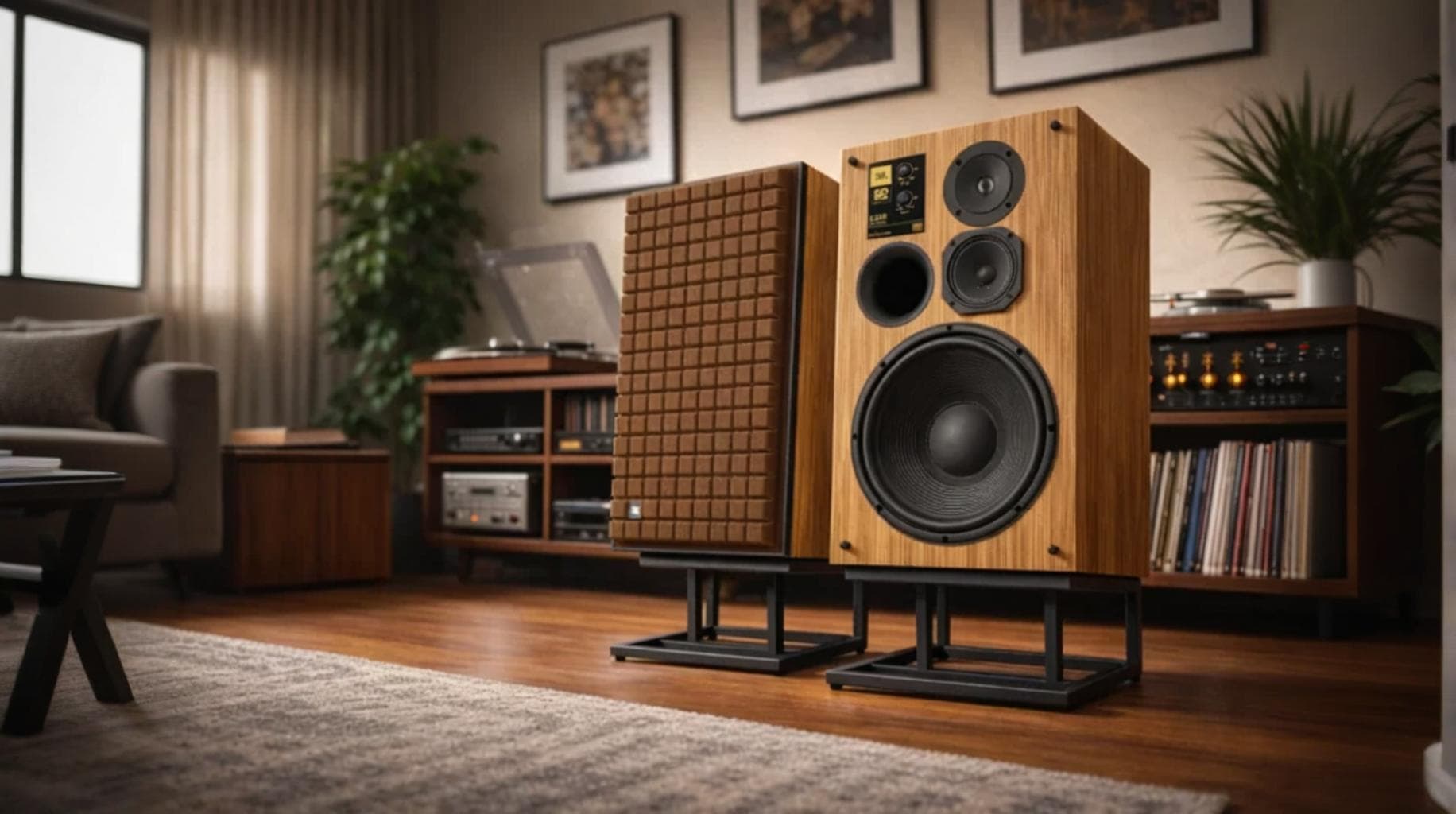
The California Return: A Definitive Monograph on the JBL L100 Classic 80th Anniversary Edition

Part I: The Burden of Iconography
Introduction: The Weight of Eight Decades
In the lexicon of high-fidelity audio, few acronyms carry the cultural and historical heft of JBL. James Bullough Lansing’s legacy is not merely one of transducers, compression drivers, and Alnico magnets; it is the soundtrack of the American century. From the dusty stages of Woodstock, where JBL D130s pushed the air that defined a counterculture, to the pristine, smoke-filled control rooms of Capitol Records and Abbey Road, JBL has been the conduit through which the world experienced the golden age of rock and roll. Now, as the company celebrates its octogenarian milestone—eighty years of defining the "West Coast Sound"—it releases the JBL L100 Classic 80th Anniversary Edition. This loudspeaker is, simultaneously, a celebration of a storied past and a defiant statement of modern electro-acoustic engineering.
The release of the L100 Classic 80 is not merely a product launch; it is a cultural event in the audiophile calendar. It arrives at a time when the industry is grappling with a dichotomy: the push for invisible, DSP-corrected wireless audio versus the resurgence of tactile, furniture-grade high fidelity that demands floor space and attention. The L100 Classic 80 stands unapologetically in the latter camp. It is a physical manifestation of audio history, clad in California Oak and fronted by the most recognizable grille in the history of consumer electronics.
However, the question that haunts every "anniversary" product remains: Is this merely a nostalgic cash-grab, a cynical exercise in branding designed to separate aging baby boomers from their pension funds? Or does the L100 Classic 80 offer a sonic performance that justifies its $7,499 price tag and its limited existence? To answer this, we must peel back the layers of marketing, veneer, and foam, and examine the physics and soul of this 63-pound transducer.
The Lineage: From Studio to Living Room
To understand the L100 Classic 80, one must first understand the 4310. In the late 1960s, JBL introduced the 4310 Control Monitor. It was designed to solve a specific problem: studios were moving from large, soffit-mounted main monitors to smaller, "nearfield" monitors that could sit on the meter bridge of a mixing console. The 4310 was compact (relatively speaking), powerful, and brutally revealing. It became the reference standard for mixing the rock and pop albums of the 1970s.
Recognizing that consumers wanted to hear what the producers heard, JBL released a consumer version of the 4310 in 1970: the L100 Century. It was a smash hit. It became the best-selling loudspeaker of the decade, moving over 125,000 pairs. It defined the "West Coast Sound": forward, dynamic, visceral, and unapologetically bold. It was not a speaker for the faint of heart, nor was it a speaker for those seeking the polite, receding presentation of the BBC monitors (like the Spendor BC1 or Rogers LS3/5a) across the Atlantic. The L100 was the speaker of the Maxell "Blown Away" ad—a cultural icon that transcended mere audio equipment to become a piece of furniture in the collective consciousness of a generation.
The 2018 resurrection of the L100 as the "Classic" series was met with skepticism by purists and jubilation by nostalgists. The original L100, for all its fame, was flawed by modern standards. It had a "presence peak" that made it exciting but fatiguing, and its cabinet resonances were significant. The 2018 "Reissue"—designed by acoustic luminary Chris Hagen—was a ground-up redesign that kept the look but fixed the sound. Now, based on the updated L100 Classic MkII platform released in 2023, the 80th Anniversary Edition arrives in a strictly limited run of 800 pairs worldwide.
Part II: Design and Aesthetics — The Art of Retro-Modernism
The 80th Anniversary Treatment: A Study in California Oak
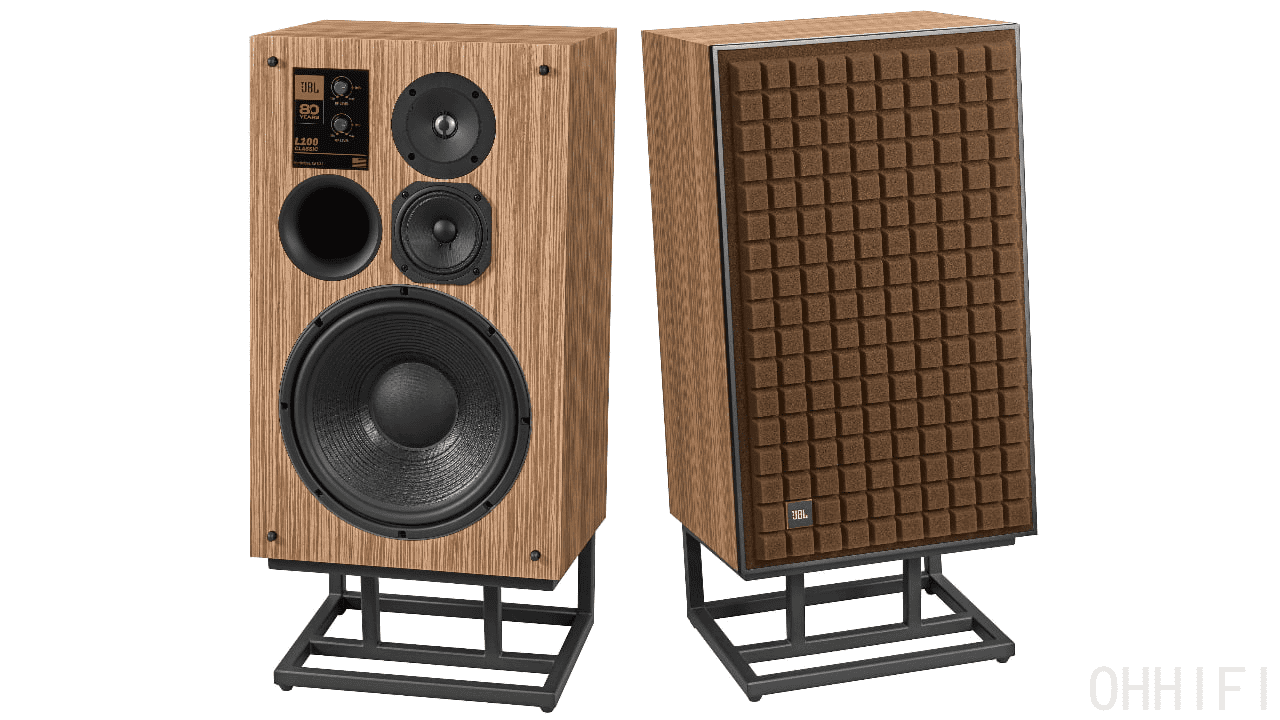
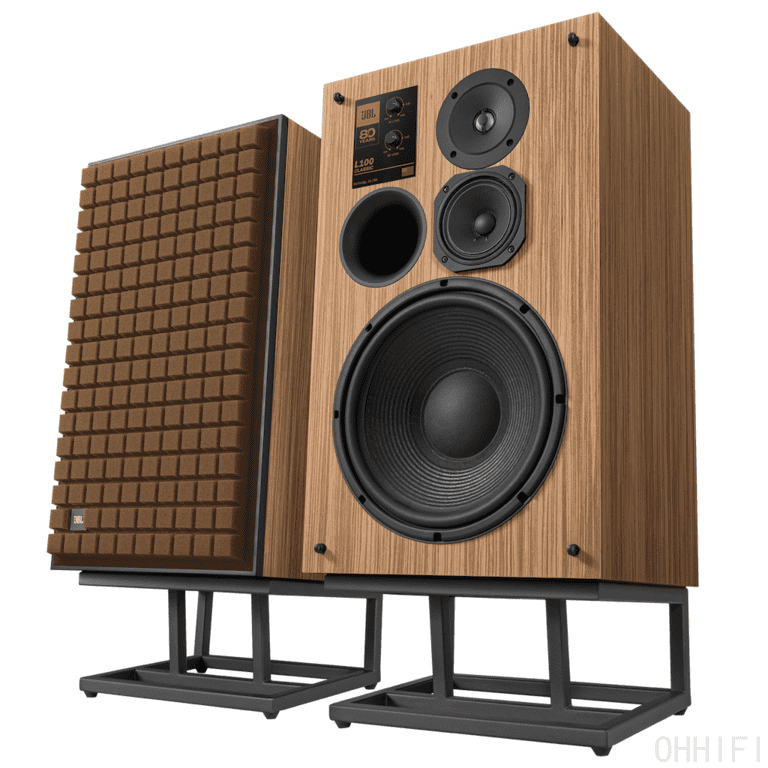
The visual language of the L100 Classic 80 is an exercise in restraint and reverence. While the standard MkII is finished in walnut and the 75th Anniversary Edition was clad in teak, the 80th Anniversary model distinguishes itself with a natural California Oak veneer. This is a significant aesthetic departure. The Walnut of the standard model feels traditional, perhaps a bit dark and "den-like." The Teak of the 75th was mid-century exotic. The California Oak, however, is lighter, honey-hued, and distinctly airy. It feels fresher, perhaps more contemporary, yet completely rooted in the sun-bleached aesthetic of 1970s Los Angeles architecture.
The veneer wrapping is comprehensive. Unlike cheaper loudspeakers where the veneer might stop at the edges or look pasted on, the L100 Classic 80 features grain-matched veneer that wraps around the cabinet, creating a seamless visual flow. The front baffle, usually hidden behind the grille, is painted a satin black, providing a high-contrast background for the white pure-pulp woofer cone—a visual trademark as identifiable as the grille itself. The cabinet construction remains robust, utilizing 1-inch (25mm) thick MDF (Medium Density Fiberboard) with extensive internal V-bracing to mitigate panel resonances that plagued the original 1970s particle board enclosures. This is "furniture grade" in the truest sense; it is built to last another 80 years.
The Iconic Quadrex Grille: Brown is the New Orange
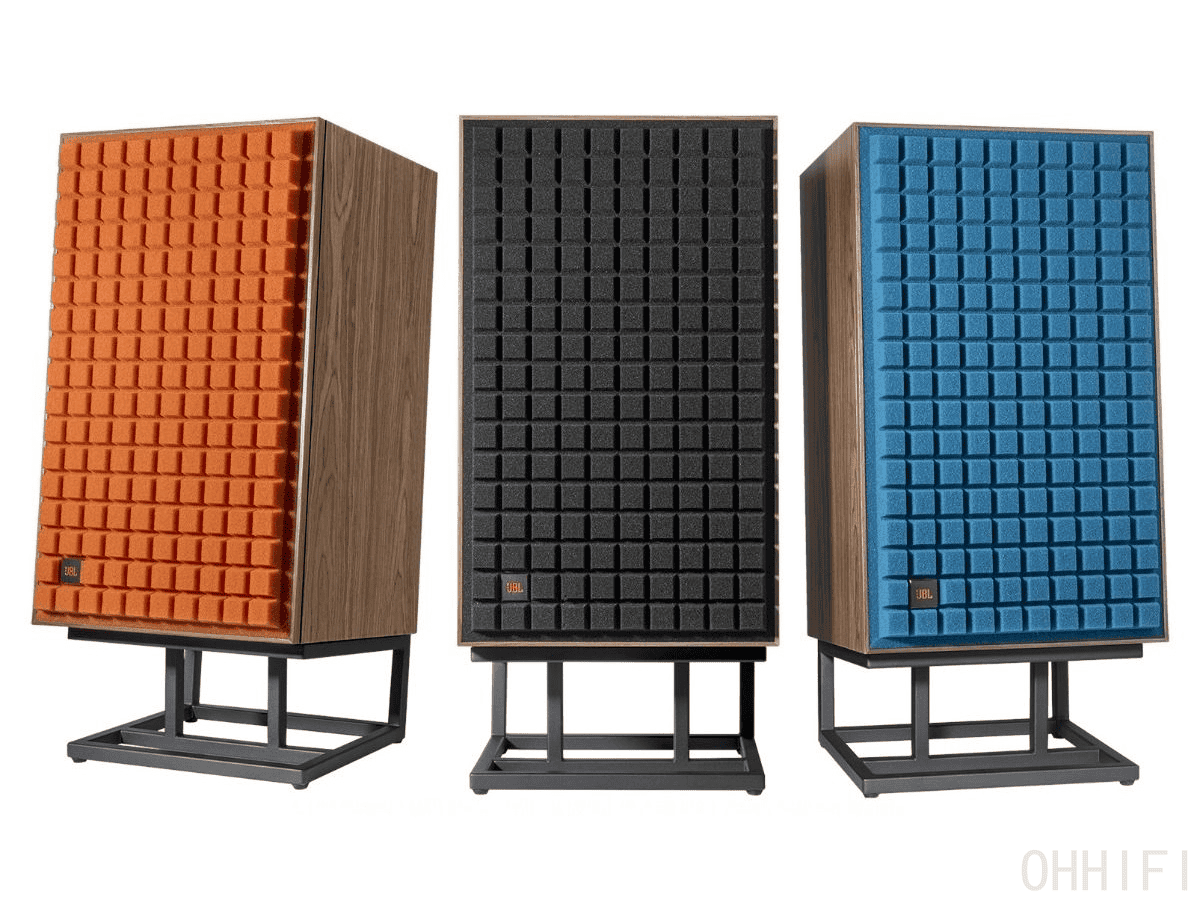
No discussion of the L100 is complete without addressing the elephant in the room—or rather, the foam on the baffle. The Quadrex foam grille is the L100’s visual signature. It is a grid of truncated pyramids that serves to diffract sound waves slightly, but mostly serves to look incredibly cool. For the 80th Anniversary, JBL has eschewed the vibrant orange and blue options available for the standard MkII, opting instead for a singular, exclusive Brown Quadrex finish.
This choice is polarizing. In the high-contrast photos of press releases, it can look dark. Some reviewers have likened it to a "giant chocolate bar". However, in person, under the warm light of a listening room, the brown foam paired with the gold-and-black JBL badging and the blonde oak cabinet creates a sophisticated, autumnal palette. It exudes a sense of premium exclusivity that the brighter orange grille sometimes lacks. It says "connoisseur" rather than "party animal," although, as we will see, the speaker can play both roles.
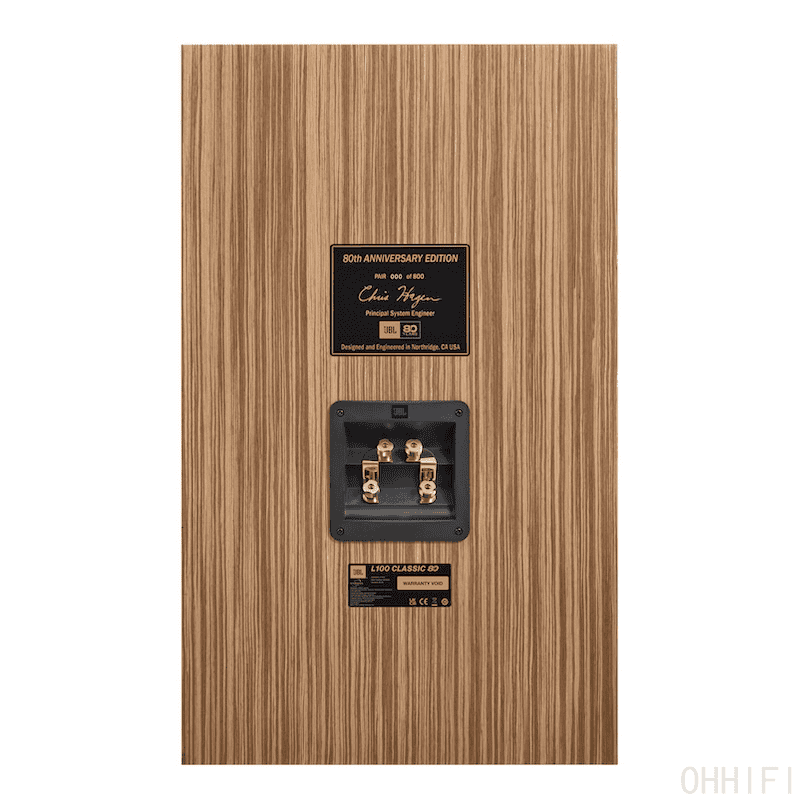
The frame of the grille is also unique to this edition, featuring a black satin wood finish rather than the standard walnut, further setting it apart as a collector's item. Behind the grille, the driver layout is identical to the MkII, but the rear of the speaker features a commemorative plaque with the signature of principal system engineer Chris Hagen and the serial number of the unit (out of 800).
Packaging and Presentation: The Theatre of Unboxing
JBL understands that at $7,499, the ownership experience begins before the first note is played. The speakers ship in a specially crafted wooden crate, reminiscent of high-end wine or munitions shipping, reinforcing the "heavy industrial" heritage of the brand. This crate is not merely protective; it is a piece of theater. Prying open the lid to reveal the California Oak within connects the owner to the industrial lineage of the product.
Included in the crate are the JS-150 floor stands. These are not the lighter JS-120 stands included with previous models or sold separately. The JS-150 is a more substantial, heavier steel stand designed to provide a more rigid foundation for the speaker. It retains the critical 7-degree backward tilt, which is essential for time-aligning the drivers at the listening position, ensuring that the acoustic centers of the woofer and tweeter reach the ear simultaneously.
Part III: Under the Hood — Acoustic Architecture and Engineering
It is a common misconception that the L100 Classic series is a "reissue" in the technical sense. It is not. While the form factor mimics the 1970s original, the internal engineering is thoroughly modern. The 80th Anniversary Edition shares its acoustic DNA entirely with the L100 Classic MkII. This means buyers of the limited edition are paying for the finish and exclusivity, not a different sonic engine. However, that engine is a marvel of electro-acoustic engineering that deserves a detailed dissection.
The Low Frequency Engine: JW300SW-8
The heart of the L100 has always been its 12-inch (300mm) woofer. In an era where "tower" speakers use multiple 6-inch or 8-inch drivers to achieve bass, the single large-diameter woofer is a rarity. The 80th Anniversary Edition utilizes the JW300SW-8, a cast-frame transducer featuring a white pure-pulp cone.
The choice of paper pulp is deliberate. While modern materials like carbon fiber, Kevlar, or aluminum offer high stiffness, they often suffer from undamped breakup modes that require complex crossover filtering. Pure pulp offers an exceptional stiffness-to-weight ratio and, crucially, excellent self-damping properties. It sounds "natural."
The "MkII" designation implies significant upgrades over the 2018 Classic model woofer (the 1200FE). The JW300SW-8 features a dual-spider suspension design. The spider is the corrugated fabric disk that holds the voice coil centered in the magnetic gap. A single spider can allow the voice coil to "rock" or tilt at high excursion levels, leading to distortion. The dual-spider arrangement creates a more rigid suspension system that keeps the voice coil perfectly linear even when the speaker is driven to thunderous levels. This results in bass that is not just loud, but significantly tighter and more articulate than the 2018 model.
The Midrange: JM125PC-8
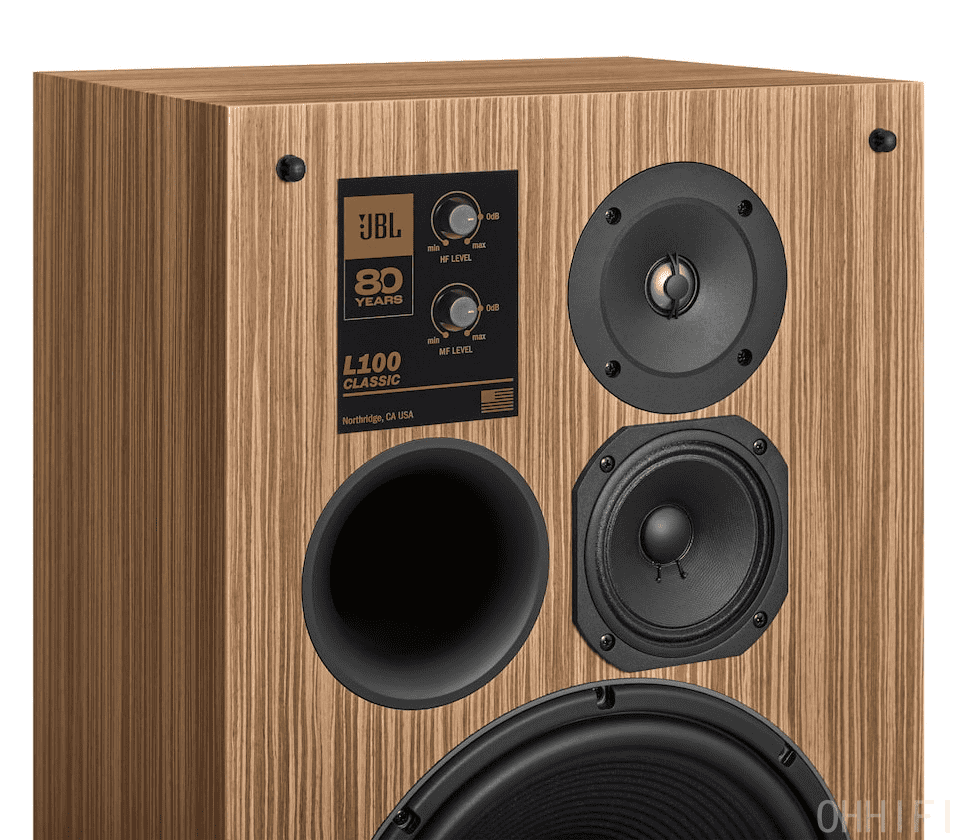
Handling the critical vocal range is the 5.25-inch (130mm) polymer-coated pure-pulp cone driver, the JM125PC-8. This driver operates in its own isolated sub-enclosure within the cabinet. This isolation is critical; without it, the massive back-pressure generated by the 12-inch woofer inside the cabinet would push and pull on the midrange cone, modulating the vocals and causing intermodulation distortion.
The polymer coating on the pulp cone adds rigidity and further damping, smoothing out the frequency response in the upper midrange. This allows for a relatively high crossover point to the tweeter (3.5kHz), keeping the vocal range coherent by reproducing it largely through a single driver.
The High Frequency Unit: JT025Ti2-4
The treble is handled by a 1-inch (25mm) titanium dome tweeter, the JT025Ti2-4, mated to an acoustic lens waveguide. This is perhaps the most significant departure from the 1970s original L100, which used the LE25 paper cone tweeter—a driver notorious for its rolled-off highs and ragged response.
The modern titanium dome offers extension up to 40kHz, well beyond human hearing. However, titanium can be harsh or "ringy" if not properly damped. The "MkII" update to this tweeter involved refinements to the soft surround and the waveguide geometry to reduce diffraction and smooth out the on-axis response. The waveguide serves two purposes: it improves the acoustic impedance match between the tweeter and the air (increasing efficiency) and it controls the dispersion, ensuring that the transition from the 5.25-inch midrange to the 1-inch tweeter is smooth even off-axis. This results in a broader "sweet spot" and a more stable stereo image.
The Crossover Network and Bi-Wiring
The crossover is the brain of the loudspeaker, directing frequencies to the appropriate drivers. The L100 Classic 80 benefits from the completely revised network developed for the MkII. The crossover points are set at 450Hz and 3.5kHz.
A major functional upgrade in the MkII/80th Anniversary platform is the inclusion of bi-wire/bi-amp capabilities via a premium terminal cup with dual sets of gold-plated binding posts. The 2018 Classic had a single set of terminals. The new layout allows audiophiles to run separate cables to the low-frequency and mid/high-frequency sections, or even to use separate amplifiers (bi-amping). While the audible benefits of bi-wiring are debated, the flexibility it offers is a nod to the serious audiophile demographic this speaker targets.
Crucially, the speaker retains the front-panel L-pad attenuators for high-frequency (HF) and mid-frequency (MF) level adjustment. While signal purists often scoff at tone controls, JBL recognizes that real-world room acoustics vary wildly. These attenuators allow the user to dial back the tweeter in a "live" (reflective/glass-heavy) room or boost the midrange in a "dead" (carpeted/curtained) room. This provides a level of integration flexibility that few modern competitors offer, bridging the gap between the studio monitor ethos of adaptability and the home audio need for adjustability.
Part IV: Setup and Synergy — Optimizing the L100
Stand Selection and Placement Mechanics
The L100 is technically classified as a "bookshelf" speaker, but placing a 63-pound (28.6 kg), 25-inch tall cabinet on a bookshelf is acoustic malpractice. The included JS-150 stands are mandatory for proper performance. They lift the speaker roughly 8 inches off the floor and tilt it back.
This tilt is not merely aesthetic. It solves a specific geometric problem. Because the woofer is large and deep, its acoustic center is recessed relative to the tweeter, which is mounted flush on the baffle. By tilting the cabinet back, JBL delays the arrival of the sound from the tweeter slightly, aligning it with the woofer at the ear level of a seated listener. Without the stands, the speaker would fire into your knees, and the phase alignment between drivers would be compromised, resulting in a "hole" in the crossover region.
Room Interaction and Positioning
Users and reviewers report that the L100 is relatively unfussy about placement due to its front-firing port. Unlike rear-ported speakers (e.g., KEF LS50, Harbeth C7) that rely on reflection off the front wall and need ample breathing room to avoid "boomy" bass, the L100 projects its bass energy forward. This means it can be placed as close as 8-10 inches from a back wall without suffering from excessive bass bloat.
However, to maximize the "holographic" soundstage noted in reviews, pulling them 18-24 inches into the room allows the soundstage to develop depth behind the speakers. The waveguide on the tweeter provides broad dispersion, meaning the "sweet spot" is wide. However, the L100 units are identical (not mirror-imaged pairs), which can shift the center image slightly if not compensated for. A slight toe-in toward the listening position—aiming the tweeters to cross just behind the listener's head—locks in the phantom center, making vocals clearer and more focused.
Amplification Matching: Feeding the Beast
The L100 Classic 80 has a sensitivity of 90dB and a nominal impedance of 4 ohms. While the high sensitivity suggests they are easy to drive (i.e., they play loud with few watts), the 12-inch woofer and 4-ohm load demand current (amperage).
Solid State (Class A/B): The JBL L100 thrives on "muscle" amps with high damping factors to control that massive pulp cone. The Sound & Vision review paired them with a high-current Denon receiver (AVR-A1H) with excellent results. Integrated amplifiers like the Yamaha A-S1200, A-S2200, or A-S3200 are frequently cited favorites. The Yamaha "Natural Sound" signature—slightly warm, full-bodied, yet detailed—complements the JBL's energy perfectly.
JBL SA750: For the ultimate synergy, the JBL SA750 integrated amplifier, designed specifically for the 75th Anniversary, is a Class G amplifier that offers a perfect aesthetic and sonic match. Its retro-styled faceplate matches the L100's vibe, while its modern internals (including Dirac Live room correction) help tame any room modes that the 12-inch woofer might excite.
Tube Amplification: Despite the large woofer, the L100 is surprisingly tube-friendly due to its high sensitivity. A push-pull EL34 or KT88 design (like the Audio Research I/50) can soften the titanium tweeter's edge while maintaining dynamic snap. The "midrange magic" of tubes pairs beautifully with the paper-cone midrange driver.
Class D: Modern Class D amps (like NAD C 3050 or Cambridge Evo 150) offer tight bass control, which can make the L100 sound faster and more precise. The NAD C 3050, with its vintage VU meters, is a particularly popular aesthetic match, though some listeners find Class D a bit "dry" compared to the richness of Class A/B or tubes.
Part V: The Sound — Subjective Listening Impressions
The term "West Coast Sound" is often used pejoratively by audiophiles to mean "bright, boomy, and lacking refinement." The L100 Classic 80 works hard to dispel this prejudice. It is a refined, mature evolution of that sound—it retains the fun but adds the fidelity.
Bass: The Pulp Punch
The most immediate characteristic of the L100 80 is the bass quality. It is not the subterranean, room-shaking rumble of a home theater subwoofer that pressurizes your ears; it is tactile, percussive bass. When a kick drum is struck, you feel it in your sternum. The frequency response extends down to 40Hz, which covers the lowest note of a standard bass guitar (41Hz).
Reviewers describe the bass as "punchy," "taut," and "fast". The dual-spider woofer in the MkII/80th edition has tightened up the low end significantly compared to the 2018 model, removing a slight trace of overhang or "bloom" that characterized the earlier version. It feels "effortless"—the large cone moves very little to produce high volumes, resulting in low distortion and a sense of infinite headroom. It does not drone; it hits and stops.
Midrange: Presence and Texture
The midrange is where the "studio monitor" heritage shines. Vocals are projected forward into the room, sitting in front of the speaker plane rather than recessed behind it. This makes for an incredibly engaging listen. Male vocals have chest resonance and weight; female vocals are clear without being sibilant.
The "paper" sound of the midrange driver contributes to a natural timbre. Instruments like saxophones, electric guitars, and cellos have a "grit" and texture that feels authentic. It is not the hyper-smooth, liquid midrange of a Harbeth or Spendor, but rather a visceral, "live" presence. It sounds like a Fender amp in the room, not a recording of a Fender amp.
Treble: Titanium Without the Tizz
Titanium tweeters have a reputation for being harsh or "fatiguing," but the acoustic lens waveguide works miracles here. The highs on the MkII/80th are described as "crystal clear" and "extended" but, crucially, "non-fatiguing". This is the single biggest improvement over the 2018 model. The integration between the mid and tweeter is seamless. Cymbals have a metallic shimmer that decays naturally, and the "air" around instruments is palpable.
However, the L100 is revealing. If a recording is bright, compressed, and poorly mastered, the L100 will tell you. It does not romanticize bad recordings. This is where the L-pad attenuators become invaluable; dropping the HF dial by just -0.5dB or -1dB can tame a hot recording instantly without destroying the detail.
Dynamics and Scale: The "Boogie Factor"
This is the L100's superpower. "Dynamics" refers to the difference between quiet and loud sounds, and the speed at which a speaker can transition between them. The L100 Classic 80 has Macrodynamics in spades. It can go from a whisper to a roar instantly, without compression. This gives music a sense of life and excitement that polite audiophile speakers often miss. It sounds "big"—the soundstage is tall and wide, creating a wall of sound that mimics a live concert. It forces you to tap your foot. It has what the British audio press calls "PRaT" (Pace, Rhythm, and Timing) in abundance.
Part VI: The Listening Room — Specific Musical Analysis
To truly understand the capabilities of the L100 Classic 80, we must analyze its performance across specific, demanding tracks that highlight its strengths and weaknesses.
1. Classic Rock: The Home Turf
Track: Steely Dan - "Aja" (Album: Aja)
The Test: Complex percussion, layering, and wide dynamic range.
Performance: This is the L100's reference track. The intricate drum solo by Steve Gadd is rendered with startling clarity. The snare snaps with a physical impact that small drivers simply cannot replicate. The L100 separates the complex layers of the mix—the piano, the sax, the guitar—without losing the rhythmic drive. The separation is distinct, yet the musical cohesion remains intact.
Track: Pink Floyd - "Another Brick in the Wall, Pt. 2" (Album: The Wall)
The Test: Low-end slam, soundstage width, and vocal clarity.
Performance: The helicopter sound effects in the intro pan wide, extending beyond the physical boundaries of the speakers. The famous disco-beat bassline and drum kick are visceral; the "slam" hits you in the chest. The speaker’s ability to play loud without strain makes it arguably the best rock speaker on the market.
2. Jazz: The Studio Connection
Track: Miles Davis - "So What" (Album: Kind of Blue)
The Test: Brass timbre, double bass texture, and "air."
Performance: The trumpet has bite and metallic resonance without piercing the ear—a testament to the improved tweeter waveguide. The double bass is full and woody, though perhaps slightly less textured and "resinous" than on a Harbeth Monitor 30.2. The forward presentation puts the listener in the front row of the jazz club, rather than mid-hall.
3. Electronic/Modern: The Test of Speed
Track: Daft Punk - "Giorgio by Moroder" (Album: Random Access Memories)
The Test: Deep synthesized bass, transient speed, and complex density.
Performance: The L100 shines here. The synthesized bass lines are tight and groovy. The 12-inch woofer moves enough air to pressurize the room, creating a club-like atmosphere. The speed of the titanium tweeter ensures that the electronic transients are razor-sharp. When the track becomes dense with orchestration and synths, the L100 maintains composure where lesser speakers would sound congested.
4. Classical: The Stress Test
Track: Stravinsky - "The Rite of Spring" (London Symphony Orchestra)
The Test: Massive dynamic swings, orchestral scale, and instrument separation.
Performance: The L100 handles the massive dynamic swings of the orchestra with ease. The timpani strikes are thunderous. However, in the quieter, more delicate string passages, the L100 can lack the ultimate "micro-detail" and "sweetness" of a dedicated classical speaker like a Sonus Faber. It paints with bold strokes rather than fine brushes.
Part VII: The Great Shootout — Competitive Landscape
At $7,500, the JBL L100 Classic 80 sits in a fiercely competitive price bracket. How does it stack up against its main rivals?
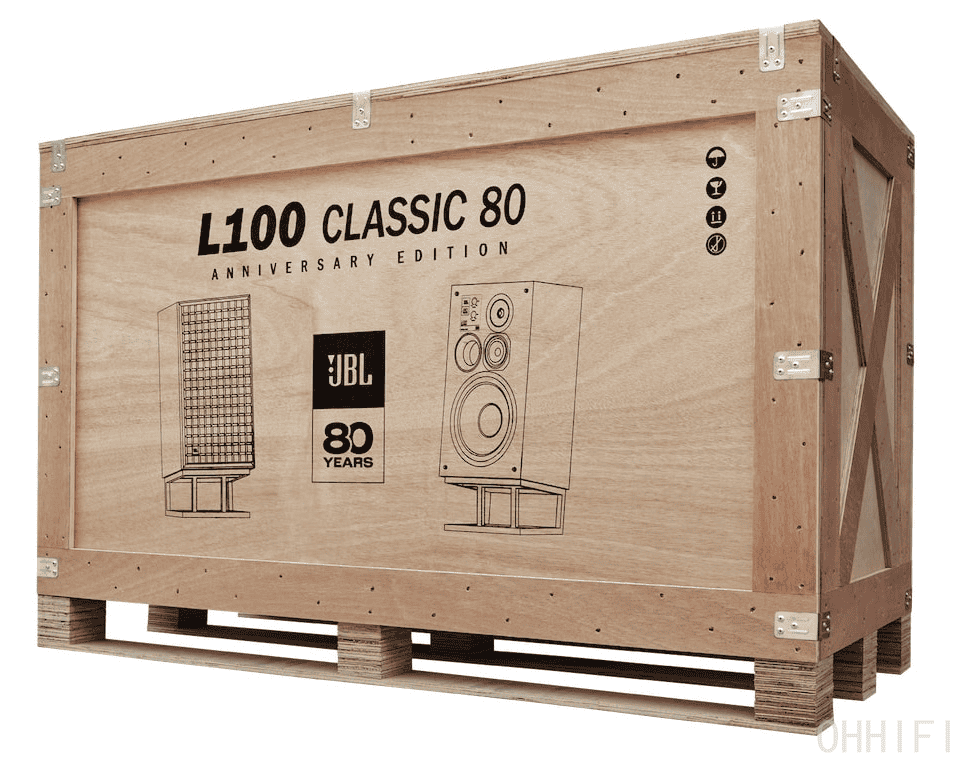
Table 1: Competitor Comparison
| Feature | JBL L100 Classic 80 | Klipsch Heresy IV | Harbeth C7ES-3 XD | Wharfedale Linton |
| Price (Pair) | ~$7,500 (Limited) | ~$3,200 | ~$4,800 | ~$1,800 (w/ stands) |
| Type | 3-Way Bass Reflex | 3-Way Acoustic Suspension | 2-Way Bass Reflex | 3-Way Bass Reflex |
| Woofer | 12" Pulp | 12" Fiber-Composite | 8" Radial2 | 8" Kevlar |
| Tweeter | 1" Titanium Dome | 1" Titanium Compression | 1" Ferro-cooled Dome | 1" Soft Dome |
| Sensitivity | 90 dB | 99 dB | 86 dB | 90 dB |
| Bass Extension | 40 Hz | 48 Hz | 45 Hz | 40 Hz |
| Sound Signature | Punchy, Neutral, Dynamic | Live, Forward, Shouty | Natural, Warm, Lush | Warm, Relaxed, Smooth |
| Best For | Rock, Pop, Jazz, Electronic | Live Recordings, Rock | Vocals, Acoustic, Classical | Jazz, Easy Listening |
1. JBL L100 Classic 80 vs. Klipsch Heresy IV / Forte IV
This is the classic "West Coast" rivalry. Both use high-efficiency designs and are spiritual successors to 1970s icons.
Bass: The JBL L100 80 digs deeper (40Hz) than the Heresy IV, which rolls off steeply around 48Hz and often requires a subwoofer to feel truly full-range. The JBL’s bass is fuller and richer. To match the JBL's bass, you would need to step up to the Klipsch Forte IV, which uses a 15-inch rear passive radiator.
Dynamics: Klipsch wins on pure sensitivity (99dB!) and "jump factor." The horn midrange on the Heresy is more "shouty" and forward, which can be exciting but fatiguing over time. The JBL is more balanced and refined, less prone to honkiness.
Refinement: The JBL MkII/80th is significantly more neutral. The Klipsch has a distinct coloration (the "cupped hands" horn sound) that is fun but less accurate. The JBL is the better all-rounder for varied genres.
2. JBL L100 Classic 80 vs. Harbeth C7ES-3 XD / Monitor 30.2
The clash of philosophies: California Party vs. BBC Politeness.
Midrange: Harbeth owns the midrange. For vocals, acoustic instruments, and classical music, the Harbeth Radial2 driver offers a level of liquidity, insight, and realism that the JBL can't quite match — an uncompromising sonic signature we recently scrutinized in our Harbeth M40.5 XD2 Review, which asks whether this classic BBC-derived architecture still holds the throne. The JBL sounds slightly 'grainy' or 'textured' by comparison.
Excitement: Harbeths can sound "polite" or even "boring" with hard rock and electronic music. They lack the visceral slam and physical impact of the JBL. If you want to relax to music, buy Harbeth. If you want to experience music, buy JBL.
Imaging: Harbeths disappear better in the room; the JBLs always remind you where the sound is coming from due to their wide baffle.
3. JBL L100 Classic 80 vs. Wharfedale Linton Heritage
The budget disruptor. The Lintons cost roughly 1/4th the price of the L100 80th.
Value: The Lintons are arguably the best value in hi-fi. They offer 80% of the vintage aesthetic and 70% of the sound for a fraction of the cost.
Performance: The JBLs have tighter bass, clearer highs, and significantly better dynamics. The Lintons are warmer, softer, and more "forgiving," but they can sound "boxy" and congested at high volumes where the JBLs keep singing. The JBL is the superior speaker, but the Linton is the smarter purchase for budget-conscious listeners.
Part VIII: Market Analysis and Value Proposition
At $7,499, the L100 Classic 80 is an investment. It is roughly $2,700 more expensive than the standard L100 Classic MkII ($4,800/pair).
The Premium: You are paying approximately $2,700 for the California Oak veneer, the limited edition badging, the Chris Hagen signature, the wooden shipping crate, and the exclusivity of the 800-unit run.
Sonic Value: Acoustically, you get the exact same sound as the $4,800 MkII. From a pure performance-per-dollar perspective, the standard MkII is the smarter buy.
Collector Value: However, JBL limited editions have a history of appreciation. The 75th Anniversary Edition (Teak) sold out quickly and now commands prices near or above its original MSRP on the secondary market. The audio market loves exclusivity. For the enthusiast who wants a centerpiece that doubles as an asset, the 80th is justifiable. It is not just a speaker; it is furniture and history.
Part IX: Conclusion — The Legend, Refined
The JBL L100 Classic 80th Anniversary Edition is a triumph of balance. It successfully navigates the treacherous waters between nostalgia and performance. It looks like a 1970s relic, but it sounds like a 2026 high-end transducer.
It is not the most neutral speaker in the world—it has a personality. It is bold, forward, and exciting. It demands your attention. It makes you want to pull out record after record, turning the volume knob slightly to the right with each track. It brings the energy of the live performance into the living room in a way that polite, "accurate" audiophile speakers simply cannot.
For the rock fan, the jazz aficionado, or the lover of dynamic sound, the L100 Classic 80 is an endgame speaker. The MkII updates have polished the rough edges, leaving a gem that sparkles with detail without glaring with harshness. While the price premium over the standard model is steep, the exclusivity and the exquisite Oak finish make it a compelling package for the collector.
Pros:
Visceral, punchy bass that energizes the room without bloat.
Improved, non-fatiguing titanium tweeter (MkII spec) with excellent dispersion.
Exquisite limited-edition California Oak finish and "furniture grade" build quality.
Flexible room integration via L-pad attenuators.
High sensitivity makes amplifier matching easy (tube or solid state).
High collector value potential.
Cons:
Significant price premium ($2,700) over the sonically identical MkII.
"Bookshelf" designation is misleading; requires large footprint and specific stands.
Imaging is precise but not as "holographic" as narrow-baffle modern competitors.
Aesthetic is polarizing—you have to love the retro look.
Final Verdict:
If you missed the L100 Classic 75, do not miss the 80. While the standard MkII offers the same acoustic thrills for less, the 80th Anniversary Edition is a piece of history—a celebration of eight decades of making the world sound larger than life. It is, quite simply, the best version of the most iconic speaker of all time.
Technical Specifications
| Feature | Specification |
| System Type | 3-way bookshelf loudspeaker with front-firing port |
| Woofer | 12-inch (300mm) cast-frame Pure Pulp cone (JW300SW-8) |
| Midrange | 5.25-inch (130mm) Polymer-coated Pure Pulp cone (JM125PC-8) |
| Tweeter | 1-inch (25mm) Titanium dome with acoustic lens waveguide (JT025Ti2-4) |
| Impedance | 4 Ohms |
| Sensitivity | 90dB (2.83V/1m) |
| Frequency Response | 40Hz – 40kHz (-6dB) |
| Crossover Frequencies | 450Hz, 3.5kHz |
| Controls | MF and HF Attenuators |
| Connectors | Dual Gold-plated Binding Posts (Bi-wire capable) |
| Finish | Natural California Oak Veneer |
| Grille | Brown Quadrex Foam with Black Satin Wood Frame |
| Dimensions (HxWxD) | 25.06 x 15.34 x 14.625 inches (636.52 x 389.64 x 371.48mm) |
| Weight | 63 lbs (28.6 kg) each |
| Global Limit | 800 Pairs |


Comments