
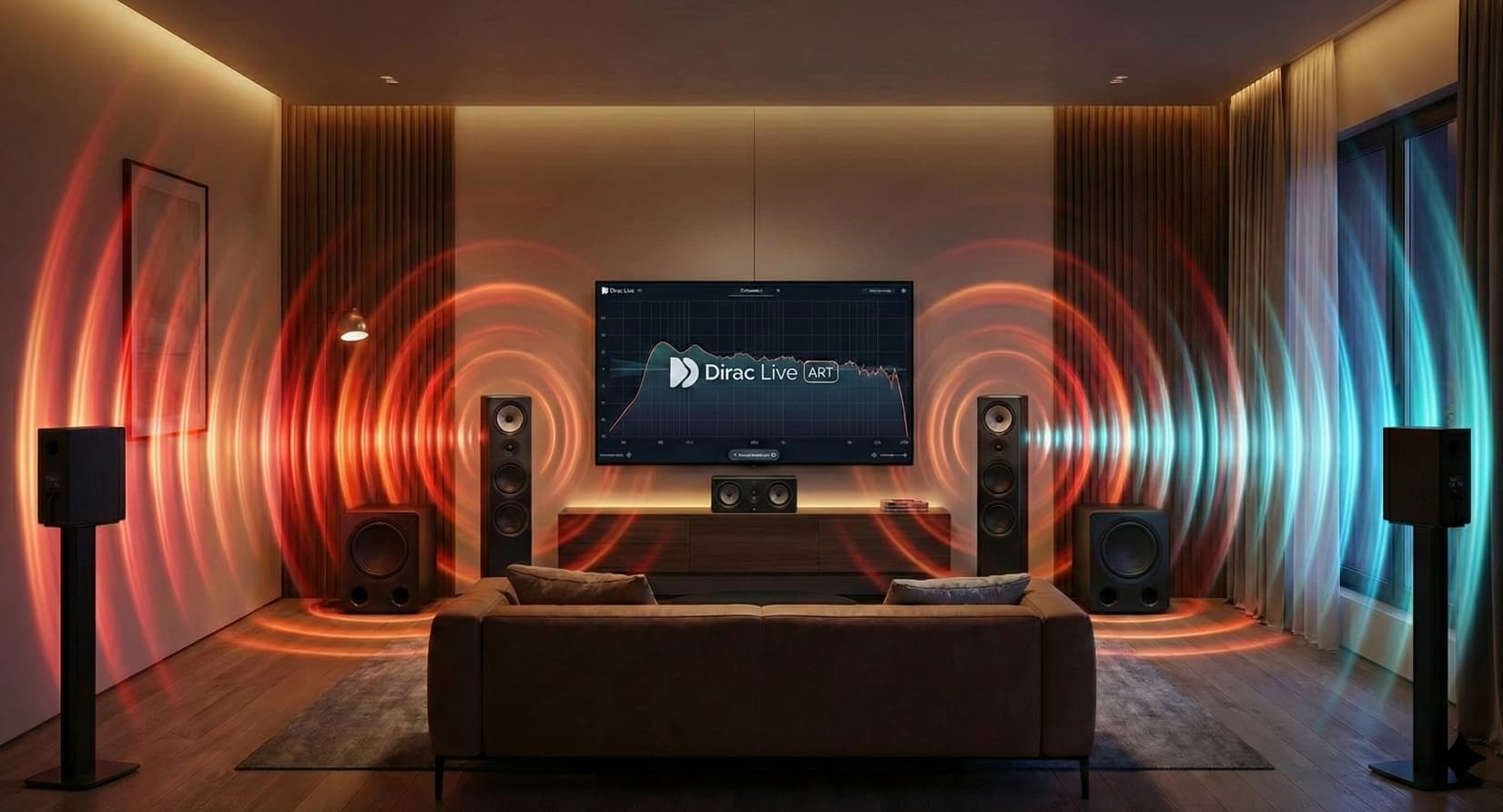
Dirac Live ART Review: Is Active Room Treatment the Future of Home Audio?

If you hang around audio forums long enough, you know the old adage: The room is the most important component in your system. You can spend $50,000 on speakers, but if your room has the acoustic properties of a tiled bathroom, it’s going to sound terrible.
For years, the solution has been twofold: ugly physical bass traps (marriage killers) or digital room correction (EQ). Standard Dirac Live has been the king of the hill for the latter, smoothing out frequency response curves. But it had a limit—it couldn’t fix time.
Enter Dirac Live Active Room Treatment (ART). It promises to do what was previously thought impossible: use your speakers to actively cancel out room resonances. But does it actually work, or is it just more marketing snake oil?
The "Mud" Problem
To understand why ART matters, we have to talk about decay.
When a kick drum hits in a movie or a track, the sound wave bounces off your walls. In most rooms, bass frequencies linger. They bounce back and forth, creating "standing waves." This creates a muddy, booming sound where the bass from the last note covers up the detail of the current note. This is often called "modal ringing."
Traditional EQ (like Audyssey or standard Dirac) tries to fix this by turning down the volume at those booming frequencies. It helps, but it doesn't stop the ringing. The energy is still bouncing around; it's just quieter.
How ART Works: The "Anti-Noise" Concept
Dirac Live ART does something radically different. It treats your speaker setup as a unified ecosystem rather than individual boxes.
It utilizes the idle speakers in your system to emit anti-signals that cancel out the lingering energy from the main speakers. Think of it like noise-canceling headphones, but for your entire room.
When your subwoofer fires a massive 40Hz wave, it hits the listener.
Ideally, that wave should stop immediately. But in a real room, it keeps bouncing.
With ART, your rear surround speakers (or other subs) might emit a precise, inverted signal to "catch" and kill that wave before it can bounce back.
The Setup Experience
Let’s be real: setting this up is not a five-minute job.
If you thought standard Dirac was finicky, ART adds another layer. You need a compatible processor (currently limited mostly to high-end gear like StormAudio, though trickling down to Denon/Marantz flagships). You also need a decent channel count—ART needs "support" speakers to work its magic.
The calibration process takes time. You are measuring how every speaker interacts with every other speaker. But the software interface is surprisingly intuitive, grouping speakers into "support" clusters.
The Listening Test: Does it "Slap"?
So, does it work? Yes. And the difference is startling.
Comparing Dirac Live Bass Control (DLBC) directly against ART, the change isn't in the frequency curve—both look flat on a graph. The difference is in the texture.
1. The "Tightness" Factor: The bass tightens up immediately. The "bloat" or "overhang" that you didn't even realize was there disappears. A double-bass pluck sounds like a wooden instrument with texture, not just a low-frequency hum. Transients are faster. The attack is sharper.
2. The Sweet Spot Expansion: Usually, there’s one "money seat" in a home theater. ART effectively democratizes the room. Because it kills the standing waves, the bass response becomes much more consistent across the sofa. You don't get that head-in-a-vise pressure variance when you move two feet to the left.
3. Removing the "Small Room" Sound: This is the most subtle but impressive part. By removing late reflections and decay, the walls seemingly disappear. The soundstage opens up because your brain isn't processing the acoustic signature of your 12x14 drywall box. It sounds like a much larger, treated studio.
The Caveats (It’s Not All Sunshine)
Before you rush out to upgrade, here is the reality check:
The "Dead" Room Risk: If you crank the ART settings too aggressively, you can suck the life out of the room. A totally dead room sounds unnatural. You need to dial it in to keep a bit of "air."
Hardware Limitations: You can't cheat physics entirely. Small surround speakers can only do so much to cancel out a massive 18-inch subwoofer. You need capable speakers all around for the best results.
Cost: Right now, the entry fee is high. You are paying for the license and the premium hardware to run it.
The Verdict
Is Active Room Treatment the future?
Absolutely.
For decades, we’ve been trying to fight room acoustics with heavy fiberglass panels and crude EQ. ART is the first technology that feels like a generational leap. It doesn't just EQ the sound; it cleans up the time domain, which is arguably more important for high-fidelity audio.
It won't replace physical treatment entirely—you still want some diffusion and absorption for mid/high frequencies—but for the difficult bass region (below 150Hz), it renders massive bass traps largely obsolete.
If you are a casual listener, the cost might not be justifiable. But for the serious enthusiast chasing that "perfect" transient response and holographic bass, there is no going back.




Comments