

Do You Really Need a Dedicated Headphone Amp?

You finally buy the headphones you've been reading about for weeks — maybe a pair of Sennheiser HD 600s, or a planar model from HiFiMan. You plug them in, hit play, and wait to be impressed.
They sound good. Really good, even. And then the doubt creeps in.
You scroll through a forum thread, and someone you've never met leaves a comment: "You're not hearing what these can really do. You need more power — you need a proper amp." The satisfaction fades, replaced by the familiar itch to upgrade. Is your source holding you back?
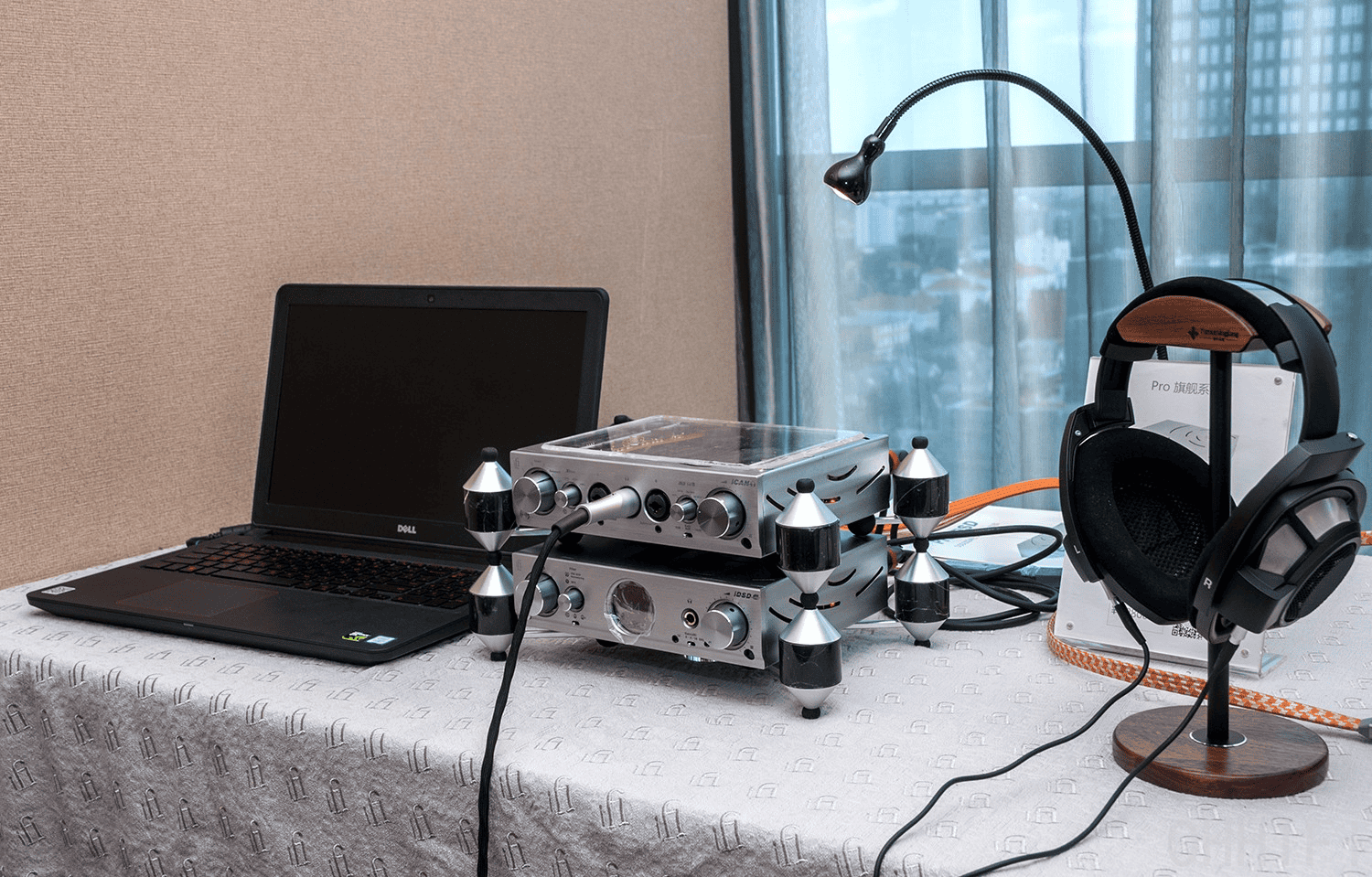
It's one of the oldest questions in the hobby. Ten years ago the answer was usually simple: no, a laptop's headphone jack probably wasn't enough. But things have changed. We now have small, capable "dongle" DACs, and motherboards with far better onboard audio than before. So do you actually need a separate amplifier? Let's set the marketing aside and look at what really matters.
Start with what you already own
Before buying anything new, it's worth taking stock of your current setup. Built-in audio has come a long way, and what you already have may be enough.
The Apple dongle as a reference point
Apple's USB-C to 3.5mm adapter is more than a passive cable. Inside is a small but genuinely competent DAC and amplifier, and it has become an informal benchmark precisely because it punches above its size and price. Measurements put its output at around 1 volt RMS, with a very low output impedance and a clean noise floor that holds its own against dedicated hardware from a few years back.
One thing worth knowing, especially in Europe: there are two versions of this adapter. The US model outputs roughly 1 V RMS, while the EU model is limited to about half that (~0.5 V) to comply with European volume-limit regulations. If power matters to you, the US version is the stronger of the two.
For sensitive in-ears, or efficient headphones like the Audio-Technica M50x, the dongle is usually all you need for clean, transparent playback. Any hiss you hear is more likely baked into the recording than added by the adapter.
Modern laptops and computers
If you own a recent Mac — the 14- and 16-inch MacBook Pro from 2021 onward, and the MacBook Air models that followed — its headphone jack deserves a closer look. These machines detect the impedance of whatever you plug in and adjust their output to match:
- Below about 150 Ω, the jack behaves like a normal output, supplying up to roughly 1.25 V RMS.
- From 150 Ω up to 1 kΩ, it switches into a higher-voltage mode and delivers up to 3 V RMS.
To put that in perspective, 3 volts is enough to drive a high-impedance pair like the Sennheiser HD 600 to loud listening levels with headroom to spare. In a case like that, adding an entry-level amp may not change much electrically.
Why "power" is the wrong thing to focus on
So why do some headphones sound flat or weak on certain sources? The problem usually isn't raw power — it's the kind of power being asked for. A rough analogy: voltage is like water pressure, and current is the rate of flow. Different headphones lean on one more than the other.
High-impedance headphones (Sennheiser, Beyerdynamic)
Models in the 300 Ω to 600 Ω range get a reputation for being "hard to drive," and that's only half right. High impedance restricts how much current can flow, so what these headphones mainly want is voltage.
Plug a 600 Ω Beyerdynamic DT 880 into a low-voltage source like a phone, and it can sound thin and underpowered. But feed it from something that swings 2 volts or more — which many modern motherboards and laptops manage — and it usually has plenty to work with. It isn't about huge amounts of power; it's about enough voltage.
Low-impedance, low-sensitivity headphones (many planars)
This is where the confusion tends to start. Planar magnetic headphones — the HiFiMan Sundara, Dan Clark Aeon, Audeze LCD series — frequently have low impedance, often somewhere between 12 Ω and 32 Ω.
Low impedance looks like it should make them easy to drive, but the opposite is often true. Lower resistance allows larger currents to flow, and many phone dongles and built-in outputs are current-limited. They might get loud enough, yet still struggle to supply the current needed for sudden dynamic peaks — particularly in the bass — which shows up as a loss of impact and a slightly flat, compressed feel.
A simple way to remember it
- High impedance (300 Ω+): needs voltage. Easier to satisfy than most people assume.
- Low impedance + low sensitivity (under ~94 dB/mW): needs current. Harder to satisfy than most people assume.
Grouping headphones by what they actually demand
Sorting headphones by their electrical needs is usually more useful than sorting them by price.
Class 1 — Easy to drive
Examples: most IEMs, the Sony MDR-7506, the Audio-Technica M50x. An external amp is typically unnecessary here. These reach high volume on very little power, and an amp may do little except amplify whatever noise the source already has.
Class 2 — Voltage-hungry
Examples: Sennheiser HD 600 / 650 / 6XX, Beyerdynamic DT 880 (250 Ω). Optional. Modern computers often drive these well on their own. A dedicated amp mainly buys extra headroom — handy for very quiet recordings or heavy EQ.
Class 3 — Current-hungry
Examples: HiFiMan Sundara and Edition XS, Dan Clark Aeon, Audeze LCD-X. Recommended. An amp with strong current delivery can tighten things up, especially in the low end, and keep the sound from going thin or strained when the music gets demanding.
Class 4 — Genuinely difficult
Examples: HiFiMan HE6se, Susvara. Necessary. These have very low sensitivity and behave almost like tiny loudspeakers, needing amplifiers that can put out several watts. This is the rare case where serious amplification really isn't optional.
What about "scaling" and the pricier options?
If a well-designed $100 amp already measures cleanly, why would anyone pay more? The honest reasons usually come down to practical engineering, not magic.
Output impedance and damping
A source with high output impedance — some tube amps, certain older PCs — can interact with a headphone and shift its frequency response. A solid-state amp with low output impedance avoids that, letting the headphone sound the way its designer intended.
EQ and headroom
When you apply digital EQ, say a bass boost, you first have to lower the overall digital level to avoid clipping. To bring the volume back up afterward, you need clean gain to spare — that's headroom. A more powerful amp gives you that margin, and it's one of the few upgrades with a clear, measurable benefit.
So, do you need one?
You probably don't need a separate amplifier if:
- Your headphones already get loud and clean from your current source.
- You mostly use efficient headphones with modern devices.
- You don't lean on heavy EQ.
- You hear no hiss or buzz from your source.
It's worth considering one if:
- You own planar magnetic, or other low-sensitivity, low-impedance headphones.
- Your source has audible noise or a weak output.
- You apply substantial EQ.
- You simply like having a physical volume knob.
The bottom line: an amplifier's job is to deliver clean gain — nothing more. It can't pull detail out of a recording that was never captured, and it can't fix a headphone whose tuning you don't enjoy. If your current setup already sounds clear and reaches the volume you want without noise, it's very likely enough. More often than not, putting that money toward more music will be the more rewarding upgrade.




Comments