
Samsung Galaxy Buds3 Pro Review: The Blade Runner of Audio

Introduction: The Stem Renaissance
For the better part of a decade, the True Wireless Stereo (TWS) market has been defined by a singular, visual schism: the "Stem" versus the "Bud." On one side stood Apple, with its iconic white protrusions that became a status symbol as much as an audio device. On the other stood Samsung, the vanguard of the Android ecosystem, who spent five years experimenting with every geometric shape imaginable—from the bean-shaped Buds Live to the spherical Buds2 Pro. Samsung’s resistance to the stem was almost ideological, a refusal to concede that Cupertino’s design language might have ergonomic merit.
That resistance ends now. With the release of the Samsung Galaxy Buds3 Pro, the South Korean titan has not only embraced the stem but sharpened it. This is not a surrender; it is a reinvention. Dubbed the "Blade" design, the Buds3 Pro introduces a prismatic, angular aesthetic that feels less like an imitation of Apple and more like a prop from a Ridley Scott film.
But to judge the Galaxy Buds3 Pro solely on their silhouette would be a profound disservice to the engineering beneath the chassis. This is not merely a cosmetic overhaul. Inside each angular shell lies a two-way hybrid driver system featuring a 10mm dynamic woofer paired with a planar magnetic tweeter—a driver technology typically reserved for high-end audiophile In-Ear Monitors (IEMs) costing significantly more. Driven by dual amplifiers and capable of streaming 24-bit/96kHz audio via the Samsung Seamless Codec (SSC) UHQ, the Buds3 Pro represent the most ambitious acoustic architecture Samsung has ever attempted.
However, ambition often breeds complexity. The launch of the Buds3 Pro was marred by significant quality control issues, specifically regarding fragile ear tips that tore upon removal—a debacle that forced a temporary halt in shipments. Furthermore, the introduction of the angular stem has introduced aerodynamic challenges, leading to widespread reports of wind noise issues that threaten to undermine the active noise cancellation (ANC) performance.
In this exhaustive review, we will dissect every facet of the Galaxy Buds3 Pro. We will move beyond the spec sheet to explore the physics of its planar drivers, the reality of its AI-infused noise cancellation, and whether its "Blade Lights" are a functional innovation or a cyberpunk gimmick. For the audiophile asking if these can dethrone the Sony WF-1000XM5—and how they compare to the newer Sony WF-1000XM6—and for the commuter wondering if they can silence the subway like the Bose QuietComfort Ultra, this is your definitive report.
1. Design Philosophy: Cyberpunk Meets Ergonomics
1.1 The "Blade" Aesthetic
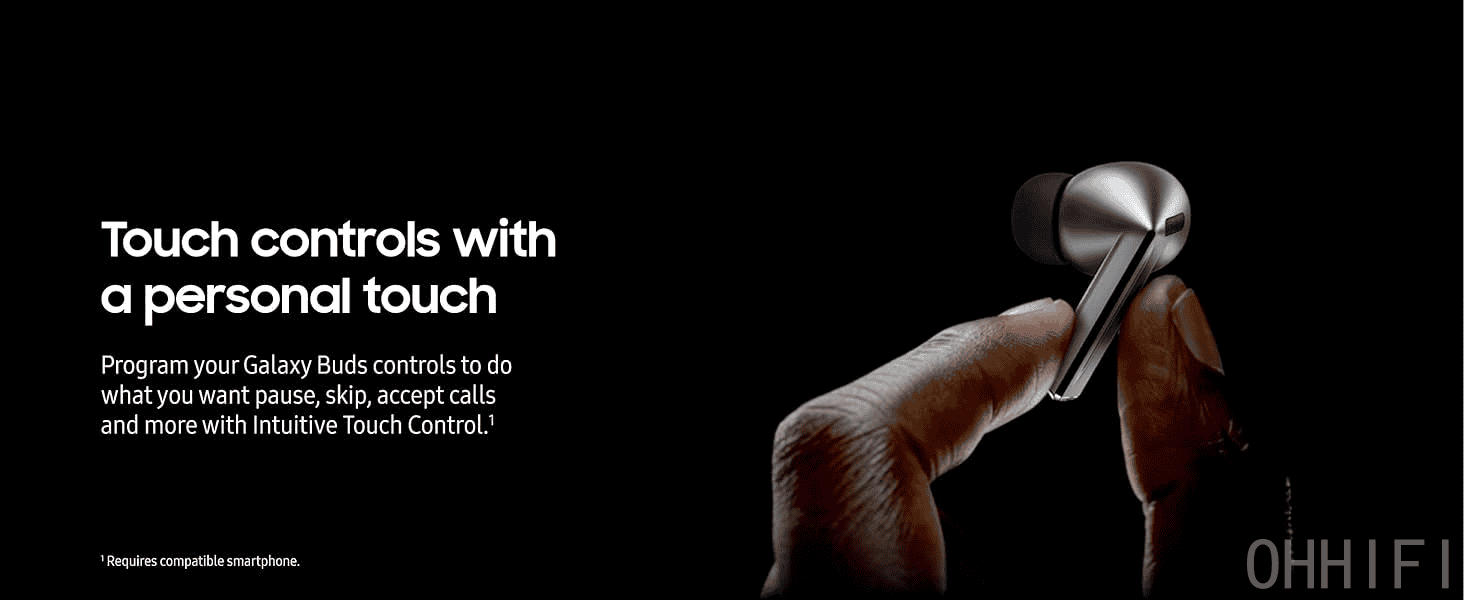
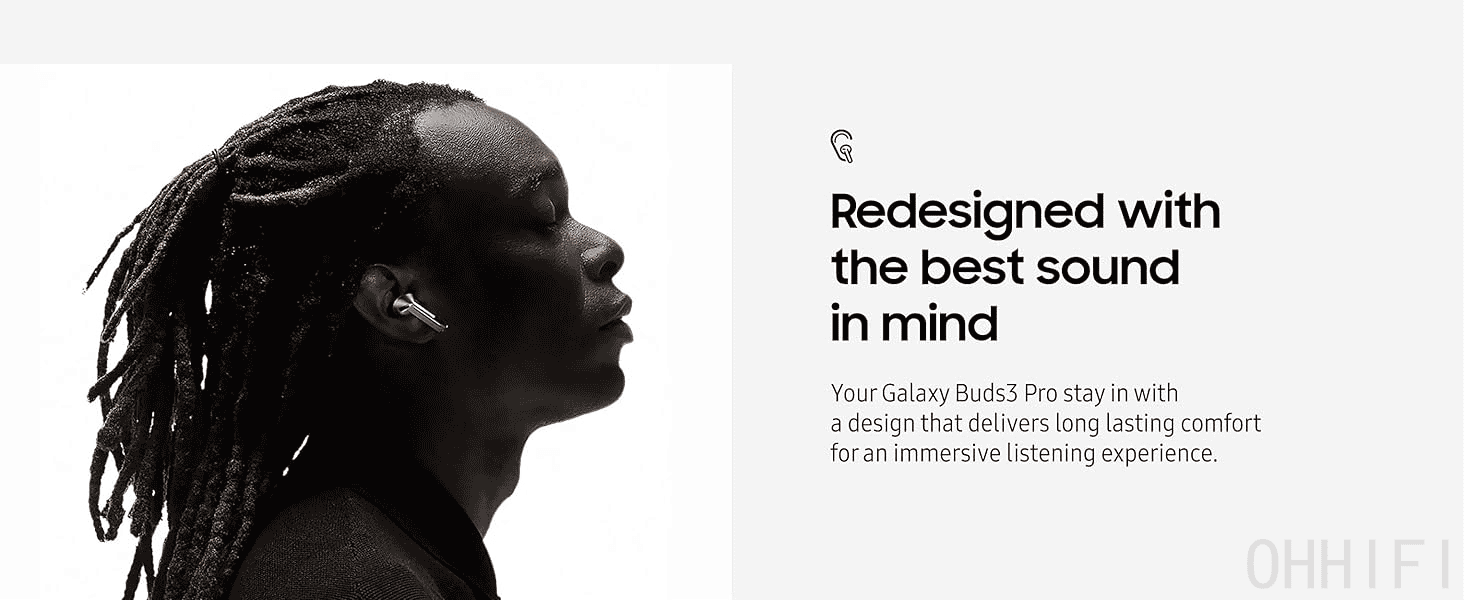
Samsung’s shift to a stem design is rooted in pragmatism. Stems allow for microphones to be placed closer to the mouth, improving call quality, and provide a dedicated surface for touch controls, reducing the accidental inputs that plagued the touch-sensitive surfaces of the Buds2 Pro.
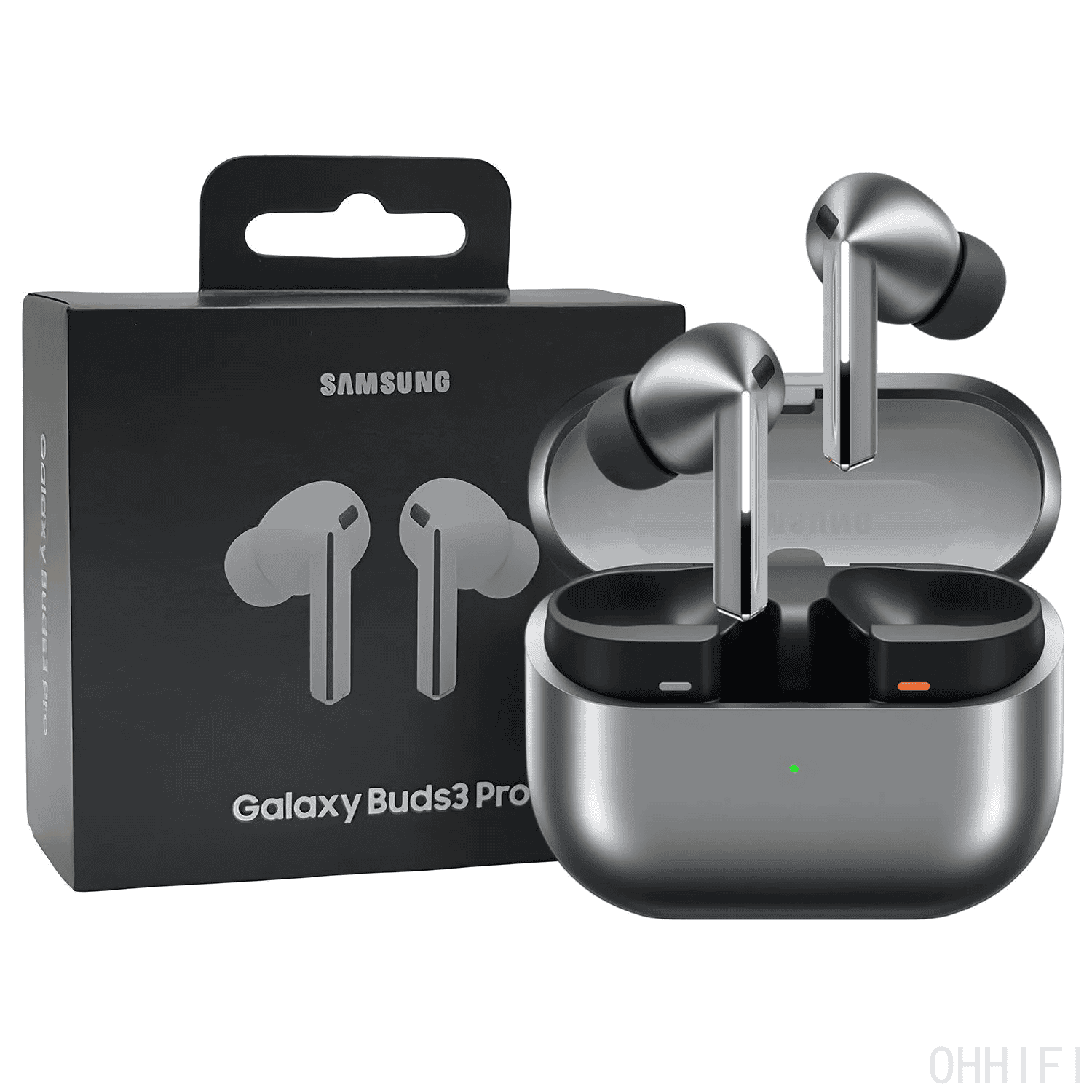
Yet, Samsung refused to make a round stem. The Buds3 Pro feature a triangular prism shape, a brutalist approach that sets them apart in a sea of white plastic cylinders. The finish is available in two colors: a classic White and a metallic Silver. The Silver variant, in particular, leans heavily into the industrial sci-fi aesthetic, often drawing comparisons to the Tesla Cybertruck due to its sharp lines and gunmetal hue.
The visual centerpiece of this design is the Blade Light—a thin LED strip running down the spine of the stem.
Functionality: While purists may dismiss RGB lighting on audio gear as a gaming gimmick, the Blade Lights serve functional purposes. They indicate battery status, pairing mode, and can be set to blink or fade via the Galaxy Wearable app.
Find My Earbuds: In a dark room, toggling the lights to flash makes locating a dropped earbud significantly easier.
Style: Users can choose between steady, blinking, or fading modes, or turn them off completely to save battery.
1.2 The Charging Case: Transparent Retro-Futurism
The charging case continues the design departure. It features a transparent plastic lid, allowing users to verify if their buds are docked without opening the case. This "space age" look is visually distinct, though opinions on the material quality vary. Some reviewers find the plastic feels lightweight and slightly cheap compared to the dense, matte finish of the Sony WF-1000XM5 case.
A notable ergonomic quirk—or flaw, depending on your dexterity—is the orientation of the buds within the case. The buds sit with the stems facing outward and the ear tips facing inward. When you remove them, you must rotate them 180 degrees to insert them into your ears. This fumble-prone maneuver has frustrated users who are accustomed to the intuitive "lift and place" motion of the AirPods Pro. It is a design choice that prioritizes the visual presentation of the Blade Lights through the transparent lid over sheer muscle memory efficiency.
1.3 Ingress Protection: A Class-Leading Standard
Despite the "Pro" moniker often implying fragility, the Buds3 Pro are built for abuse. They carry an IP57 rating.
IP5X (Dust): Protected against dust ingress that could interfere with operation.
IPX7 (Water): Capable of withstanding immersion in fresh water up to 1 meter for 30 minutes.
This is a significant advantage over major competitors like the Sony WF-1000XM5 and Bose QuietComfort Ultra, which typically offer only IPX4 (splash resistance). You can drop the Buds3 Pro in a puddle or rinse them off after a sweaty workout without fear, a reassurance that justifies the premium pricing for active users.
2. The "Tipgate" Controversy: A Quality Control Autopsy
No review of the Buds3 Pro can ignore the disastrous launch period in July 2024. As early units reached consumers, a widespread issue emerged: the silicone ear tips were tearing when users attempted to swap sizes.
2.1 The Failure Mechanism
The Buds3 Pro utilize a proprietary hard plastic ring at the base of the silicone tip that snaps onto the nozzle of the earbud. This design is intended to ensure a secure acoustic seal and prevent the tip from detaching in the ear canal. However, in early batches, the friction between the snap-lock mechanism and the nozzle was too high, or the tensile strength of the silicone was too low.
The Result: When users pulled on the silicone flange to remove the tip, the silicone would rip away from the hard plastic base, leaving the base locked onto the nozzle. Removing the stuck base often required tools, risking damage to the delicate speaker grille.
2.2 Samsung’s Response and Current Status
The backlash was immediate. Samsung suspended shipments to conduct a quality control review and reportedly updated the manufacturing process.
The Fix: Current retail units (post-August 2024) reportedly use a modified material blend or tolerance specification.
User Advisory: Despite the fix, Samsung and reviewers advise a specific removal technique: invert the silicone flange fully, grip the hard plastic base directly with fingernails, and pull gently. Yanking from the silicone umbrella remains risky.
For the prospective buyer, this incident serves as a caution: treat the ear tips with surgical care. While third-party manufacturers like Azla and SpinFit have begun producing compatible tips (e.g., Azla Crystal), the proprietary nozzle shape limits aftermarket options compared to standard round nozzles.
3. Acoustic Architecture: The Planar Revolution
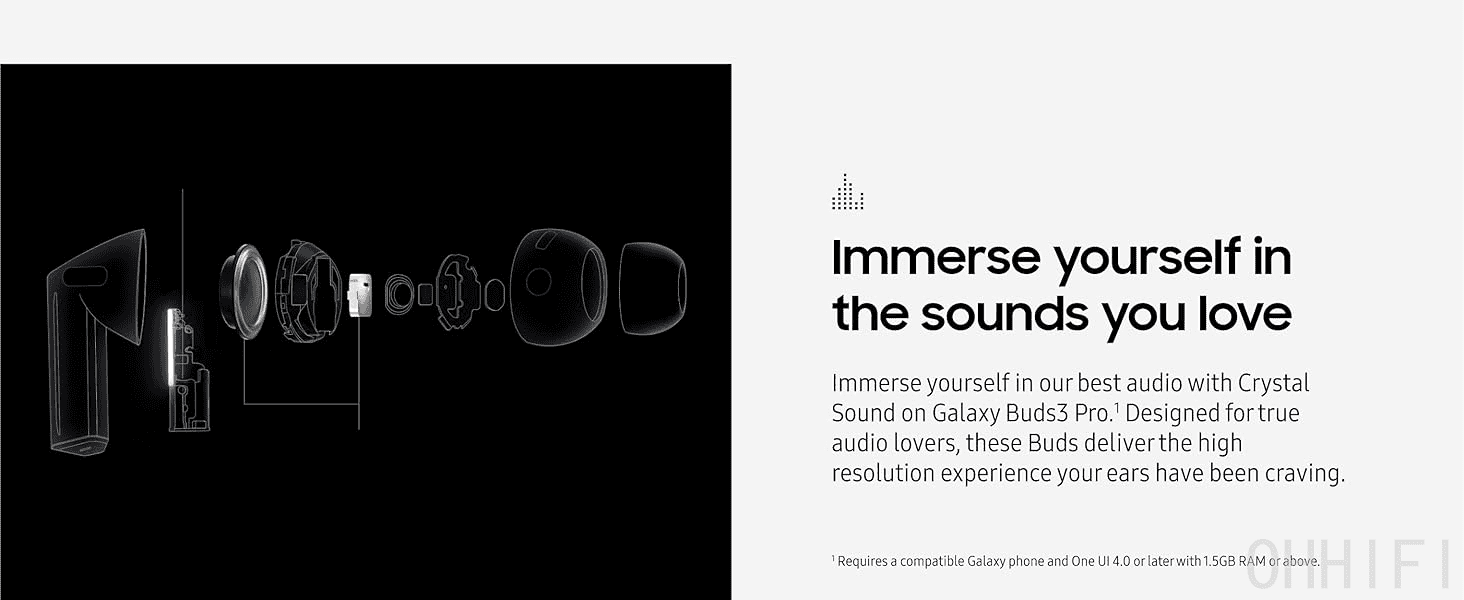
To understand why the Galaxy Buds3 Pro sound the way they do, one must look under the hood. Samsung has implemented a driver topology that is exceedingly rare in the mass-market TWS space.
3.1 The Hybrid Driver Configuration
Most TWS earbuds, including the AirPods Pro 2 and Sony WF-1000XM5, use a single dynamic driver to handle the entire frequency spectrum (20Hz to 20kHz). While effective, single drivers often struggle to reproduce deep sub-bass and sparkling treble simultaneously without distortion, as the diaphragm must move heavily for bass while vibrating rapidly for treble.
Samsung solves this with a 2-Way Hybrid System:
10mm Dynamic Woofer: This driver is dedicated to low and mid frequencies. Dynamic drivers are excellent at moving the volume of air required to create physical, punchy bass.
6.1mm Planar Magnetic Tweeter: This is the headline feature. Planar drivers use a flat, lightweight diaphragm suspended in a magnetic field. Because the voice coil is spread across the diaphragm, it moves with uniform force. This results in incredibly fast transient response—the ability to start and stop sound instantly.
3.2 Dual Amplifiers
Crucially, these two drivers are not just wired together; they are powered by Dual Amplifiers. This active crossover approach ensures that the planar tweeter receives a clean, high-frequency signal without interference from the power-hungry bass notes. This separation allows for a level of instrumental layering and detail retrieval that single-driver systems struggle to match.
3.3 The Signal Chain: Samsung Seamless Codec (SSC) UHQ
Hardware is only as good as the source file. The Buds3 Pro introduce an upgraded version of Samsung's proprietary codec, SSC UHQ.
Resolution: Supports up to 24-bit/96kHz audio sampling.
Bandwidth: While exact bitrates fluctuate dynamically, SSC UHQ aims to rival Sony's LDAC (990kbps) in information density.
The Catch: This is a "Walled Garden" feature. SSC UHQ is exclusively available on Samsung Galaxy smartphones running One UI 6.1.1 or later (e.g., S23, S24, Z Fold 6). Users on Pixel, OnePlus, or iOS devices are relegated to AAC or SBC, effectively bottlenecking the planar tweeter's potential.
4. Sound Quality Analysis: A Sonic Vivisection
4.1 Sound Signature: The "V" with a Sparkle
Out of the box, the Galaxy Buds3 Pro present a lively, energetic V-shaped sound signature. This is a departure from the "Harman Target" neutrality that characterized the Buds2 Pro. The bass is elevated for impact, the treble is boosted for perceived detail, and the midrange is slightly recessed. It is a "fun" tuning designed for modern pop, hip-hop, and EDM, rather than a flat reference tuning for mixing audio.
4.2 Bass Response
The 10mm woofer digs deep. Sub-bass extension (20-60Hz) is visceral. On tracks like Limit to Your Love by James Blake, the sub-bass throb is felt as much as heard, providing a solid foundation without completely muddying the lower mids.
Critique: At higher volumes (above 80%), the bass can lose composure, becoming slightly "boomy" or loose. However, for daily commuting where low-frequency noise cuts bass perception, this boost is often welcome.
4.3 Midrange: The Clean Dip
Due to the V-shape, vocals sit slightly back in the mix. However, the planar tweeter helps here by rendering the upper harmonics of vocals with exquisite clarity. Male vocals have adequate body, but female vocals truly shine, benefiting from the tweeter's speed. Instruments like acoustic guitars retain their texture, though they lack the lush, forward warmth found in the Sony WF-1000XM5.
4.4 Treble: The Planar Advantage
This is the differentiating factor. The planar tweeter delivers highs that are airy, fast, and incredibly detailed. Cymbal crashes decay naturally without the "splashy" metallic artifacting common in Bluetooth audio.
Sibilance: There is a peak around 6-8kHz that emphasizes "S" and "T" sounds. For treble-sensitive listeners, this might be fatiguing over long sessions, but for "treble-heads," it provides a sense of hyper-resolution. The sheer separation allows you to hear the space between instruments in orchestral recordings.
4.5 Soundstage and Imaging
The open nature of the vented design (essential for the ANC) combined with the planar tweeter creates a soundstage that is wider than average for an in-ear monitor. It feels less "in-your-head" and more like a halo around the listener. Imaging is precise; in complex tracks like Bohemian Rhapsody, the panning of the operatic section is tracked with laser focus.
4.6 Audiophile Customization: The 9-Band EQ
For those who dislike the stock V-shape, the Galaxy Wearable app offers a comprehensive 9-band equalizer. This is a massive advantage over the AirPods Pro (which have no manual EQ).
Audiophile Tip: Users on communities like Reddit and Head-Fi have developed "neutral" EQ profiles (often targeting the JM-1 Diffuse Field curve) to flatten the response. A common tweak is to lower the 63Hz band by -1dB to tame the boom and reduce the 4k-8k region by -2dB to smooth out the sibilance.
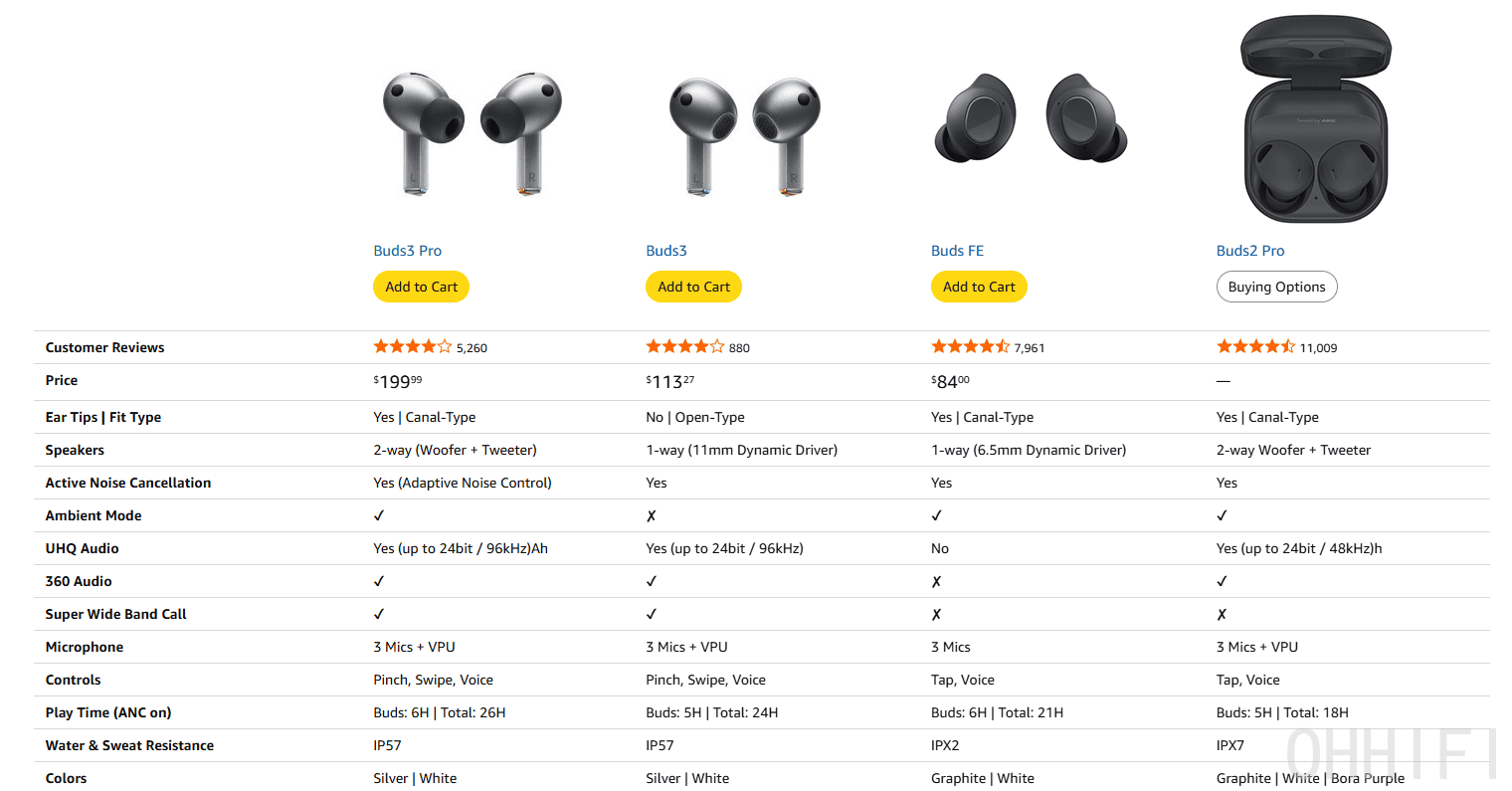
Galaxy Buds Series Comparison
5. Noise Cancellation and the Wind Noise Achilles Heel
5.1 Active Noise Cancellation (ANC) Performance
The Buds3 Pro utilize an adaptive ANC system that claims to block up to 33dB of noise. In practice, the cancellation of low-frequency drones (airplane engines, AC units) is excellent, rivaling the best in the class.
Comparison: While the Sony WF-1000XM5 and Bose QC Ultra still hold the crown for absolute silence (especially in the mid-range voice frequencies), the Buds3 Pro are comfortably in the top tier, blocking approximately 76% of ambient noise in lab tests.
5.2 The Wind Noise Failure
However, there is a significant flaw in the design: Wind Noise. The sharp, angular stems act as airfoils, creating turbulence when wind hits them.
The Experience: Numerous users report that while cycling, running, or even walking on a windy day, the ANC microphones pick up this turbulence and, in an attempt to cancel it, actually amplify the "whooshing" sound.
The Workaround: Unlike the Buds2 Pro, which had a rounded, low-profile design that shed wind effectively, the Buds3 Pro often require users to turn ANC off or switch to a lower intensity setting when outdoors. This is a significant regression for outdoor enthusiasts and a baffling oversight in the aerodynamic design of the "Blade."
5.3 Transparency and Adaptive Mode
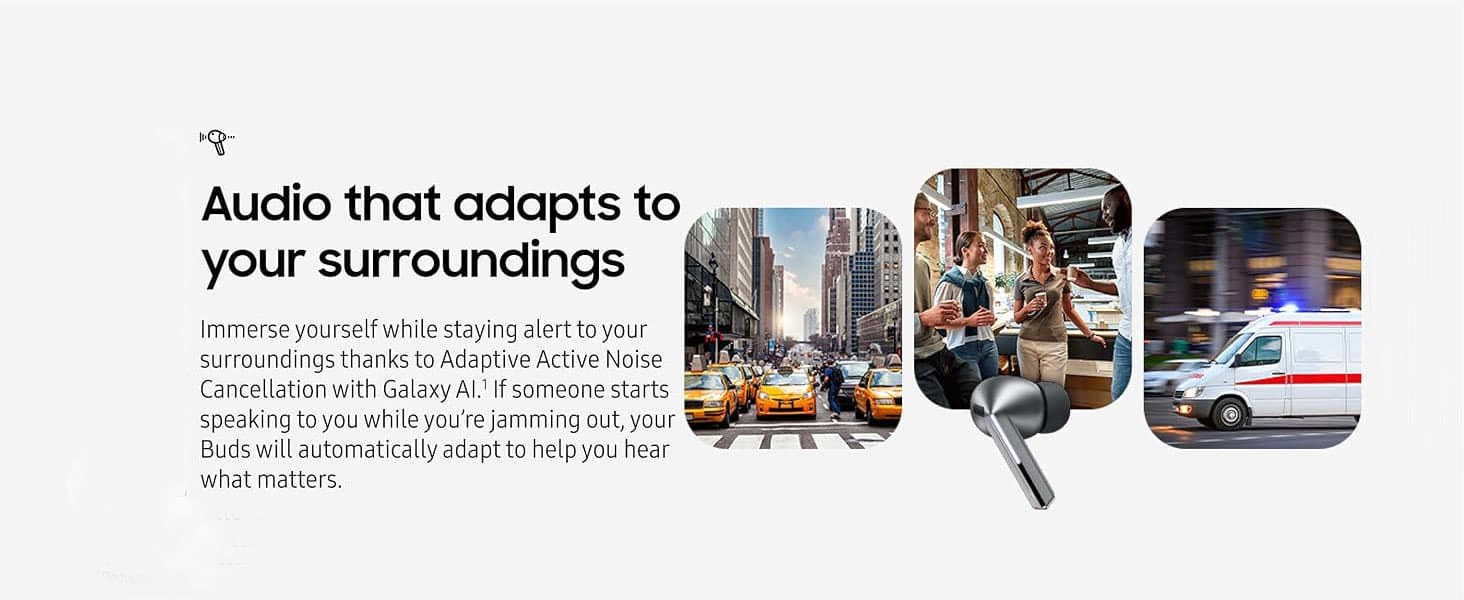
On the flip side, the Ambient Sound (transparency) mode is superb. It sounds natural, lacking the robotic hiss of cheaper models.
Siren Detect: An AI feature that continuously monitors for emergency sirens. If detected while ANC is on, the buds automatically switch to Ambient mode to ensure safety.
Voice Detect: If you start speaking, the buds lower your music and activate transparency. While useful, it can be over-sensitive, triggering when you cough or clear your throat.
6. Ecosystem Integration: The Walled Garden
The Galaxy Buds3 Pro are designed to function as an extension of the Samsung Galaxy smartphone. If you own a Pixel or an iPhone, you are paying for features you cannot use.
6.1 Exclusive Features
360 Audio with Head Tracking: This creates a spatial surround effect that tracks your head movement. It works best with movies but can sound artificial with stereo music.
Real-Time Interpreter: Leveraging Galaxy AI, this feature allows for near-simultaneous translation. In "Listening Mode," you can leave your phone on a table to capture a lecture in a foreign language, and the translation is whispered into your ears.
Auto Switch: The buds intelligently switch between your Galaxy phone, Galaxy Tab, and Galaxy Book based on usage (e.g., pausing a movie on the tablet to take a call on the phone).
6.2 The Dolby Atmos Conflict
A peculiar software conflict exists between Samsung's 360 Audio and the system-level Dolby Atmos setting on Galaxy phones.
The Issue: Enabling 360 Audio often overrides the Dolby Atmos for Headphones setting. Audiophiles generally prefer the system Dolby Atmos (set to "Music" mode) as it provides a cleaner, object-based spatial effect without the aggressive reverb and phase processing of Samsung's 360 Audio.
Recommendation: For music listening, leave 360 Audio OFF and enable Dolby Atmos in the phone's sound settings for the most natural soundstage.
7. Call Quality: Super Wide Band (SWB)
The move to stems has paid dividends for microphone performance. The Buds3 Pro utilize a "Super Wide Band" (SWB) protocol (over HFP 1.9) to transmit speech at 16kHz, double the bandwidth of standard Bluetooth calls.
Quiet Rooms: Your voice will sound rich, full, and podcast-like. The "robotic" compression artifacts are largely gone.
Noise Rejection: The VPU (Voice Pickup Unit) and beamforming mics do an excellent job of cutting out coffee shop chatter. However, as with the ANC, strong winds can cause the noise gate to struggle, leading to choppy voice transmission outdoors.
8. Battery Life and Charging
If there is a mediocrity in the Buds3 Pro package, it is battery endurance.
ANC On: Expect around 5 to 6 hours of continuous playback.
ANC Off: Pushes to around 7 hours.
Comparison: This is acceptable but unimpressive compared to the Sony WF-1000XM5 (8 hours + ANC) or the Master & Dynamic MW09 (12 hours).
Case: The case provides roughly 3-4 full recharges, bringing total time to ~26-30 hours.
Charging: USB-C and Qi wireless charging are standard. The case supports fast charging (10 mins = ~1 hour play). Note that leaving the Blade Lights on "steady" will drain the battery faster.
9. Competitive Landscape: The Battle of the Flagships
9.1 vs. Sony WF-1000XM5
Sound: The Sony is warmer, darker, and smoother. The Samsung is brighter, punchier, and more detailed in the treble.
ANC: Sony wins. The foam tips and QN2e processor create a superior seal against the world.
Fit: Samsung wins for comfort. The Sony buds require deep insertion with foam tips that can be fatiguing; the Buds3 Pro sit lighter in the ear.
Verdict: Buy Sony for commuting and noise isolation. Buy Samsung for energetic sound and Galaxy integration.
9.2 vs. Apple AirPods Pro 2 (USB-C)
Sound: Apple is neutral and safe. Samsung is aggressive and customizable. Samsung's EQ gives it the edge for tweakers.
Transparency: Apple remains the gold standard for "invisible" transparency mode. Samsung is 95% there but Apple is 100%.
Verdict: Platform choice dictates the winner. Using Buds3 Pro on an iPhone is a crippled experience (no app, no firmware updates), just as AirPods are limited on Android.
9.3 vs. Bose QuietComfort Ultra
ANC: Bose is the undisputed king of silence.
Sound: Bose is bass-heavy and sculpted. Samsung offers better detail and instrument separation thanks to the planar tweeter.
Verdict: If your primary goal is silencing a jet engine, buy Bose. For everything else, Samsung is the more versatile all-rounder.
Conclusion: A Sharper Image
The Samsung Galaxy Buds3 Pro are a fascinating, flawed masterpiece. They represent a bold engineering risk—bringing planar magnetic technology to the mass market—that pays off handsomely in sonic performance. The treble detail, soundstage, and instrument separation are, quite simply, addictive. For the Galaxy smartphone owner, the ecosystem integration (Interpreter, SSC UHQ, seamless switching) makes them an indispensable tool.
However, the "Blade" design is a double-edged sword. While visually striking and ergonomically sound for controls, its angularity invites wind noise that hampers outdoor utility. The launch-day quality control issues with ear tips have left a scar on consumer trust that Samsung must work to heal. And the strict gating of high-res codecs to Samsung devices limits their appeal to the wider audiophile community.
If you live within the Samsung ecosystem and prize musical detail above all else, the Buds3 Pro are the best earbuds you can buy today. They are not just an answer to the AirPods Pro; they are a challenge to the entire industry to stop playing it safe with single drivers and start innovating.
Pros:
Superb clarity and detail via dual-driver (Planar+Dynamic) setup.
Excellent 9-band EQ and customization options.
IP57 rating offers top-tier durability.
"Blade Lights" offer unique utility and style.
Comfortable, secure fit for long sessions.
Cons:
Wind noise issues due to angular stem design.
Battery life is merely average compared to Sony.
Hi-Res (SSC UHQ) and AI features locked to Samsung phones.
Ear tip removal requires extreme care (QC legacy).
360 Audio conflicts with system Dolby Atmos settings.
Final Verdict: 4.5 / 5 Stars
Technical Specifications
| Feature | Specification |
| Driver Unit | 2-Way: 10mm Dynamic (Woofer) + 6.1mm Planar (Tweeter) |
| Microphones | 3 High-SNR Mics + VPU (Voice Pickup Unit) |
| Processor | BES2700 (High-Performance Audio SoC) |
| Connectivity | Bluetooth 5.4 / LE Audio / Auracast |
| Codecs | Samsung Seamless Codec (SSC) UHQ (24bit/96kHz), AAC, SBC |
| Sensors | Accelerometer, Gyro, Hall, Pressure, VPU |
| Battery | Earbuds: 53mAh (6hr ANC) / Case: 515mAh (26hr Total) |
| Durability | IP57 (Dust and Water Resistant) |
| Dimensions | Earbud: 18.1 x 19.8 x 33.2 mm / 5.4g |
| Price | $249.99 / £219.00 |



Comments