
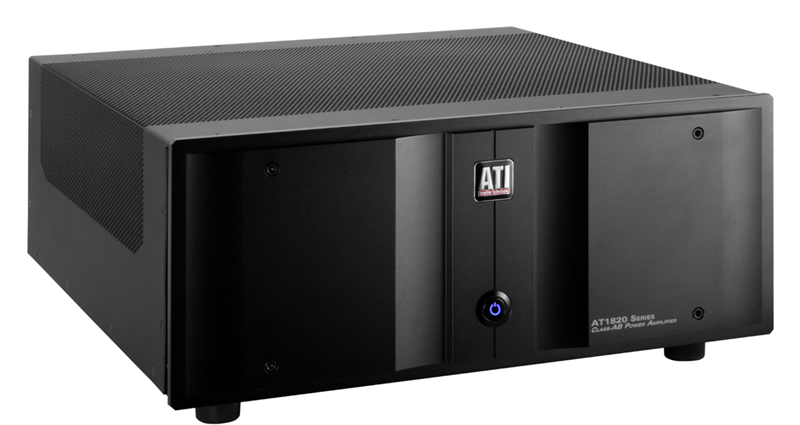
The Heavyweight Champion of Home Theater: A Deep-Dive Review of the ATI AT1827

1. Introduction: The Case for Heavy Metal
In an era where technology relentlessly marches toward miniaturization—where Class D modules shrink massive power into the size of a paperback book and switching power supplies replace heavy copper transformers—there is something reassuring, almost defiant, about the ATI AT1827. It is a monolith in every sense of the word (and ironically, the progenitor of the Monolith brand itself). It weighs nearly 100 pounds. It occupies a massive footprint. It runs warm. It is built not with the delicate touch of modern efficiency, but with the brute force of traditional American engineering.
For the uninitiated, Amplifier Technologies Inc. (ATI) might not be a household name like Sony or Denon. But for those who live and breathe home theater, ATI is the wizard behind the curtain. Founded by industry legend Morris Kessler, ATI has spent decades designing and manufacturing amplifiers for some of the most prestigious names in high-end audio. If you have owned a high-power amplifier from an American boutique brand in the last twenty years, there is a strong probability it rolled off ATI’s assembly line in Montebello, California.

The AT1827 is the seven-channel flagship of the AT1820 series. It represents a "sweet spot" in the market: significantly more powerful and capable than any AV receiver (AVR), yet attainable compared to the stratospheric pricing of the company's "Signature" series. It promises 200 watts per channel of pure, unadulterated Class AB power. But in 2026, does "heavy iron" still hold the crown against the new wave of hyper-efficient competitors?
This comprehensive review will dissect the AT1827 from every angle—engineering, installation, sonic performance, and its complex relationship with its OEM cousins—to determine if this American giant is still the king of the ring.
2. The Philosophy of Power: Why Separates Matter
To understand the AT1827, one must first understand the limitations it solves. The modern AV Receiver is a miracle of integration, combining processing, switching, and amplification into a single box. However, physics is a cruel mistress. As channel counts have exploded with the advent of Dolby Atmos and DTS:X—moving from 5.1 to 7.1.4 and beyond—the demands on a single chassis have become untenable.
When an AVR claims "140 Watts per channel," there is almost always an asterisk: driven into 2 channels only. When driving 7 or 9 channels simultaneously during a complex action scene, the shared power supply of an AVR often sags, dropping the real-world output to a fraction of the spec. The result? Collapsed dynamics, muddied dialogue, and a soundstage that feels small and constrained.
The AT1827 is the antidote to this compromise. By offloading the amplification to a dedicated chassis with its own massive power reserves, the system gains:
Headroom: The ability to handle massive dynamic peaks (explosions, orchestral swells) without clipping.
Separation: Reduced electrical interference between sensitive digital processing boards and high-current amplifier rails.
Control: High current delivery to grip the speaker drivers, starting and stopping them with precision (damping factor).
ATI’s approach to this solution is classic: Big transformers, big capacitors, and big heat sinks. It is a philosophy that prioritizes sound quality and reliability over convenience and weight savings.

3. Engineering and Design: Inside the Beast
3.1 The Kessler Heritage
Morris Kessler, the founder of ATI, is a pivotal figure in the history of American audio. His lineage traces back to SAE (Scientific Audio Electronics), a brand that defined the "muscle amp" era of the 1970s. The DNA of the AT1827 is directly linked to this heritage, as well as to designs ATI manufactured for B&K Components. Enthusiasts often note "B&K vibes" when looking at the internal layout of ATI amps, citing the vertical card structure and robust build.
The AT1827 is not a radical reinvention of the wheel; it is a refinement of a proven formula. It avoids the "component of the month" syndrome, opting for parts and topologies that have stood the test of time. This conservatism is a feature, not a bug. It ensures that the amplifier will likely outlast the processor it is connected to, and potentially the owner themselves.
3.2 Class AB Topology Explained
The AT1827 utilizes a fully complementary Class AB design.
Class A offers the purest sound by keeping transistors fully "on" all the time, eliminating switching distortion. However, it is incredibly inefficient and hot.
Class B switches transistors on and off to save power but introduces "crossover distortion" where the signal hands off between push and pull devices.
Class AB is the hybrid standard for high-fidelity. It operates in pure Class A for the first few watts—where the majority of critical listening detail resides—and switches to Class B operation only for high-power peaks.
While Class D (switching) amplifiers have made massive strides in recent years with modules from Hypex and Purifi offering ruler-flat measurements, many audiophiles still prefer Class AB. The argument is often subjective: Class AB is described as having a "warmer," "fuller," or more "organic" presentation, particularly in the treble region, compared to the perceived "dryness" of Class D. The AT1827 adheres strictly to this analog tradition.
3.3 The Power Supply: The Engine Room
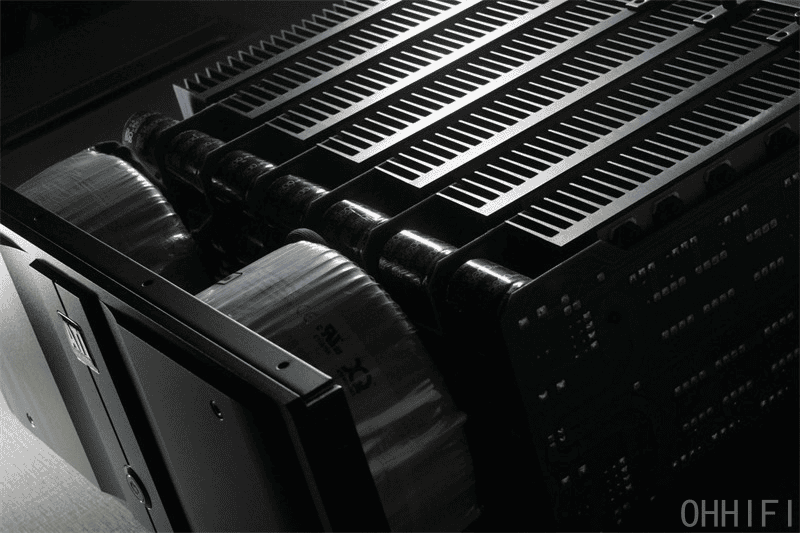
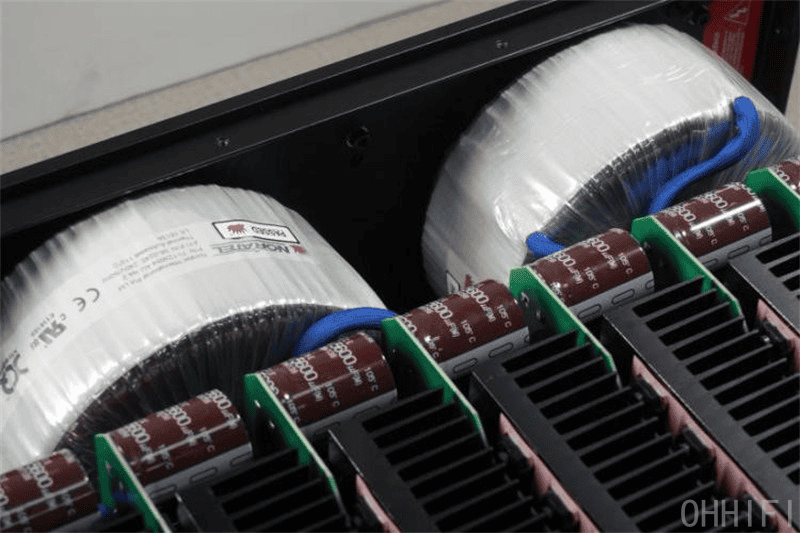
The heart of the AT1827 is its power supply. Unlike mass-market gear that uses EI-core transformers, the AT1827 employs two massive toroidal transformers. Toroidal (donut-shaped) transformers are more efficient and, crucially for audio, have a much lower magnetic stray field. This reduces the likelihood of "hum" being induced into nearby circuits.
These transformers are wound in-house at ATI’s factory in Southern California. This vertical integration allows ATI to ensure the quality of the magnetic core and the winding geometry—details that are often lost when outsourcing to generic suppliers.
Supporting the transformers is a massive capacitor bank. The AT1827 features 22,400 microfarads (µF) of capacitance per channel. In a 7-channel amp, that is a staggering total energy reservoir. These capacitors act like batteries, storing instantaneous power. When a movie soundtrack demands a sudden, massive transient—like the crack of a gunshot or the thud of a T-Rex footstep—the power supply doesn't need to wait for the wall outlet; it draws from this reservoir. This capability is what gives the amplifier its "slam" and dynamic impact.
3.4 Thermal Management: Passive Cooling
One of the most critical design choices in the AT1820 series is the cooling system. The AT1827 is passively cooled. There are no fans.
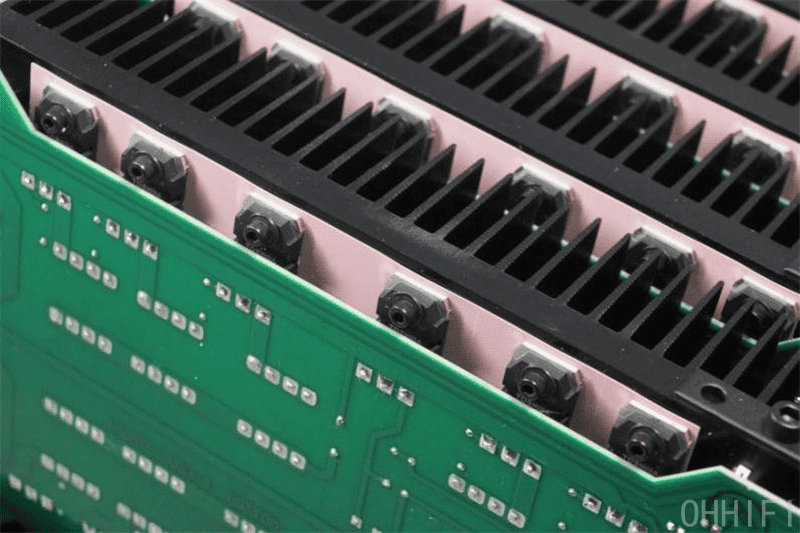
In a dedicated home theater, the noise floor of the room is paramount. The whir of a cooling fan during a quiet, suspenseful scene breaks the immersion. By using massive extruded aluminum heat sinks that run the entire depth of the chassis, ATI eliminates this noise source entirely.
The internal layout facilitates this: amplifier cards are mounted vertically, with the heat sinks facing the center or sides, creating a "chimney" effect. As the amp warms up, hot air naturally rises, pulling cool air in from the bottom vents. This requires the user to leave adequate ventilation space above the amp (we recommend at least 3 inches), but the reward is absolute silence during operation.
3.5 Protection Circuitry: Optically Coupled
ATI employs a sophisticated protection scheme that is "optically coupled". In traditional protection circuits, the monitoring hardware is electrically connected to the audio path, which can theoretically introduce noise or degradation.
ATI’s design uses optocouplers (light-based isolators) to separate the protection logic from the audio signal. If the amplifier detects a short circuit, DC offset, or overheating, it trips the protection instantly without the monitoring circuit ever "touching" the audio signal electrically. It checks conditions every few seconds and automatically resets once the fault is cleared. This "set and forget" reliability is a favorite of custom integrators who do not want to roll a truck every time a client accidentally shorts a speaker wire.
4. Physical Overview: Industrial Chic
4.1 Unboxing the Monolith
When the delivery driver arrives with an AT1827, they will likely not be smiling. The shipping weight is approximately 107 lbs (48.6 kg), and the unit itself weighs 95.2 lbs (43.3 kg).
Unboxing is a two-person operation. The amplifier is double-boxed with heavy-duty foam density that speaks to the item's value. Once revealed, the AT1827 presents a stark, utilitarian aesthetic. It does not have the glowing blue meters of a McIntosh or the sculpted curves of a Classé. It is a black box. A very, very well-made black box.
The faceplate is thick, milled aluminum with a gentle curve, powder-coated in a textured black finish that resists fingerprints. The only adornments are the ATI logo, a power button, and seven small LEDs that glow blue when active and red when in standby or protection mode.
4.2 Rear Panel Connectivity
The business end of the AT1827 demonstrates its flexibility:
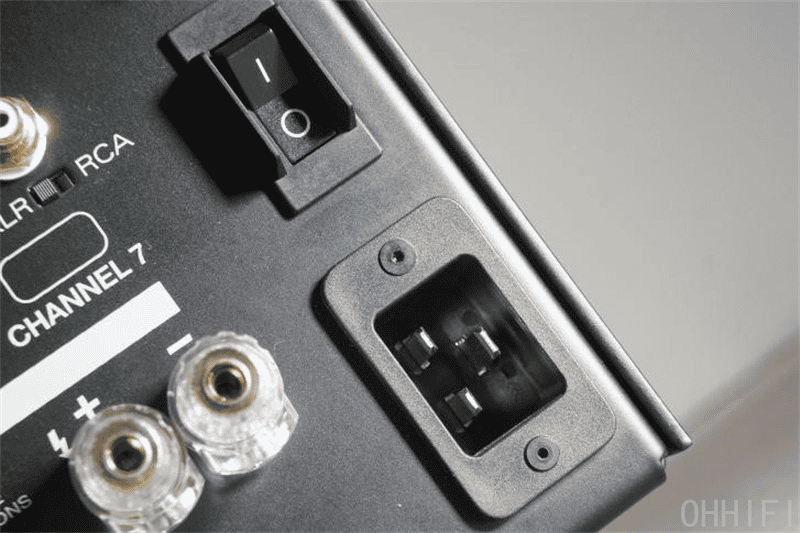
Inputs: Each channel features both an unbalanced RCA jack and a balanced XLR jack. A small toggle switch between the connectors selects the active input. We highly recommend using XLR connections if your processor supports them. XLR (balanced) cables reject common-mode noise (RF interference, hum), which is essential when running long cables in a rack filled with power cords and digital gear.
Speaker Terminals: The binding posts are heavy-duty, gold-plated, and encased in clear plastic to prevent accidental shorts. They accept bare wire, spades, or banana plugs. They are spaced widely enough to accommodate thick "audiophile" garden-hose cables without difficulty.
Trigger Input: A 3.5mm jack allows your processor to turn the amp on and off automatically.
Power Input: The IEC socket is a C20 type (rectangular pins), not the standard C14 "kettle lead" found on computers. This is necessary to handle the 20-amp current capacity. ATI supplies a heavy-gauge power cord with the appropriate NEMA 5-15 (US) or region-specific plug.
5. The "White Elephant": ATI vs. Monolith
No review of the AT1827 is complete without addressing the elephant in the room: The Monoprice Monolith 7x200.
5.1 The Connection
It is an open secret—confirmed by industry insiders, forum sleuths, and even Monoprice reps at various times—that the Monolith amplifiers are manufactured by ATI. The internal layout of the Monolith 7x200 is virtually identical to the AT1827: same vertical cards, same dual toroids, same heat sink arrangement.
This has led to a massive debate in the enthusiast community: Why buy the ATI branded version for ~$3,400 when the Monolith version sells for significantly less?
5.2 The Differences
While the "engine" is likely the same, the differences lie in the details and the support infrastructure:
Chassis and Build: The ATI version features a higher-grade finish, a thicker faceplate, and arguably better binding posts. Users have noted the Monolith posts feel "cheaper".
Warranty: This is the big one. ATI offers a 7-year warranty on their branded amps. Monolith typically offers 3 to 5 years depending on the specific model and promotion. An extra 2-4 years of coverage on a 100lb electronic device is significant value.
Country of Origin Labeling: There was a controversy where Monoprice changed the silk-screening on the back of their amps from "Manufactured in USA" to "Designed and Engineered in USA," sparking fears that production had moved offshore. While internal photos still suggest ATI (US) origin, the ambiguity unsettles some buyers. ATI-branded units are unequivocally made in Montebello, CA.
Resale Value: ATI is a heritage brand. Monolith is a store brand. Five years from now, the ATI unit will likely command a higher price on the used market (Audiogon, US Audio Mart) due to brand prestige.
Verdict: If budget is the absolute constraint, the Monolith is the steal of the century. But for those building a "forever" system who value guaranteed US support and longer warranty coverage, the premium for the ATI nameplate is justifiable insurance.
6. Installation and Setup
6.1 Placement
We installed the AT1827 in a Middle Atlantic rack. Due to its weight, it was placed at the very bottom to lower the center of gravity. We used the optional ATI rack-mount ears.
Warning: Standard rack shelves may bow under 95 lbs. We used heavy-duty rails.
Depth: The unit is deep (approx. 17 5/8" or 448mm). Ensure your rack rails are spaced correctly and that you have clearance for the XLR connectors sticking out the back.
6.2 Electrical Needs
We connected the AT1827 to a dedicated 20-amp circuit. While the amp uses a "Soft Turn-On" circuit to prevent tripping breakers during the initial capacitor charge (inrush current), driving 7 channels to reference levels draws significant juice.
Soft Start: When you press the power button, the amp doesn't just bang on. It clicks, hums quietly as the transformers energize, and then engages. This prevents lights in the house from dimming—a nice touch for a high-power beast.
6.3 Associated Gear
For this review, the system chain was:
Processor: Anthem AVM 70 (connected via XLR).
Sources: Panasonic DP-UB820 (4K Blu-ray), Apple TV 4K (Streaming).
Speakers: A mix of KEF R-Series (R11 Meta mains, R2 Meta center, R3 surrounds) and custom install ceiling speakers. These are nominal 4-ohm loads, presenting a moderate challenge to amplifiers.
7. Listening Tests: Movie Performance
The primary mission of the AT1827 is cinema. We ran it through a gauntlet of reference scenes.
7.1 Dynamics and Transient Response
Reference: Master and Commander: The Far Side of the World (Chapter 4: The First Battle) - DTS-HD Master Audio.
This track is the gold standard for dynamics. It shifts from the quiet creaking of the ship and the wind in the rigging to the deafening roar of cannon fire in milliseconds.
Performance: The AT1827 was startling. When the first cannon fired, the acoustic impact was physical. Lesser amps (and certainly AVRs) often "round off" the leading edge of such transients because they run out of instantaneous current. The ATI delivered a sharp, terrifying crack followed by the deep resonance of the hull. The separation was superb; amidst the chaos, the shouting of orders from the surround channels remained distinct and intelligible.
7.2 Low-Frequency Control (Damping Factor)
Reference: Blade Runner 2049 (Intro: Flight to Sapper Morton's) - Dolby Atmos.
Hans Zimmer’s score digs deep into the subsonic. While subwoofers handle the LFE channel, the main speakers are often asked to reproduce mid-bass punch and pressure.
Performance: The AT1827 gripped the KEF R11 woofers with an iron fist. The bass texture was tight and articulate. There was zero "bloat" or "overhang"—when the synth note stopped, the woofer stopped. This indicates a high damping factor (ATI specs >400) , meaning the amp is controlling the speaker's motion precisely rather than letting the speaker's momentum muddy the sound.
7.3 The "Black" Noise Floor
Reference: A Quiet Place (The Silo Scene) - Dolby Atmos.
This film relies on extreme dynamic range: near silence punctuated by sudden, loud creature attacks.
Performance: This is where the SNR (Signal-to-Noise Ratio) of >120dB shines. With the volume at reference level during the silent passages, there was absolutely no hiss audible from the tweeters at the listening position. The background was "black." This silence amplifies the tension. When the creature finally shrieked, the jump scare was effective not just because it was loud, but because it emerged from absolute nothingness.
7.4 Channel Separation and Steering
Reference: Roma (Criterion Collection) - Dolby Atmos.
Alfonso Cuarón’s mix is dense with environmental cues—dogs barking, street vendors, water flowing—that pan seamlessly around the room.
Performance: The modular design of the AT1827 (where each channel is a separate card) ensures minimal crosstalk. Sounds panned from the left surround to the right front with seamless fluidity. The soundstage was cohesive, creating a "bubble" of audio rather than discrete points of sound.
8. Listening Tests: Music Performance
Many home theater enthusiasts also use their systems for 2-channel listening. Can a 7-channel "muscle amp" do Hi-Fi?
8.1 Stereo Listening
Track: Hotel California - Eagles (Hell Freezes Over) - PCM Stereo.
Impression: The AT1827 dispels the myth that high-power amps are "clumsy." The opening guitar plucks had excellent decay and air. The sound signature is neutral but leans slightly to the "warm" side of neutral compared to some clinical Class D amps. It has a full-bodied midrange that gives vocals (Don Henley's rasp) a palpable presence. It lacks perhaps the very last 1% of "air" or "sparkle" that a pure Class A amp like a Pass Labs might offer, but for a multi-channel amp, it is exceptionally musical.
8.2 Multi-Channel Music
Track: Hans Zimmer: Live in Prague (Gladiator Medley) - Dolby Atmos.
Impression: This is where the AT1827 destroys 2-channel amps. Driving 7 speakers simultaneously with complex orchestral music requires massive continuous power. The ATI didn't break a sweat. The scale of the orchestra was immense. The choir was spread wide across the front stage, anchored solidly by the center channel. The headroom allowed the crescendo to hit chest-thumping levels without a hint of harshness or compression.
9. Competitive Landscape: ATI vs. The World
How does the AT1827 stack up against its main rivals in 2026?
9.1 vs. Anthem MCA 525 Gen 2
The Anthem MCA Gen 2 series is the primary competitor in the "North American Power" segment.
Sound: The Anthem is often described as slightly "cleaner" and "crisper," with a modern, detailed presentation. The ATI is "warmer," "heavier," and has more mid-bass slam.
Aesthetics: The Anthem wins easily. Its modern industrial design matches the AVM processors and looks great in a rack. The ATI looks like industrial machinery.
Specs: Anthem claims 225W vs ATI's 200W, but independent tests often show ATI ratings are very conservative. Both are powerhouses.
Verdict: Choose Anthem for a modern, detailed sound and sleek looks. Choose ATI for ultimate reliability, "warm" power, and the 7-year warranty.
9.2 vs. Emotiva XPA Gen 3
Emotiva uses a "Class H" topology (switching power rails) to save weight and cost.
Weight: The Emotiva XPA-7 is roughly half the weight of the ATI.
Technology: Class H is more efficient but complex. Some purists argue the rail switching can introduce noise, though Emotiva's implementation is good.
Reliability: The complexity of Class H and switching power supplies (SMPS) generally has a higher failure rate than the simple linear power supply (LPS) of the ATI.
Verdict: The Emotiva is a great value and easier to move. The ATI is the "no-compromise" performance choice.
9.3 vs. Class D (Hypex/Purifi based amps like NAD, Buckeye, Apollon)
Class D is the future, offering high power with low heat.
Heat: Class D amps run cool. The ATI turns your rack into a heater.
Size: Class D amps are often 1RU or 2RU; the ATI is 4RU + ventilation.
Sound: Modern Class D (Purifi 1ET400A, Hypex NCx500) measures better (lower THD) than almost any Class AB amp. However, many listeners still prefer the subjective "body" and "slam" of the heavy ATI iron.
Verdict: If you have limited ventilation or hate high electricity bills, go Class D. If you believe in the sonic benefits of Class AB and have the space/cooling, stick with ATI.
10. Specifications Table
| Feature | ATI AT1827 | Monolith 7x200 | Anthem MCA 525 Gen 2 |
| Channels | 7 | 7 | 5 (MCA 525) |
| Topology | Class AB | Class AB | Class AB |
| Power (8Ω) | 200W RMS | 200W RMS | 225W RMS |
| Power (4Ω) | 300W RMS | 300W RMS | 400W RMS |
| THD | <0.03% | <0.03% | <0.001% (1k) |
| SNR | >120dB | >120dB | 120dB |
| Transformers | 2x Toroidal | 2x Toroidal | Toroidal |
| Capacitance | 22,400µF / ch | 22,400µF / ch | Proprietary |
| Damping Factor | >400 | >400 | 300 |
| Weight | ~95 lbs | ~93 lbs | ~61 lbs |
| Warranty | 7 Years | 5 Years | 2-5 Years |
| Origin | USA | USA/Global | Canada |
(Note: Anthem MCA 525 is a 5-channel model; comparison is for performance class)
11. FAQ: Common User Questions
Q: Can I run this amp on a standard 15-amp household outlet? A: Yes. The "Ultra Soft Turn-On" circuit prevents it from popping your breaker when you turn it on. However, if you are running a full 7.1.4 system at reference volumes for extended periods, a dedicated 20-amp circuit is recommended to ensure the amp gets all the current it needs for peak transients.
Q: Is it too heavy for my rack?
A: Possibly. 95 lbs is no joke. Check your rack's weight rating. Do not place it on glass shelves unless they are rated for 100+ lbs. We recommend placing it on the bottom floor of the rack or cabinet.
Q: Does it get hot?
A: It gets warm. After a 2-hour movie, the heat sinks will be hot to the touch (approx. 120-130°F). It needs "breathing room." Do not put it in a closed cabinet without active fans.
Q: Why choose this over the cheaper Monolith?
A: Peace of mind. You are paying for the 7-year warranty, the assured US manufacturing, higher resale value, and the slightly better connectors/finish. It is an investment in longevity.
12. Conclusion: The Final Verdict
The ATI AT1827 is a dinosaur—and thank goodness for that. In a world of disposable electronics, firmware bugs, and planned obsolescence, the AT1827 stands as a monument to permanence. It is a simple machine designed to do one difficult thing perfectly: take a small electrical signal and make it very, very large without changing its character.
Its sonic signature is one of effortless authority. It makes speakers sound bigger. It makes explosions hit harder. It reveals the silence between the notes.
Pros:
Limitless Power: Drives difficult 4-ohm loads with ease.
Build Quality: Built like a tank (and weighs as much as one).
Sound: Neutral, dynamic, powerful, with a pitch-black noise floor.
Reliability: Passive cooling means no fans to fail; optical protection keeps it safe.
Support: 7-Year Warranty from a US manufacturer.
Cons:
Weight: A logistical nightmare to move and install.
Size: Requires deep racks and good ventilation.
Aesthetics: Utilitarian "black box" look isn't for everyone.
Heat: Not as eco-friendly as Class D.
Final Score: 4.8 / 5.0
For the serious home theater enthusiast who has the space and the muscle to move it, the ATI AT1827 is arguably the best value in high-end amplification today. It is not just an amplifier; it is the foundation upon which a reference-grade cinema is built.




Comments