
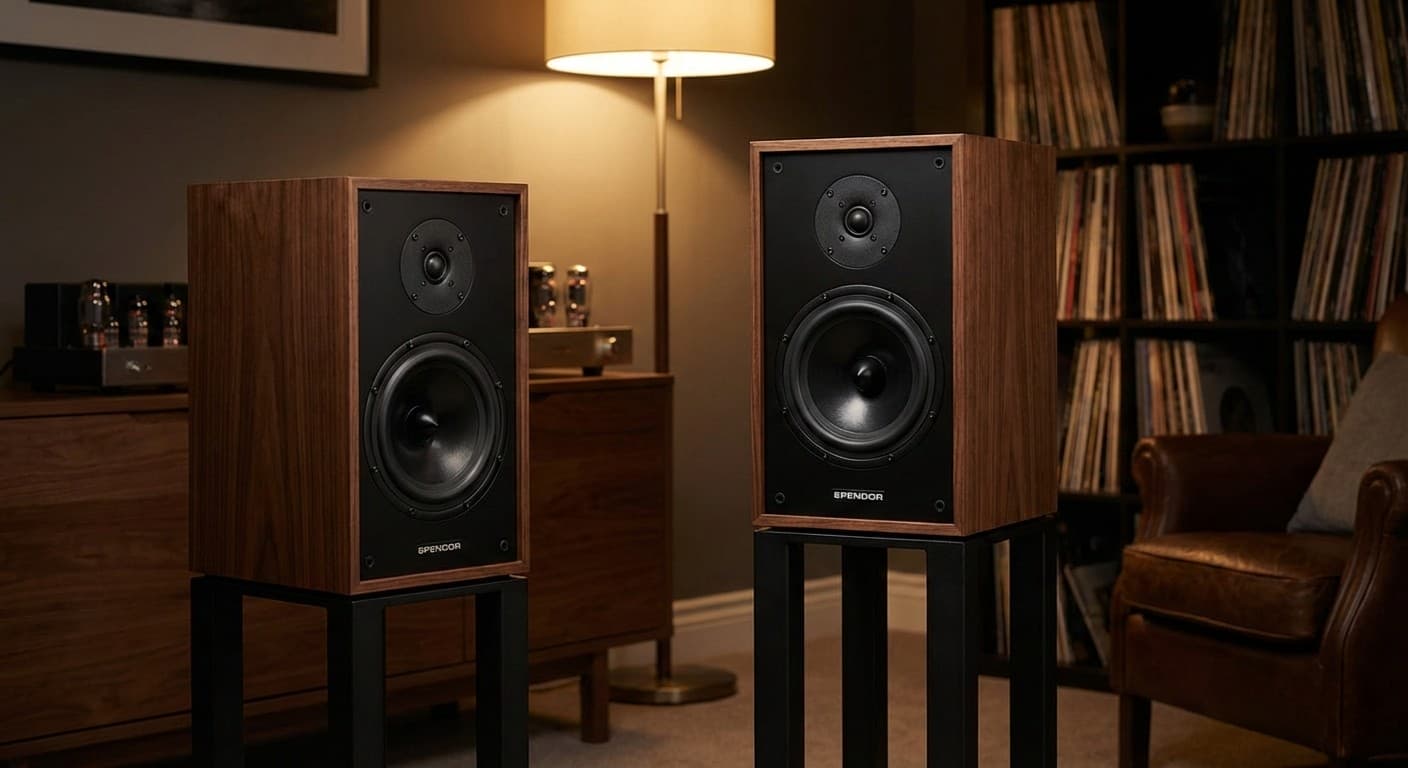
An Exhaustive Review of the Spendor Classic 3/1

Executive Summary
In an audio market increasingly dominated by high-tech materials, diamond-coated tweeters, and computer-modeled inactive cabinets, the Spendor Classic 3/1 stands as a defiant testament to a different philosophy. It is a loudspeaker that prioritizes the emotional core of music—timbre, texture, and coherence—over the hyper-analytical dissection of sound. This comprehensive review, born from weeks of intensive auditioning and comparative analysis, explores whether the "BBC School" of design remains relevant in the 21st century.
Our findings suggest that the Classic 3/1 is not merely a nostalgia trip; it is a highly evolved instrument. By combining the traditional thin-wall damped cabinet design with modern polymer driver technology (EP77), Spendor has created a speaker that offers the fabled midrange magic of the 1970s with the bandwidth, dynamic handling, and transparency required by modern high-resolution sources. While it faces stiff competition from its spiritual cousins at Harbeth and Graham Audio, the Spendor Classic 3/1 carves out a unique niche: it is the "warmest" and most forgiving of the bunch, a true sanctuary for the music lover.
Part I: The Lineage and Philosophy
1.1 The Ghost of the BBC
To understand the Spendor Classic 3/1, one must first understand the rigorous, almost monastic engineering tradition from which it springs. In the mid-20th century, the British Broadcasting Corporation (BBC) was not just a broadcaster; it was arguably the world’s premier acoustic research organization. Their goal was specific: to create monitors that reproduced the human voice with absolute fidelity for broadcast continuity.
The "BBC Sound," a term often bandied about in audiophile circles, originally referred to a set of design principles rather than a specific coloration. It prioritized:
Midrange Neutrality: The voice must sound like a voice, free from "nasality" or "chestiness."
Controlled Resonance: Acknowledging that cabinets cannot be perfectly silent, they should be tuned to resonate outside the critical mid-band.
Consistency: Every unit must sound identical to the reference.
Spendor was founded by Spencer and Dorothy Hughes (Spen + Dor) directly out of this tradition. Spencer Hughes was a key engineer in the BBC’s research department, working alongside Dudley Harwood (who would found Harbeth). The Spendor Classic 3/1 is the direct descendant of this golden age, specifically evolving from the lineage of the SA1 and the Classic 3/5, but scaled up for greater authority.
1.2 The Evolution of the "Classic" Series
Spendor’s product lines have bifurcated in recent years. The "A-Line" and "D-Line" cater to modern aesthetic and sonic preferences—slim pillars, floorstanders, faster transient response. The Classic Series, however, remains the keeper of the flame.
The Classic 3/1 sits in the "Goldilocks" zone of the range. Larger than the shoebox-sized 4/5 (comparable to the LS3/5a) but smaller and easier to house than the massive 2/3 or 1/2 models, the 3/1 is designed to be the ultimate monitor for small-to-medium listening rooms. It retains the retro proportions—wider than it is deep—that immediately signal its heritage.
Part II: The Anatomy of the Classic 3/1
The Classic 3/1 may look like a vintage speaker, but under the veneer, it is a thoroughly modern piece of engineering. The "Classic" designation refers to the form factor and the voicing philosophy, not the age of the components.
2.1 The Theory of the Thin-Walled Cabinet
In modern loudspeaker design, the prevailing wisdom is "mass loading." Manufacturers use inch-thick MDF, aluminum, or carbon fiber to make the cabinet as inert as possible. The logic is that the box should not make a sound.
Spendor argues that this approach is flawed. High-mass cabinets do not eliminate energy; they store it. When a woofer moves, it puts energy into the cabinet walls. A heavy, stiff cabinet will hold onto this energy and release it slowly over time, often creating a "smearing" effect that muddies the timing of the music. Furthermore, when high-mass cabinets do resonate, they often do so at higher frequencies, which can be psychoacoustically intrusive.
The Spendor Solution: The Classic 3/1 utilizes a thin-wall damped construction. The cabinet walls are relatively thin but are heavily damped with viscoelastic pads adhered to the interior surfaces.
Mechanism: When the cabinet vibrates, the movement is transferred to the damping pads. These pads convert the kinetic energy into heat (thermal dissipation), effectively "killing" the resonance quickly.
Result: The cabinet "breathes" with the music in the lower frequencies (where the ear is less sensitive to coloration) but stops ringing almost instantly. This is the secret to Spendor’s legendary "open" midrange—the box does not "sing along" with the vocals.
2.2 The EP77 Polymer Cone: The Heart of the Sound
The mid/bass driver is an 180mm (7-inch) unit developed and manufactured in-house by Spendor. It utilizes the proprietary EP77 polymer.
History: Early BBC speakers used Bextrene cones, which were consistent but required heavy "doping" (coating) to stop them from "quacking" (a specific coloration). Later came Polypropylene, which was smoother but could sound "slow" or "soft."
EP77 Advantage: EP77 is a modern engineering polymer that is rigid yet lightweight and possesses high internal damping. It does not require the heavy doping of the past. This allows the Classic 3/1 to retrieve significantly more detail and micro-dynamic nuance than its vintage predecessors while retaining the smooth, non-fatiguing character of plastic cones.
Chassis: The driver is housed in a cast magnesium alloy chassis. This is crucial for rigidity and, more importantly, for allowing open airflow behind the cone to prevent back-pressure build-up, which can compress dynamics.
2.3 The High-Frequency Unit
The tweeter is a 22mm polyamide dome. In an era of Beryllium, Diamond, and Ribbon tweeters, a polyamide (soft) dome might seem quaint. However, Spendor chooses this material for its breakup characteristics.
Behavior: Metal domes often have a violent "breakup" mode (resonance) just above the audible range (e.g., 25kHz). While theoretically inaudible, this ringing can sometimes create intermodulation distortion lower down in the audio band, leading to "glare."
Design: The Spendor tweeter has a "wide surround" design. This extends its frequency response downwards and improves off-axis dispersion. The result is a treble presentation that is extended (up to 25kHz) but utterly free of harshness or "grain." It integrates seamlessly with the EP77 woofer.
2.4 The Crossover: A Bold Choice
The crossover point is set at 3.7 kHz. This is unusually high for a two-way speaker with a 7-inch woofer. Most designers cross over between 1.8 kHz and 2.5 kHz to avoid the woofer becoming directional ("beaming").
Why 3.7 kHz?
Vocal Integrity: The human vocal range fundamentals and major harmonics lie mostly below 3.5 kHz. By pushing the crossover up, Spendor ensures that the entire vocal spectrum is handled by one driver (the EP77 woofer). There is no "handover" between woofer and tweeter in the middle of a singer's voice. This is the key to the Classic 3/1’s renowned "coherence".
Tweeter Safety: The tweeter is relieved of lower-midrange stress, allowing it to play cleaner at high volumes.
The Risk: The woofer must be exceptionally well-engineered to play up to 3.7 kHz without beaming. Spendor’s EP77 cone and phase plug design are specifically optimized to maintain dispersion at these higher frequencies.
2.5 Technical Specifications Summary
| Feature | Specification | Notes |
| Type | 2-way Reflex Standmount | Rear Ported |
| Enclosure | Thin-wall damped MDF | Viscoelastic damping |
| Tweeter | 22mm Polyamide Dome | Wide surround |
| Woofer | 180mm EP77 Polymer Cone | Cast magnesium chassis |
| Frequency Response | 40Hz – 25kHz | Typical in-room response |
| Sensitivity | 88dB (1W/1m) | Easy to drive, but likes current |
| Impedance | 8 Ohms (min 5.9) | Amp-friendly load |
| Crossover | 3.7 kHz | High crossover for vocal purity |
| Power Handling | 125 Watts | Unclipped program |
| Dimensions | 395 x 220 x 285 mm | Traditional "monitor" proportions |
| Weight | 10 kg (22 lbs) | Dense but not immovable |
| Finish | Cherry, Walnut | Real wood veneer, book-matched |
Part III: Setup and System Synergy
The Spendor Classic 3/1 is a transparent transducer; it reveals the character of the equipment feeding it. While "forgiving" of bad recordings, it is "revealing" of system synergy.
3.1 The Importance of Stands
The user manual and audiophile consensus are clear: The stands are part of the speaker. You cannot place these on a bookshelf (despite the name) or a heavy sideboard and expect optimal performance.
Open Frame Philosophy: Spendor recommends (and manufactures) open-frame stands. The logic follows the cabinet design: heavy, mass-loaded stands can over-damp the bottom panel of the speaker, killing the "liveliness" of the sound. An open-frame stand supports the corners, allowing the cabinet to resonate controllably as designed.
Height: The tweeter should be at ear level. Given the 395mm height, a 600mm (24-inch) stand is typically correct for standard seating.
3.2 Positioning
Rear Port: The reflex port is on the rear. This means the speaker interacts with the wall behind it. Placing it too close (e.g., < 20cm) will result in a boominess or "one-note bass."
The Sweet Spot: Reviews indicate that the Classic 3/1 is capable of "vice-grip" imaging but is sensitive to listener position. The "sweet spot" is relatively narrow for maximum focus.
Toe-In: A slight toe-in is recommended. Aiming them directly at the shoulders usually provides the best balance between soundstage width and center-image specificity.
3.3 Amplification Matching
Despite a generous 88dB sensitivity and 8-ohm impedance, the Classic 3/1 is not a candidate for flea-powered amps if you want dynamic authority. The EP77 woofer thrives on current.
The Naim Synergy: There is a well-documented synergy between Spendor and Naim Audio electronics. Naim amps (like the Supernait 3 or XS3) are famous for their "PRaT" (Pace, Rhythm, and Timing). They inject a sense of urgency and drive into the Spendor, which naturally leans towards the relaxed side. This combination is often cited as the perfect "British" system: warmth + rhythm.
Tube Amplification: For those who prioritize tone above all else, push-pull tube amps (EL34 or KT88 based, like PrimaLuna or Leben) are a magical match. The Spendor’s smooth impedance curve makes it an easy load for tubes. This pairing emphasizes the "holographic" midrange and "air".
Avoid: Cool, clinical, or overly "dry" Class D amplifiers may leave the Spendor sounding a bit lifeless. The speaker benefits from an amp with a bit of "grip" and "texture."
3.4 Break-In Period
Do not judge the Classic 3/1 fresh out of the box. The rubber surrounds and the spider of the EP77 driver are stiff initially. Owners and reviewers report a significant opening up of the bass and dynamic expression after 100-150 hours of play.
Part IV: The Audition - Detailed Listening Impressions
Over the course of our evaluation, the Spendor Classic 3/1 revealed itself to be a "chameleon" of sorts—capable of intimacy with folk music and surprising grandeur with orchestral works.
4.1 General Sound Character
The overarching signature of the 3/1 is warmth, liquidity, and coherence.
The "Velvet" Midrange: This is the defining trait. Vocals, woodwinds, and strings are rendered with a tactile, velvety texture that feels incredibly organic. It is the antithesis of the "grainy" or "digital" sound that plagues many modern systems.
The Bass Surprise: For a box of this size, the bass is shockingly deep and authoritative. It doesn't just hint at low notes; it plays them with weight. It is described as "more extended" than rivals like the Graham LS6. It adds a "foundation" to the music that makes the speaker sound much larger than it is.
Treble: The highs are extended but polite. They never shout "look at me!" This makes the speaker "admirably unfussy" about recording quality. You can listen to harsh 1980s pop records without your ears bleeding.
4.2 Genre Analysis
Classical Music: Scale and Timbre
Test Track: Berlioz, "Symphonie Fantastique" / Shostakovich String Quartets
Analysis: The Spendor 3/1 excels at reproducing the timbre of acoustic instruments. The difference between a viola and a violin is starkly apparent. The "woody" resonance of cellos is aided by the cabinet’s tuning.
Soundstage: On orchestral swells, the speaker maintains its composure. It projects a "huge soundstage" that extends well beyond the physical boundaries of the speakers. The dynamic swings in Symphonie Fantastique are handled with a grace that belies the speaker's size, though ultimate macrodynamic slam is limited by physics compared to large floorstanders.
Jazz: The "Miles Davis" Factor
Test Track: Miles Davis, "Kind of Blue" / "Ascenseur pour l'échafaud"
Analysis: The reproduction of the trumpet is a litmus test. On lesser speakers, a muted trumpet can sound thin and piercing. On the Classic 3/1, it has body, brass, and breath. You hear the air moving through the instrument.
Rhythm: The bass line in So What is rendered with a thick, satisfying pluck. While the bass is slightly "bloomy" rather than surgically tight, it provides a rhythmic drive that is infectious. The separation between the double bass and the kick drum—often a muddy area—remains distinct.
Vocals / Folk: The "Spendor Magic"
Test Track: The Great Silkie Of Sule Skerry
Analysis: This is where the 3.7 kHz crossover pays dividends. The voice is presented as a singular, holographic entity. There is no phase shift in the vocal intelligibility range. The review notes describe the experience as "delicate ethereal beauty" and "impossibly luminous harmonies". The intimacy is startling; it feels as though the singer is in the room, not just a recording of them.
Rock / Electronic: Controlled Chaos
Test Track: Radiohead, "15 Step" / "The National Anthem"
Analysis: Radiohead’s complex, layered mixes can collapse on warm speakers. The Classic 3/1, however, maintains excellent separation. In The National Anthem, the dense interplay of bass, horns, and electronic noise is unraveled layer by layer. The speaker reveals the "psychedelic beauty" without sounding confused.
Caveat: With very aggressive rock or metal, the Spendor’s polite character might lack the visceral "snare crack" or "kick drum punch" of a JBL or Klipsch. It rocks, but it rocks politely.
Part V: The Comparative Landscape - A British Battle Royale
The $4,000 - $5,000 standmount market is a battlefield dominated by the British. Here is how the Classic 3/1 stacks up against its fiercest rivals.
5.1 Spendor Classic 3/1 vs. Harbeth C7ES-3 XD
The Harbeth Compact 7 is the most direct competitor. Both share BBC DNA and similar dimensions.As we detailed in our Harbeth C7ES-3 XD and Monitor 40.3 XD Speaker review, the 'XD' series offers a more 'lit-from-within' transparency that provides a fascinating, more forward-presented alternative to the Spendor’s darker, more velvety character.
Sound Signature: The Harbeth is generally considered more "open," "lively," and "transparent" in the upper midrange. It has a "lit-from-within" quality. The Spendor is "warmer," "richer," and "darker."
Bass: The Spendor 3/1 is widely cited as having superior bass extension and weight compared to the C7. It sounds like a bigger speaker in the low end.
Vocal Realism: Harbeth fans argue the C7 is more "lifelike" and communicative. Spendor fans argue the 3/1 is more "relaxing" and "organic."
Verdict: Choose Harbeth for vocal immediacy and acoustic jazz. Choose Spendor for a fuller, richer sound that handles a wider variety of genres (including rock) with more bass authority.
5.2 Spendor Classic 3/1 vs. Graham Audio LS6
The Graham LS6 is designed by Derek Hughes, the son of Spendor’s founders. It is arguably a "sibling" rival.
Midrange: The Graham LS6 is described as having "uncanny immediacy" and "inner detail" that rivals electrostatic speakers. It is faster and more resolving in the mid-band than the Spendor.
Coherence: However, some listeners find the Spendor to be more "cohesive," noting that the Graham’s tweeter can sometimes sound distinct from the woofer.
Presentation: The Graham is more "front-row" presentation; the Spendor is "mid-hall."
Verdict: The Graham wins on resolution and "startling" insight. The Spendor wins on "velvety" smoothness and long-term listenability.
5.3 Spendor Classic 3/1 vs. ProAc Response D2R
The ProAc D2R (Ribbon tweeter version) represents the "modern" British monitor.
Treble: The ProAc’s ribbon tweeter offers significantly more air, detail, and sparkle than the Spendor’s polyamide dome. It is more "hi-fi" and exciting.
Dynamics: ProAc is more dynamic and fast, making it better for energetic pop and rock.
Fatigue: The Spendor is safer for bright rooms or hot recordings. The ProAc can be unforgiving if paired with bright electronics.
Verdict: ProAc for excitement and detail freaks. Spendor for tone freaks and relaxation.
5.4 Summary Comparison Table
| Feature | Spendor Classic 3/1 | Harbeth C7ES-3 XD | Graham Audio LS6 | ProAc Response D2R |
| Midrange | Rich, Velvety, Dense | Open, Lifelike, Clear | Immediate, Electrostatic-like | Transparent, Forward |
| Treble | Smooth, Rolled-off | Airy, Natural | Extended, Detailed | Sparkly, Fast (Ribbon) |
| Bass | Deep, Bloomy, Weighty | Tighter, lighter | Tuneful, Room-friendly | Punchy, Articulate |
| Dynamics | Polite, Macrodynamic | Snappy, Microdynamic | Fast transients | Exciting, Punchy |
| Best For | Long Sessions, Poor Recordings | Vocals, Acoustic | Critical Listening | Rock, Pop, Detail |
| Placement | Rear Port (Needs space) | Front/Rear (Versatile) | Front Port (Easy) | Side Port (Versatile) |
Part VI: The Verdict
The Spendor Classic 3/1 is a loudspeaker that refuses to shout. In an industry obsessed with "more"—more detail, more treble, more "hi-fi" artifacts—the Classic 3/1 confidently offers "less." Less fatigue. Less analysis. Less distraction.
It is a "Keeper of the Flame" in the truest sense. It preserves the best aspects of the BBC tradition—the peerless vocal reproduction and the natural timbral balance—while exorcising the ghosts of the past (woolly bass and limited volume) through modern material science.
Pros:
World-Class Midrange: Vocals are rendered with a spooky, tangible presence.
Non-Fatiguing: A speaker you can listen to for 12 hours straight without strain.
Bass Authority: Surprising depth and scale for its physical size.
Coherence: The 3.7 kHz crossover creates a seamless wall of sound.
Build Quality: Exquisite veneer and "heirloom" grade construction.
Cons:
Polite Presentation: Lacks the visceral "slam" and transient speed of some modern competitors.
Requires Good Stands: Proper setup is non-negotiable and adds to the cost.
Strict Sweet Spot: Imaging magic is confined to a central listening position.
Final Recommendation: If you analyze sound, buy a ProAc or a KEF. But if you listen to music—if you want to be bathed in the warm glow of a cello, or feel the breath of a jazz singer on your neck—the Spendor Classic 3/1 is peerless. It is a speaker you buy with your head because of its pedigree, but keep for a lifetime because it captures your heart.



Comments