

A Comprehensive Review of the Pathos Acoustics InPoL Legacy Integrated Amplifier

Part I: The Philosophy of Excess
In the high-stakes poker game of ultra-high-end audio, there is a moment when "sufficient" becomes a dirty word. We live in an era of efficient Class D modules that fit in the palm of a hand, and streaming all-in-ones that vanish into the decor. But for a specific breed of audiophile—the kind who measures their listening room’s noise floor in the middle of the night and owns cables thicker than a garden hose—efficiency is not the goal. Emotion is the goal. And in the philosophy of Vicenza-based Pathos Acoustics, emotion has a weight. specifically, 140 kilograms (309 pounds).
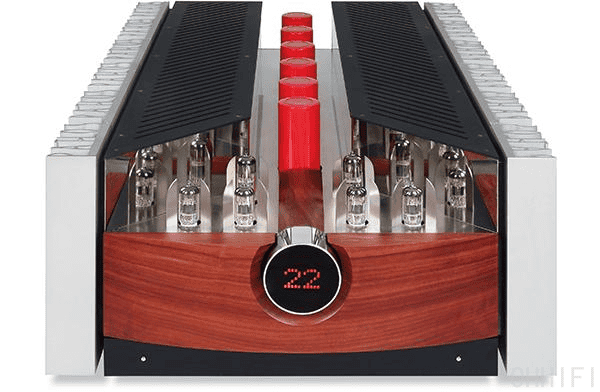
The Pathos Acoustics InPoL Legacy is not merely an integrated amplifier. To call it that is to call the Vatican just a church. It is a declaration of intent. It is a physical manifestation of a "no limits" design brief handed down by company co-founder Gaetano Zanini, who sought to build the ultimate testament to the company's thirty-year history. This is a machine that eschews the modern trend of downsizing. It is massive, it runs hot enough to warm a New England winter, and it demands a physical commitment from its owner that borders on the devotional.
But why? Why build a hybrid amplifier—mixing vacuum tubes and solid-state MOSFETs—that weighs as much as an NFL linebacker and costs $55,000? The answer lies in the proprietary circuit that beats at its heart: the InPoL (Inseguitore Pompa Lineare) topology. This system, patented by Pathos, represents one of the few genuinely divergent paths in amplifier design, rejecting the standard Class AB push-pull architecture in favor of a zero-feedback, pure Class A operation that attempts to fuse the harmonic "breath" of tubes with the current-driving grip of silicon.
As a senior editor who has hauled, unboxed, and lived with everything from the D'Agostino Relentless to the Gryphon Mephisto, I approached the Legacy with a mix of skepticism and anticipation. Is this just Italian jewelry—a pretty face with heat sinks shaped like logos—or is it a true reference tool? Over the next several thousand words, we will strip away the chrome and the rhetoric. We will examine the physics of the Linear Pump Tracker, endure the back-breaking installation process, measure the thermal output, and, most importantly, lose ourselves in the music. This is not a casual review; this is an autopsy of a giant.
The Italian Context: Art Meets Industrial Brutalism
Italy has always occupied a unique space in hi-fi. Unlike the clinical precision of the Swiss (Soulution, CH Precision) or the muscular pragmatism of the Americans (Krell, Pass Labs), Italian audio—think Sonus faber, Viva, Unison Research—has always prioritized the "human" element. There is an insistence that the equipment must look as good as it sounds, that it is a piece of furniture living in a home, not a lab instrument.
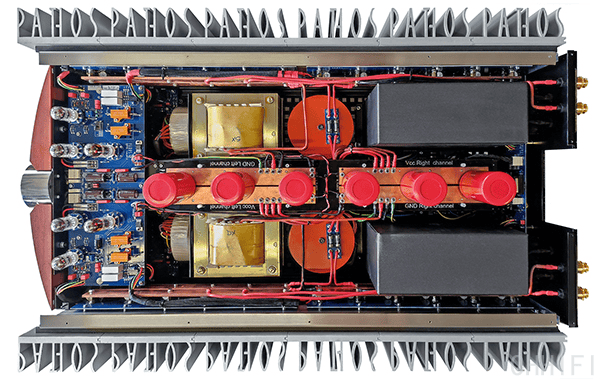
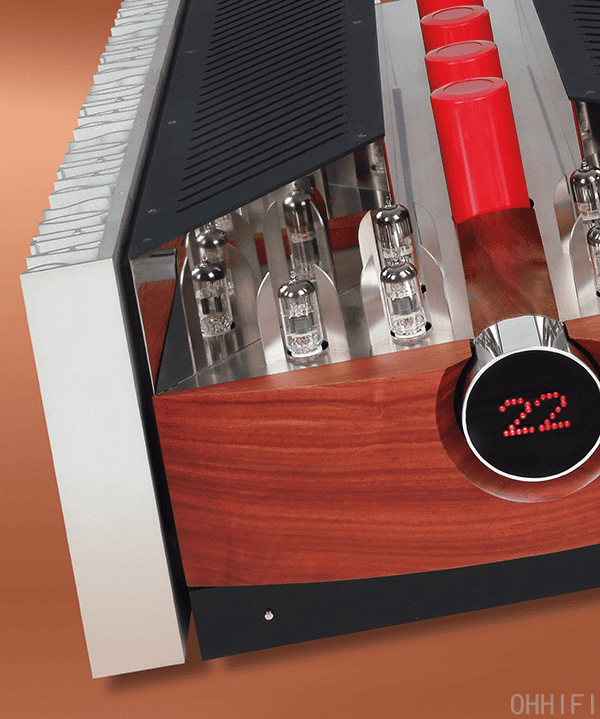
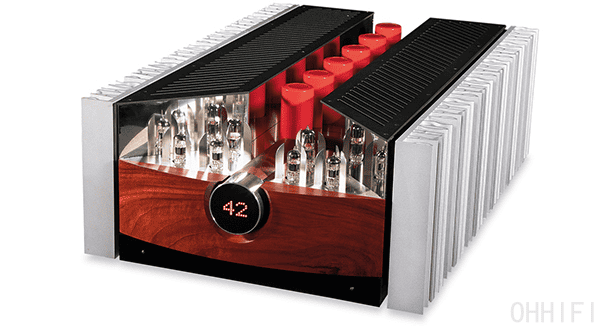
Pathos, founded in 1994, took this a step further. Their "Twin Towers" amplifier (now the T.T.) became an icon not just for its sound, but for its stunning combination of wood, cast metal, and glowing tubes. The InPoL Legacy takes that aesthetic DNA and injects it with steroids. The front panel is a curved slab of solid Padouk wood, a tropical timber known for its stability and rich, reddish hue. Behind it sits a chassis that spans nearly a meter in depth. The heatsinks, spelling out the word "PATHOS" in their aluminum profile, are not just vanity; they are necessary survival mechanisms for the Class A inferno within.
This amplifier doesn't just sit in a rack; it dominates the room. It demands to be looked at. And in a market flooded with anonymous black boxes, that "fearless visual swagger" is a feature, not a bug.
Part II: The Ghost in the Machine – The InPoL Topology
To understand why the Legacy sounds the way it does, one must abandon conventional amplifier theory. Most high-power amplifiers today use a Class AB topology with global negative feedback. Feedback is the "spell check" of audio: it compares the output to the input and corrects errors. It lowers distortion and output impedance, but many purists argue it also kills the "spirit" of the music, introducing timing errors and flattening the soundstage.
Pathos takes the hard road. The InPoL system uses zero global negative feedback. This is high-wire audio engineering. Without feedback to correct mistakes, the circuit must be inherently linear.
The Linear Pump Tracker Explained
"InPoL" stands for Inseguitore Pompa Lineare (Linear Pump Follower). Here is the breakdown of what that actually means for the signal:
The Brain (Tube Stage): The voltage amplification—the part of the amp that makes the signal "bigger" in terms of voltage—is handled entirely by vacuum tubes. In the Legacy, this is a "totem pole" configuration using two Tung-Sol ECC803s and one Sovtek 6H30 per channel. The tube stage imparts the sonic character: the harmonic richness, the air, the texture.
The Muscle (MOSFET Stage): The solid-state output stage has a voltage gain of 1 (unity gain). It does not amplify the voltage. It simply provides the current (amperes) required to push the loudspeaker cones. It "follows" the tube's voltage signal exactly.
The Pump (The Inductor): In a standard Class A amp, a resistor or active source sets the bias current, which is hugely inefficient (max 25%). Pathos uses a massive inductor (a coil of wire) in parallel with the power supply. This stores energy and allows the theoretical efficiency to double to 50% for Class A operation.
The Legacy uses a Double InPoL configuration. This is a bridged design where two InPoL circuits work in opposite phase for each channel. This bridging is critical: it cancels out common-mode noise (essential when you have massive transformers near sensitive tubes) and quadruples the potential power output compared to a single-ended version. This is how Pathos achieves 100 watts of pure Class A power, whereas most single-ended triode amps struggle to produce 10.
The Thermal Consequence
There is no free lunch in physics. 100 watts of Class A power means the output devices are conducting full current all the time, regardless of whether you are playing silence or heavy metal. The Legacy draws 855 watts from the wall at idle.
Let that sink in. Turning on this amplifier is thermodynamically equivalent to turning on a hairdryer and leaving it running on the floor. The heatsinks reach temperatures of 60°C (140°F). In my listening room, which is typically a cool 68°F, the ambient temperature rose by four degrees after a six-hour listening session. This is an amplifier that breathes. It is a living, consuming entity. If you live in a tropical climate without aggressive air conditioning, the Legacy might be a seasonal indulgence. But in the depths of winter, its warmth—both physical and sonic—is oddly comforting.
Part III: The Installation Ritual
The delivery of the InPoL Legacy is less like receiving a package and more like a construction project. It arrives in a wooden crate so large it looks like it should contain a grand piano. The crate is fitted with wheels, a merciful inclusion because moving 140kg (309 lbs) is a task for a forklift, not a human back.
Unboxing it requires a tactical plan. Pathos provides lifting brackets, but you will need at least two, preferably three, strong individuals to move it from the crate to its final resting place. And that resting place must be chosen with extreme care. Standard MDF equipment racks will bow or snap under this load. Pathos sells a dedicated stand, which I highly recommend. If you choose to go third-party, think Finite Elemente Pagode or high-mass CMS platforms.
Once positioned, the sheer depth of the unit—890mm (35 inches)—becomes apparent. It hung off the back of my standard heavy-duty amp stand by nearly a foot. This is an amp that needs floor space. It needs room to breathe.
Connections and Ergonomics
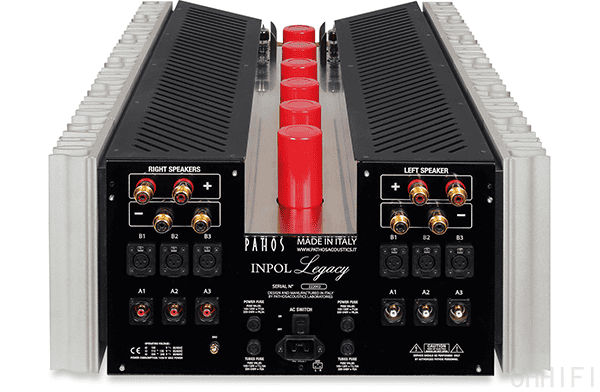
The rear panel is a study in high-quality minimalism. You get two sets of balanced XLR inputs and three sets of unbalanced RCA inputs. The connectors are top-tier Neutrik and WBT, feeling reassuringly tight. The speaker binding posts are custom Pathos designs—robust, easy to grip, and capable of clamping down on spades with vice-like pressure.
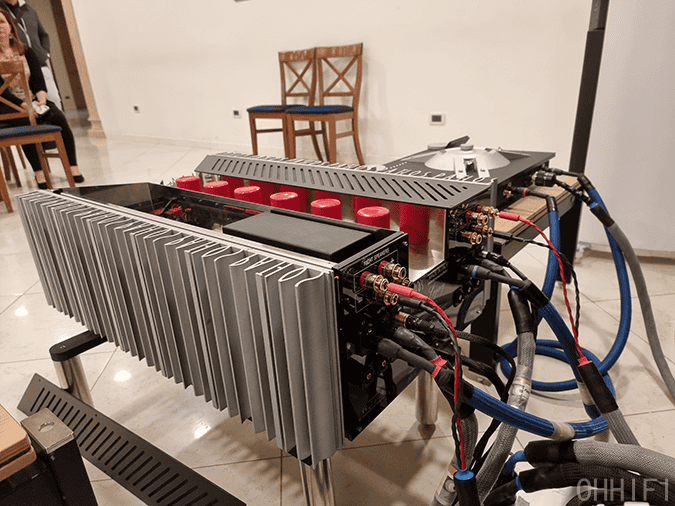
I connected my reference dCS Vivaldi Apex DAC and a turntable setup involving the TechDAS Air Force Three. Speakers rotated between the Wilson Audio Alexx V, the Magico M2, and the high-efficiency Fleetwood Deville to test noise floor.
The user interface, however, is where the "Italian Eccentricity" shines through. The main power switch is on the back. To bring the amp out of standby, you press a tiny, nail-head-sized button on the front fascia. It’s almost hidden by the wood paneling, requiring a game of "find the button" every time you want to listen.
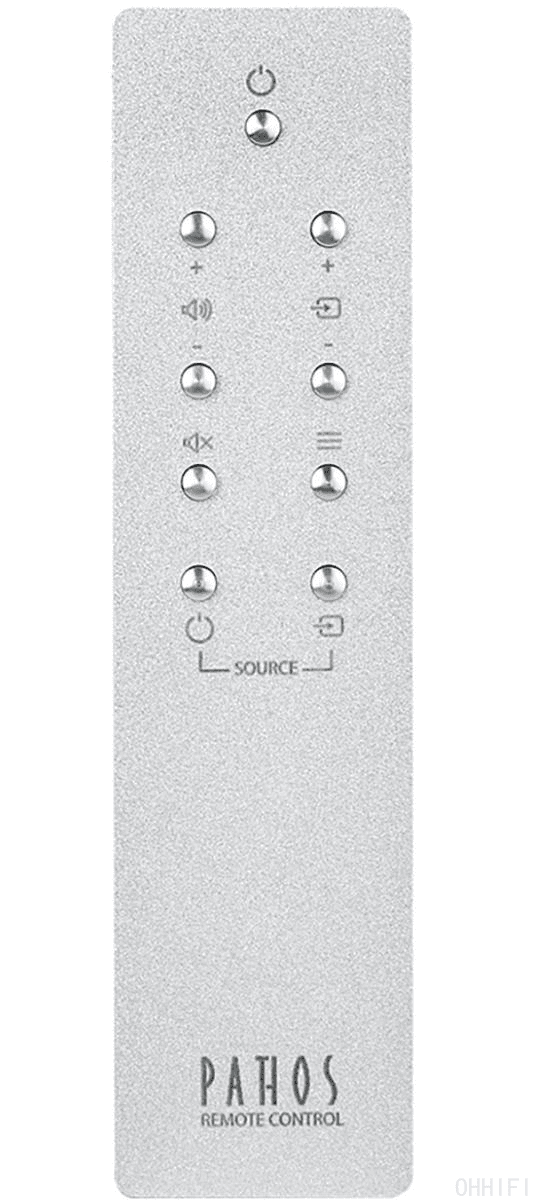
Then there is the remote. For $55,000, one expects a heavy aluminum wand that doubles as a defensive weapon. The Pathos remote is... finicky. It requires precise aim. During my time with the unit, I found myself walking up to the amp to adjust volume manually, just for the tactile satisfaction of turning the massive central dial. And what a dial! It drives a 100-step passive resistor ladder. You can hear the relays clicking—clack, clack, clack—as you turn it. It feels like cracking a safe. It’s mechanical, visceral, and deeply satisfying, even if the "stuttering" of the sound during volume changes (due to the break-before-make relays) takes some getting used to.
Part IV: The Sound of "No Feedback"
Describing the sound of the InPoL Legacy is difficult because it contradicts so many audiophile stereotypes. It uses tubes, so you expect "warm and woolly." It uses MOSFETs, so you expect "dry and grainy." It is massive, so you expect "slow and muscle-bound."
It is none of these things.
The overriding sensation is one of fluidity. The absence of global feedback removes the subtle "electronic haze" or "grain" that plagues even very expensive solid-state amplifiers. The music pours out of the speakers like heavy cream. There is a continuousness to the soundstage that is mesmerizing.
The Midrange: A Tube Lover's Dream
We must start with the midrange, for this is where the Legacy makes its most compelling argument. On vocal tracks, the presentation is startlingly holographic. Listening to Norah Jones on "Shoot the Moon", her voice wasn't just a point in space; it had volume and density. You could hear the chest resonance, the moistness of the lips, the subtle intake of breath. It was, to use a word that appeared in my notes multiple times, "fleshy".
This is not the hyper-detailed, X-ray vision of a Soulution or CH Precision amp, which dissects the recording. The Pathos reconstructs the event. On Johnny Van Zant’s acoustic version of "Sweet Home Alabama", the gravel in his voice wasn't harsh; it was textured, like running your hand over rough-hewn wood. The ECC803s tubes provide a golden glow to the timbre, a harmonic richness that makes voices sound undeniably human.
The High Frequencies: Sweetness and Light
Solid-state amps often struggle with the complex harmonic structure of violins or the decay of cymbals. They can sound "glassy" or "steely." The Legacy, driven by its tube voltage stage, is utterly devoid of this artifact.
Cueing up Samuel Barber’s Adagio for Strings, the massed strings swelled with an intensity that was emotional rather than strident. As the violins climbed into the upper registers—a moment that often induces wincing on lesser gear—the Pathos held the note with a "butter-smooth" consistency. The air around the instruments was palpable. The lack of feedback allows the natural decay of notes to fade into a "black" background without being cut off prematurely.
This "airiness" is supported by measurements. Despite the tubes, the noise floor is exceptionally low (S/N ratio >97dB). This means that the "micro-details"—the chair squeaks, the page turns, the ambient room tone—are preserved.
The Bass: Quality over Quantity?
Here we reach the most polarizing aspect of the InPoL sound. If you are migrating from a massive Krell or Gryphon amplifier, the bass of the Legacy will surprise you. It is not the sledgehammer "slam" that hits you in the chest and stops on a dime.
The InPoL circuit, with its output impedance of around 0.25 ohms, has a lower damping factor than typical solid-state designs. This means it exerts slightly less "vice-like" grip on the woofer.
On Led Zeppelin’s "Heartbreaker", the bass line was tuneful, rich, and incredibly distinct. You could hear the pitch of every note, the vibration of the round-wound strings. But the visceral "kick" of the drum was slightly softer, slightly rounder than with the Gryphon Diablo 300. It blooms into the room rather than firing like a cannon.
However, for acoustic jazz, this characteristic is a revelation. On Charles Mingus’s Blues & Roots, the double bass sounded massive and woody. It sounded like a real instrument resonating in a room, not a synthesized facsimile. The "looseness" that some critics note is, in my opinion, actually a more accurate representation of how low-frequency energy behaves in a live acoustic environment. It breathes.
Soundstage: The "Horseshoe" Effect
One of the most remarkable traits of the Legacy is its lateral imaging. On Led Zeppelin’s "Bring It On Home", the soundstage didn't just span the distance between the speakers; it wrapped around the sides of the room. Reviewers have noted a "horseshoe-shaped" presentation where sounds seem to originate from the side walls.
This is likely due to the superb channel separation afforded by the dual-mono power supplies. On Ary’s "The Sea", the electronic soundscape was vast, with backing vocals appearing to float in the ether, completely untethered from the speaker cabinets. The depth of the stage is equally impressive, allowing one to "hear into" the back corners of the recording venue.
Part V: The Comparative Gauntlet
To justify its price and size, the Legacy must compete with the titans of the industry. Let’s pit it against its primary rivals.
Pathos InPoL Legacy vs. Gryphon Diablo 300
The Gryphon Diablo 300 ($16,000 - $22,000 depending on options) is the benchmark for high-power integrateds. It is the "Dark Knight" to the Pathos’s "Renaissance Painter."
Tonality: The Gryphon is darker, denser, and more bottom-heavy. It has a lower noise floor and a sense of infinite power. The Pathos is lighter, airier, and more illuminated from within.
Control: The Gryphon has superior grip. If you listen to speed metal or complex electronica at 110dB, the Gryphon holds it together better. The Pathos is more relaxed.
Emotion: The Pathos wins on vocals and acoustic instruments. The Gryphon commands respect; the Pathos invites love. The Pathos sounds "live"; the Gryphon sounds "master tape."
Pathos InPoL Legacy vs. Dan D'Agostino Progression Integrated
The D'Agostino Progression ($18,000+) is a masterpiece of modern industrial design and modularity.
Features: The D'Agostino offers an optional DAC and streamer module, making it a true "just add speakers" solution. The Pathos is strictly analog.
Sound: The D'Agostino is faster, more transparent, and has more "snap." It sounds distinctly modern and high-resolution. The Pathos sounds "bigger" and richer. The Class A operation of the Pathos gives it a liquidity that the Class AB D'Agostino, good as it is, cannot quite match.
Aesthetics: Steampunk vs. Italian Yacht. Choose your fighter.
Part VI: The Deep Technical Dive – Measurements & Specs
For the objectivists in the audience, let’s look at the numbers.
| Metric | Specification | Measured Reality | Notes |
| Power (8Ω) | 100 Watts | ~160 Watts (1% THD) | Conservative rating. |
| Power (4Ω) | 170 Watts | ~220 Watts (2% THD) | Good scaling. |
| Power (2Ω) | N/A | ~70 Watts | Critical Limitation. |
| THD @ 1W | < 0.02% | 0.02% | Clean at listening levels. |
| THD @ 100W | 0.5% | > 0.5% | Rises linearly (Zero Feedback). |
| S/N Ratio | > 97dB | 88.9dB (unweighted) | Very quiet for tubes. |
| Output Z | N/A | 0.25Ω - 0.74Ω | Low damping factor. |
Key Insight: The current limiting of the InPoL inductor (max 7.5 Amps) means the power collapses into 2 ohms and 1 ohm.
Implication: Do not pair this amp with speakers that have impedance dips below 3 ohms (e.g., certain older Apogee ribbons, some MartinLogans, or the Wilson Alexia 2 in the bass). It needs a relatively stable load (4-8 ohms) to perform its magic. With an 8-ohm speaker, it is a powerhouse; with a 2-ohm load, it will run out of current.
Distortion Profile: The distortion is dominated by 2nd and 3rd harmonics. This is the "musical" distortion that our ears find pleasing, adding warmth and body. It lacks the jagged high-order harmonics that cause fatigue. This explains why it can measure "worse" than a Halcro but sound "better."
Part VII: Synergy and Matching
Building a system around the Legacy requires care.
Speakers: Avoid current-hungry monsters with low impedance.
Ideal Matches: Focal Utopia series (high sensitivity, benign impedance), Wilson Audio (Sasha V or Alexx V work well due to high sensitivity, despite impedance dips, as long as the room isn't huge), Sonus faber (a natural cultural and sonic match).
Avoid: MBL Radialstrahlers (need massive current), older Thiel or Apogee models.
Cables: Pathos recommends spending 10% of the system cost on cables. Because the amp is so transparent and smooth, you can use silver cables (like Nordost Valhalla or Siltech) without fear of brightness. They will help define the leading edges of notes.
Tubes: The Legacy is a tube-roller's playground. The stock Tung-Sol ECC803s are excellent—dynamic and punchy. However, swapping in NOS Telefunken or Mullard 12AX7 equivalents can shift the sound significantly. Want more romance? Go Mullard. Want more air? Go Telefunken.
Part VIII: The Verdict
The Pathos Acoustics InPoL Legacy is an anachronism. In a world chasing efficiency, miniaturization, and specifications, it stands as a defiant monument to the old ways. It is heavy, hot, expensive, and demanding. It forces you to interact with it physically.
But for the listener who craves connection over perfection, it is unrivaled. It offers the harmonic truth of the best 300B triode amps with the power to drive real-world speakers. It creates a soundstage that is not just heard, but felt.
Is it the "best" amplifier in the world? If "best" means measuring perfect flat lines on an oscilloscope, then no. But if "best" means the component that makes you stay up until 3 AM, pulling out record after record, tears streaming down your face as you rediscover the soul of Nina Simone or the rage of Kurt Cobain, then the Legacy makes a compelling case for the crown.
It is a "Legacy" in name and spirit—a machine built to be the last amplifier you will ever buy. Just make sure you hire professional movers to get it into your house.
Pros:
Unrivaled midrange liquidity and texture.
Holographic, wrap-around soundstaging.
Zero listening fatigue (grain-free).
Stunning industrial design and craftsmanship.
"Alive" dynamic presentation at micro and macro levels.
Cons:
Massive weight (140kg) and size make placement difficult.
Runs extremely hot (Class A).
Remote control and display ergonomics are quirky.
Not suitable for speakers with impedance drops below 3 ohms.
Score: 94/100
Highly Recommended for the incurable romantic.



Comments