
ELAC Concentro M 807: The German Titan That Reimagines the Coaxial Soul

Introduction: The Weight of a Century
In the high-stakes theater of ultra-high-end audio, anniversaries are rarely just calendar events; they are justifications for excess. They are opportunities for engineers to break the shackles of "bill-of-materials" constraints and for designers to turn sketches into monolithic reality. As ELAC (Electroacustic GmbH) approaches its 99th year—a staggering milestone that traces back to 1926 in the maritime city of Kiel, Germany—the anticipation for a statement piece was palpable. The audio world expected a celebration. What we got was the Concentro M 807.
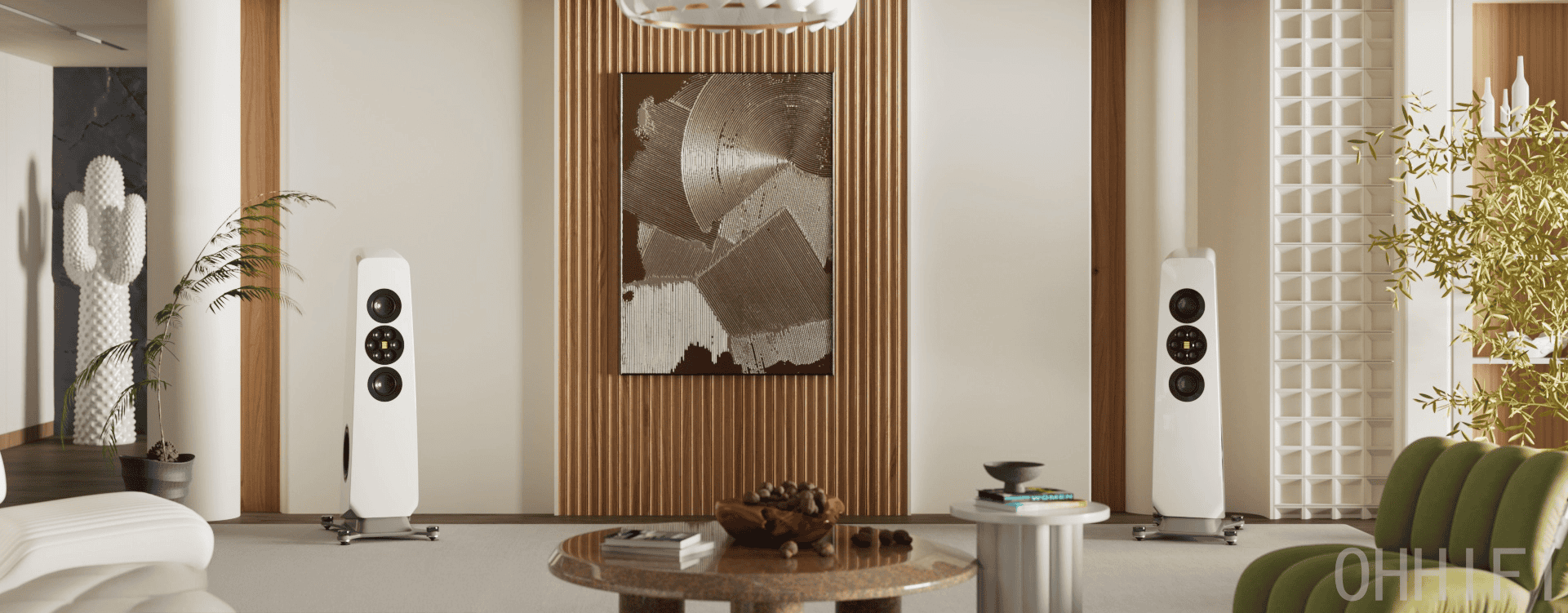
The M 807 is not merely a loudspeaker; it is a declaration of intent. Standing as the latest evolution in the Concentro 2.0 series, it arrives at a time when the market is flooded with "lifestyle" luxury speakers that prioritize aesthetics over acoustics. ELAC, however, has chosen a different path. While the M 807 is undeniably a visual spectacle—a "sculpture of sound" developed in collaboration with a prestigious Hamburg design studio—its beauty is brutally functional. Every curve, every facet, and every sweep of its high-gloss cabinet is calculated to serve the physics of sound propagation.
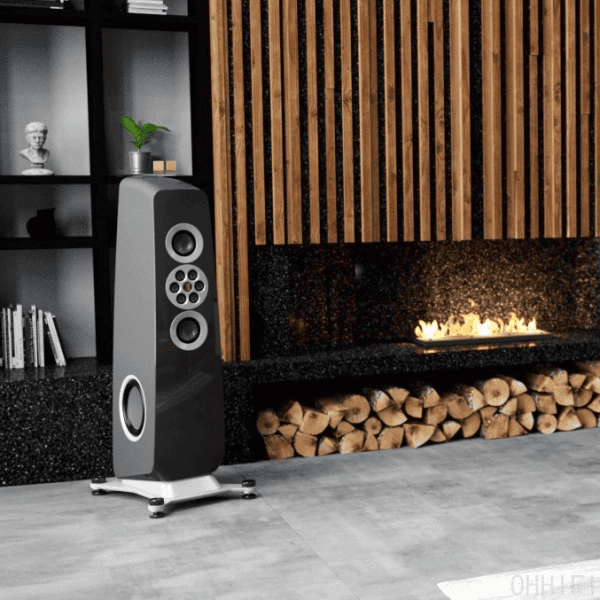
This is the "Other ELAC." For the past decade, the brand has found immense success dominating the entry-level and mid-tier markets, largely thanks to the wizardry of their approachable Debut and Uni-Fi lines. But long-time audiophiles remember a different ELAC—the company that engineered the miraculous 4Pi omnidirectional tweeter, the company that milled drive units from aluminum sandwiches when others were using paper, the company that pushed the boundaries of what German precision could achieve in the domestic listening room. The Concentro M 807 is a return to that uncompromising ethos. It is a four-way, bass-reflex leviathan that costs as much as a luxury sedan and demands partnering electronics of equal pedigree.
In this exhaustive review, we will dissect the M 807 from the inside out. We will explore the revolutionary VXe (Variable Coaxial electric) technology that promises to solve the eternal conflict between room acoustics and imaging. We will scrutinize the implementation of the legendary JET 6c tweeter and the Crystal Membrane drivers. And, most importantly, we will put this German heavyweight through a torture test of musical genres to see if it can dance as well as it can deadlift.
1. Design and Aesthetics: Architecture for the Ears
1.1 The Silhouette of Speed
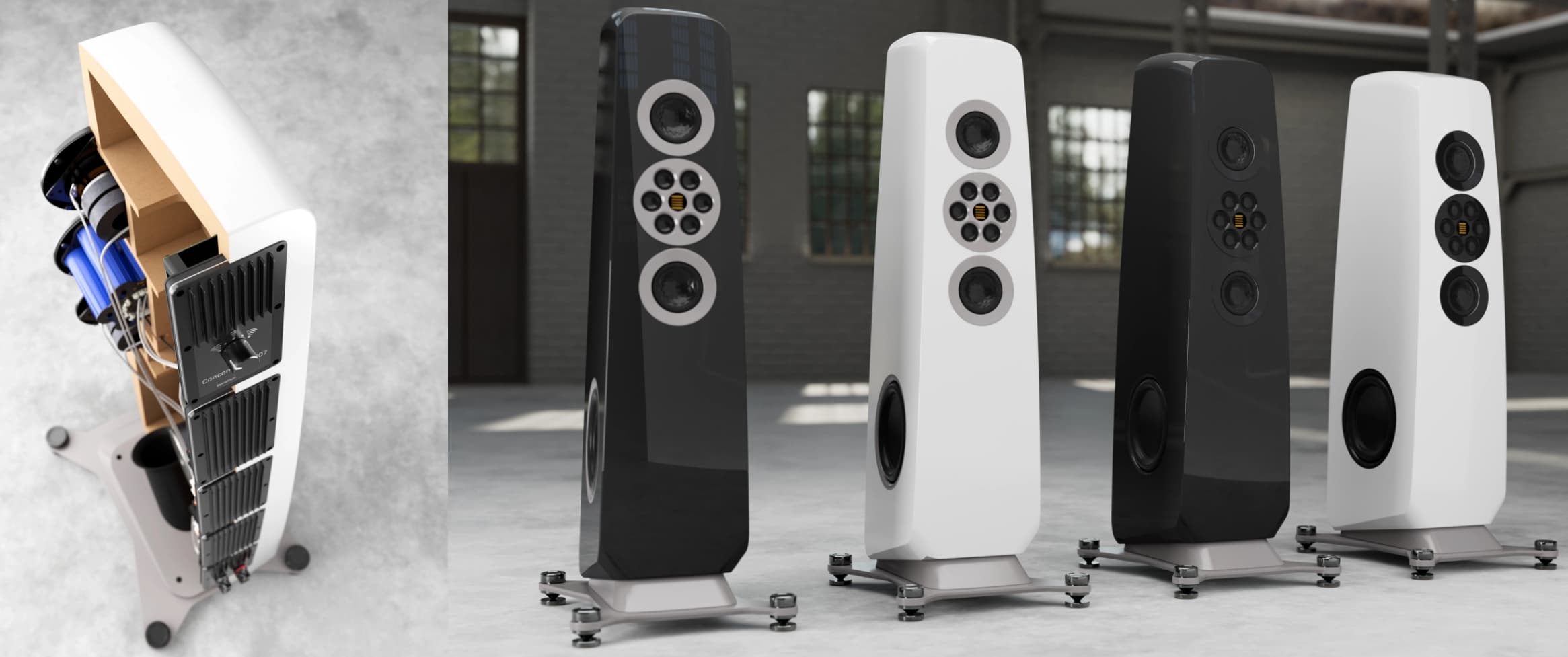
Uncrating the Concentro M 807 is a physical reminder of the difference between "consumer electronics" and "heavy industry." Each tower weighs in at a spine-compressing 62 kilograms (136.7 lbs). Once wrestling them into position, however, the visual impact is immediate and arresting. The M 807 does not look like a traditional speaker box; it looks like it was grown rather than built, or perhaps eroded by a supersonic wind tunnel.
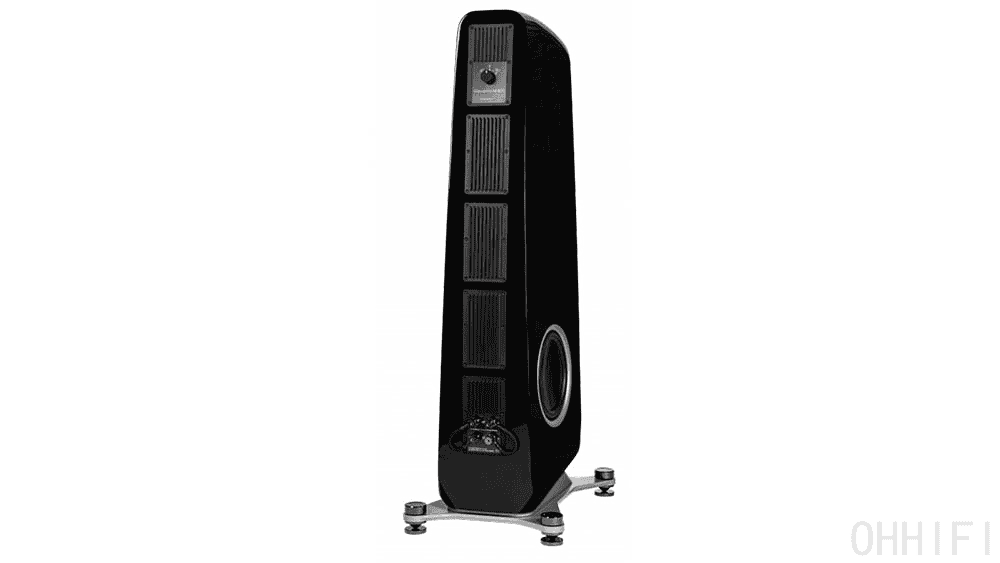
The cabinet stands 1340mm (52.8 inches) tall, resting on a massive, intricate aluminum bottom assembly that gives the speaker a "high-heel" elegance.1 This is not just styling; this assembly provides the necessary mass-loading and stability for the narrow footprint while housing the critical down-firing bass port. The main enclosure tapers dramatically, sweeping back from a baffle width of 461mm. There are no parallel walls. This is Audiophile Design 101 taken to the extreme: parallel surfaces create internal standing waves—acoustic resonances that color the sound. by eliminating them, ELAC ensures that the only thing you hear is the driver output, not the box singing along.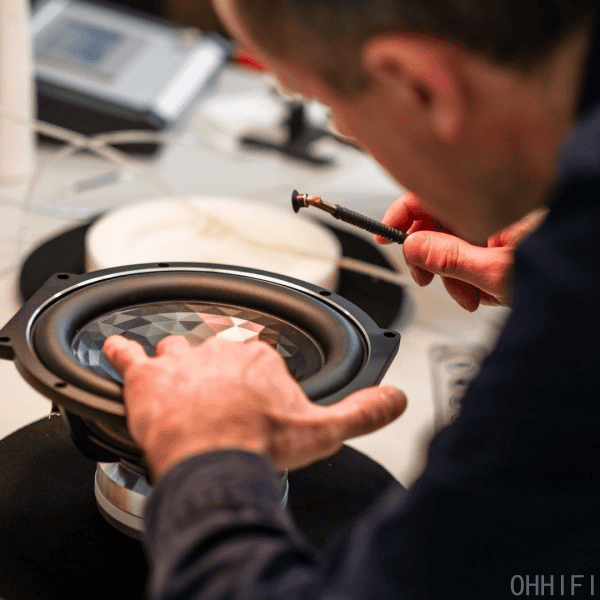
The finish is, as expected from a German flagship, flawless. Our review sample arrived in High Gloss Black, though a pristine White is available. The lacquer is deep enough to feel like you could dip your hand into it, polished to a mirror shine that reflects the listening room. Aluminum accents—deco rings available in black or grey—break up the monochrome, highlighting the drivers like jewelry in a display case.
1.2 The Hamburg Connection
The design credit goes to a renowned Hamburg design studio, and their influence is evident in the tension between organic curves and industrial precision. The speaker manages to look futuristic—"like a spaceship," as some early commentators noted—without appearing garish. It occupies space with confidence but, thanks to its tapering rear profile, doesn't visually dominate the room as much as its volume would suggest. It is a "statement piece" in the truest sense; it demands attention, sparking conversation before a single note is played.
2. Technological Tour de Force: The Engine Room
Underneath the glossy skin lies an arsenal of proprietary technologies. ELAC has always been an engineering-first company, and the M 807 is a showcase of their current capabilities.
2.1 The Revolution: VXe Technology
The headline feature of the Concentro M 807 is undoubtedly the VXe (Variable Coaxial electric) Technology. To understand why this is significant, we must briefly revisit the concept of the coaxial driver.
2.1.1 The Coaxial Grail
Ideally, all sound should come from a single point in space (a "point source"). This ensures that the high frequencies and mid-frequencies reach your ear at the exact same time, preserving the phase relationship of the music. Traditional speakers with a tweeter on top and a midrange below suffer from "lobing"—as you move your head vertically, the distance to each driver changes, causing cancellations. Coaxial drivers (like KEF's Uni-Q or Tannoy's Dual Concentric) solve this by placing the tweeter inside the midrange cone. The same point-source logic now reaches far more affordable, studio-focused designs as well — the coaxial, cardioid Palmer Orbit 11 chases this exact coherence for a tiny fraction of the M 807's outlay.
However, traditional coaxials have a flaw: the midrange cone acts as a waveguide (horn) for the tweeter. As the midrange cone moves back and forth to produce sound, it modulates the tweeter's output (intermodulation distortion).

2.1.2 The Ring Radiator Solution
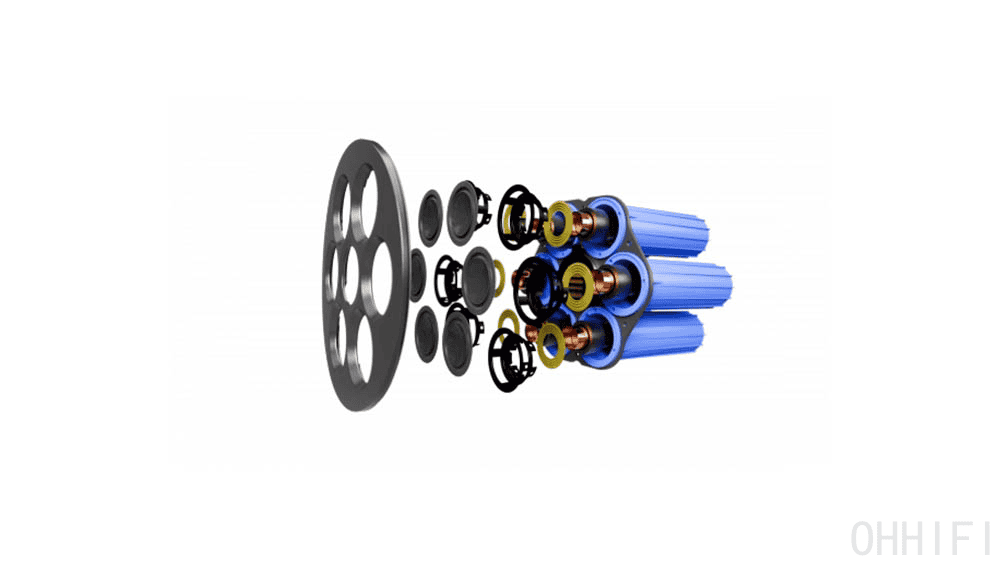
ELAC’s VXe approach is different. Instead of a large moving cone, they use a circular array of six ultra-compact 40mm (1.6”) A-XR midrange drivers.
The Array: These six tiny drivers surround the central tweeter in a ring. Because they are small and lightweight, they are incredibly fast. Because there are six of them, they have the combined surface area to move significant air, providing dynamic snap in the upper midrange.
The Stability: Crucially, this ring acts as a static waveguide for the central tweeter. The tweeter doesn't see a moving cone; it sees a stable acoustic environment. This theoretically eliminates the modulation distortion inherent in traditional coaxials.
Acoustic Center: The acoustic center of the midrange array is exactly in the center of the tweeter, achieving the point-source ideal without the mechanical drawbacks.
2.1.3 The "Variable" Factor: Directivity Control
The "V" in VXe stands for Variable. On the rear of the cabinet, there is a control mechanism that allows the user to alter the radiation pattern of this array. This is the M 807's "killer app."
The Problem: In a modern living room with floor-to-ceiling windows and hardwood floors, a speaker with wide dispersion will splash sound off the side walls, creating harsh reflections that smear imaging. In a treated listening room with plush carpets, a narrow-dispersion speaker might sound dull and lifeless.
The Fix: The VXe system offers five switchable modes. These modes likely alter the amplitude and phase relationship between the inner and outer sections of the crossover or the drivers themselves, allowing the user to tune the ratio of direct to diffuse sound. You can dial in a focused, laser-like beam for a "monitoring" experience or a wide, diffuse wash for a "live concert" feel. This is psychoacoustic customization at a hardware level.
2.2 The High-Frequency Master: JET 6c Tweeter
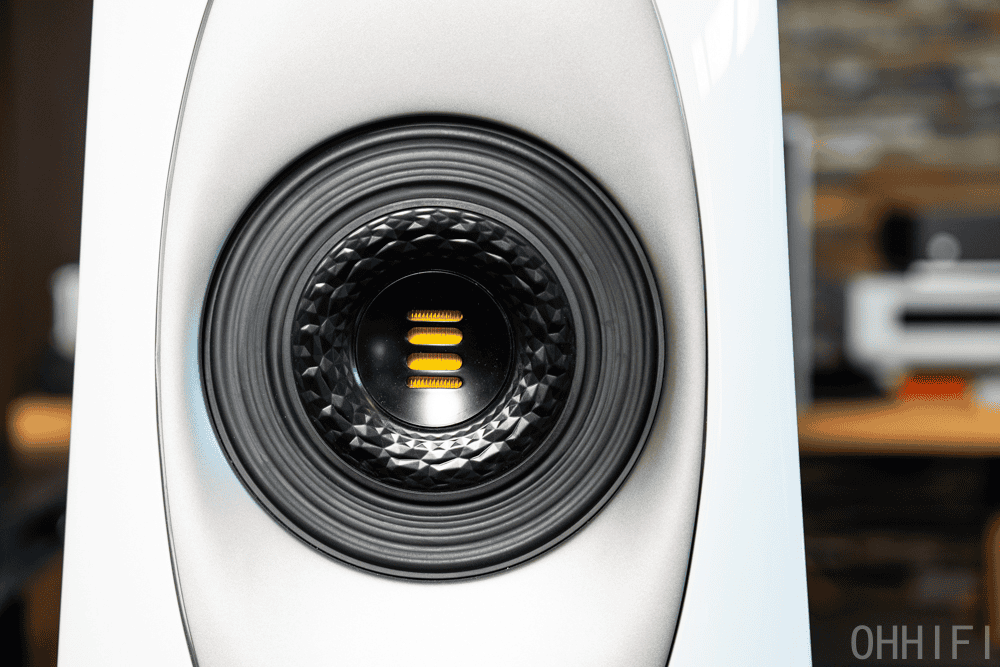
Anchoring the center of the VXe ring is the JET 6c tweeter. The JET is ELAC’s crown jewel, an Air Motion Transformer (AMT) based on the work of Dr. Oskar Heil.
How It Works: Unlike a dome tweeter that pushes air like a piston (1:1 ratio), the JET uses a folded foil membrane (like an accordion). As the signal runs through the aluminum traces on the foil, the pleats squeeze together and pull apart. This squeezes air out at a velocity 5 times faster than the membrane itself moves.
The Result: Lightning-fast transient response, massive dynamic headroom, and extension up to 50kHz. The "c" variant is optimized for the coaxial configuration, ensuring its dispersion matches the surrounding midrange ring perfectly.
2.3 The Mid-Bass Bridges: Crystal Membrane AS-XR
Handling the transition between the ethereal VXe array and the thunderous woofers are two 115mm (4.5”) Low-Midrange drivers. These utilize ELAC’s famous Crystal Membrane.
The Facets: You’ll notice the cones look like a crushed diamond or a piece of crumpled foil. This "Crystal" stamping is not for looks. By faceted the aluminum surface, ELAC increases the stiffness of the cone by an order of magnitude without adding mass. This pushes the "breakup mode" (the frequency where the cone stops moving as a piston and starts flexing) well outside the operating range.
AS-XR: This stands for Aluminum Sandwich Extended Range. The aluminum cone is glued to a paper pulp backing using a proprietary process. The paper provides self-damping (stopping the metal from ringing like a bell), while the aluminum provides the speed and attack.
2.4 The Foundation: Impulse Compensated Woofers
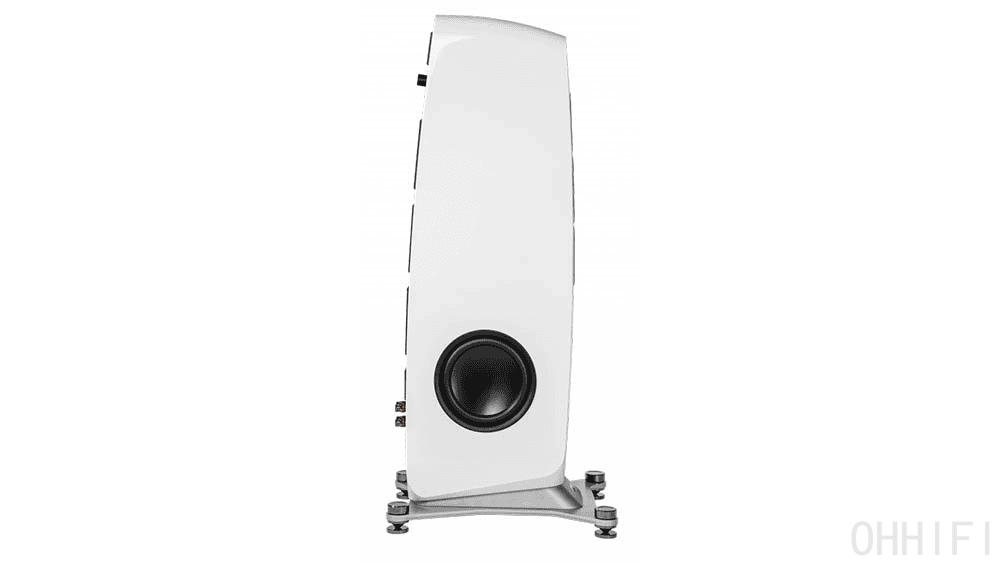
Finally, we reach the low end. The M 807 features dual 250mm (10-inch) Aluminum Sandwich woofers.
Side-Firing Configuration: To keep the front baffle narrow (essential for good imaging), the massive woofers are mounted on the sides of the cabinet.
Push-Push / Pull-Pull: The woofers are mechanically linked and wired to move in unison (both move out, both move in). As per Newton’s Third Law, the force generated by the left woofer pushing out is exactly cancelled by the right woofer pushing out.
Inert Cabinet: This "Impulse Compensation" means that even when the speakers are outputting 110dB of bass energy, the cabinet remains rock still. Place a coin on top of the M 807 during a drum solo, and it won't wobble. This ensures that all the amplifier power goes into generating sound, not vibrating the box.
2.5 Crossover and Connectivity
The crossover network is housed in its own shielded chamber to prevent microphonic pickup from the bass energy. It uses audiophile-grade components: air-core inductors (for zero magnetic saturation) and MOX (metal oxide) resistors for thermal stability. The crossover points are set at 150Hz, 650Hz, and 2650Hz, effectively dividing the labor to ensure no driver is stressed outside its comfort zone.

3. Setup and Compatibility: Taming the Beast
Setting up the M 807 is a ritual. Given the weight and the complex porting, placement requires patience. The Down-Firing Bass Reflex port is a blessing here. Unlike rear ports that turn walls into bass boosters, the down-firing arrangement couples the bass energy to the floor omnidirectionally. We found the M 807 to be surprisingly room-friendly. They didn't need to be pulled 5 feet into the room to avoid booming; 2-3 feet sufficed.
However, they are revealing of upstream equipment. With a nominal impedance of 4 Ohms and a dip to 3.1 Ohms, they are current-hungry. They are rated for amplifiers up to 600 Watts, and in our testing, they thrived on power. A modest 50W tube amp will not wake these giants up. You need current. We utilized a reference stack including high-current Class A/B monoblocks to ensure we had sufficient headroom.
The VXe adjustment proved pivotal. In our treated listening room (which is relatively "dead"), the "Diffuse" setting opened up the top end, restoring the "air" that the room treatments were absorbing. Conversely, in a living room setup with glass windows, the "Direct" mode tightened the focus, preventing the sound from becoming a splashy mess. This feature alone justifies a significant portion of the price tag—it effectively gives you five speakers in one.
4. The Listening Experience: A Journey into Sound
After a comprehensive burn-in period (essential for the mechanical suspension of those six midrange drivers to settle), we sat down for critical listening. The immediate impression is one of scale and precision. It is a rare paradox: usually, big speakers sound big but slow, while small monitors sound fast but small. The M 807 sounds massive and fast.
4.1 Tonality and Timbre
The M 807 is neutral, but not clinically so. The Crystal Membrane drivers impart a texture to the lower mids that gives body to vocals and strings. It doesn't have the "golden glow" of a vintage Tannoy or the romantic warmth of a Sonus Faber; it is undeniably German in its honesty. If the recording is bright, the speaker will tell you. If the recording is lush, the speaker will wrap you in velvet.
4.2 Soundstage and Imaging
This is the VXe party trick. The imaging is holographic. The "Step-Point Source" concept works. On orchestral recordings, the M 807 disappears completely. The soundstage is not just wide; it is deep. You can hear the rows of the orchestra. The "Directivity Control" allows you to dial in the width of the sweet spot. Locked in the center seat, the focus is razor-sharp—phantom images are solid enough to touch.
4.3 Dynamics and Speed
Thanks to the JET tweeter and the lightweight midrange array, the "start/stop" ability of this speaker is startling. Transients—the crack of a snare, the pluck of a guitar string—are instantaneous. There is no overhang. The sound doesn't "linger" in the box. This speed extends to the bass. The push-push woofers stop on a dime, revealing texture in low-frequency notes that are usually just a blur of rumble.
4.4 Bass Performance
With a rated extension down to 24Hz, the M 807 is a full-range loudspeaker. No subwoofer is required, or desired. The bass is deep, pressurized, and visceral. It hits you in the chest. But it is "smart" bass. It doesn't overwhelm the midrange. It creates a foundation, a bedrock upon which the rest of the music stands.
5. Musical Analysis: Track by Track
To truly understand the M 807, we must look at how it handles specific musical challenges.
5.1 The Resolution Test: Radiohead - "2+2=5" (Hail to the Thief)
This track is a density test. It builds from a quiet intro into a chaotic wall of sound.
The Detail: In the intro, Thom Yorke’s vocals are doubled—one main vocal, one quieter and higher. Most speakers meld these into a single, thickened vocal line. The M 807 separates them surgically. You can hear the "connective gestalt" of the second voice, tracing its melody independent of the main line.2
The Climax: When the band kicks in, lesser speakers compress; the soundstage collapses into a 2D plane. The M 807 simply gets louder. The separation between the distorted guitars and the cymbals remains pristine. The JET tweeter dissects the high-frequency noise without becoming harsh.
5.2 The Bass Texture Test: Pino Palladino & Blake Mills - "Just Wrong" (Notes With Attachments)
This album is a masterclass in low-end mixing. The bass is not just deep; it's woody, resonant, and full of character.
The Texture: The M 807 reveals the grain of the bass strings. You don't just hear a low note; you hear the finger interaction with the fretboard. The impulse-compensated woofers keep the decay clean.
The Room: Even with the deep synth notes, the down-firing port kept the room modes in check. The bass rolled through the floor rather than booming off the back wall.
5.3 The Dynamic Swing Test: Gustav Mahler - Symphony No. 2 (Resurrection)
A full orchestral crescendo is the ultimate torture test for dynamic range.
The Whisper: The quiet passages are rendered with a "black" background. The low noise floor of the speaker (thanks to the inert cabinet) preserves the micro-dynamics of the woodwinds.
The Roar: When the brass and percussion erupt, the M 807 hits with the force of a physical blow. The scale is immense. The VXe array maintains the placement of the violins and cellos even during the loudest peaks—nothing blurs. The "Diffuse" setting here was magical, expanding the walls of the listening room to the dimensions of a concert hall.
5.4 The Vocal Intimacy Test: Leonard Cohen - "You Want It Darker"
The Presence: Cohen’s voice is recorded close-miked and deep. The M 807 projects him dead center, a towering monolith of gravel and grace. The Crystal Membrane mids capture the rasp and the chest resonance perfectly. It feels like he is in the room.
5.5 The Speed Test: Daft Punk - "Giorgio by Moroder"
The Transient: The click track and the synthesized arpeggios require absolute speed. Any overhang makes this track sound sluggish. The M 807 locks into the groove. The interplay between the synthesized bass and the live drum kit (recorded with vintage mics) is fascinating—the speaker clearly differentiates between the digital precision of the synth and the organic resonance of the drum skin.
6. Competitive Landscape: Giants in the Ring
At a price point hovering around $45,000, the Concentro M 807 enters the ring against some of the most storied names in high-end audio.
6.1 ELAC M 807 vs. KEF Blade Two Meta
The KEF Blade is the most direct conceptual rival. Both feature side-firing, force-cancelling woofers and a signature coaxial driver (Uni-Q).
The Difference: KEF’s Uni-Q is a true point source with the tweeter inside the midrange. ELAC’s VXe is a ring radiator. Sonic-wise, the KEF tends to be slightly warmer and more "organic" in the treble due to its dome tweeter. The ELAC is faster, more airy, and has more "sparkle" thanks to the JET AMT.
The Advantage: The ELAC’s bass hits harder and goes deeper in-room. The VXe adjustability also gives the ELAC an edge in difficult rooms where the KEF might be fixed in its dispersion character.
6.2 ELAC M 807 vs. Bowers & Wilkins 801 D4
The B&W is the studio standard.
The Difference: The 801 D4 uses a Diamond dome tweeter and a dedicated turbine head for the midrange. It is a more "forward" presentation, often described as the "studio sound."
The Advantage: The ELAC sounds more cohesive. The transition from bass to mid to treble feels more seamless on the M 807, likely due to the unified wavefront of the VXe array compared to the separate physical enclosures of the B&W. The ELAC is also less visually traditional, which may appeal more to the modern design aficionado.
6.3 ELAC M 807 vs. Wilson Audio Sasha V
The American heavyweight.
The Difference: Wilson focuses heavily on cabinet materials (X-Material) and time-alignment via adjustable modules. The Wilson sound is famous for its mid-bass punch and dynamic slam.
The Advantage: The ELAC M 807 offers a more extended, effortless top end. The JET tweeter simply retrieves details that the Wilson’s dome might smooth over. However, the Wilson might have the edge in ultimate mid-bass "slam" for rock music. The ELAC is the more refined, "high-resolution" choice.
7. Technical Specifications Summary
To recap the data for the data-hungry:
| Feature | Specification | Notes |
| Type | 4-Way, Bass Reflex | Down-firing port |
| Tweeter | JET 6c AMT | Coaxial optimized, 50kHz extension |
| High-Mid | 6 × 40 mm A-XR | VXe Array, Ring Radiator |
| Low-Mid | 2 × 115 mm AS-XR | Crystal Membrane |
| Woofer | 2 × 250 mm (10") AS | Impulse Compensated (Push-Push) |
| Frequency Range | 24 Hz – 50,000 Hz | 3 |
| Crossover Freqs | 150 / 650 / 2,650 Hz | 4 |
| Sensitivity | 88 dB (2.83 V / 1 m) | Needs power |
| Impedance | 4Ω nominal (3.1Ω min) | High-current amp required |
| Power Handling | 300W Nom / 400W Peak | 3 |
| Dimensions | 1340 × 461 × 595 mm | 5 |
| Weight | 62 kg (136.7 lbs) | Per speaker |
8. Conclusion: The Masterpiece of Kiel
The ELAC Concentro M 807 is a triumph. It successfully bridges the gap between the "science project" aesthetic of the extreme high-end and the emotional requirements of a musical instrument. It is a speaker that appeals to the brain with its VXe technology and impulse compensation, and to the heart with its effortless dynamics and holographic imaging.
It is not a speaker for everyone. Its visual language is polarizing—it demands a modern room. Its electrical demands are significant—it will expose weak amplifiers. And its revealing nature means it will not forgive bad recordings. But for the audiophile who wants to hear everything, who wants to be transported to the venue, and who appreciates the fusion of industrial art and acoustic science, the M 807 is a revelation.
In a world of safe, rectangular boxes, ELAC has dared to build a sculpture that sings. As they approach their 100th year, the M 807 proves that this German giant is not just resting on its history; it is actively writing the future of high-fidelity sound.
Final Verdict:
Reference Status: Confirmed.
Sound Quality: 9.5/10
Build Quality: 10/10
Value: 9/10 (in the context of ultra-high-end)
The "Wow" Factor: 11/10
The Concentro M 807 is, simply put, one of the most exciting loudspeakers to come out of Europe in the last decade. If you have the space, the budget, and the amplification, it is a destination speaker—one you buy to keep for life.





Comments