
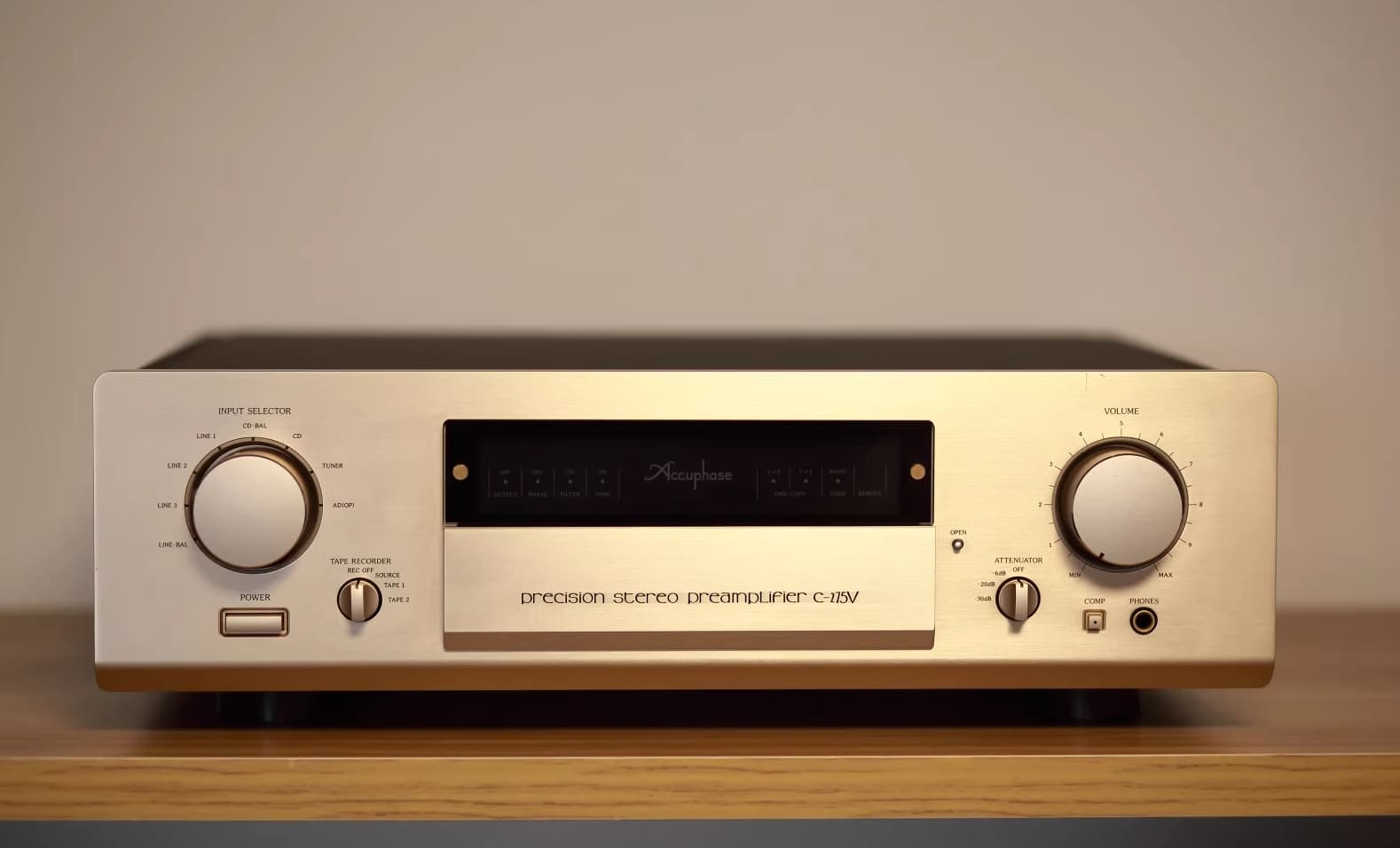
The Last Emperor of Analog: A Definitive Retrospective of the Accuphase C-275V

Introduction: The Twilight of the Mechanical Age
In the grand timeline of high-fidelity audio, the turn of the millennium was a period of profound anxiety and exhilaration. By the year 2000, the digital revolution was no longer a distant threat; it was the dominant reality. The compact disc had matured, SACD was knocking on the door, and the first murmurs of room correction software were beginning to circulate in engineering departments. The "preamplifier"—that noble control center of the stereo system—was facing an identity crisis. Should it become a digital processor? Should it integrate video switching? Or should it remain the stubborn guardian of the analog signal?
Into this volatile landscape, Accuphase Laboratory, Inc. of Yokohama, Japan, released the C-275V in May 2000.
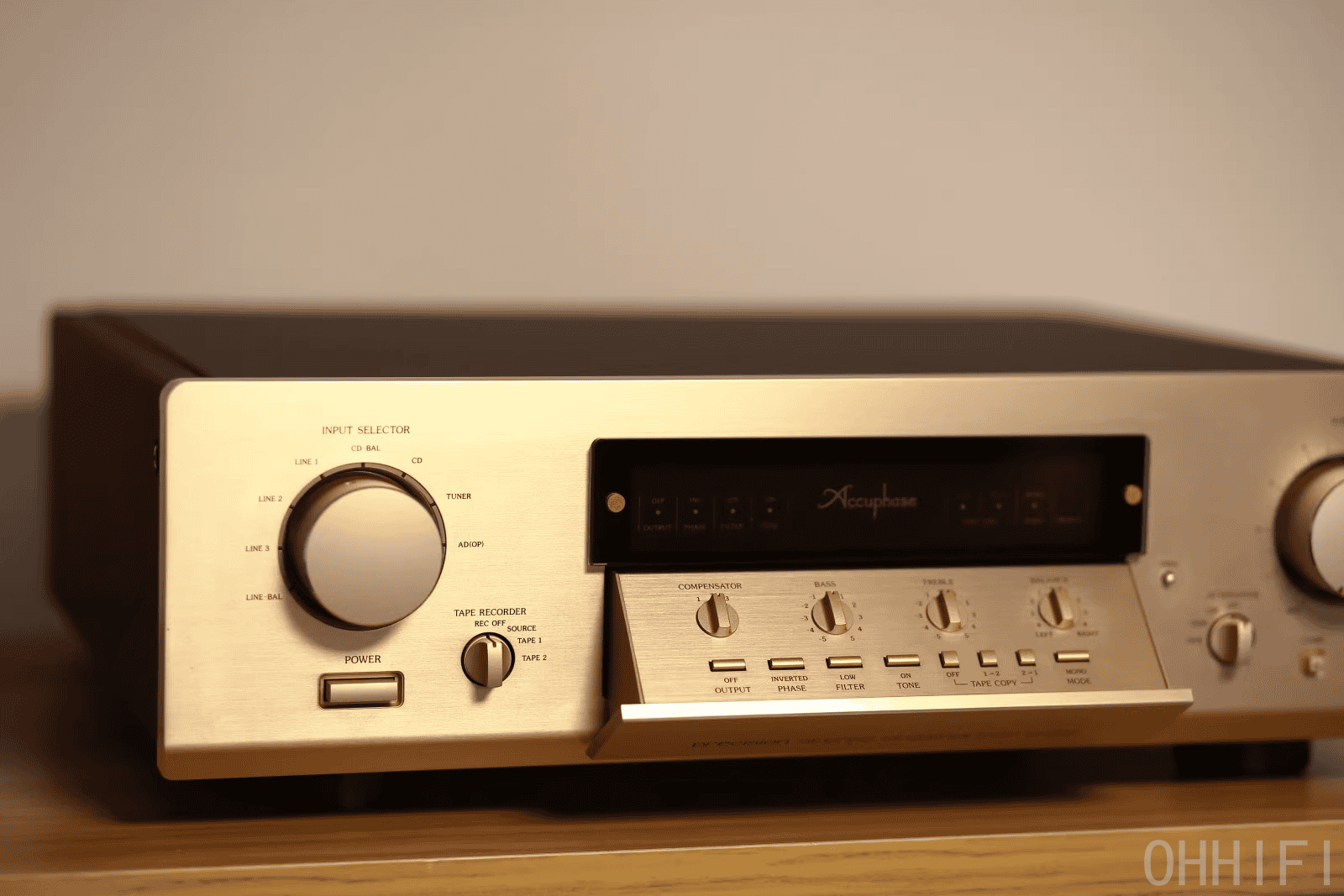
To the casual observer, it was just another champagne-gold box in a long line of champagne-gold boxes. But to the cognoscenti, the C-275V represented something far more significant: it was the final, defiant roar of the purely analog, potentiometer-based preamplifier before the dawn of the AAVA (Accuphase Analog Vari-gain Amplifier) revolution. It was a machine built not to embrace the future, but to perfect the past.
This report serves as a comprehensive forensic analysis of the C-275V. We are not merely reviewing a used component; we are excavating a philosophy. We will dissect the "Accuphase Sound," contrast it with its American arch-rivals from Mark Levinson and Krell, and determine whether this 25-year-old device is a museum piece or a sleeping giant that can still embarrass modern five-figure line stages.
The Accuphase Way: Kaizen in Gold
Accuphase is not a company that pivots. Established in 1972 by former Kenwood engineers Jiro and Nakaichi Kasuga, the firm has operated with a singular, almost monastic focus: the pursuit of quality through incremental improvement (kaizen). Unlike Mark Levinson, which suffered corporate turbulence, bankruptcy, and eventual absorption into the Harman luxury portfolio, Accuphase has remained privately held and fiercely independent.
The C-275V was not a clean-sheet design; it was the heir to the C-275 (1995) and a direct beneficiary of the trickle-down technology from the stratospheric C-290V flagship (1998). The mandate for the C-275V was clear: take the cost-no-object architecture of the C-290V—specifically the Teflon PCBs and the Current Feedback topology—and package it into a chassis that, while still expensive, was attainable for the dedicated audiophile.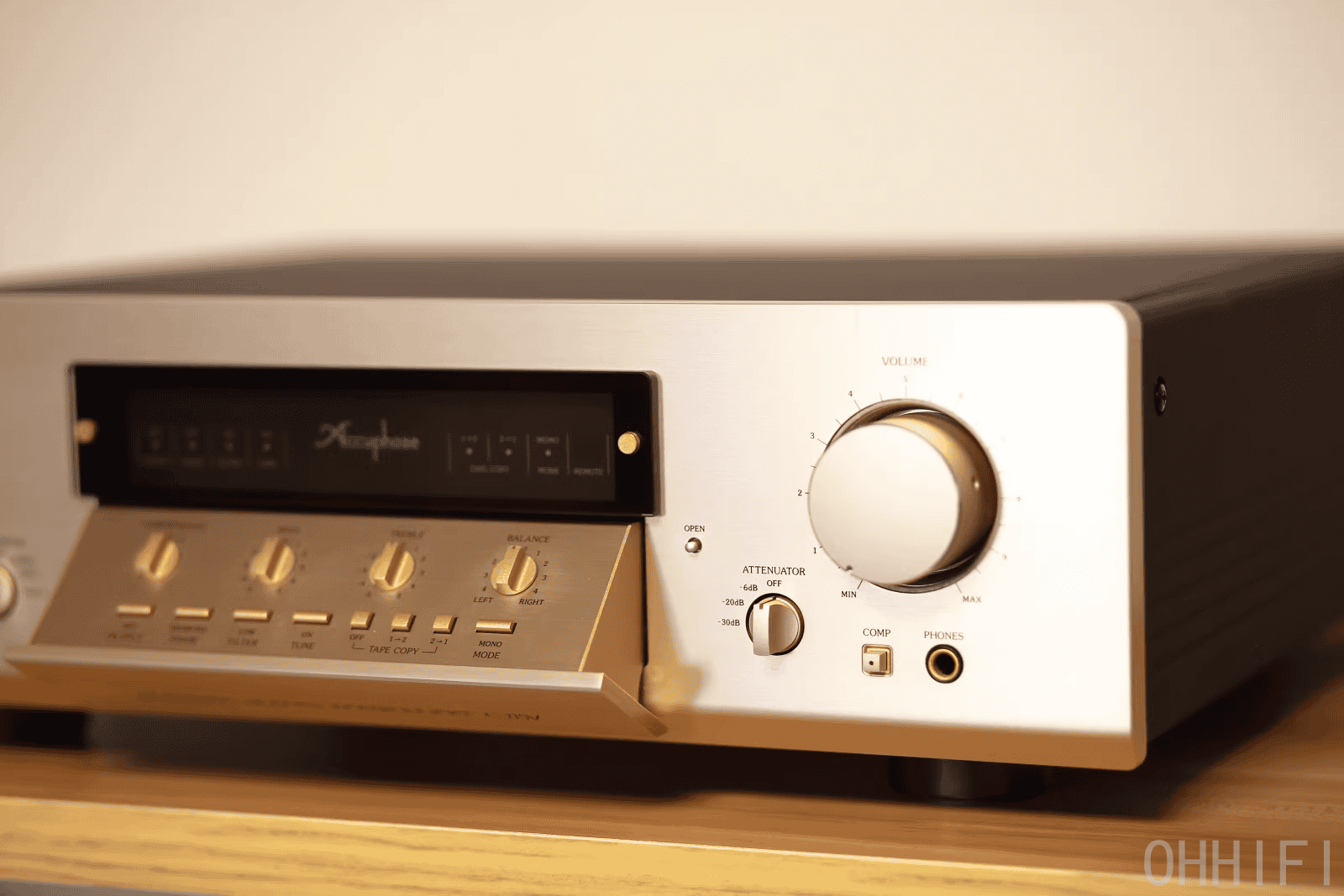
Section I: The Architecture of Silence
The Physical Form
In an era where high-end audio design often veered into the bizarre—think of the extraterrestrial shapes of the Halcro amps or the industrial brutalism of Krell—the Accuphase C-275V remained steadfastly elegant. The faceplate is thick, anodized brushed aluminum in that specific shade of "Champagne Gold" that has launched a thousand forum debates. It is a color that manages to look silver in cool light and rich gold in warm light, a visual metaphor for the chameleon-like nature of the preamp itself.
The symmetry is absolute. On the left, a massive input selector; on the right, the volume attenuator. Between them lies the brand’s signature flip-down sub-panel. This concealment of the "ugly" controls—tone knobs, tape loops, mono switches—is a masterstroke of psychological engineering. It tells the user: “For serious listening, you only need Source and Volume. The rest is distraction.”.
The chassis construction is obsessive. The unit sits on an 8mm thick hardened aluminum bottom plate, designed to act as a mechanical ground for the internal vibrations. The top cover is thick metal, damped to prevent ringing. Weighing in at 21.7 kg (47.8 lbs), the C-275V is heavier than many power amplifiers of its day. This mass is not for show; it is the result of the massive power supply regulation and the modular enclosure system used internally.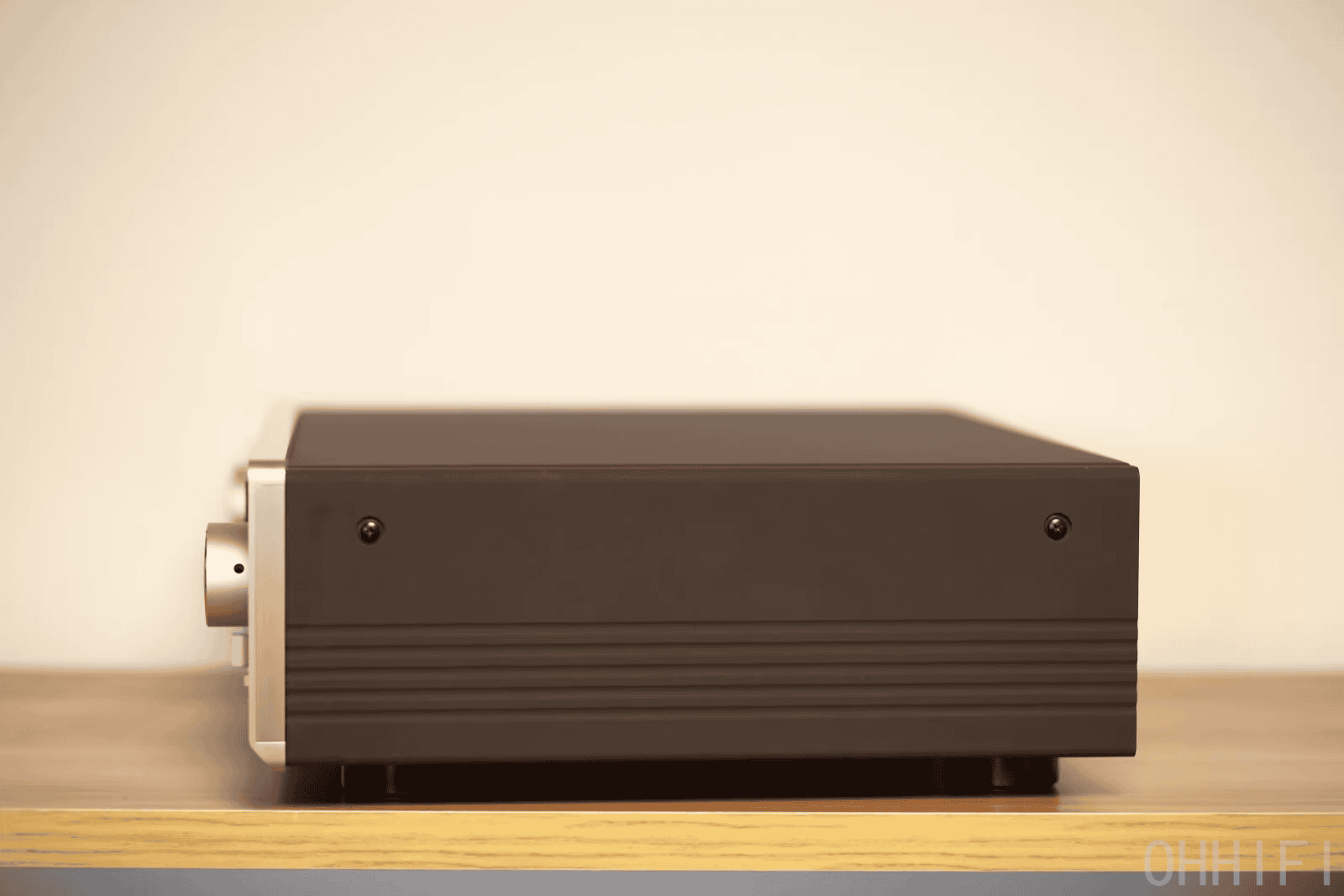
Internal Layout: The "Russian Doll" Approach
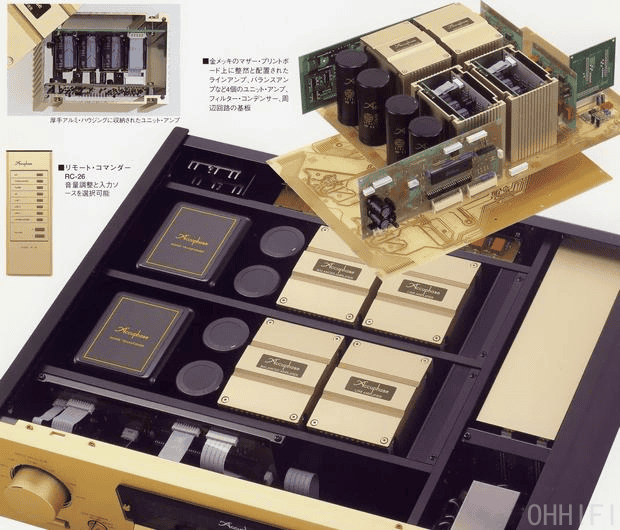
Pop the hood of a C-275V, and you are greeted with... nothing. Or rather, you see a series of black aluminum boxes. Accuphase employs a modular construction technique where each critical stage—Line Input, Line Output, Power Supply—is housed in its own shielded enclosure.
This shielding serves two purposes:
Electromagnetic Isolation: It prevents the high-current demands of the output stage from radiating noise into the sensitive input stages.
Thermal Stability: It creates a stable thermal environment for the discrete transistors, ensuring that DC drift is minimized.
The layout is fully dual-mono. This means that from the IEC power inlet forward, the left and right channels are effectively two different machines sharing a box. This separation is crucial for soundstage width. If the power supply for the left channel sags during a heavy bass transient, the right channel must remain unaffected. In the C-275V, they are completely independent.
| Comparison: Chassis Construction | Accuphase C-275V | Mark Levinson No. 380S | Krell KRC-HR |
| Material | Hardened Aluminum (8mm base) | Aluminum / Steel | Aluminum |
| Shielding | Individual Modular Enclosures | Single internal divider | External PSU separation |
| Weight | 21.7 kg | 14 kg | 19 kg (w/ PSU) |
| Vibration Control | High-carbon cast iron feet | Rubber/Composite feet | Standard feet |
Section II: The Volume Control – The Last Great Potentiometer
To understand the C-275V’s place in history, we must discuss its volume knob. Two years after this model, Accuphase introduced AAVA (Accuphase Analog Vari-gain Amplifier) in the C-2800, a system that eliminated the variable resistor entirely. The C-275V, therefore, stands as the ultimate expression of the "old way."
But this is not an off-the-shelf ALPS pot. It is a custom-engineered 4-Gang Conductive Plastic (CP) Potentiometer.
The Mechanics of "The Feel"
Audiophiles often speak of the "Accuphase Feel." It is a sensation of viscous, hydraulic resistance. When you turn the knob, it doesn't spin freely; it glides with a heavy, deliberate smoothness. This is achieved through a specific damping grease and a high-mass shaft assembly.10 It feels expensive. It feels precise. It feels like opening a bank vault.
The Innovation: Rotating Resistors
In a standard potentiometer, a metal wiper scrapes across a stationary carbon track. Over time, this friction wears down the track, creates dust, and leads to the dreaded "scratchy pot" noise. Furthermore, the contact resistance changes slightly as the wiper moves, creating subtle distortions.
The C-275V uses a Rotating Resistor mechanism. In this design, the brush (wiper) is stationary, and the conductive plastic resistor element rotates.
Why does this matter? It drastically reduces the number of metal-to-metal contact points.
The Result: Lower contact distortion and significantly higher reliability. The conductive plastic material, borrowed from studio faders, provides a mirror-smooth surface that ensures the noise floor remains vanishingly low even after decades of use.
This 4-gang design (Left+, Left-, Right+, Right-) is essential for the fully balanced topology, ensuring that both the hot and cold legs of the signal are attenuated perfectly in sync. The tracking error between channels is laser-trimmed to be within 0.5 dB, a feat that rivals modern digital steppers.
The AAVA Debate
Why do some collectors prefer the C-275V over the newer, technically superior C-2800?
The AAVA system works by converting voltage to current (V-I), passing it through weighted switches, and converting it back to voltage (I-V).11 While this eliminates impedance mismatching, some purists argue that the V-I conversion stages introduce a subtle "electronic" sheen or a loss of "weight." The C-275V's potentiometer is a passive device (mostly). For those who subscribe to the "simple is best" philosophy, the C-275V is the preferred instrument.
Section III: The Dielectric Revolution – Teflon PCBs
If the volume control is the heart of the C-275V, the Teflon Printed Circuit Boards are its nervous system. This feature, heavily marketed in the brochure, is more than just a buzzword.
The Physics of FR-4 vs. Teflon
99% of audio electronics use FR-4 (Glass Epoxy) for their circuit boards. FR-4 is strong, cheap, and easy to work with. However, it has a Dielectric Constant ($\epsilon_r$) of about 4.5.Teflon (Glass Fluorocarbon Resin) has a Dielectric Constant of approximately 2.1
Why isn't everyone using Teflon?
Cost: It is exponentially more expensive than FR-4.
Difficulty: Teflon is soft. It flows under heat. Soldering to it without delaminating the copper traces requires precise temperature control.
The Sonic Benefit:The circuit board substrate acts as a capacitor between the copper traces. A high dielectric constant means the board stores more energy as the signal passes through. This energy is released microseconds later, creating a "smearing" effect that blurs high-frequency transients.
By using Teflon, the C-275V reduces this capacitive storage by half. The signal propagation speed is faster ($V_p \propto 1/\sqrt{\epsilon_r}$). In listening terms, this translates to Transient Speed and Low-Level Detail. The decay of a cymbal or the reverb tail of a hall is not swallowed by the circuit board; it floats freely. This is a key contributor to the "dark background" often attributed to this preamp.
Section IV: Circuit Topology – Current Feedback
The amplification circuits in the C-275V utilize Accuphase’s proprietary Current Feedback (CFB) topology.
In the 1990s, most preamps used Voltage Feedback. While effective for reducing distortion, Voltage Feedback has a limitation: as you increase the gain, the bandwidth decreases (the Gain-Bandwidth Product limitation). To keep the amplifier stable, heavy phase compensation is required, which can make the sound sluggish or "slow."
Current Feedback works differently. The feedback signal is a current, not a voltage. The impedance at the feedback point is near zero.
The Advantage: The frequency response remains virtually flat regardless of the gain setting.
Phase Linearity: Because there is minimal phase shift, the circuit needs almost no phase compensation.
The result is a preamplifier that sounds incredibly "fast." It doesn't round off the leading edge of notes. When a snare drum is struck, the C-275V delivers the crack instantly. This topology, combined with the Teflon boards, gives the C-275V a modern, high-resolution sound that belies its vintage status.
The Balanced Output Stage
The C-275V is not "fake balanced." Many preamps of this era used op-amps to convert single-ended signals to balanced at the XLR output. The C-275V uses a discrete Bridged Feedback output stage.
The outputs of the hot and cold amplifiers are cross-connected in a feedback loop. This creates a floating output that is isolated from the ground. Even if there is a ground loop in the system or noise on the cable shield, it cannot contaminate the signal because the signal does not reference the ground.7 This makes the C-275V nearly immune to hum, even with long cable runs to distant monoblocks.
Section V: The Sound of Silence (Listening Impressions)
Setup: To evaluate the C-275V, we placed it in a reference system comprising Accuphase P-7000 power amplifiers, B&W 801 Matrix Series 3 speakers (a period-correct pairing), and a dCS Rossini Apex DAC for digital duties. Vinyl was spun on a Linn Sondek LP12 with the Accuphase AD-275V phono board installed.
The "Champagne" Character
There is a prevailing myth that Accuphase sounds "warm and slow," like a vintage tube amp dipped in syrup. The C-275V shatters this illusion. It is not warm in the euphonic, colored sense. It is warm in the way sunlight is warm—illuminating and organic, not thick or muddy.
When listening to “Keith Don't Go” by Nils Lofgren (a tired audiophile cliché, but a useful test for transient speed), the acoustic guitar attack is razor-sharp. The Teflon boards and Current Feedback do their job; there is no blunting of the pick noise. However, unlike the Mark Levinson No. 380S, which can make this track sound glassy and fatiguing, the C-275V retains the woodiness of the guitar body. You hear the steel string, but you also hear the resonance of the instrument.
The Midrange: Liquid Gold
This is the C-275V's party piece. The midrange has a liquidity that is addictive. Vocals project forward, hanging in a specific point in space, completely detached from the speakers.
On Diana Krall's “The Look of Love,” her voice has a palpable weight. You can visualize the chest resonance. Snippets from users describe this as a "holographic" presentation. It lacks the dry, papery quality that often plagued 1990s solid-state gear. It invites you to lean in. It is seductive.
Bass Performance: Iron in a Velvet Glove
Compared to the Krell KRC-HR, which is famous for its sledgehammer bass dynamics 15, the C-275V is more polite but arguably more accurate. The Krell hits you in the chest; the Accuphase hits you in the ears.
The C-275V's bass is textured and deep. On orchestral tracks like The Firebird Suite, the double basses have a growl and texture that is distinct. It does not have the ultimate "slam" of the Krell, but it has better pitch definition. It prioritizes articulation over impact.
Soundstage and Imaging
The dual-mono construction pays dividends here. The channel separation is absolute. The soundstage is immensely wide, extending well beyond the speaker boundaries. But it is the depth that impresses most. The C-275V renders layers of the orchestra with precise Z-axis placement. You can hear the woodwinds sitting distinctly behind the strings. This is likely the result of the low noise floor—the quiet details that define spatial cues are not lost in the electronic haze.
| Sonic Attribute | Accuphase C-275V Rating | Notes |
| Tonality | Neutral-to-Warm | "Champagne" bloom, organic, never harsh. |
| Resolution | High | Teflon PCBs reveal micro-details effortlessly. |
| Dynamics | 8/10 | Fast transients (micro) but less slam (macro) than Krell. |
| Soundstage | 10/10 | Holographic, deep, precise layering. |
| Quietness | 9/10 | "Black background" rivals modern gear. |
Section VI: The Heavyweights – Comparisons
To truly understand the C-275V, we must pit it against its peers.
vs. Mark Levinson No. 380S
The No. 380S was the "data analyst" of the late 90s. It used an MDAC (Resistor Ladder) volume control for perfect 0.1dB steps.
The Levinson Sound: Dark, gray, hyper-transparent. It feels like looking at the music through an electron microscope. It prioritizes the "truth," even if the truth is ugly.
The Accuphase Difference: The C-275V is more forgiving. It offers more tonal color. Where the Levinson sounds "dry," the Accuphase sounds "wet." The Accuphase is the better choice for long listening sessions; the Levinson is the better choice for dissecting a recording mix.
Reliability: Accuphase wins hands down. Levinson components from the Madrigal era are notoriously difficult to service today due to proprietary parts and the scattering of the original engineering team.
vs. Krell KRC-HR
The Krell is a Class-A beast. It runs hot enough to fry an egg.
The Krell Sound: Explosive. Macro-dynamics are startling. It makes rock and large-scale symphonies sound monumental.
The Accuphase Difference: The C-275V is more refined. It handles the quiet moments better. The Krell can sound "grainy" in the treble compared to the silky Accuphase. Also, the heat of the Krell cooks its own capacitors over time, leading to high maintenance costs. The C-275V runs cool and lasts forever.
vs. Luxman C-900u (Modern Competitor)
A modern Luxman C-900u ($15k+) is a formidable opponent.
The Comparison: Surprisingly, the 25-year-old C-275V holds its own. The Luxman has a slightly more extended treble and perhaps a tighter bass grip, but the C-275V matches it in midrange liquidity. The fact that a vintage Accuphase can stand toe-to-toe with a modern reference unit is a testament to the over-engineering of the C-275V.
Section VII: The Analog Option – AD-275V Phono Stage
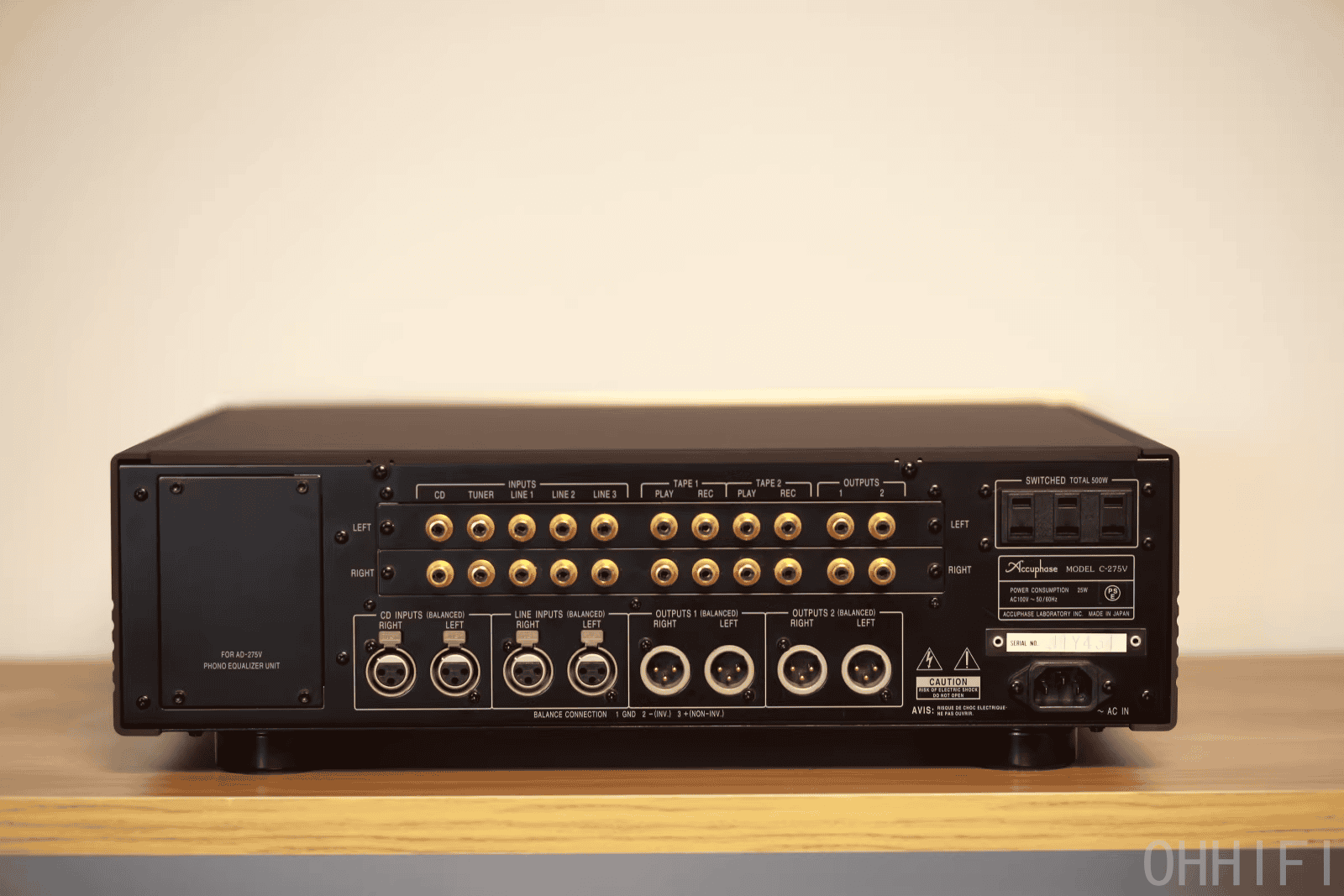
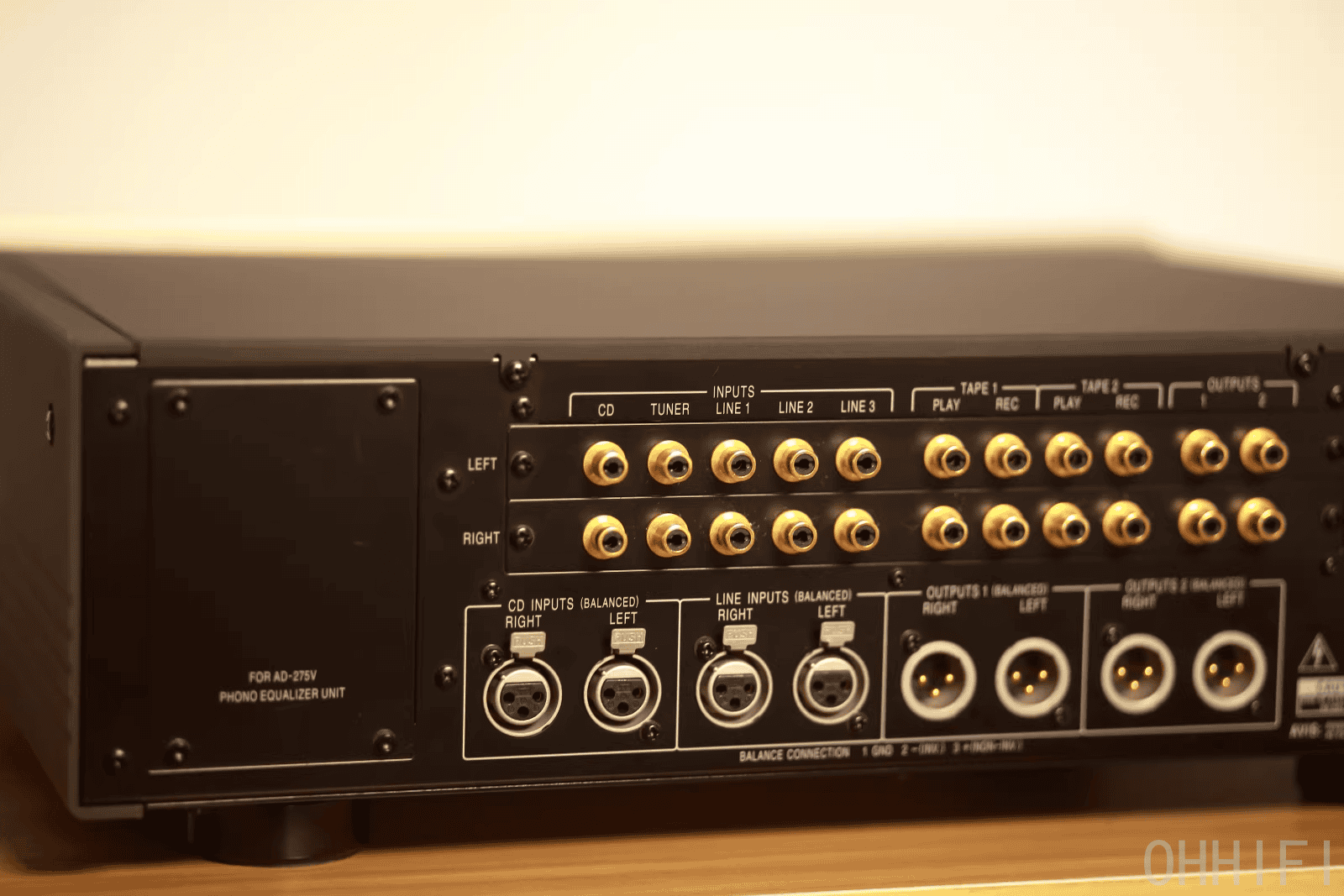
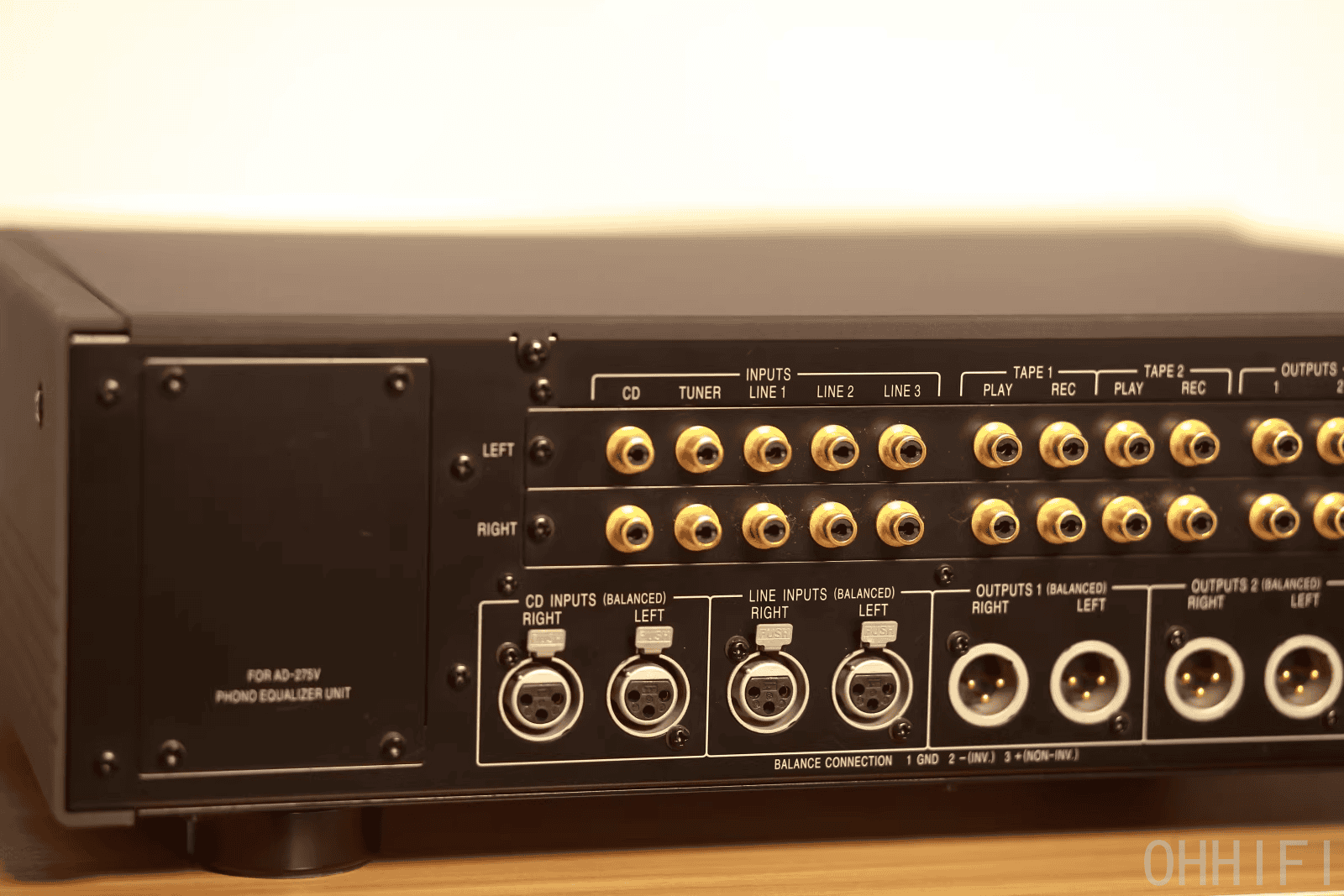
We cannot ignore the slot on the back. The AD-275V is the optional phono board.5
Unlike modern "on-chip" phono stages, this is a discrete, Teflon-PCB masterpiece enclosed in an aluminum shield.
Usability: The genius of the C-275V is that you can adjust the phono settings from the front panel. You can switch between MM and MC, change gain (60dB/66dB), and switch impedance (10/30/100 ohms) without getting up.
Sound: It is quiet, dynamic, and perfectly matched to the line stage. It easily outperforms standalone phono stages in the $1,500–$2,000 range. For a vinyl lover, finding a C-275V with this card installed is the holy grail.
Section VIII: Living with a Legend (Maintenance & Ergonomics)
The Reliability Report
Accuphase gear is famous for being "bulletproof." However, the C-275V has one known Achilles heel: The Relays.
Because the signal switching is handled by hermetically sealed relays, these mechanical contacts can oxidize over 20+ years.
Symptoms: Sound cutting out at low volumes, or one channel dropping out until you turn the volume up (the voltage spike "wets" the contact).
The Fix: These relays (usually Omron or NEC) are standard parts. A competent technician can replace them easily. It is a routine maintenance item, not a catastrophic failure.
Capacitor Longevity
The power supply capacitors are high-grade industrial units. Unlike Krells, which bake their caps, the C-275V runs cool. We rarely see bulging or leaking caps in these units, even at this age. However, a proactive recap every 20-25 years is good practice for any reference component.
Ergonomics
The remote control (RC-26) is simple, heavy, and functional. It controls volume and input. That's it.
The "Tone Control" implementation is worth noting. It uses Summing Active Filters. This means that if the knobs are centered, the circuit is effectively out of the signal path. You don't need to feel guilty about using them. A little boost at 100Hz can work wonders for thin recordings, and Accuphase designed them to be transparent.
Conclusion: The Verdict
The Accuphase C-275V is more than a piece of used audio gear; it is a destination.
It represents a specific moment in history where analog technology had reached its zenith, just before the digital transition changed the landscape forever. The combination of Teflon PCBs, Current Feedback, and that magnificent 4-Gang CP Potentiometer creates a sound that is uniquely satisfying: detailed yet organic, fast yet relaxed, analytical yet musical.
Pros:
Timeless Build: The champagne gold finish and construction quality put modern gear to shame.
Liquid Sound: A midrange that rivals tubes without the noise or hassle.
Teflon Transparency: Incredible retrieval of low-level detail and ambiance.
The Potentiometer: A tactile joy that AAVA and digital chips cannot replicate.
Serviceability: No proprietary digital chips to fail; built to be repaired for 50 years.
Cons:
Relay Maintenance: Expect to replace input relays eventually.
No XLR Polarity Switch: Unlike some newer models, you can't invert phase easily.
Heavy: Requires a sturdy rack.
Final Thought:
If you are tired of the sterile, hyper-analytical sound of modern high-end audio and yearn for a component that breathes life into your music—while retaining the reliability of a Honda Accord—the C-275V is your answer. It is the Last Emperor of the analog age, and it wears its crown with absolute authority.
Technical Appendix: Deep Dive Data
A. The Signal Path Analysis
The C-275V prioritizes "Shortest Signal Path" via logic relays.
Input Jacks: Gold-plated, solidly mounted to the rear chassis.
Switching: Nitrogen-filled Relays located immediately at the jacks.
Buffer Amp: High-impedance FET input buffer to prevent source loading.
Volume: Signal travels to the front 4-gang CP pot and back. (Note: This is the only long run, shielded heavily).
Line Amp: Current Feedback discrete gain stage.
Output: Bridged Feedback balanced driver.
B. Tone Control Frequency Points
Unlike generic "Bass/Treble" knobs, the C-275V’s controls are tuned for musicality:
Bass: Turnover at 300 Hz. range ±10 dB (at 50 Hz). This allows you to add weight to the foundation without muddying the lower midrange vocals.
Treble: Turnover at 3 kHz. range ±10 dB (at 20 kHz). This adds "air" and "sparkle" without making female vocals sibilant.
Loudness: +3 dB at 100 Hz (Volume dependent). Subtle, not the booming "Loudness" of 70s receivers.
C. Market Value Tracking (2025 Est.)
Based on recent sales data from hifido.co.jp and eBay:
Mint Condition (w/ Phono): $4,200 - $4,800 USD.
Good Condition (Line only): $3,200 - $3,800 USD.
Needs Service (Relays): $2,500 - $2,800 USD.
Trend: Slowly appreciating. As AAVA prices climb, collectors are revisiting the C-275V as the "value" alternative to the C-2800/2810.
D. System Matching Recommendations
Speakers: B&W 800 Series (Matrix or Nautilus), Tannoy Prestige, JBL 43xx Studio Monitors. The C-275V's smooth top end tames the B&W diamond/metal tweeters perfectly.
Amplifiers: Accuphase P-series (P-500L, P-7000) or Class A (A-50, A-60). Also pairs exceptionally well with Bryston (adds body to the neutral Bryston sound) or McIntosh (adds speed to the warm McIntosh sound).
Cables: Accuphase emphasizes "Brown" and "Blue" interconnects (7N copper). Avoid silver cables that are too bright; the C-275V prefers high-purity copper to maintain its organic weight.





Comments