
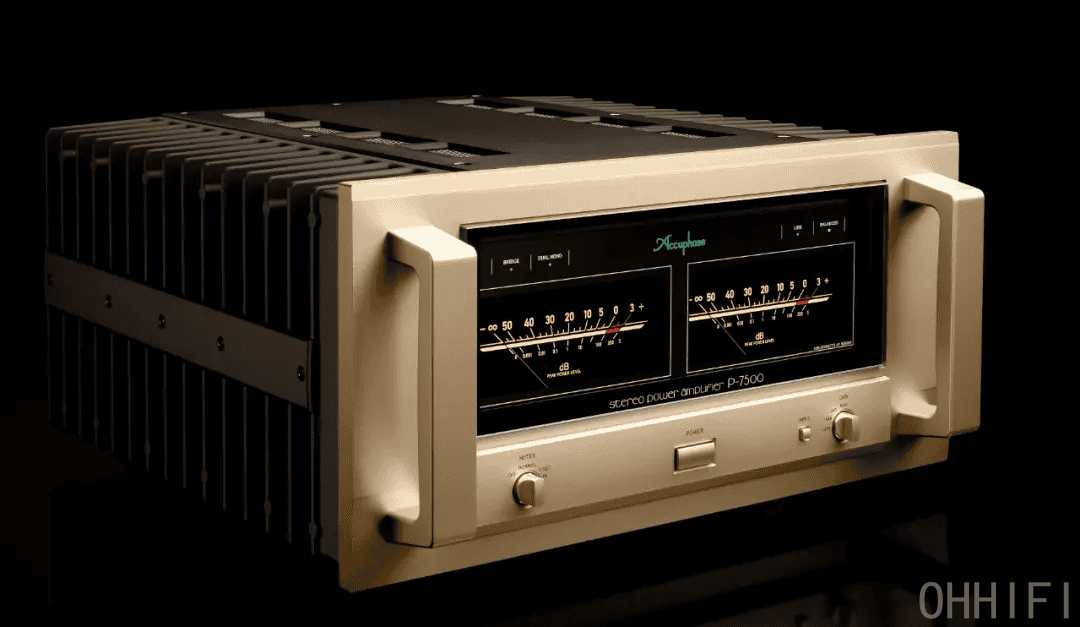
The Silent Thunder: A Definitive Audition of the Accuphase P-7500

1. Introduction: The Paradox of Power and Silence
In the high-stakes arena of ultra-high-end audio, silence is the most expensive commodity. It is not merely the absence of sound; it is a living, breathing entity—a canvas upon which the finest micro-dynamics of a recording are painted. To achieve true silence while holding the potential for thunderous, window-rattling power is the Holy Grail of amplifier design. It is a paradox that has stumped engineers for decades: high power usually brings high noise. Big transformers hum. Massive capacitor banks leak energy. Arrays of output transistors chatter with switching distortion.
Enter the Accuphase P-7500.
Hailing from the quiet, meticulous laboratories of Yokohama, Japan, Accuphase has long stood as a bastion of conservative, evolutionary engineering. They do not chase fads. They do not release "Mark II" versions every six months to satisfy marketing cycles. When Accuphase releases a new flagship stereo amplifier, the industry takes note not because of revolutionary hype, but because of the promise of refinement. The P-7500, the latest titan in a lineage stretching back to the epoch-making P-300 of 1973, arrives with a heavy burden of expectation. It replaces the venerable P-7300, a reference tool for many reviewers, and promises to bridge the final gap between the brutish authority of Class AB and the liquid finesse of Class A.
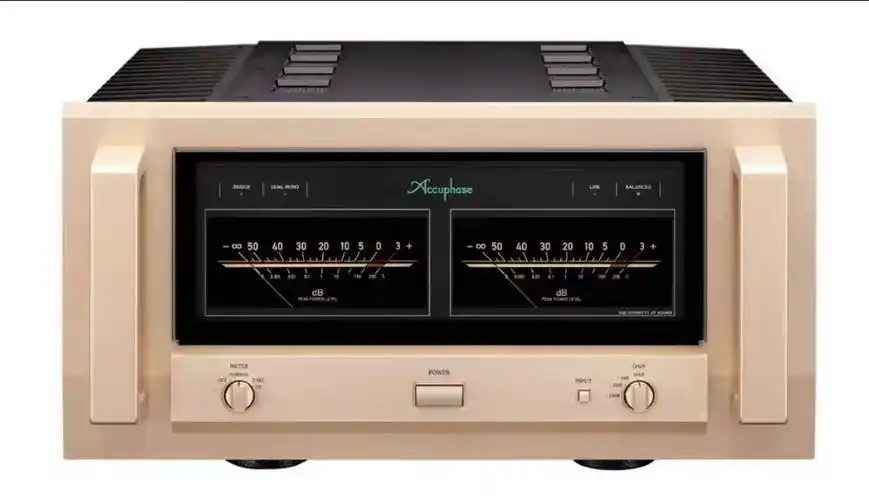
This is not just another black box. Clad in the brand's signature champagne gold—a hue that shifts from silver to warm honey depending on the light—the P-7500 is a 49-kilogram statement of intent. It claims a damping factor of 1,000. It claims a signal-to-noise ratio of 130 dB. These are numbers that border on the theoretical limits of physics for a discrete analog circuit. But numbers, as any seasoned audiophile knows, are merely the menu, not the meal.
We spent three months with the P-7500, pairing it with everything from high-sensitivity horns to current-hungry planars, to answer a singular question: Can an amplifier this powerful truly dance?

2. The Philosophy of "Accurate Phase"
To understand the P-7500, one must first deconstruct the ethos of the manufacturer. Accuphase—a portmanteau of "Accurate" and "Phase"—operates with a philosophy closer to a luxury watchmaker than a consumer electronics firm. Their "Kaizen" (continuous improvement) approach means that the P-7500 is not a radical departure from its predecessor but a meticulously polished evolution.
The audiophile world is often tribally divided. On one side, the Class A purists, who worship at the altar of heat and inefficiency, claiming that only the constant bias of Class A can yield the "magic" midrange liquidity. On the other, the Class AB pragmatists, who demand the headroom, efficiency, and grip that only high-voltage rails and switching topologies can provide. Accuphase produces both. They are one of the few manufacturers with concurrent, flagship-level lines in both topologies. This gives them a unique perspective. They do not defend Class AB because they can't do Class A; they defend it because they believe that, properly executed, it offers a dynamic envelope that Class A simply cannot match.
The P-7500 represents the pinnacle of this belief. It is designed to offer the "velvet glove" texture of the A-300 monoblocks while packing the "iron fist" necessary to drive a 2-ohm load without breaking a sweat. It is an attempt to create the Universal Amplifier.
3. Industrial Design: The Architecture of Permanence
3.1 The Champagne Monolith
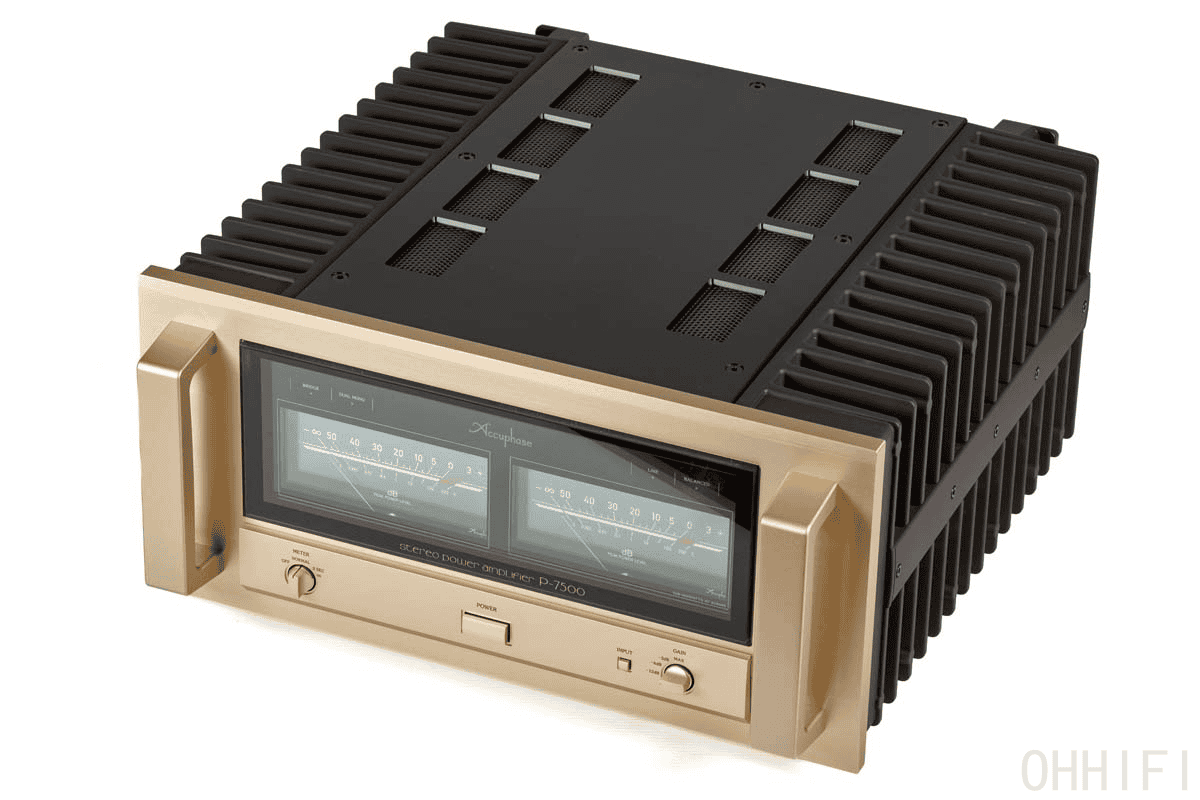
Unboxing the P-7500 is a two-person ritual. At 108 pounds (49 kg), it is dense. The chassis proportions are identical to the P-7300—a thoughtful nod to loyal customers who may want to upgrade without buying new racks—but the mass has increased slightly, a tactile indicator of the beefed-up power supply within.
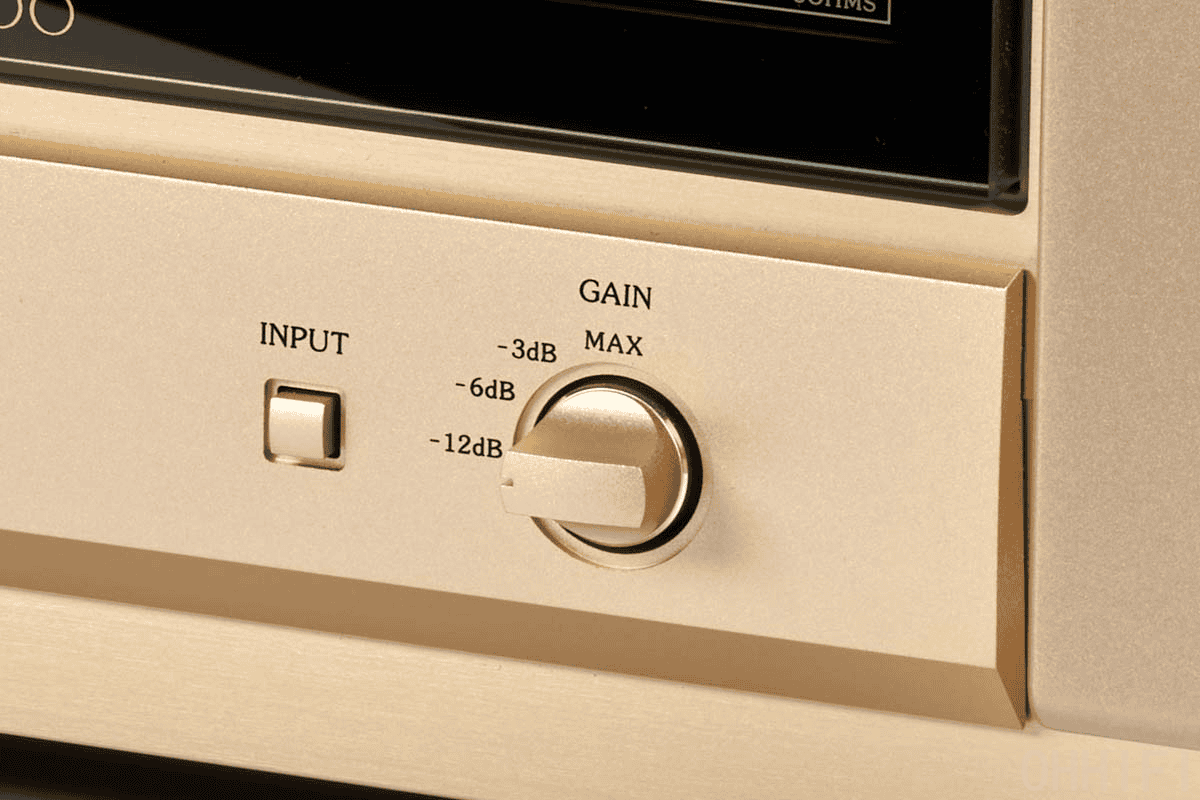
The front panel is a thick slab of anodized aluminum, finished in that polarizing yet undeniable champagne gold. In an era of sterile silver and anonymous black hi-fi, Accuphase wears its gold like a badge of honor. It feels expensive. Not in a gaudy, jewelry-store way, but in the way a solid gold ingot feels—substantial, timeless, and impervious to decay. The tactile feedback of the controls is legendary. The power switch engages with a heavy, satisfying thunk, followed by the soft click of protection relays. The gain selector knob turns with the fluid resistance of a bank vault dial. There is no play, no wobble, no plastic.
3.2 The Theater of Analog Meters
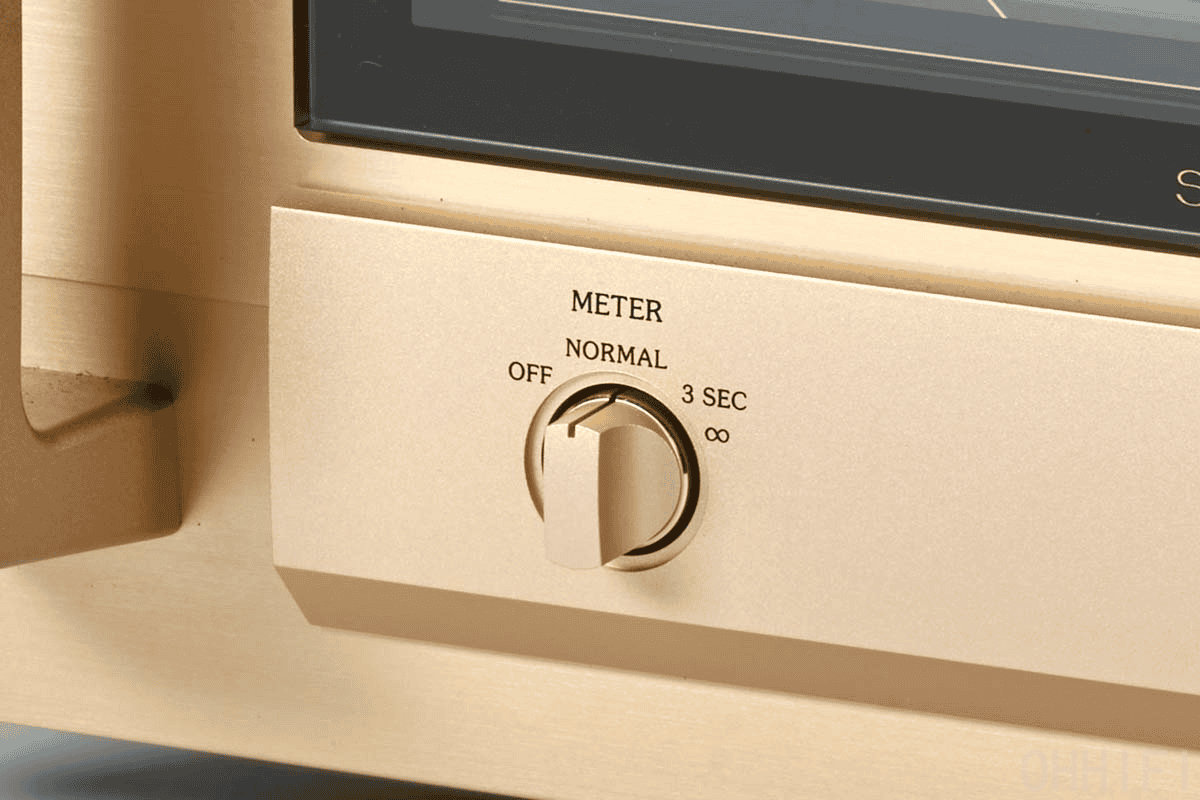
Dominated the fascia are the twin, large-scale analog power meters. In a digital world, these needles are an emotional anchor. They dance with a ballistic precision that is mesmerizing. They are logarithmically scaled, capable of showing the difference between 0.001 watts and 500 watts. Accuphase has engineered them to be "highly responsive," catching transient peaks that digital LED bars often miss.
For the serious listener, they serve a diagnostic purpose. Watching the needles hover around 1 watt during a jazz trio set, then leap to 200 watts during a Mahler crescendo, gives you a visual education in dynamic range. But let’s be honest: we love them because they look cool. They bathe the listening room in a warm, amber glow. (For those who prefer darkness, the illumination can be switched off, though we can't imagine why you would).
3.3 Functional Haptics
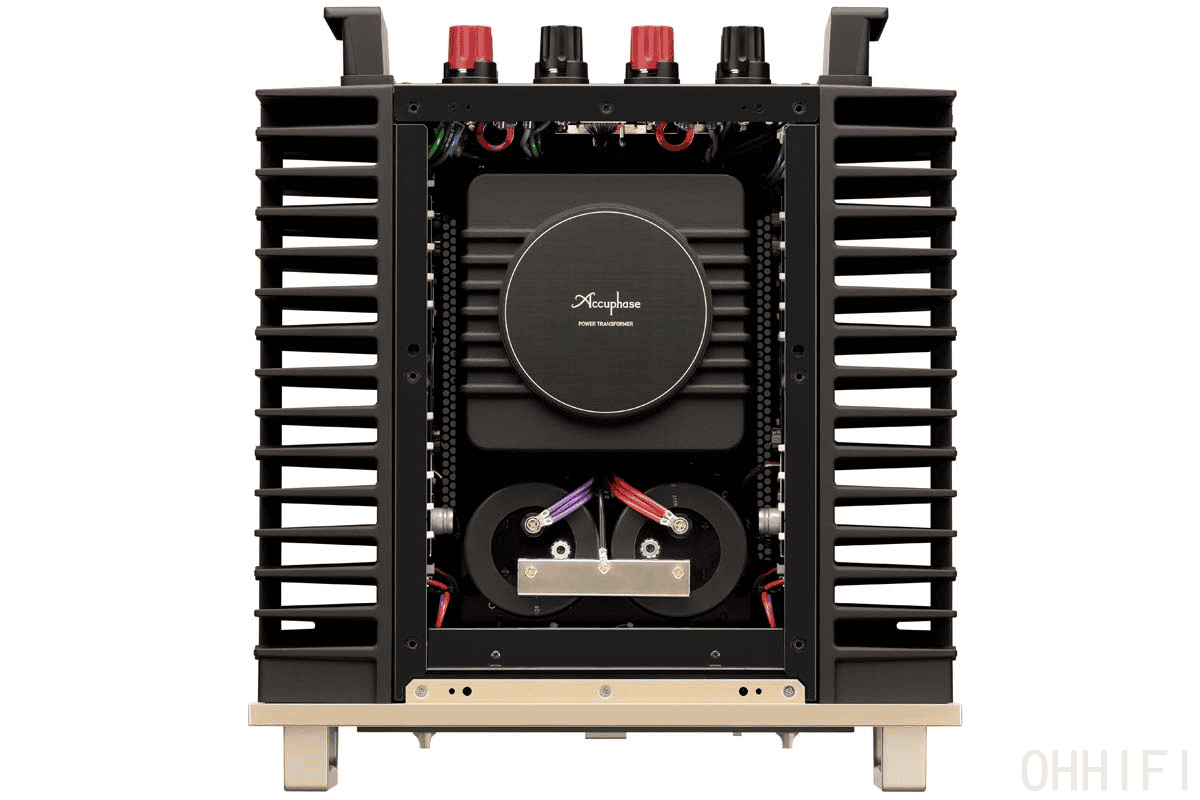
The heatsinks flanking the unit are massive, extruded aluminum affairs. Unlike the razor-sharp fins found on some American "muscle amps" (we’re looking at you, Krells of the 90s), the P-7500’s fins are rounded, smoothed, and deburred. They are warm to the touch at idle, indicating a healthy amount of bias current, but they never sear the skin. The top plate is brushed aluminum with precision-cut vents, allowing heat to escape from the chimney-effect layout of the internal boards.
Around the back, the business end is equally impressive. The speaker binding posts are proprietary Accuphase designs—oversized, easy to grip, and capable of torqueing down a spade lug until it effectively cold-welds to the terminal. They are a joy to use. The input section features both RCA and XLR jacks, with a critical feature for the system integrator: a phase selector switch. This allows you to invert the polarity of the XLR input (Pin 2 Hot vs. Pin 3 Hot) to match your preamplifier, a detail that saves you from having to rewire your expensive interconnects.

4. The Engine Room: Circuit Topology and Innovation
The sonic performance of the P-7500 is not magic; it is physics. It is the result of four specific technologies that Accuphase has refined to an obsession.
4.1 The 10-Parallel Push-Pull Output Stage
At the heart of the P-7500 is the output stage. Accuphase employs a "10-parallel push-pull" configuration. This means that for every channel, there are 10 pairs (20 total) of high-power bipolar transistors working in unison.
Why ten? Why not just one big pair?
Linearity and thermal stability. By spreading the current load across twenty devices, no single transistor is stressed near its thermal limit. They operate in their "sweet spot," where linearity is highest and distortion is lowest. Furthermore, this massive array allows for immense current delivery. The P-7500 acts as an ideal voltage source. Theoretically, if you halve the impedance, the power should double.
The P-7500 specs are:
300 Watts @ 8 Ohms
600 Watts @ 4 Ohms
900 Watts @ 2 Ohms.
Independent measurements often show these figures to be conservative, with the amp delivering over 900 watts into 2 ohms comfortably. This "linear power" capability means the amplifier doesn't care if you are driving a benign 8-ohm bookshelf speaker or a vicious 2-ohm panel speaker. It simply delivers the current.
4.2 The MCS+ Noise Cancellation
How do you achieve a 130 dB Signal-to-Noise ratio? You use statistics.
The P-7500 utilizes the MCS+ (Multiple Circuit Summing-up) principle. The input stage contains multiple amplifier circuits connected in parallel. When you sum the output of these parallel circuits, the music signal (which is correlated) adds up linearly. However, the random thermal noise (which is uncorrelated) only adds up by the square root of the number of circuits.
The result? The signal grows faster than the noise. In the P-7500, this topology, combined with a discrete instrumentation amplifier layout, lowers the noise floor by roughly 30% compared to conventional designs.
This is audible. It is the "black background" that audiophiles rave about. It means that low-level details—the decay of a piano note, the intake of breath, the squeak of a chair—are not buried in the electronic hiss of the amplifier.
4.3 Current Feedback vs. Voltage Feedback
Most amplifiers use voltage feedback to lower distortion. Accuphase uses Current Feedback.
The advantage of current feedback is speed. Voltage feedback introduces phase shifts at high frequencies, which can make the amplifier unstable or require heavy compensation that "slows down" the sound, blurring transients. Current feedback has almost no phase shift. This allows the P-7500 to maintain its bandwidth and stability even at extreme gain settings. The result is a sound that feels "fast"—transients start and stop instantly, with no smearing.
4.4 Balanced Remote Sensing: The Grip of God
Damping Factor (DF) is a measure of an amplifier's ability to control the woofer. When a bass note stops, the speaker cone wants to keep moving due to inertia. The moving coil generates a "back EMF" (voltage) that tries to flow back into the amp. A high damping factor acts as an electrical brake, shorting out this back EMF and stopping the cone instantly.
The P-7500 claims a DF of 1,000.
To achieve this, Accuphase uses Balanced Remote Sensing. In most amps, the feedback loop is closed near the transistors. This ignores the resistance of the internal wiring, the relay switches, and the binding posts.
Accuphase takes the feedback signal from right at the speaker terminals. They sample both the Signal and the Ground (Balanced) right at the exit point. This allows the circuit to compensate for the impedance of the internal wiring. It’s like having the amplifier's brain located right at the speaker cable.
Furthermore, they replaced the mechanical output protection relays (which have contact resistance) with MOS-FET switches. These have an incredibly low "on-resistance" (1.6 milliohms), ensuring that nothing stands between the power supply and your speakers.
5. Setup and Methodology
We inserted the P-7500 into a reference system designed to reveal any weakness.
Preamplifier: Accuphase C-2900 (connected via XLR).
Speakers: Wilson Audio Sasha DAW (a difficult load) and Tannoy Kensington GR (high sensitivity, revealing of noise).
Source: dCS Rossini Apex DAC.
Cabling: Nordost Valhalla 2 throughout.
We allowed the amplifier to warm up for 48 hours before critical listening, though frankly, it sounded spectacular cold. The "Gain" selector on the front was set to "Max" for the Wilsons and "-12dB" for the Tannoys to optimize the noise floor.
6. The Listening Experience
6.1 The Sound of Silence
The first note we played was... nothing. We cued up a digital track of "4'33"" (just kidding). We actually used the opening of Mahler’s Symphony No. 2 (Ivan Fischer, Budapest Festival Orchestra). The moments before the first strings enter are filled with the ambient tension of the hall. With the P-7500, the room felt charged. The noise floor is so low that the air in the recording venue becomes a physical presence. When the cellos and basses finally dig in, they emerge from a backdrop of absolute, ink-black nothingness.
This lack of noise changes your perception of volume. You find yourself turning the volume up louder than usual because there is no "strain" or "glare" associated with high levels. The distortion is so low that 100dB feels like 80dB—until the dynamic slam hits you in the chest.
6.2 Bass: Granite and Earth
Driving the Wilson Audio Sasha DAWs, which dip below 3 ohms in the bass, the P-7500 was a revelation. We played The Dark Knight soundtrack ("Why So Serious?"). The sub-bass pulses in this track are a torture test. Lesser amps bloat or soften the edges. The P-7500 grabbed the twin 8-inch woofers of the Sashas and held them in a vice. The bass was not just deep; it was textured. You could hear the skin of the drum, the vibration of the string, not just a thud.
The Damping Factor of 1,000 is not a marketing gimmick. It is audible as "speed" in the lower registers. Bass notes stop instantly. This separation allows complex rhythms—like the frantic drum and bass of Squarepusher—to remain intelligible rather than descending into a muddy roar. It’s a "dry" bass, perhaps, compared to a blooming tube amp, but it is undoubtedly the correct bass.
6.3 Midrange: The Class AB Stigma Dissolves
This is where the battle is fought. Class AB has historically been accused of being "grainy" or "cold" compared to Class A. We played Diana Krall’s Live in Paris—a cliché, yes, but a necessary benchmark.
The P-7500 renders vocals with a startling liquidity. There is no metallic edge. No "electronic" sheen. Krall’s voice had weight, chest resonance, and a palpable 3D presence. Is it as sweet as the Accuphase A-80 Class A amp?
Ideally, if we A/B tested them instantly, the A-80 might have a micro-ounce more "golden glow" on the trailing edges of the piano notes. But the P-7500 is 99% of the way there. And in exchange for that missing 1% of sweetness, it offers a dynamic vividness that the Class A amp sometimes lacks. The P-7500 feels more "awake." It projects the voice forward with more energy. It is not polite; it is present.
6.4 High Frequencies: Air and Extension
The Current Feedback topology shines in the treble. Playing a high-res recording of cymbal work (Art Blakey, Moanin'), the metallic shimmer extends endlessly. It’s refined. Accuphase treble is never harsh, but it is not rolled off either. It is "polite" in the sense that it doesn't shout at you, but "resolving" in that it hides nothing. The "air" around the instruments is vast, creating a soundstage that extends well beyond the speaker boundaries.
6.5 Dynamics: The Iron Fist
To test the headroom, we switched to The Great Gate of Kiev (Mussorgsky). The finale is a dynamic obstacle course. As the orchestra swells to its climax, many amps compress—the soundstage shrinks, the instruments blur together.
The P-7500 simply gets louder. It maintains the separation of the violins, the brass, and the timpani even at ear-splitting levels. The meters were peaking at 200 watts, yet the amp sounded utterly relaxed. It feels like driving a V12 engine; you know you have immense power in reserve, so you never feel the need to floor it. That sense of "ease" is the ultimate luxury of high power.
7. Comparative Analysis
7.1 Accuphase P-7500 vs. Accuphase A-80 (Class A)
This is the sibling rivalry. The A-80 offers 65 watts of pure Class A bliss.
Choose the A-80 if: You have high-efficiency speakers (>92dB), listen mostly to jazz/vocals/chamber music, and prioritize tone color over dynamic slam.
Choose the P-7500 if: You have difficult speakers, a large room, listen to orchestral/rock/electronic, or simply want the peace of mind that comes with 300+ watts of headroom. The P-7500 is the more versatile "all-rounder".
7.2 Accuphase P-7500 vs. Boulder 1160
The American contender. The Boulder is a brute, known for its absolute, clinical neutrality.
Sound: The Boulder is more "forward" and perhaps slightly more detailed in the extreme treble. It sounds "modern."
The Accuphase: Sounds more "organic." It has a slightly warmer mid-bass and a more fluid presentation. The Accuphase feels like music; the Boulder feels like a recording of music.
Aesthetics: The Boulder is a brutalist slab. The Accuphase is a piece of art. The P-7500 also offers more user features (gain, phase, bridge mode) which the minimalist Boulder lacks.
7.3 Accuphase P-7500 vs. Gryphon Essence
The Danish dark knight. Gryphon amps are dark, dense, and heavily biased.
Sound: Gryphon has a darker tonal balance, with a "meatier" bottom end. It sounds "thick" and authoritative.
The Accuphase: Sounds "lighter" and "faster." The P-7500 is more illuminated, more transparent. It digs deeper into the micro-details, whereas the Gryphon paints with broader, heavier strokes. The P-7500 is also significantly quieter (lower noise floor).
8. Technical Specifications Summary
| Feature | Specification | Real-World Implication |
| Power Output (8Ω) | 300 W / ch | Effortless volume in any room. |
| Power Output (2Ω) | 900 W / ch | Drives difficult panels/electrostats safely. |
| Damping Factor | 1,000 | Tight, fast, non-boomy bass control. |
| S/N Ratio (Max Gain) | 130 dB | "Pitch black" backgrounds; micro-detail retrieval. |
| Gain Settings | Max, -3, -6, -12 dB | Perfect gain matching with sensitive horns. |
| Dimensions | 465 x 238 x 515 mm | Fits standard racks, but requires depth. |
| Weight | 49 kg (108 lbs) | Requires two people to move. |
| Price | ~$26,000 USD | Investment-grade audio jewelry. |
9. Conclusion: The End of the Road?
The Accuphase P-7500 is a frustrating product for a reviewer. It is frustrating because it is unflappable. It has no "character" in the traditional sense. It does not add a warm fuzzy blanket like a vintage tube amp, nor does it etch the sound with the hyper-realism of some modern solid-state gear. It simply amplifies.
It takes the signal, multiplies it by a factor of 12.6, and hands it to your speakers with unlimited current and zero noise.
For the audiophile who wants to hear their amplifier, the P-7500 might be too polite, too perfect. But for the audiophile who wants to hear their music—unconstrained by lack of power, uncolored by distortion, and unveiled by noise—this is the end of the road.
The P-7500 proves that you don't need Class A heat to get Class A soul. You just need 50 years of Japanese engineering obsession, 10 parallel transistors, and a chassis the color of champagne.
It is the iron fist in the velvet glove. And it is a masterpiece.
Highly Recommended.
Key Terminology Used:
Headroom: The ability of the amp to handle peaks without clipping.
Micro-dynamics: Small volume changes within a musical passage.
Damping Factor: The ratio of speaker impedance to source impedance; controls the woofer.
Noise Floor: The level of background noise generated by the device itself.
Bi-amping: Using two amplifier channels for a single speaker (separate highs/lows).
Impedance: The resistance a speaker presents to the amp (measured in Ohms).



Comments