
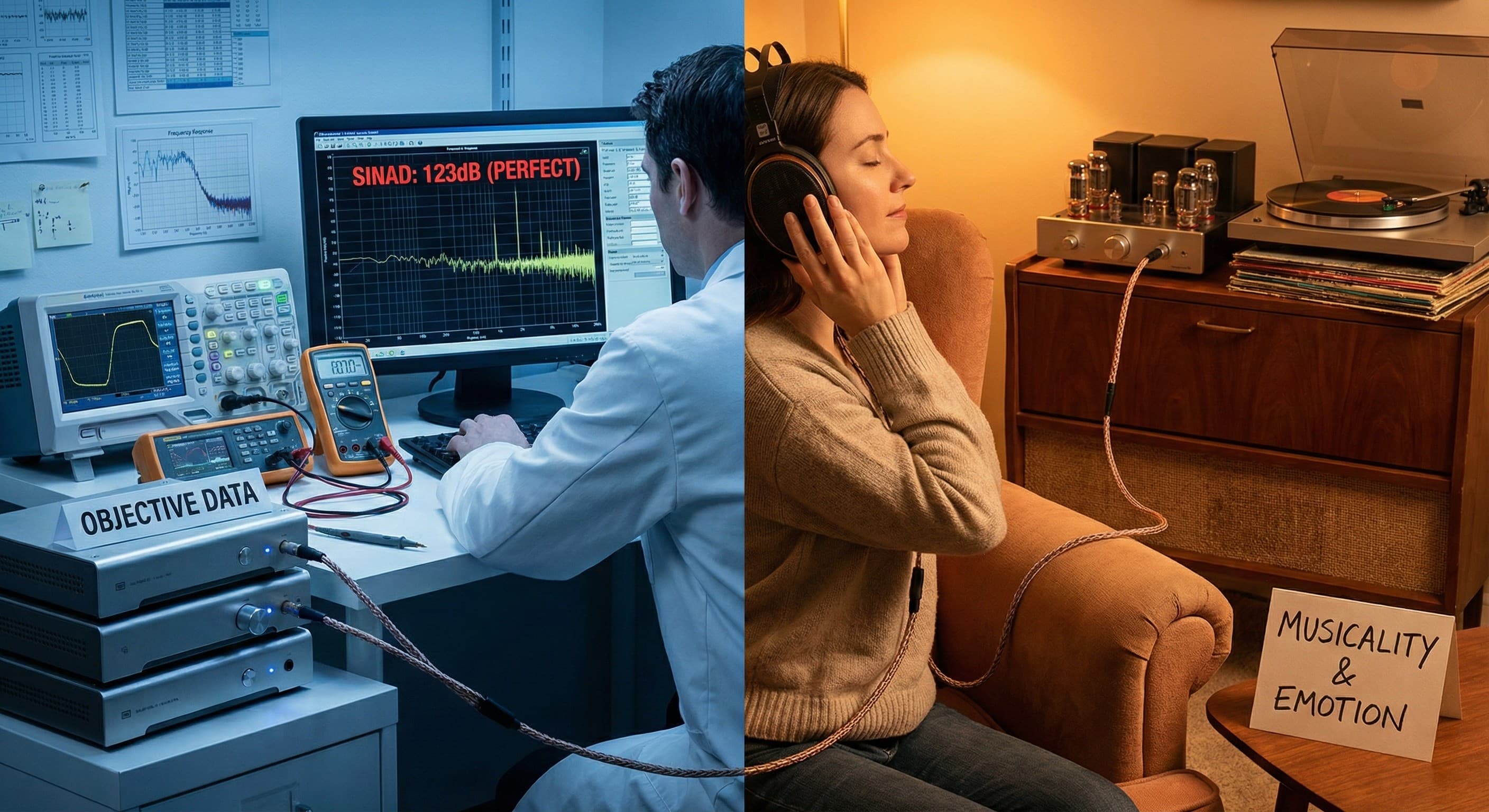
High SINAD vs. Sound Quality: Do Measurements Tell the Whole Story?

If you have spent any time on audio forums like Audio Science Review (ASR) or Reddit’s r/audiophile recently, you have undoubtedly seen the "SINAD" charts. It’s the metric of the moment, the number to beat, and for some manufacturers, the holy grail of audio engineering.
We are living in a golden age of affordable audio, largely driven by "Chi-Fi" brands like Topping, SMSL, and Moondrop pushing the boundaries of what is measurable. You can now buy a $150 DAC that measures "better" than a $5,000 unit from a decade ago.
But here is the uncomfortable question that divides the community: If a device measures perfectly, why does it sometimes sound… boring?
Let’s dive down the rabbit hole of measurements versus musicality.
What is SINAD, Anyway?
Without getting too bogged down in the math, SINAD stands for Signal-to-Noise and Distortion ratio. It essentially tells you how much of what you are hearing is the music (the Signal) versus the garbage you don't want (Noise and Distortion).
A higher number is better. A SINAD of 120dB is technically "cleaner" than a SINAD of 90dB.
For the "Objectivists" (the measurement crowd), high SINAD proves engineering competence. It means the device is transparent. It adds nothing and takes nothing away. It is "wire with gain."
The "Audibility Threshold" Reality Check
Here is where things get tricky. Human hearing has limits.
Most psychoacoustic research suggests that once distortion and noise drop below a certain threshold (often debated, but generally around -115dB to -120dB for dynamic range), our ears simply cannot detect it.
Comparing a DAC with a 122dB SINAD against one with a 115dB SINAD is like comparing two windows. One is perfectly clean, and the other has a microscopic speck of dust in the top corner. Can you measure the difference with a laser? Yes. Can you see the difference while looking at the scenery? Absolutely not.
At a certain point, we are just chasing numbers for the sake of numbers. This is what we call "spec wars."
Why "Worse" Measurements Can Sound "Better"
If transparency is the goal, why do so many audiophiles still swear by Tube Amps, R2R (Resistor-Ladder) DACs, and Vinyl?
On a SINAD chart, a tube amplifier often looks terrible. It has high distortion. But when you listen to it, it sounds "warm," "holographic," and "rich."
This is because not all distortion is created equal.
Even-Order Harmonics: Tube amps often add "second-order harmonic distortion." To the human ear, this sounds pleasing, thickening the sound and adding body to vocals. It’s a "euphonic" coloration.
Clinical vs. Musical: A system with ultra-high SINAD can sometimes sound "clinical," "sterile," or "dry." It reveals every flaw in a bad recording. A system with a bit of character might smooth over those edges, making the music more enjoyable to listen to for hours on end.
The Problem with "Listening with Your Eyes"
The danger of the current SINAD obsession is that it encourages people to listen with their eyes.
We see a chart, we see a device at the top of the leaderboard, and our brain is primed to believe it must be the best. This is a classic confirmation bias.
Conversely, if you see a device with a "red" score on a chart, you might dismiss it immediately, missing out on a piece of gear that might have the exact timbre and soundstage you are looking for.
The Verdict: Use Measurements as a Filter, Not a Bible
So, do measurements tell the whole story? No.
Measurements are excellent for:
Spotting broken engineering: If a $2,000 DAC has a high noise floor or grounding issues, the measurements will catch it.
Verifying value: Ensuring you aren't paying "snake oil" prices for sub-par internal components.
But measurements cannot tell you about soundstage width, imaging depth, or that emotional toe-tapping factor (PRaT - Pace, Rhythm, and Timing).
The Bottom Line: Respect the engineering that goes into high SINAD scores—it is an impressive technical feat. But don't be afraid to trust your own ears. If a "perfectly measuring" amp leaves you cold, and a "imperfect" tube amp makes you cry during a violin solo, buy the one that moves you.
After all, we are in this hobby to listen to music, not to listen to a graph.



Comments