
Samsung S95H QD-OLED Review: The Brightest OLED Yet But Is the New Design Worth It?

Samsung's latest flagship QD-OLED packs record-breaking brightness and a first-ever Art Mode. The picture is genuinely extraordinary. The frame around it? That's more complicated.
The S95H is Samsung's strongest OLED performance to date — measurably brighter, sharper in its tone mapping, and still the best OLED TV for bright-room use. Art Mode is genuinely impressive on a self-emissive panel. The FloatLayer frame design, however, is a real polarizer, and the removal of the One Connect Box is a step backward for cable management. If picture quality is your primary concern, little else at this price competes.
Panel QD-OLED (Penta Tandem) | Peak brightness ~2,553 nits (measured) | Native refresh rate 165 Hz |
HDR support HDR10+, HLG (no Dolby Vision) | Processor NQ4 AI Gen3 | Gaming VRR, G-Sync, FreeSync, ALLM |
HDMI ports 4× HDMI 2.1 (on-set) | OS Tizen (2026 edition) | Sizes available 55 / 65 / 77 / 83-inch |
Price range $2,499 – $6,499 |
Context: Where the S95H fits in
Samsung's S95 line has moved fast. The S95D arrived in 2024 with the first OLED Glare-Free coating on a QD-OLED panel. The S95F — TechRadar's 2025 TV of the Year — sharpened that formula, pushed peak brightness past 2,100 nits, and made a genuinely compelling case against LG's G5 and the Panasonic Z95B. Now comes the S95H, and Samsung hasn't just iterated — it's taken a swing at something structurally different.
The headline specs are easy: a new Penta Tandem QD-OLED panel that Samsung claims is around 30–35% brighter than its predecessor, and a 165Hz native refresh rate that leaves the standard 120Hz ceiling of most OLED TVs in the dust. But the bigger story is the design overhaul, and that's where things get interesting — and divisive.
Design: FloatLayer and the Art Mode gamble
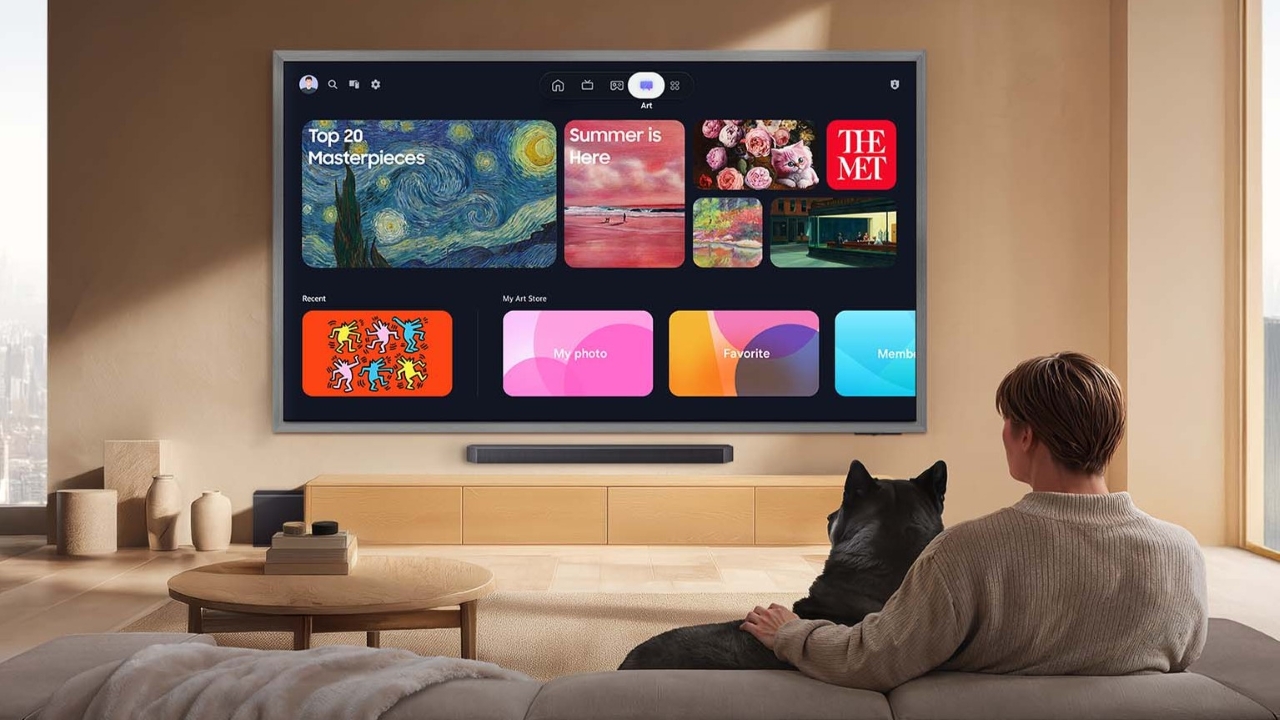
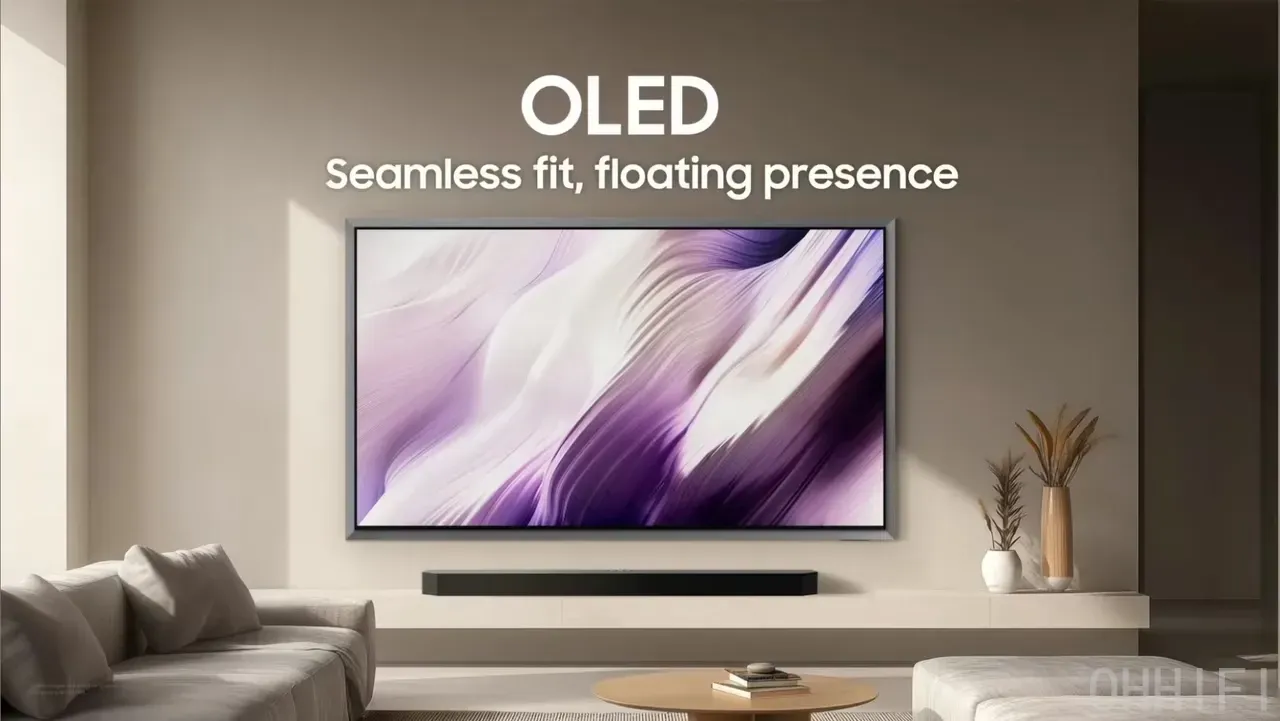
Walk up to an S95H on the shelf and your first instinct is probably confusion. There's a substantial metal frame surrounding the panel — Samsung calls it the FloatLayer design — that makes the TV look like a cross between a picture frame and a gallery artwork. It's thick by modern OLED standards, and it's not going anywhere; unlike Samsung's The Frame TV, the bezel here is non-removable.
The motivation is clear enough. Samsung has watched The Frame sell in enormous numbers to buyers who prioritize aesthetics over raw specs, and the S95H is their answer to the question: what if a flagship performance TV could also disappear into your living room? Wall-mount the S95H and it does sit genuinely flat — the included flush-mount bracket is excellent, and the effect is striking. Artwork displayed in Art Mode on a 2,553-nit self-emissive panel looks almost three-dimensional. Compared to The Frame Pro's matte paper-like finish, the QD-OLED panel makes colors in museum pieces from the Louvre and Prado collection positively glow.
Art Mode access: up to 30 artworks per month are free. Full access to Samsung's Art Store (3,000+ pieces) costs $5/month or $50/year — a subscription model that may frustrate buyers at this price point.
The problem comes when you take the S95H off the wall. Sitting on a stand, the frame looks chunky and frankly ungainly. It works as an aesthetic concept only when the TV is flush-mounted, which rules out a significant number of real-world living room setups. If you're not planning to wall-mount, the S95H's design makes a lot less sense — and you'd be better served by the S90H, which retains the traditional slim-bezel OLED look at a lower price.
The other big structural change is the removal of the One Connect Box that came standard with the S95F. Samsung has instead moved all four HDMI 2.1 ports directly onto the TV's rear panel. For wall-mounted installs, this is actually a significant cable management headache — one of the primary reasons people loved the One Connect system was the single optical fiber to the TV, keeping the panel completely wire-free. A Wireless One Connect Box is available as an optional accessory, adding four more HDMI 2.1 ports for eight total, but it's a separate purchase.
Picture quality: Here's where it gets serious
Brightness and HDR
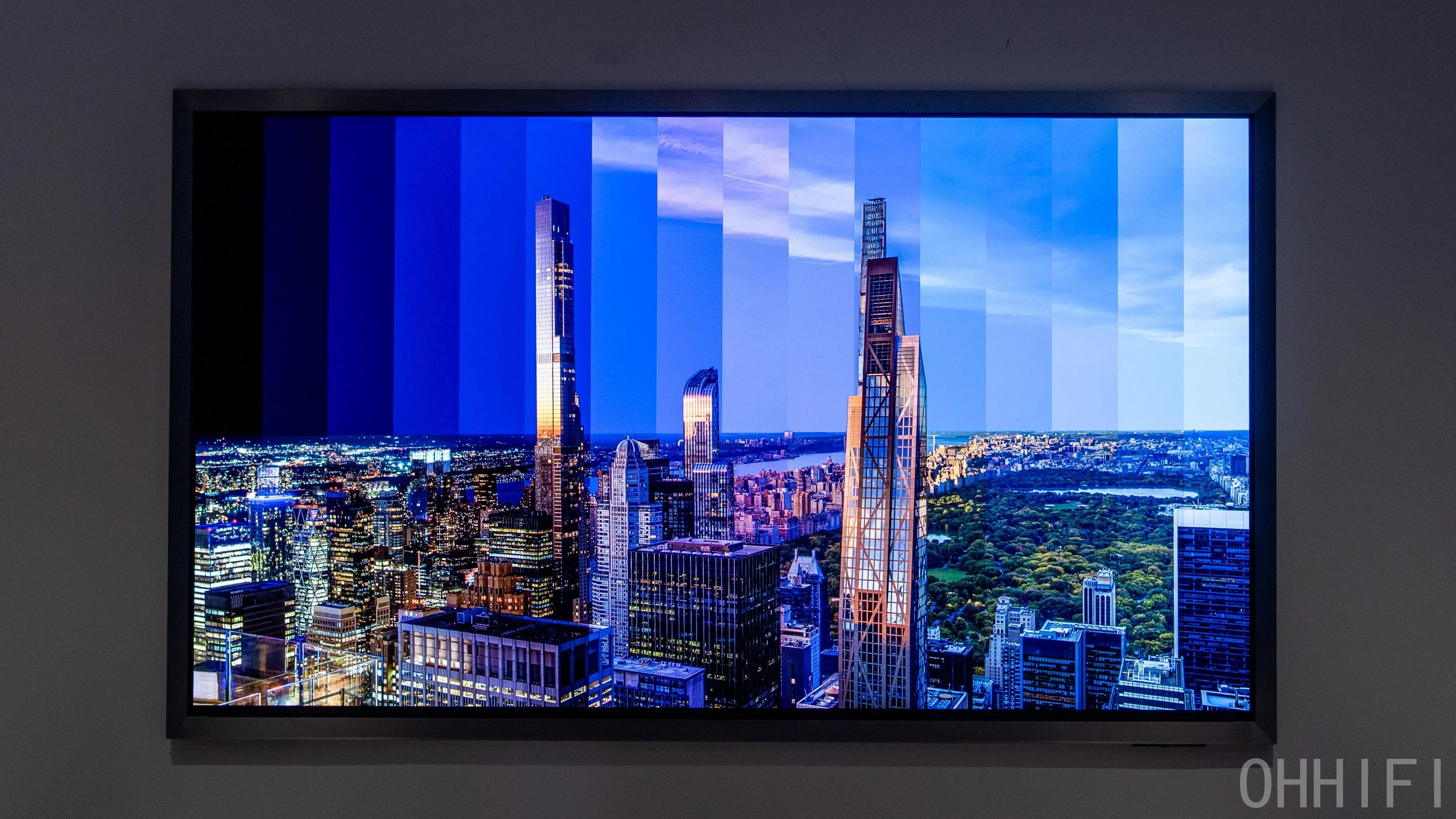
Right, the numbers. In Standard picture mode, we measured peak HDR brightness at 2,553 nits on a 10% window — making the S95H the brightest OLED TV we've ever tested, besting even the very capable LG G5 (which measured around 2,268–2,296 nits in similar conditions). Drop into Filmmaker Mode, and peak brightness falls to around 1,072 nits on a 10% window, which is calibrated and accurate — but notably lower if you're trying to do direct comparisons with the G5 in that mode.
The practical upshot? In a bright living room with sunlight coming through windows, the S95H is in a different class from most OLED TVs. Specular highlights on metalwork, lens flares, sunlit skies — all of it pops in a way that was previously the exclusive domain of the best Mini LED TVs. To see how this record-breaking QD-OLED luminance compares to the current backlight champion, read our SONY Bravia 9 Mini LED In-Depth Review, which explores how Sony's latest flagship pushes the boundaries of localized dimming and peak brightness.Samsung's updated Glare-Free Matte coating also helps considerably here. It's not the same as a glossy screen — there's a very faint diffusion to the image that some purists will notice in side-by-side comparisons — but in real-world use, it's far less distracting than the mirror-like reflections you deal with on the LG G5.
Color
Color coverage is stellar. In Filmmaker Mode, the S95H measured 99.9% coverage of the P3 color space and 88.4% of BT.2020 — figures that exceed what we've seen on recent LG and Sony flagship OLEDs. Colors in HDR content are vivid and punchy, with QD-OLED's inherent advantage over W-OLED panels evident in saturated primaries. Reds are genuinely red, not orange-red. Greens are lush without tipping into neon.
One real-world scene that illustrates the S95H's strengths well: the twilight dancing sequence in La La Land. As the sky transitions from warm orange to deep blue, the S95H maintains luminance across the gradient without banding, and the streetlights at the end of the sequence have a physical intensity without haloing into the surrounding darker portions of the image. That's OLED doing what OLED does best — perfect pixel-level control — augmented by peak brightness that previously felt unachievable on a self-emissive panel.
Black levels and shadow detail
It's OLED. Black levels are perfect by definition — pixels simply turn off. In a dark room, watching something like The Batman, the S95H renders shadow information with exceptional precision. There's no ABL (automatic brightness limiter) crushing darker shots the way some OLED TVs struggle when they're being pushed hard on highlights simultaneously. Samsung's tone mapping has genuinely improved here.
One caveat worth flagging: earlier S95 models occasionally exhibited some black crush — a slight loss of detail in near-black areas. We saw minimal evidence of that on the S95H, but it's worth checking against content you know well if you're demoing in a showroom.
Upscaling and motion
The NQ4 AI Gen3 processor does solid work on upscaled content. Standard-definition streaming from broadcast services upscales respectably, though Samsung's upscaling pipeline remains slightly more aggressive than Sony's equivalent — there's a marginal sharpening artifact on fine textures at max AI sharpening settings. Knock it back half a notch and it cleans right up. 4K native content, predictably, is flawless. Motion handling at 165Hz is genuinely smooth — sports content in particular benefits, and the new AI Soccer Mode is a neat touch that adjusts motion and backlight settings automatically when it detects a football match.
Gaming performance
For the gaming crowd, the S95H delivers. Input lag in Game Mode measures around 1ms at 4K/120Hz, and the TV now supports VRR, AMD FreeSync Premium Pro, and Nvidia G-Sync out of the box — no firmware update required this year. The 165Hz native panel means PC gamers with high-end Nvidia or AMD cards can actually take advantage of frame rates above 120fps, something very few TVs support at 4K. PS5 Pro and Xbox Series X users max out at 4K/120Hz VRR, but that's the console ceiling, not the TV's.
Samsung's Game Bar has been updated again with an improved AI Auto Game Mode, which intelligently detects genre and adjusts settings — it correctly distinguished between a fast-paced FPS and a slower RPG in our testing, cutting down on the amount of manual tweaking required.
No Dolby Vision gaming: Samsung continues to omit Dolby Vision support entirely. If you're invested in the DV gaming ecosystem (Xbox Series X in particular), this remains a real limitation.
Smart TV and audio
Tizen is a mature platform at this point, and the 2026 iteration runs smoothly. Netflix, Prime Video, Disney+, and Apple TV+ all run natively with full 4K/HDR10+ support. AirPlay and Miracast are both present. Samsung's Vision AI suite has been reorganized into a more coherent hub, and features like Click to Search, translated captions, and real-time AI captions work reliably. AI Sound Controller is a new addition that lets you adjust dialogue, music, and effects layers independently — it's surprisingly useful if you frequently find yourself turning captions on because you can't hear dialogue over a film's score.
On-board sound is adequate but not outstanding. The S95H's speaker configuration delivers Object Tracking Sound+ with Dolby Atmos support, and it handles spatial cues reasonably well for a flat panel. But at this price, a soundbar is essentially assumed. The S95H doesn't embarrass itself, but it won't compete with the Sony Bravia 8 II's acoustic surface audio system for pure tonal quality.
How it compares to the competition
| Model | Panel | Peak brightness | Refresh rate | Dolby Vision | Price (65") |
|---|---|---|---|---|---|
| Samsung S95H This review | QD-OLED | ~2,553 nits | 165 Hz native | No | ~$3,499 |
| LG G5 (2025) | Primary RGB Tandem OLED | ~2,296 nits | 120 Hz native | Yes | ~$2,999 |
| Sony Bravia 8 II (2025) | QD-OLED | ~1,439 nits | 120 Hz native | Yes | ~$2,799 |
| Samsung S90H (2026) | QD-OLED | Lower than S95H | 165 Hz native | No | ~$2,499 |
Samsung S95H vs LG G5
The S95H is straightforwardly brighter — by a meaningful margin in real-world use. The Glare-Free coating also makes the S95H significantly more versatile in non-dark-room environments, where the G5's glossy panel picks up reflections. The G5 counters with Dolby Vision support, slightly more natural deep blacks in calibrated Filmmaker Mode comparisons, and a slimmer profile. If you're a home theater purist who watches in a controlled environment and cares about DV, the G5 remains worth considering. If you watch in mixed lighting, the S95H wins.
Samsung S95H vs Sony Bravia 8 II
The Sony is significantly dimmer — about 1,100 nits less at peak in comparable modes — but delivers what many consider the most cinematically accurate color tuning of any current OLED. The Bravia 8 II also supports Dolby Vision, has better native speaker performance (Acoustic Surface Audio+), and is typically priced lower. For home cinema enthusiasts who want accuracy over impact, Sony is still the choice. For anyone watching in a bright room, gaming seriously, or prioritizing sheer vibrancy and future-proofing at 165Hz, the S95H is the stronger package.
| What we like | What we don't |
| Record-breaking OLED brightness for HDR impact | FloatLayer frame looks awkward on a stand |
| Best-in-class glare resistance for bright rooms | No Dolby Vision support at any price |
| 165Hz native panel for smooth gaming and motion | One Connect Box no longer included |
| G-Sync + FreeSync out of the box | Art Store requires a subscription fee |
| Art Mode looks genuinely stunning on QD-OLED | Filmmaker Mode brightness lower than Standard |
| Excellent 4K AI upscaling performance | On-board audio trails Sony at same price tier |
| 4× HDMI 2.1 ports on the set itself |
The bottom line
The Samsung S95H is the easiest recommendation Samsung has ever had for buyers who want the best raw OLED picture quality available in 2026 — especially anyone watching in a room with real ambient light. The brightness leap over the already-excellent S95F is genuine, the 165Hz gaming credentials are class-leading, and Art Mode is a feature that actually delivers on QD-OLED in a way it never could on LCD. The new FloatLayer design is the one real sticking point: committing to wall-mounting is essentially a prerequisite for getting the most out of this TV's aesthetic ambition. If that works for your setup, this is the OLED to beat. If you'd rather keep your options open — or want Dolby Vision — take a look at the LG G5 or drop down to the S90H and pocket the difference.


Comments