
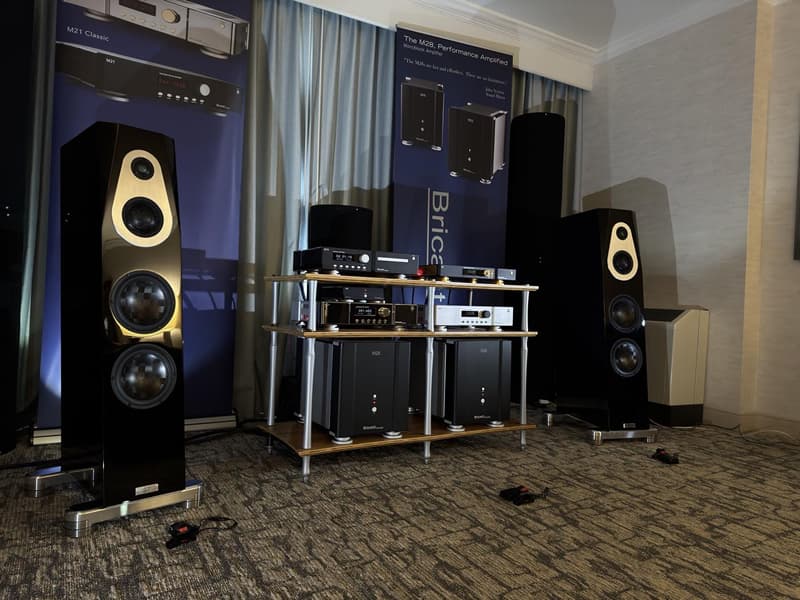
Bricasti Design S7 Loudspeaker: A Leap from Digital Peaks to Analog Transducers

1. Introduction: When the "Digital Heart" Begins to Beat
In the vast landscape of High-End Audio, Bricasti Design carries significant weight. For a long time, this Massachusetts-based manufacturer has been regarded as a benchmark for digital processing and signal amplification. From the Model 7 (M7) reverb processor that dominates professional recording studios, to the M1 series DACs highly revered in the consumer Hi-Fi realm, Bricasti has defined the balance between "transparency" and "musicality" with an almost fastidious engineering attitude. However, at the 2025 Capital Audio Fest (CAF), Bricasti Design made the boldest strategic move in its twenty-year history—officially releasing its first loudspeaker system: the Bricasti S7.
Priced at $36,000 (approx. pair), this floor-standing speaker not only completes Bricasti's final puzzle piece from source to sound but also drops a heavy bomb into the competitive $30k-$40k speaker market with its unique "Agility Factor" design philosophy and forward-looking driver selection.
This report provides a comprehensive, in-depth analysis of the Bricasti S7 based on current technical disclosures, show floor feedback, and industry background. We will interpret the engineering logic and acoustic ambition behind this new product from multiple dimensions: brand DNA inheritance, core acoustic architecture innovation, material science application, and market competition landscape.
2. Brand Origins: From Lexicon Legacy to Closed-Loop Chain
To understand why the S7 is designed the way it is, one must first understand Bricasti Design's "pedigree." The S7 is not a rebadged product made to simply fill a catalog slot; it is a natural extension of founders Brian Zolner and Casey Dowdell's audio philosophy into the physical world.
2.1 The Throne of Digital Reverb and the "Bricasti Sound"
Bricasti's legend began with the Model 7 (M7) Stereo Reverb Processor. The M7 was born during a golden age of digital audio, created by founders who were core members of the industry giant Lexicon. After leaving Lexicon, they didn't take old code with them; instead, they rebuilt reverb algorithms from the ground up based on a profound understanding of DSP (Digital Signal Processing).
The success of the M7 lies in its creation of a "non-existent listening sensation." Traditional reverbs often carry obvious traces of artificial modification, whereas the M7 simulates a spatial sense that is extremely natural, deep, and does not interfere with the original signal. This "transparent, fast, and uncolored" sonic characteristic was later fully transplanted into Bricasti's consumer product lines.
2.2 The Last Mile of the Signal Chain
Before the advent of the S7, Bricasti's product line already covered digital transports (M19), DACs (M1/M21), preamplifiers (M20), and power amplifiers (M28/M32). In this chain, every link pursues extreme low distortion and high transient response.
However, an audio system is a chain heavily influenced by the "wooden bucket effect." No matter how many femtoseconds of jitter accuracy the front-end achieves, or how high the slew rate of the amplifier is, the signal must ultimately be converted into sound waves by the loudspeaker—the "transducer." The loudspeaker is typically the component in the entire system with the highest distortion and slowest reaction.
The original intention behind the S7's development was precisely to solve this bottleneck. Brian Zolner clearly felt that while existing speakers on the market were excellent, it was difficult to perfectly match the "lightning-fast" speed and micro-dynamic reproduction capabilities of Bricasti electronics. Therefore, the core design of the S7 is not to pursue a thick timbre, but to pursue extreme agility and precision.
3. Technical Core: S7's Acoustic Architecture and Material Revolution
The Bricasti S7 is a moderately sized floor-standing speaker, but it contains a high density of technology. It does not use common off-the-shelf driver solutions but instead collaborates deeply with top-tier driver manufacturers, selecting the most cutting-edge drivers in the field of materials science.
3.1 Driver Configuration Overview
The S7 adopts a 3-way, 4-driver design architecture. The specific driver configuration is both luxurious and hardcore:
| Frequency Band | Driver Type | Diaphragm Material | Supplier | Key Feature |
| High | 1-inch Dome | Beryllium | Bliesma | Extremely light mass (0.10g) |
| Mid | 3-inch Dome | TPCD (TeXtreme®) | Bliesma | Thin Ply Carbon Diaphragm technology |
| Low | 7.5-inch Cone x 2 | TPCD (TeXtreme®) | SB Acoustics (Satori) | Balance of high rigidity and damping |
3.2 Tweeter: Bliesma Beryllium's Extreme Transients
The high-frequency section of the S7 is handled by a beryllium dome from the rising German driver brand Bliesma. In High-End audio circles, Beryllium (Be) is known as the "King of Metals" due to its extremely high Stiffness-to-Mass Ratio.
Compared to traditional silk or aluminum domes, beryllium domes have an extremely high breakup frequency, usually extending to 30kHz or even above 40kHz, far beyond the range of human hearing. This means that within the audible range, the beryllium dome moves almost as a perfect "piston" without its own coloration.
The Bliesma tweeter chosen by Bricasti has a moving mass (Mms) of only 0.10 grams. This is an astonishing figure. Extremely light mass means minimal inertia, allowing the tweeter to capture the finest overtone structures and "air" in the music, which aligns perfectly with the "zero digital flavor" high-frequency performance of Bricasti DACs.
3.3 Midrange: The Renaissance of the Dome Mid & TPCD Material
The most striking technical highlight of the S7 lies in its midrange driver. Instead of using a common cone, it employs a 3-inch Dome Midrange with a diaphragm made of TPCD (Thin Ply Carbon Diaphragm), commercially known as TeXtreme®.
3.3.1 Why Choose a Dome Midrange?
Dome midranges were popular in the 1970s and 80s (e.g., ATC, PMC "buns"), but became less common due to manufacturing difficulties and high costs. Bricasti is reviving this design primarily for two advantages:
Dispersion: The off-axis response of a dome structure is excellent, meaning the speaker's "sweet spot" is wider, soundstage creation is stronger, and the sound feels more "detached" from the box.
Voice Coil Drive: The large voice coil drives the edge of the dome directly, making force transmission more direct and transient response faster.
3.3.2 What is TPCD (TeXtreme®)?
TPCD is a revolutionary carbon fiber material. Traditional carbon fiber diaphragms are woven from carbon fiber bundles and soaked in resin; while hard, they are prone to sharp breakup modes at certain frequencies.
TeXtreme® technology uses Spread Tow carbon fiber tapes for multi-layer cross-plying (0°/90° or other angles), achieving:
Extremely Light Weight: The S7 midrange unit has an Mms of only 2.1 grams.
Controlled Breakup Modes: The special ply structure acts like miniature dampers, dispersing breakup vibrations over a wider frequency band, avoiding harsh peaks at a single frequency. This gives TPCD both the resolution of hard domes and the smoothness of soft domes.
3.4 Woofers: Dual Satori TPCD Energy Foundation
For the low frequencies, the S7 uses two 7.5-inch SB Acoustics Satori series woofers, also featuring TPCD diaphragms.
Consistency in full-range material (TPCD for both mid and low) is crucial. Many speakers use diamond for highs, ceramic for mids, and paper for lows, leading to a disjointed timbre across the three bands. By unifying the diaphragm technology, the S7 ensures tonal coherence from 200Hz to 20kHz.
The 7.5-inch size is a "sweet spot." It offers better depth and air movement than a 6.5-inch, yet is easier to control than a 10-inch, allowing for a narrower front baffle design which helps reduce diffraction and improve imaging.
4. Core Acoustic Concept: Decoding the "Agility Factor"
In the S7's development documentation, Bricasti introduced a novel quantitative metric—the Agility Factor. This is an attempt to use a mathematical formula to explain the sensation of "speed."
4.1 Formula Definition
Where:
$Bxl$ (Force Factor): The magnetic force factor, representing the driving force exerted by the magnetic system on the voice coil (Unit: N/A).
$LF$ (Load Factor): Defined as $Mms / Sd$.
$Mms$: Total moving mass of the vibration system (Unit: g).
$Sd$: Effective radiating area of the diaphragm (Unit: cm²).
4.2 Physical Interpretation
Expanding the formula:
In layman's terms, this metric measures the "acceleration potential of a unit mass of diaphragm under unit driving force."
Higher $Bxl$ means more engine horsepower.
Lower $Mms$ means a lighter car body.
Larger $Sd$ means higher efficiency in pushing air.
Therefore, a higher Agility Factor means the driver starts faster, stops quicker, and follows minute signals more capable.
4.3 S7 Data Performance
According to data released by Bricasti, the Agility Factors for the S7 drivers are as follows:
| Position | Model | Mms (g) | Sd (cm²) | Bxl (Tm) | Agility Factor | Interpretation |
| Tweeter | Bliesma Be Dome | 0.10 | 5.7 | 2.6 | 159.59 | Extremely high value, ensuring delicacy and airiness in high frequencies. |
| Midrange | Bliesma TPCD Dome | 2.1 | 50.25 | 6.8 | 162.71 | Astonishing Discovery: The midrange's agility actually exceeds the tweeter! This is extremely rare in speaker design, foreshadowing that the S7's midrange will possess unparalleled transparency and penetration. |
| Woofer | SB Satori TPCD | 15.6 | 158 | 7.5 | 75.98 | Excellent level for a long-throw woofer, ensuring bass is not sluggish. |
This set of data clearly reveals the sonic orientation of the S7: It is not the type of "old-school sound" that pursues extreme thickness and slow build-up, but rather a precision, high-speed, responsive Formula 1 race car.
5. CAF 2025 Launch & Listening Impressions
Paper specs aside, the final verdict comes from the ears. From November 14 to 16, 2025, the Bricasti S7 made its global debut at the Capital Audio Fest in Rockville, Maryland.
5.1 Demo System Setup
To ensure a successful debut, Bricasti set up a full "monobrand" system:
Source: Bricasti M19 SACD Transport / M1 Series DAC.
Preamp: Bricasti M20.
Power Amp: Bricasti M32 Monoblocks (Platinum Series). These are high-current, high-bias Class AB monsters with immense control.
Cabling: Top-tier audiophile cables (e.g., Transparent or similar) to minimize transmission loss.
5.2 On-Site Listening Feedback: Controversy and Potential
As a debut product, the S7's performance at the show sparked heated discussion, with evaluations showing intriguing complexity.
5.2.1 Positive Reviews: Unlimited Potential
Dynamics and Energy: Reports from Audiophile Junkie noted that the demo track "The Town Burns" from the Rosewood soundtrack was used. This track has massive dynamics, deep bass, and complex orchestration. The S7 demonstrated immense energy inconsistent with its size, with extremely fast transient response and zero compression during explosive peaks.
Gorgeous Mids and Highs: Thanks to the dual Agility Factor > 150 mid-high combination, listeners generally reflected that the S7 had extremely high resolution, with clear and embossed vocal imaging, and fully preserved instrument overtone structures.
5.2.2 Negative Feedback: Environmental Challenges
Bass Boom Issues: On technical forums like Audio Science Review, attendees bluntly pointed out significant "Boomy Bass" phenomena in the exhibition room.
In-Depth Analysis: This critique is common at audio shows. Hotel rooms are usually untreated acoustically, with thin walls prone to resonance. While "agile," the S7's dual 7.5-inch woofers pump huge low-frequency energy into the room when driven by the powerful M32 amps. If placed too close to the rear wall or exciting room modes, bass accumulation occurs. This ironically proves the S7's strong low-frequency output capability—it is by no means "lightweight."
Media Reservation: Editors from Positive Feedback were more objective, stating "these speakers deserve a better listening than I was able to give them," implying the show environment limited the S7's true potential.
5.3 Show Phenomenology: Industry Trends via S7
CAF 2025 was not just about the S7; many brands showcased Active speakers and Horn speakers. In such a diverse environment, Bricasti's persistence in launching a Passive floor-stander highlights their commitment to traditional Hi-Fi—allowing users to fine-tune sound through amplifier matching, while also serving audiophiles who already own expensive power amplifiers.
6. Market Positioning & Competitive Landscape
The $36,000 / pair price point drops the S7 directly into the most brutal "gladiator arena" of High-End speakers.
6.1 Competitive Benchmarking
In this price range, the S7 faces challenges from heavyweights:
Wilson Audio Sasha V (approx. $50k+):
Comparison: Wilson has immense brand power and unique cabinet materials (X-Material/S-Material). Its sound style is known for grandeur and authority. The S7's advantage lies in more modern driver technology (TPCD vs. Paper/Composite) and potentially faster transient response.
Magico A5 (approx. $28k) / S3 2023 (approx. $45k):
Comparison: Magico represents "Sealed Box + All Metal Cabinet," focusing on ultra-low distortion. If the S7 uses a Bass Reflex design, its low frequencies might be looser and more enveloping than the Magico A5, while Magico may have the edge in cabinet silence.
Vivid Audio Kaya 90 / Giya G4:
Comparison: Vivid, designed by the B&W Nautilus creator, features sci-fi styling. The S7's appearance is more traditional, making it easier to integrate into standard home environments.
6.2 Bricasti's Ecosystem Strategy
The biggest moat for the S7 is the "System Ecosystem."
For loyal Bricasti users who already own an M1 DAC or M28 amplifiers, the S7 provides an "officially certified ultimate answer." Audiophiles often struggle with "matching"—which speakers go with which amp? Now Bricasti says: This setup is the sound we referenced during design; this is the standard.
This strategy works repeatedly in high-end audio (Goldmund, Linn, Audio Note), selling not just a product, but "a complete sonic aesthetic."
7. Conclusion: The Final Puzzle Piece
The release of the Bricasti S7 marks the company's magnificent transformation from a "behind-the-scenes hero" (studio equipment supplier) to a "front-stage star" (full Hi-End system manufacturer).
7.1 Core Value Extraction
Technical Level: The S7 is not a pile of old tech but boldly adopts cutting-edge materials like Bliesma Beryllium and TPCD Dome Mids. Through the unique lens of the "Agility Factor," it achieves an extreme pursuit of transients and transparency.
Listening Experience: It is a modern speaker full of energy, astonishing resolution, and extreme speed. It may not suit players looking for a warm, viscous "vintage sound," but for modern audiophiles craving every minute detail in a recording, it is a compelling choice.
Market Level: It offers a perfect upgrade path for existing Bricasti users and stirs up the $30k speaker market with highly competitive technical specs.
7.2 Buying Advice
For audiophiles considering the S7, based on current analysis:
Space & Placement: Given its potent low-frequency energy, a listening room larger than 25 square meters is recommended. Pay attention to the distance from the rear wall, and Bass Traps may be needed to tame room modes.
Amplifier Matching: Although the Agility Factor is high, controlling the rapid start-stop of light, rigid drivers requires high Damping Factor and Current Reserve. Bricasti's own M25/M28/M32 are natural matches; if using other brands, high-current solid-state amplifiers are suggested.
The Bricasti S7, like its predecessor the M7 reverb, is not just a machine, but Brian Zolner and Casey Dowdell's physical answer to the ultimate question: "What should sound be like?" As the first batch ships in late 2025, audiophiles worldwide will have the chance to verify the weight of this answer.
Appendix: Bricasti Design S7 Technical Specifications
| Parameter | Specification | Notes |
| Model | S7 Loudspeaker | Bricasti Design's first loudspeaker |
| Release Date | November 2025 | Capital Audio Fest 2025 Premiere |
| Shipping Status | Late November 2025 | First batch shipping commenced |
| MSRP | $36,000 USD / Pair | Approx. price |
| Architecture | 3-Way, 4-Driver Floorstanding | |
| Tweeter | 1" Bliesma Beryllium Dome | Agility Factor: 159.59 |
| Midrange | 3" Bliesma TPCD Dome | TeXtreme® Carbon Fiber Dome, Agility Factor: 162.71 |
| Woofer | 2 x 7.5" SB Acoustics Satori TPCD | TeXtreme® Carbon Fiber Cone, Agility Factor: 75.98 |
| Recommended Power | High Current Amplification | Recommend Bricasti M25/M28/M32 |
| Origin | Made in USA | Handcrafted |


Comments