
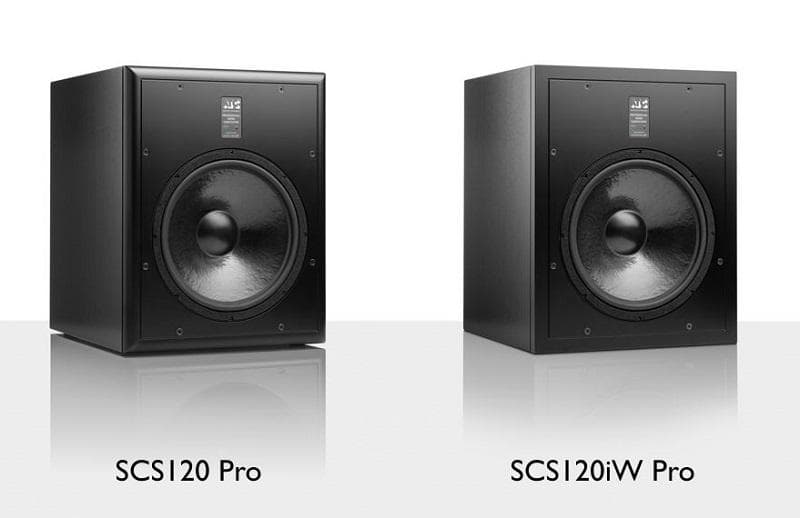
A Comprehensive Technical Analysis of the ATC SCS120 Pro and SCS120iW Pro

Introduction: The New Low-Frequency Standard
The Changing Landscape of Studio Monitoring
The evolution of professional audio monitoring has reached a critical inflection point. For decades, the subwoofer was often viewed as a secondary component in the studio environment—a utility tool for "checking the low end" or a specialized requirement for film post-production. In the music mixing world, specifically within the purist circles of high-end mastering, subwoofers were frequently viewed with suspicion. They were notorious for introducing phase anomalies, timing errors (group delay), and integration headaches that often outweighed the benefits of extended bandwidth.
However, the tectonic plates of the audio industry have shifted. Two primary factors are driving a renaissance in low-frequency reproduction:
The Dominance of Bass-Heavy Genres: Modern production styles—from Electronic Dance Music (EDM) and Hip-Hop to modern Pop—rely heavily on sub-bass frequencies (30Hz–60Hz) not just for weight, but for fundamental musical information. The "feeling" of the track is often dictated by the transient response of the kick drum and the sustain of the 808 bass, requiring monitoring systems that can reproduce these frequencies with the same pitch precision as the midrange.
The Rise of Immersive Audio: The widespread adoption of Dolby Atmos and other spatial audio formats has transformed the subwoofer from an optional add-on to a mandatory LFE (Low Frequency Effects) channel. In an Atmos environment, the LFE channel is a full-bandwidth bass channel capable of delivering 115dB SPL. Furthermore, "bass management" steers low-frequency energy from ceiling and surround speakers to the subwoofer, making it the energetic foundation of the entire immersive array.
It is within this high-stakes environment that the Acoustic Transducer Company (ATC) has planted its flag. Known globally for the legendary "ATC Midrange" and the uncompromising build quality of their active monitors, ATC has launched two new flagship 15-inch active subwoofers: the SCS120 Pro and the SCS120iW Pro.
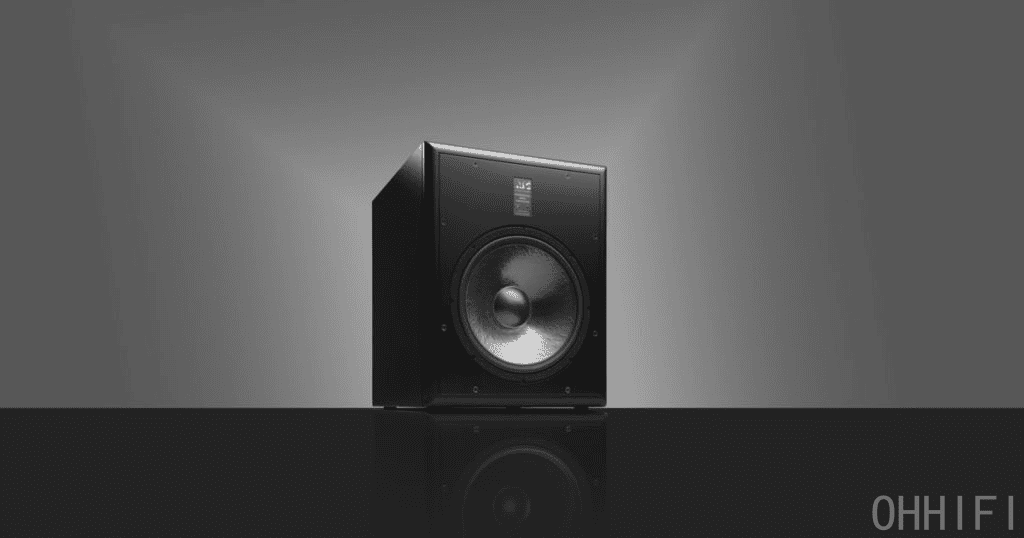
ATC's "Pro" Philosophy
The launch of the SCS120 series is not merely a product update; it is a statement of engineering philosophy. In a market saturated with DSP-corrected, Class-D powered, ported subwoofers that prioritize efficiency and compactness, ATC has taken a diametrically opposite approach. The SCS120 Pro utilizes a massive 15-inch driver, a sealed (infinite baffle) cabinet, discrete Class AB amplification, and purely analog filtering.
This "analog purist" approach is designed to address the one metric that digital processing often obscures: Time Domain Performance. By minimizing group delay and avoiding the latency inherent in AD/DA conversion, ATC aims to provide a subwoofer that doesn't just play low, but plays fast.
This report serves as an exhaustive technical dossier and critical analysis of the SCS120 Pro and SCS120iW Pro. We will dissect the physics of the hand-built SS75-375SC driver, the thermal engineering of the R1-300 amplifier, and the acoustic implications of the 120-liter sealed enclosure. We will also contextualize these monitors within the competitive landscape, comparing them to industry stalwarts like Genelec and PMC to understand where they sit in the pantheon of professional monitoring.
The Legacy of Acoustic Transducer Company (ATC)
To fully appreciate the engineering decisions behind the SCS120 Pro, one must understand the pedigree of the manufacturer. ATC was founded in 1974 by Billy Woodman, an Australian pianist and engineer whose obsession with piano reproduction led him to develop loudspeaker drivers that could handle the immense dynamic range and transient attack of a grand piano.
The Soft Dome Revolution
ATC’s reputation was built on the back of the SM75-150s soft dome midrange driver. This component redefined midrange clarity by maintaining linearity at high sound pressure levels (SPL). The core philosophy—over-engineering the motor system to ensure the voice coil remains under strict control—permeates every product ATC makes.
For decades, ATC's large main monitors (like the SCM100 and SCM150) relied on ported designs to achieve bass extension. While these monitors are legendary, the physics of ported boxes inevitably introduce some degree of "ringing" or resonant overhang at the port tuning frequency. As Billy Woodman and his R&D team (led by Richard Newman) looked to the future of sub-bass, they recognized that to match the speed of their midrange domes, the bass needed to be tighter and faster than a reflex port could allow.
The Shift to Sealed Subwoofers
The introduction of the SCS (Subwoofer Control System) series marked a pivot in ATC's bass strategy. Starting with the 12-inch SCS70 Pro, ATC moved to sealed cabinets for their standalone subs. The SCS120 Pro is the "big brother" to the SCS70, scaling up the concept to move the massive volumes of air required for larger control rooms and main monitoring applications.
This move to sealed boxes is significant. It signals ATC's belief that in the trade-off between "efficiency" (getting more volume per watt) and "transient fidelity" (stopping the note exactly when it ends), the professional engineer requires fidelity above all else.
The Heart of the Beast: The SS75-375SC Driver
The definitive component of the SCS120 Pro is its driver. In an era where many manufacturers source transducers from third-party OEMs (Original Equipment Manufacturers), ATC remains one of the few companies that designs and hand-builds its drivers in-house at their facility in Stroud, Gloucestershire, UK.
The SS75-375SC is a 15-inch (375mm) masterpiece of electro-mechanical engineering. Let us break down its nomenclature and design:
SS: Short Coil (Topology)
75: 75mm Voice Coil Diameter (approx. 3 inches)
375: 375mm Chassis Diameter (15 inches)
SC: Short Coil (Suffix)
The "Short Coil / Long Gap" Topology
The defining feature of this driver is its Short Coil / Long Gap motor topology. To understand why this matters, we must contrast it with the standard industry practice.
The Standard: Long Coil, Short Gap
Most commercial subwoofers use a "Long Coil, Short Gap" design.
The Design: A very long voice coil is suspended in a thin magnetic gap (a thin plate of steel).
The Pros: It is cheap to manufacture because it requires less magnetic material (steel and ferrite/neodymium).
The Cons: As the coil moves, the amount of copper inside the magnetic gap remains roughly constant, but the inductance of the coil changes significantly as different parts of the coil enter and exit the pole piece. Furthermore, the magnetic flux fringe fields at the edges of the gap cause the drive force (BL) to drop off non-linearly at high excursions.
The Result: High distortion (THD) and Intermodulation Distortion (IMD) when the driver is pushed hard. The bass sounds "woolly" or "compressed" at high volumes.
The ATC Way: Short Coil, Long Gap
The SS75-375SC inverts this arrangement.
The Design: A relatively short voice coil sits inside a massive, elongated magnetic gap.
The Mechanism: The magnetic gap is machined to be significantly deeper (longer) than the voice coil height. For example, if the coil is 20mm high, the gap might be 50mm deep.
The Physics: This ensures that the entire voice coil remains completely immersed in a uniform magnetic field throughout its full range of motion. Even at peak excursion (Xmax), the coil never leaves the area of maximum magnetic flux.
The Benefits:
Linear Drive Force: The force factor (BL) remains constant regardless of cone position. This virtually eliminates odd-order harmonic distortion caused by motor non-linearities.
Stable Inductance: Because the amount of coil surrounded by steel is constant, the voice coil inductance does not modulate with position. This prevents the "phase modulation" that can blur transients.
Heat Dissipation: The massive steel top plate required to create the long gap acts as a giant heatsink, wicking heat away from the coil.
The trade-off? Cost and weight. Creating a long magnetic gap requires a massive amount of precision-machined steel and a gigantic magnet structure to generate sufficient flux density across such a large volume. This contributes significantly to the subwoofer's nearly 100lb weight.
Cone Material: The Carbon-Paper Composite
ATC has resisted the trend toward rigid metal cones (aluminum, magnesium) for their bass drivers. While metal cones are stiff, they tend to "ring" like a bell at their breakup frequency, requiring steep crossover filters to hide the resonance.
The SS75-375SC utilizes a Carbon-Paper Composite cone.
Paper/Pulp: Provides excellent internal damping. When the electrical signal stops, the cone stops moving. It does not resonate or "color" the sound.
Carbon Fiber Reinforcement: Adds the tensile strength and rigidity required for a large 15-inch surface area to move as a perfect piston without flexing under the immense pressure of the sealed cabinet.
This combination offers the "best of both worlds": the transient speed and neutrality of paper with the stiffness required for high-SPL sub-bass reproduction.
High-Excursion Suspension
To produce 20Hz at 113dB SPL, a driver must move a significant volume of air. The SS75-375SC features a ruggedized suspension system (spider and rubber roll surround) optimized for high excursion. ATC’s R&D team used Finite Element Analysis (FEA) to ensure that the suspension remains linear (i.e., it doesn't pull back tighter as it stretches) up to the mechanical limits of the driver.
The Acoustic Architecture: Sealed Box Physics
The SCS120 Pro employs a Sealed Cabinet (Infinite Baffle) design with an internal volume of approximately 120 liters. This is the second pillar of ATC’s "precision first" philosophy.
The Problem with Ports (Bass Reflex)
The vast majority of subwoofers on the market are ported. A port (or vent) is a Helmholtz resonator tuned to a specific low frequency. This reinforces the driver's output, granting higher efficiency and more output at the tuning frequency.
However, resonance is the enemy of time. A resonator, by definition, stores energy. When a transient signal (like a kick drum) excites the port, it takes time for the resonance to build up and, crucially, time for it to decay. This "ringing" blurs the silence between notes.
Furthermore, below the tuning frequency, a ported driver loses all air damping and can flap uncontrollably, requiring steep high-pass filters (subsonic filters) that introduce severe phase shift and group delay.
The Sealed Advantage: Group Delay and Phase
In a sealed box like the SCS120 Pro, the air trapped inside acts as a linear pneumatic spring.
Transient Response: The air spring provides an immediate restoring force. The cone starts instantly and stops instantly. There is no resonant "tail" or "overhang."
Group Delay: Group delay is a measure of how much time it takes for different frequencies to pass through the system. Ported systems often have high group delay (20ms–50ms) near their tuning frequency, meaning the sub-bass arrives at the listener's ear later than the mid-bass. The SCS120 Pro, being sealed, exhibits exceptionally low group delay, keeping the sub-bass "tight" and time-aligned with the main monitors.
Rolloff Slope: A sealed box rolls off at a gentle 12dB/octave. A ported box rolls off at a steep 24dB/octave.
The "Room Gain" Bonus: In a typical studio, the room's boundaries naturally reinforce bass frequencies below the lowest room mode (typically 30Hz–40Hz) at a rate of roughly 12dB/octave. The SCS120's 12dB/octave rolloff perfectly complements this room gain, often resulting in a flat in-room response down to single-digit frequencies (DC) without the need for excessive equalization.
Cabinet Construction
The cabinet is a fortress. Weighing 44.5kg (98.1lbs), it is constructed from heavy, inert materials (likely high-density MDF) with extensive internal bracing.
This mass is functional. According to Newton's Third Law, when the 15-inch cone accelerates forward with high force, it exerts an equal and opposite force on the cabinet. If the cabinet were light, it would rock backward, absorbing transient energy and muddying the sound. The mass of the SCS120 anchors the system, ensuring that 100% of the motor's energy is converted into acoustic output.
Electronic Topology: The Class AB R1-300 Amplifier
In a world obsessed with lightweight, high-efficiency Class D amplification, ATC’s choice of a 300W Class AB amplifier is a defiant stand for audio quality over convenience.
Class AB vs. Class D
Class D amplifiers operate by switching their output transistors on and off at very high frequencies (PWM). While efficient, this switching generates high-frequency noise that must be filtered out, and the output impedance can vary with frequency.
ATC uses a Grounded Source MOSFET Class AB design.
Linearity: The transistors operate in their linear region, avoiding the "switching noise" and artifacts of Class D.
Bandwidth: The amplifier has a bandwidth extending to 90kHz. Even though the sub only plays up to 320Hz, this ultra-wide bandwidth ensures that the phase response is absolutely linear (flat) across the audible bass range. There is no phase shift caused by the amplifier itself.
Noise Floor: The absence of switching noise results in a pristine noise floor, essential for high-dynamic-range mastering environments.
The "No DSP" Decision
Perhaps the most controversial decision is the total lack of Digital Signal Processing (DSP) inside the SCS120 Pro.
Competitors like Genelec (SAM) and Neumann (MA 1) rely heavily on DSP for room correction, crossovers, and driver protection.
ATC avoids DSP for one primary reason: Latency.
The Latency Problem: Any AD/DA conversion and DSP processing takes time (typically 2ms to 5ms). If you use a DSP subwoofer with an all-analog main monitor (like an ATC SCM50A), the subwoofer will always be "late." This time misalignment causes a dip (comb filtering) at the crossover frequency that cannot be fixed with EQ.
The Analog Solution: By keeping the SCS120 Pro 100% analog, there is near-zero latency. The signal passes through the active filters at the speed of electricity. This ensures perfect time integration with analog main monitors, preserving the rhythmic integrity of the music.
Filter Implementation
The SCS120 Pro features 4th-order Linkwitz-Riley low-pass filters.
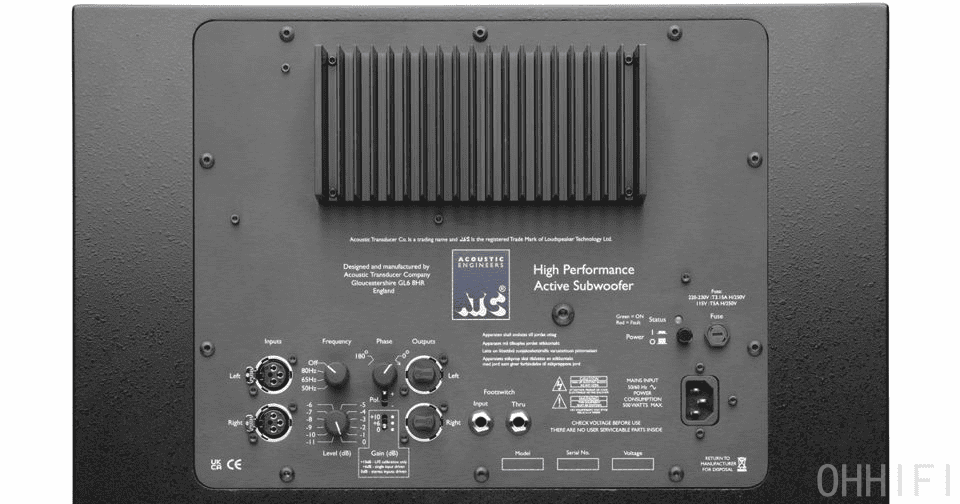
Selectable Frequencies: 50Hz, 65Hz, 80Hz, and 320Hz (Off).
Why Linkwitz-Riley? L-R filters sum to unity gain (flat response) at the crossover point, whereas Butterworth filters create a +3dB bump. This makes integration smoother.
The "Off" Setting: The 320Hz setting essentially bypasses the internal filter. This is designed for users who have external DSP processors (like a Trinnov Altitude or an Avid MTRX) handling the bass management. It turns the SCS120 into a "dumb" power engine, ready to be controlled by the external brain.
A Tale of Two Models: SCS120 Pro vs. SCS120iW Pro
ATC has released two versions of this subwoofer to cater to different studio architectures. While they share the same driver and acoustic DNA, their physical forms are distinct.
The SCS120 Pro (Freestanding)
Use Case: Designed for placement on the floor in the room.
Cabinet: Features "radius baffles" (curved edges) to minimize diffraction.
Amplifier: The amplifier is mounted on the rear of the cabinet.
Dimensions: 630 x 498 x 568mm (H x W x D).
Cooling: Convection cooled via the rear heatsink.
The SCS120iW Pro (In-Wall / Flush Mount)
Use Case: Designed to be built into the front wall of the studio (soffit mounting). This is the gold standard for main monitoring as it eliminates the "quarter-wavelength cancellation" (SBIR) that occurs when a speaker is placed near a wall but not in it.
Cabinet: Features a "square edge baffle." In a flush-mount scenario, the wall itself acts as an infinite baffle extension, making diffraction irrelevant.
Depth: The cabinet is significantly shallower (255mm / 10 inches) to fit inside standard wall cavities or behind acoustically transparent screens.
Remote Amplifier (R1-300 Pro):
The Problem: You cannot put an amplifier inside a wall; it will overheat, and you cannot reach it to service it.
The Solution: The SCS120iW comes with the R1-300 Pro, a separate 7U, 19-inch rack-mount amplifier unit.
Connection: The amp connects to the sub via a standard NL4 Speakon cable (for power) and a 5-pin XLR cable (to drive the front-panel LEDs and return thermal/limit status to the amp).
Benefit: The amp can be housed in a climate-controlled machine room, isolating the sensitive electronics from the extreme vibrations of the subwoofer cabinet.
| Feature | SCS120 Pro | SCS120iW Pro |
| Mounting | Freestanding | Flush / In-Wall |
| Baffle | Radiused (Curved) | Square Edge |
| Cabinet Depth | 568mm (22.4") | 255mm (10.0") |
| Amplifier | Built-in (Rear Plate) | Remote Rack-Mount (R1-300) |
| Ideal For | Flexible placement, retrofitting | Purpose-built control rooms |
Performance Analysis: By The Numbers
The specifications of the SCS120 Pro paint a picture of a device built for headroom and linearity.
Frequency Response: 20Hz – 320Hz (-6dB)
This spec is conservative. Many manufacturers rate their subs at -10dB or use "in-room" figures. ATC's measurement is anechoic/half-space.
In a real room, thanks to the sealed box synergy mentioned in the acoustic architecture section, the usable output will extend well below 20Hz. This covers the entire audible spectrum of human low-frequency hearing, plus the infrasonic energy that is "felt" rather than heard.
Max SPL: 113dB Continuous / 119dB Peak
113dB Continuous: This means the sub can sustain this volume indefinitely without thermal failure.
119dB Peak: This provides the headroom for transients (explosions in film, kick drums in music).
Context: The Dolby Atmos specification for an LFE channel requires 115dB peak capability at the listening position. A single SCS120 Pro (or a pair for larger rooms) comfortably meets this requirement with headroom to spare.
Distortion
While ATC lists amplifier THD at <0.003%, the acoustic distortion of the system is the real star. Thanks to the Short Coil/Long Gap motor, 3rd harmonic distortion is exceptionally low. This manifests subjectively as "pitch definition." Instead of a generic low-frequency "thud," the listener can clearly distinguish the pitch of a synth bass note or the tuning of a tom drum.
Integration and Applications
Stereo Augmentation
For stereo music studios using monitors like the SCM50 or SCM100, the SCS120 Pro performs two roles:
Extension: It reveals the bottom octave (20Hz–40Hz) that the main monitors might roll off.
Headroom: By filtering the bass out of the main monitors (using the SCS120's outputs or an external crossover), the main monitors are relieved of the heavy lifting. This reduces Intermodulation Distortion (Doppler distortion) in the midrange drivers of the mains, resulting in cleaner vocals and stereo imaging.
The Dolby Atmos Imperative
The SCS120 Pro is tailor-made for the immersive audio revolution.
LFE Duty: It has the displacement to handle the dedicated.1 LFE channel.
Bass Management: In Atmos, bass from all speakers (ceilings, surrounds) is often redirected to the subwoofer. This places a massive load on the sub. The 15-inch driver and high thermal capacity of the SCS120 make it robust enough to handle the summed bass energy of 11+ speakers.
Scalability: The "Thru" jacks allow multiple SCS120s to be daisy-chained for larger rooms (e.g., using 2 or 4 subs to smooth out room modes or increase total SPL).
Competitive Landscape
How does the SCS120 Pro stack up against the titans of the industry?
ATC vs. Genelec (e.g., 7380A)
Genelec: Uses Class D amps, ported cabinets, and highly sophisticated DSP (GLM) to auto-calibrate the sub to the room.
ATC: Uses Class AB amps, sealed cabinets, and zero DSP.
The Verdict: The Genelec is a "problem solver" for difficult rooms and quick setups. The ATC is a "performance instrument" for treated rooms where the engineer values time-domain purity and mechanical integrity over digital correction. The ATC requires more skill to set up (manual phase alignment) but rewards the user with potentially superior transient response.
ATC vs. PMC (e.g., PMC8-2 SUB)
PMC: Uses "Advanced Transmission Line" (ATL) technology to boost bass from smaller drivers.
ATC: Uses a sealed box and a massive driver.
The Verdict: Transmission lines are efficient but can have complex phase behaviors. ATC's sealed box is theoretically simpler and more phase-linear. ATC relies on "displacement supremacy" (big driver, big box) rather than acoustic loading tricks.
Conclusion: The Anchor of the Studio
The release of the ATC SCS120 Pro and SCS120iW Pro is a defining moment for the British manufacturer. It represents the successful scaling of their "sealed box, short coil" philosophy to the very limits of what a 15-inch driver can achieve.
These are not "smart" speakers. They will not connect to Wi-Fi, they do not have an app, and they will not fix your room's standing waves with a magical button press. They are, instead, precision instruments of physics. They are built on the belief that if you get the electro-mechanics right—if you build a motor that is linear, a cone that is rigid, and a cabinet that is inert—you do not need digital bandages.
For the professional engineer working in high-end mastering, film scoring, or immersive mixing, the SCS120 Pro offers something increasingly rare: Truth. The truth about the bottom octave of your mix, delivered with the speed, impact, and transparency that has made ATC a legend in the industry.
In a world of disposable tech, the SCS120 Pro is a 100lb declaration that heavy engineering still matters.
Technical Appendix: Data Sheets
Acoustic Specifications
| Parameter | Value | Notes |
| Drive Unit | 1 x SS75-375SC | 15" / 375mm, 8Ω |
| Low Frequency Cut-off | 20Hz | -6dB, Half Space |
| Max SPL | 113dB Continuous | 119dB Peak (IEC Weighted Pink Noise @ 1m) |
| Sensitivity | +4dBu | For 100dB SPL @ 1m |
| Total Harmonic Distortion | <0.003% | Amplifier THD+N |
Electronic Specifications
| Parameter | Value | Notes |
| Amplifier Type | Grounded Source MOSFET | Class AB, Convection Cooled |
| Output Power | 300W RMS | Into 8Ω |
| Filters | 4th Order Linkwitz-Riley | 50Hz, 65Hz, 80Hz, 320Hz (Off) |
| Inputs | 2 x Balanced XLR | Female, Pin 2 Hot |
| Outputs | 2 x Balanced XLR | Male, Buffered/Thru (Full Range) |
| Controls | Gain, Level, Phase, Polarity | Continuous 0-180° Phase |
Physical Specifications
| Model | SCS120 Pro | SCS120iW Pro | R1-300 Pro Amp |
| Width | 498mm (19.6") | 498mm (19.6") | 483mm (19") |
| Height | 630mm (24.8") | 630mm (24.8") | 311mm (7U) |
| Depth | 568mm (22.4") | 255mm (10.0") | 133mm (5.25") |
| Weight | 44.5kg (98.1lbs) | 35.3kg (77.8lbs) | 12kg (26.4lbs) |
| Baffle | Radiused | Square Edge | N/A |
| Price (UK) | £4,575 + VAT | £5,408 + VAT | Included w/ iW |
| Price (US) | ~$6,990 | ~$8,290 | Included w/ iW |
(Note: Prices are approximate and subject to region/dealer variations. Dimensions exclude rear clearance for cables.)




Comments