
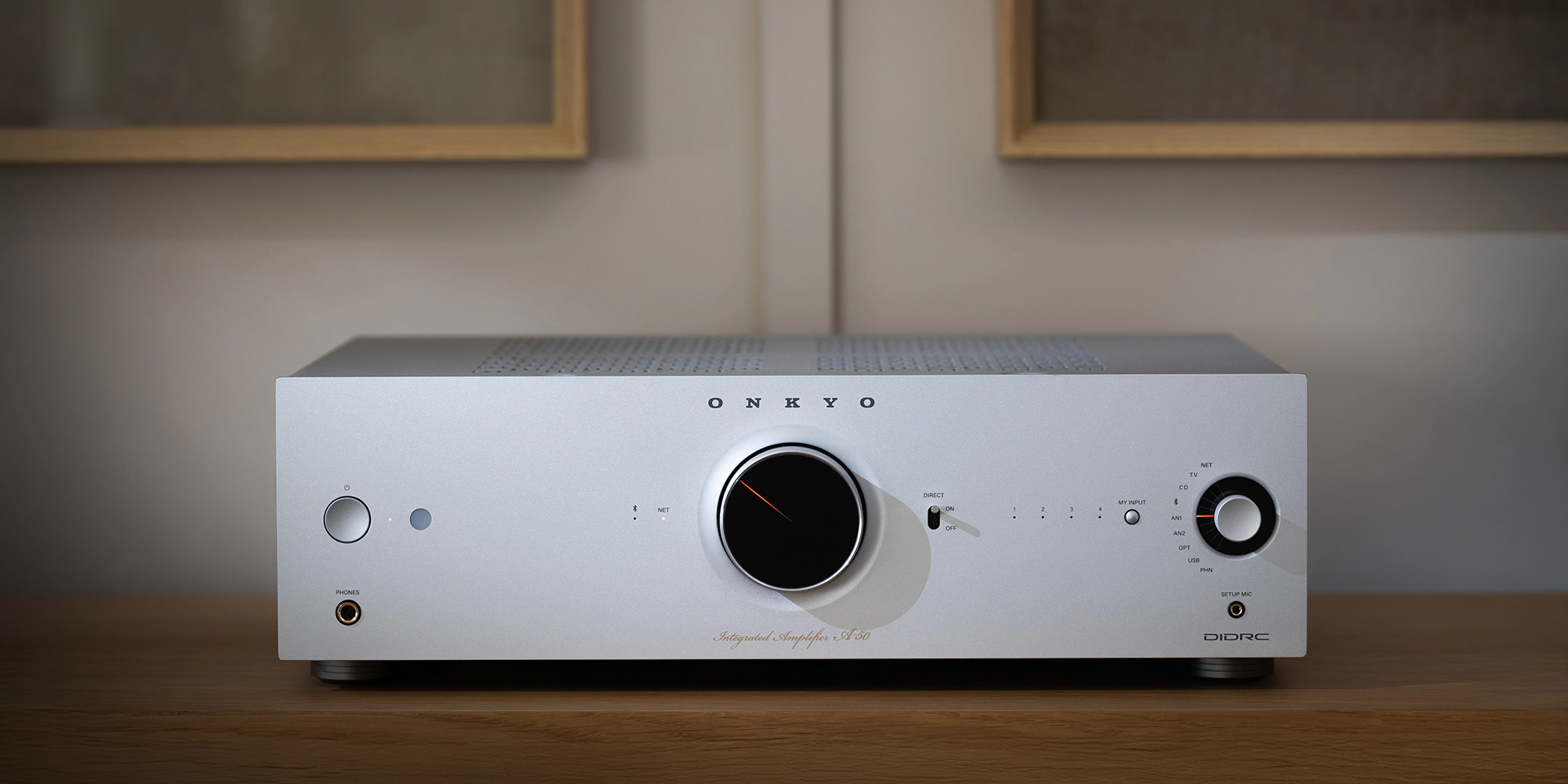
Onkyo Icon A-50 Review: The Comeback Amp That Split the Critics

Onkyo went bankrupt in 2022. That's not a rumor or an exaggeration — the company that spent decades next to Denon and Marantz on every AV shelf in America filed for it, sold its home audio division to a joint venture between Premium Audio Company (Klipsch's parent) and Sharp, and went quiet. Then, at CES 2025, it came back with a two-channel line called Icon — a streaming preamp, a power amp, and the subject of this Onkyo Icon A-50 review: a $1,599 / £1,199 Class A/B streaming integrated amplifier that's supposed to announce the brand's return to serious hi-fi.
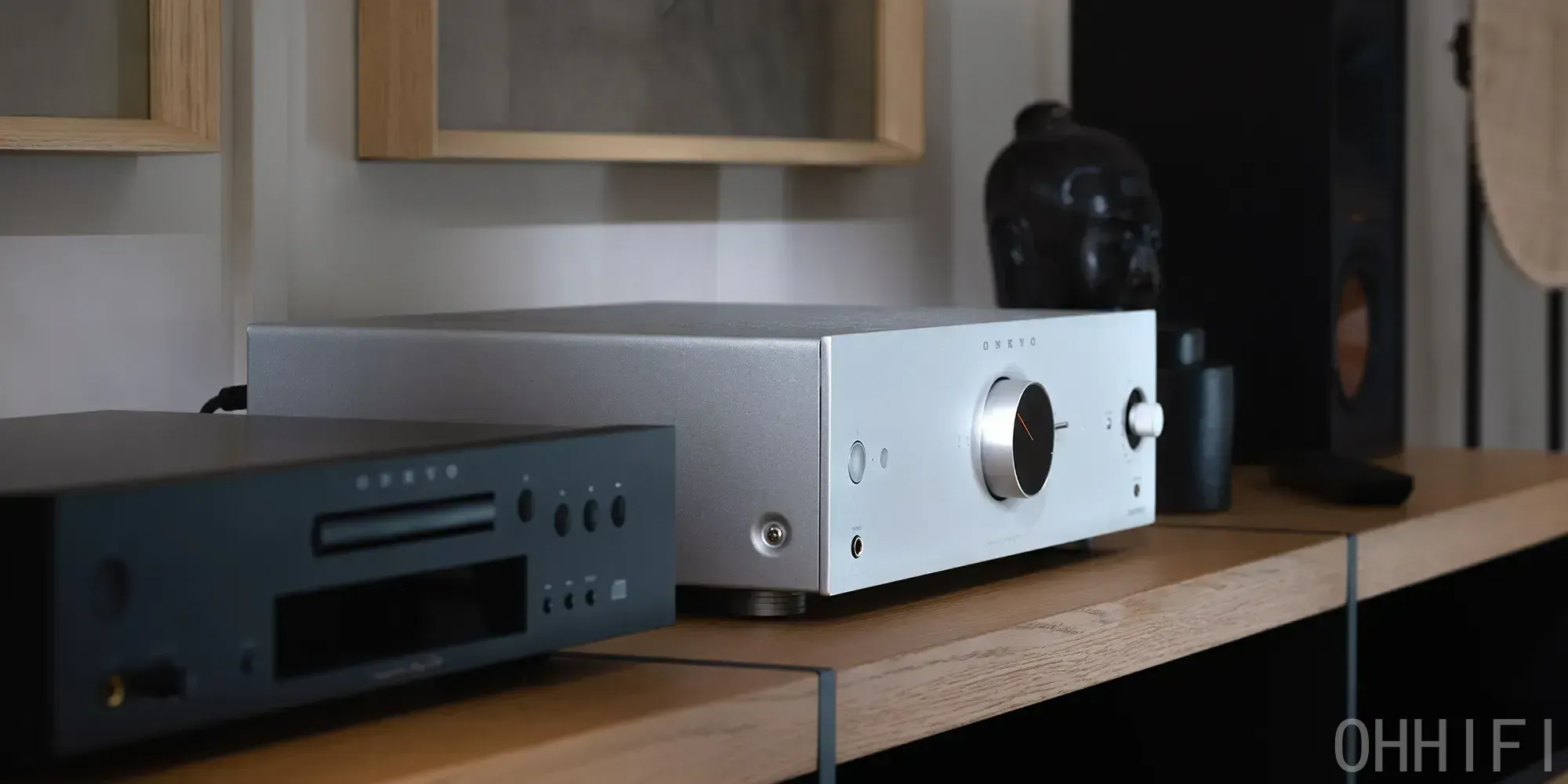
Here's what makes the A-50 interesting, and why it's worth a long look rather than a quick verdict: the reviews are genuinely split. One camp — mostly US-based — calls it a high-value muscle amp with a feature list nothing else matches at the price. The most prominent dissenting test put it up against the segment's reigning favorite and walked away unimpressed, citing soft dynamics, build niggles, and a buggy app. Both camps heard the same amplifier. The question is which set of priorities is yours.
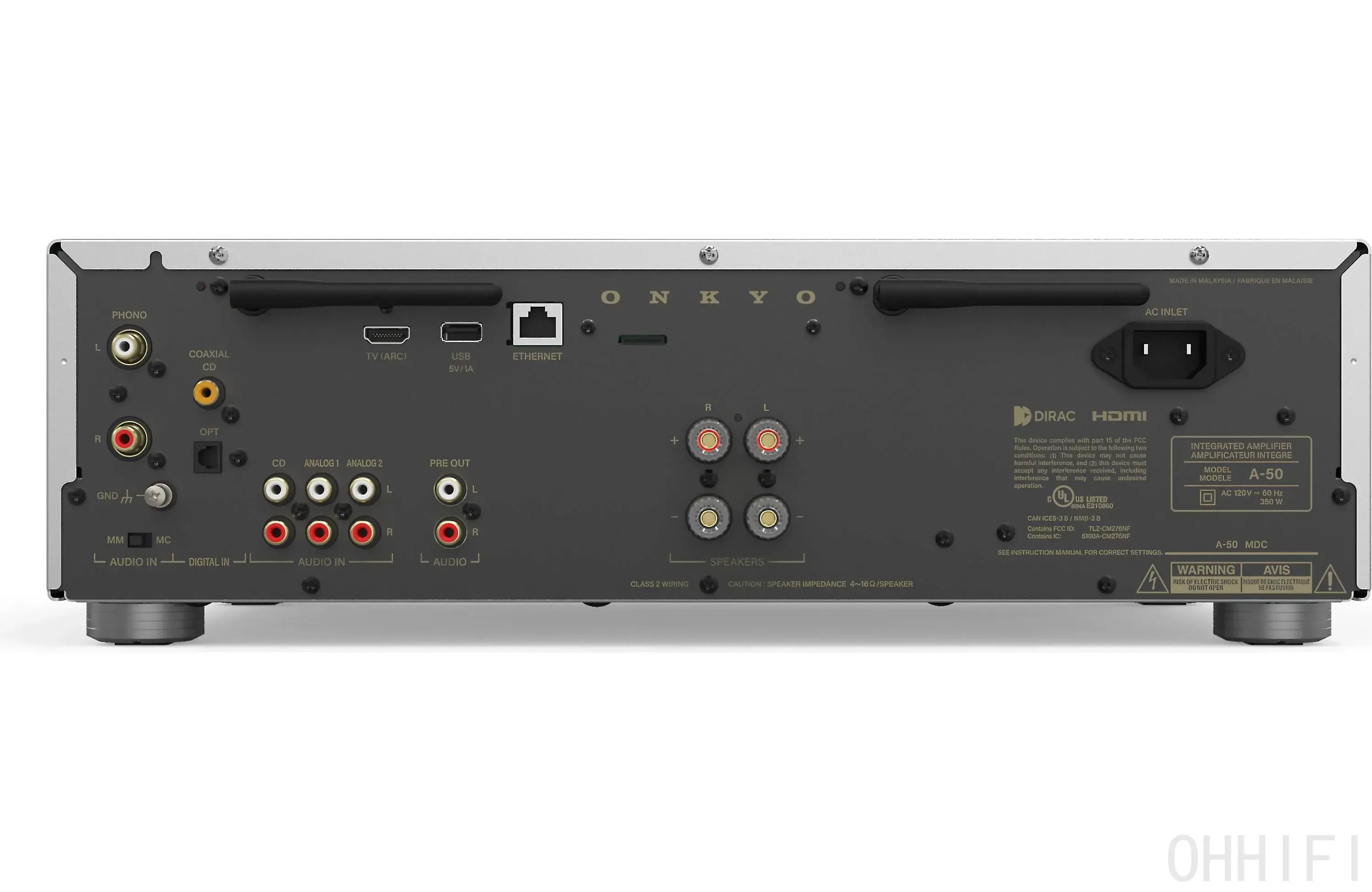
Onkyo Icon A-50 Specs at a Glance
| Spec | Detail |
|---|---|
| Price | $1,599 / £1,199 / AU$3,299 (US street price dips to ~$1,488) |
| Power output | 110W per channel (8 ohms, 20Hz–20kHz, both channels driven); 180W into 4 ohms (1kHz) |
| Amplification | Class A/B, three-stage inverted Darlington, Onkyo DIDRC circuit |
| DAC | AKM AK4452; up to 32-bit/768kHz PCM over network/USB (S/PDIF inputs top out at 24-bit/96kHz) |
| Streaming | Wi-Fi, Ethernet, Spotify / Tidal / Qobuz Connect, Amazon Music, AirPlay 2, Chromecast, Roon Ready, internet radio |
| Bluetooth | SBC, aptX, aptX HD — receive and transmit (to wireless headphones) |
| Analog inputs | 3 x RCA line, MM/MC phono |
| Digital inputs | HDMI ARC, 1 x coaxial, 1 x optical, USB for storage drives |
| Outputs | RCA pre-out, 6.3mm headphone jack, speaker binding posts |
| Room correction | Bandwidth-limited Dirac Live (full version is a paid upgrade) + Onkyo Fidelity IQ; mic included |
| Dimensions / weight | 435 x 135 x 355mm (W x H x D), full-width chassis; 13kg |
A fact-check note, since you'll see conflicting numbers elsewhere: Onkyo's own EMEA spec sheet lists two optical inputs, and at least one major review repeats it. The official rear-panel images for both the North American and international versions show one optical and one coaxial. Trust the panel.
Read that feature list twice, because it's the A-50's strongest argument. A switchable MM/MC phono stage, HDMI ARC, every Connect protocol that matters, Roon certification, two-way Bluetooth, and Dirac in the box at $1,599 — there is no Class A/B amplifier I can point to that ticks all of those at this money. Most rivals make you pick: streaming smarts or analog muscle. Onkyo is claiming you can have both.
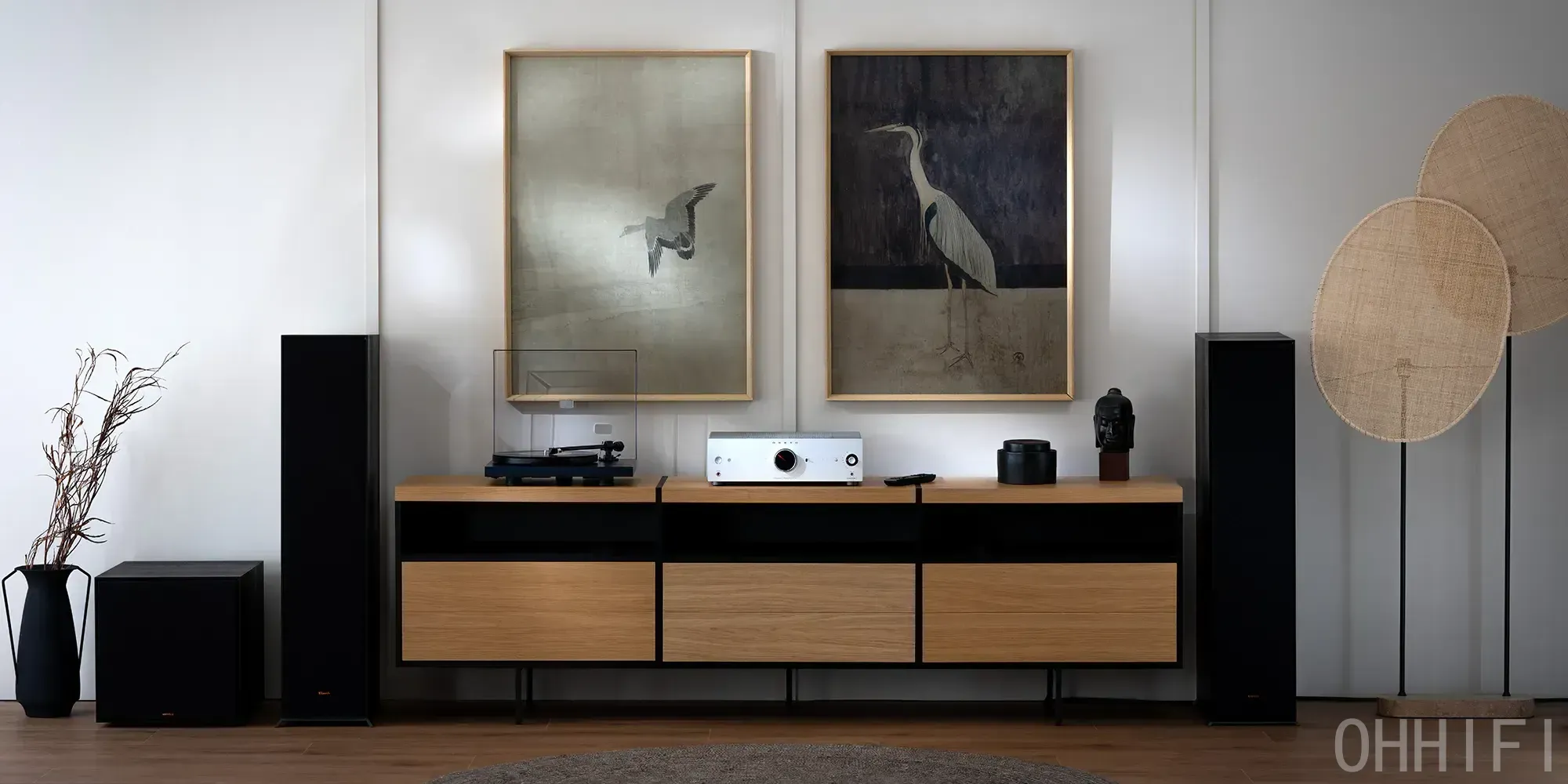
Design & Build: Traditional Looks, Uneven Execution
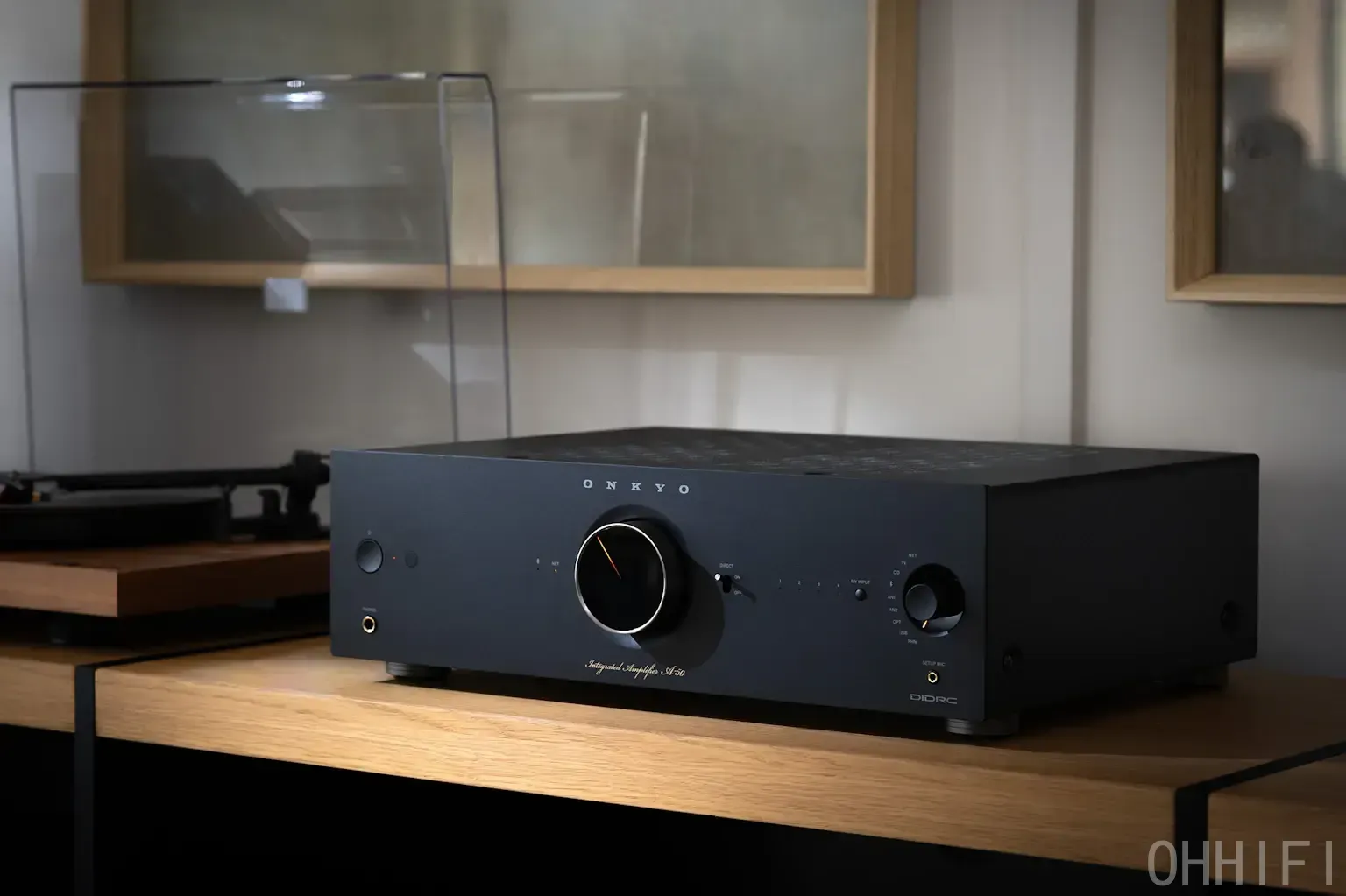
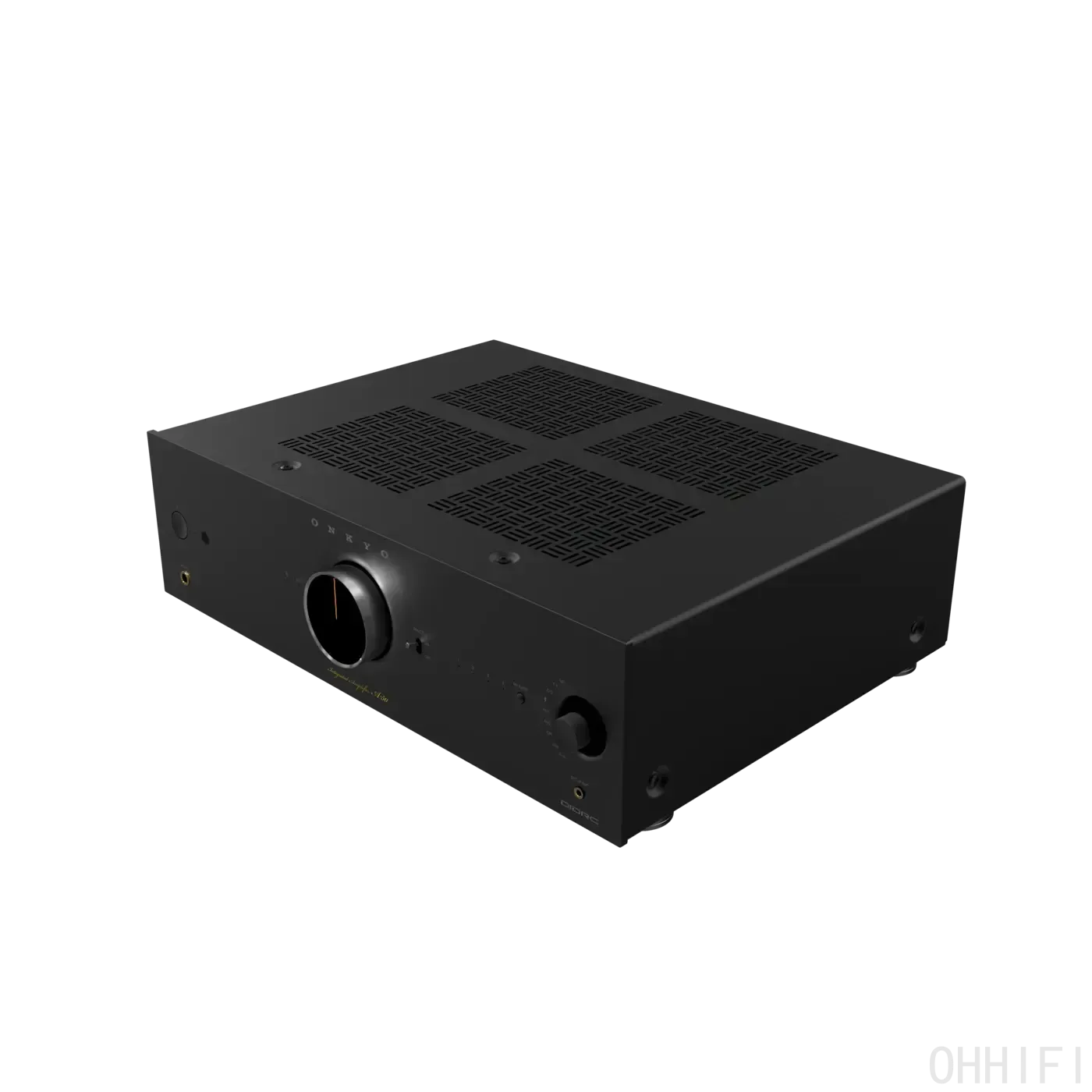
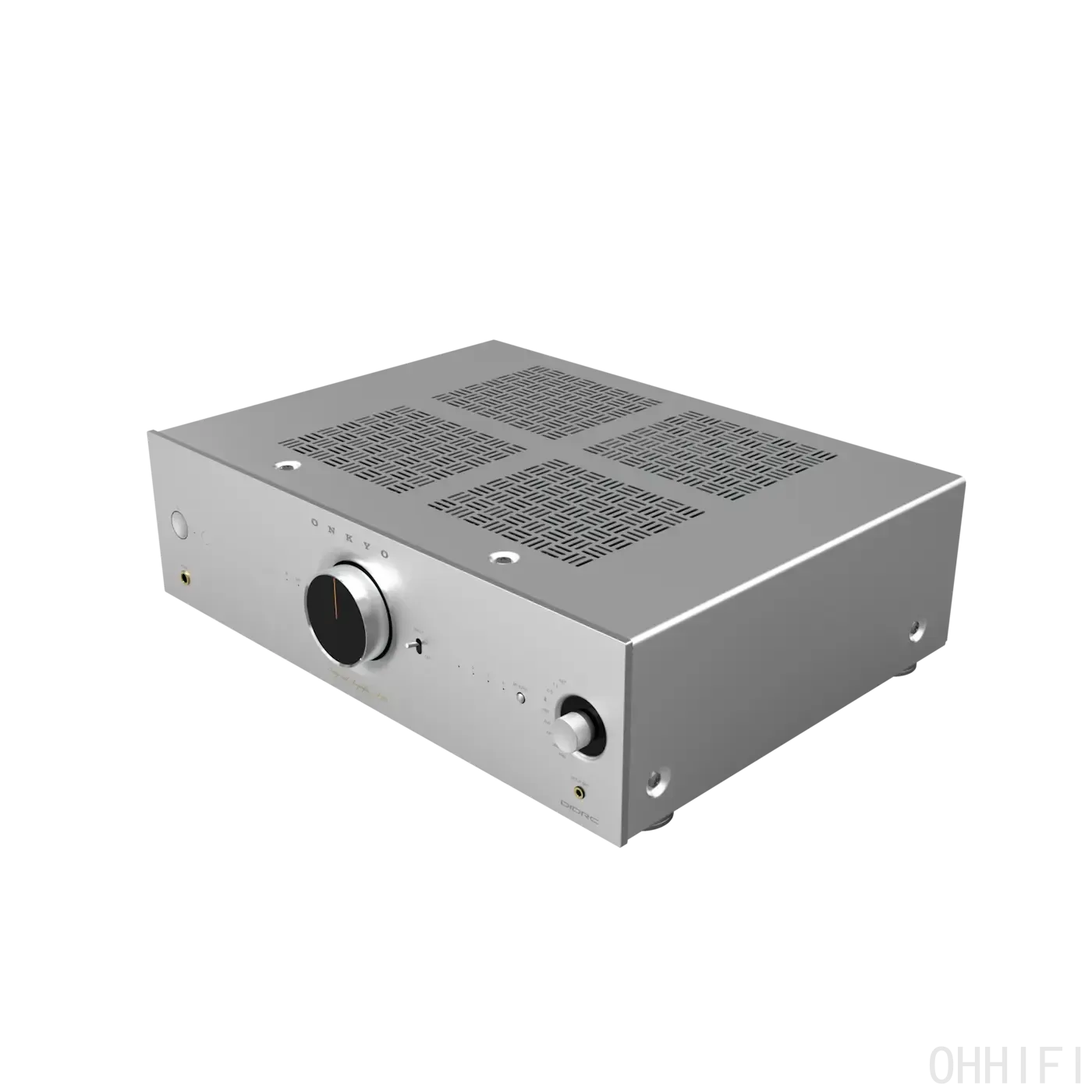
The A-50 is a deliberately old-school object — full-width, black or silver, extruded aluminum front panel, a big volume knob ringed in orange LEDs that arc around the input selector. Internally Onkyo talks up custom 10,000µF capacitors, a copper busbar, and a rigid, fanless chassis. On paper, that's exactly the parts-bin language a returning Japanese brand should be speaking.
The execution gets less flattering up close. The recurring complaint across reviews is that the contact points don't match the price: a power button with a springy, cheap action, a top panel that flexes more than it should, and an input selector whose rotation feels softer and vaguer than its nice knurled texture promises. None of this affects the sound. All of it affects whether a $1,599 box feels like $1,599, and the consensus is that it doesn't quite.
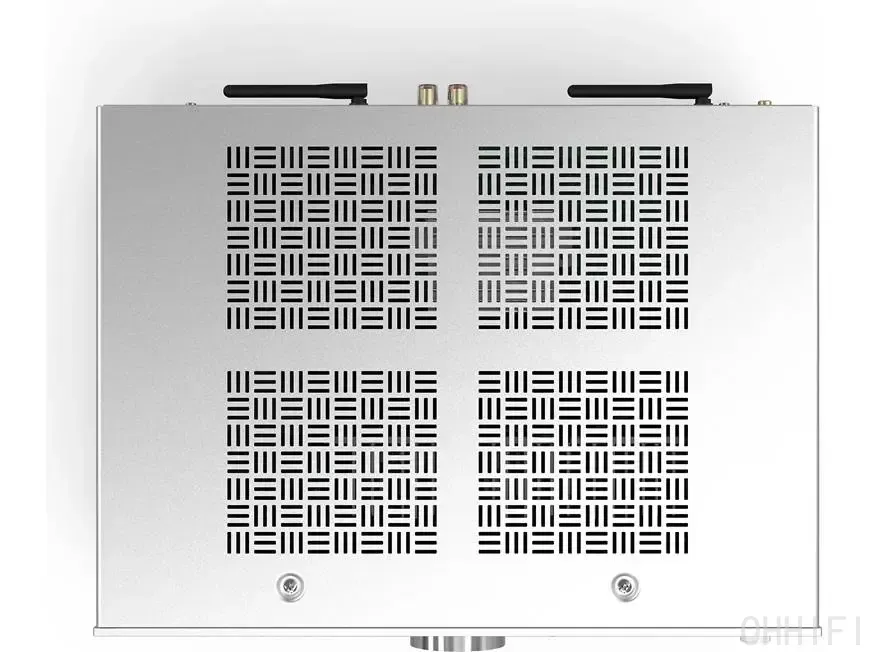
Then there's the click. Partway up the volume control's travel, the amp makes an audible mechanical clack. Onkyo's own explanation is that the power supply switches between low and high rails depending on volume, internal temperature, and output level — a thermal-management strategy. As engineering, I get it: two-tier rails keep idle heat down in a fanless Class A/B design. As a user experience at this price, it's the kind of quirk that should have been engineered into silence before launch. Cleverness you can hear isn't cleverness.
The app is the bigger wart. Onkyo Controller draws consistent criticism for sluggishness, an over-fussy setup flow, and intermittent bugs — vanishing transport controls, the amp occasionally muting or nudging tone settings when switching between Dirac, Fidelity IQ, and Direct mode. The Connect protocols (Tidal, Spotify, Qobuz) work fine because they bypass the app entirely, which tells you where to live day-to-day. But a streaming amplifier with a flaky control app has a self-inflicted wound, and no firmware roadmap excuses shipping it that way.
The Sound: Big, Bold, and a Little Blunt
One framing note before the frequency tour: everything below is synthesized from the published reviews and measurements, weighed against what this architecture should deliver — my read on the evidence, not a listening diary.
Bass
This is the most agreed-upon strength. A 110W Class A/B output stage with a stiff power supply and 180W on tap into 4 ohms should produce low end with genuine weight and grip, and that's precisely the consistent report: punchy, authoritative bass with real texture, the kind that distinguishes intensity between successive low-frequency hits rather than smearing them into one thud. Stereophile's bench tests back the architecture up — speaker output impedance of roughly 0.15 ohms means a healthy damping factor and an amp that doesn't let woofers flap. If you've found Class D streaming amps polite down low, this is the counter-argument.
Midrange
Here's where the split begins. The favorable camp describes a clean, honest midrange that doesn't editorialize — revealing of poor masters, faithful to good ones. The critical camp hears the same neutrality but finds vocals delivered without full conviction: tonally correct, dynamically a touch flat. My read: both are describing an amp that's accurate but not expressive. Three-stage Darlington output stages and Onkyo's DIDRC distortion circuit are built to suppress intermodulation grunge, and low IMD usually buys you cleanliness rather than charisma. If you want an amp that leans into a vocal, this isn't built to do that.
Treble
Broad agreement again, and it's good news: balanced, extended, and free of the brightness or grain that budget Japanese amps were once notorious for. Nobody — in either camp — accuses the A-50 of hardness. Reviewers note it won't sweeten a compressed or spotlit recording, which I'd file under honesty rather than fault.
Soundstage & Dynamics
The A-50's presentation is consistently described as large-scale, open, and spacious — bold without being pushy. Where opinions genuinely diverge is precision and timing. The most demanding comparison test found it less focused and less rhythmically sure-footed than the class leader at this price, with smaller dynamic gradations. Other reviews call the staging wide, believable, and consistent across material, if not exotic. Reading between the lines: this is a broad-brush amplifier. It paints big and it paints confidently, but it doesn't draw fine lines. Whether that's a flaw depends entirely on whether you listen for scale or for scalpel work.
Two paths worth knowing about
First: every analog input is digitized at 24-bit/48kHz for tone control and DSP duty unless you engage the front-panel Direct switch, which keeps the signal path analog and shorter. Multiple reviews report a subtle but real cleanup with Direct engaged. Flick it and leave it — unless you're using Dirac.
Second: the phono stage is a puzzle. Per Stereophile's measurements, its RIAA equalization is superbly accurate with excellent channel matching — textbook stuff. Yet the subjective reports on it range from serviceable to flat and under-driven, and the measured MC noise floor is high enough that the MC setting looks more like a spec-sheet checkbox than a serious feature. My take: the MM input is a competent convenience, fine for a starter turntable. Anyone running a decent MC cartridge should budget for an outboard stage and treat the built-in one as a backup.
How I Put This Review Together
My read here pulls together Onkyo's published specs, the independent bench measurements that are out there, and the consensus — and the genuine disagreements — across the reviews published since launch, weighed against what this kind of Class A/B architecture usually delivers. Where the critics split, I say so and tell you which side the evidence favors.
Measured Performance
Stereophile ran the A-50 through a full bench workup, and the numbers sketch a coherent picture (all figures per Stereophile):
The amplifier section is the strong suit — low speaker output impedance (~0.15–0.19 ohms across the band), accurate 0.5dB-step volume control, and power delivery that supports the rated 110W/8-ohm figure. The DAC section is more ordinary: measured resolution works out to about 18 bits, with evidence of LSB truncation — fine for an integrated at this price, but the "premium DAC" marketing line deserves a raised eyebrow. Channel separation is moderate at around 65dB, which may be one objective thread behind the "lacks pinpoint focus" subjective reports; wide, slightly diffuse staging is what modest separation tends to sound like.
The most consequential number is the headphone output impedance: 316 ohms. That is very high. Into typical 32-ohm headphones it wrecks damping and will audibly tilt the response of anything with impedance swings — which maps neatly onto the published complaints that the headphone jack sounds grey and underwhelming next to the speaker outputs. With 75mW rated into 32 ohms, treat this jack as a courtesy feature for late-night background listening, not a headphone rig. High-impedance dynamics (300–600 ohm) will fare best; IEMs, worst.
That's the value of measurements: the bench explains the ears. The speaker outputs measure like a serious amp; the headphone and DAC sections measure like afterthoughts. The listening reports, on both sides of the critical divide, track that split almost exactly.
The Competition
| Rival | Comparison | Verdict |
|---|---|---|
| Ruark Audio R610 ($1,599 / £1,199) | Same money, opposite philosophy: compact 75W Class D, Burr-Brown DAC, furniture-grade design, no control-app drama. Less power and scale; widely reported as more precise, more composed, more rhythmically engaging. | The benchmark at this price. If refinement and timing top your list, the published comparisons favor it — clearly. |
| WiiM Amp Ultra ($529 / £499) | A third of the price for 100W Class D, a touchscreen, slicker software than Onkyo's by every account, and room correction. No phono stage, no headphone jack, no analog muscle. | The value bully. The A-50 must justify a $1,000 gap on amplifier quality and analog connectivity alone — for some buyers it will, for many it won't. |
| NAD C 700 V2 ($1,999 / £1,499) | 80W HybridDigital UcD, BluOS streaming (the most mature multi-room platform here), MM phono, HDMI eARC. Dirac is a paid license, and it's now pricier than the Onkyo in the US. | The software-first pick. Less raw power, far more polished ecosystem. Choose it if the app experience matters as much as the amp. |
| Marantz Model M1 ($1,000) | Compact 100W Class D with HEOS streaming and HDMI ARC at a friendlier price. No headphone output; Dirac costs extra; smaller-scale presentation by most accounts. | The sensible middle path if you don't need phono flexibility or big-amp swagger. |
Notice what's missing from that table: another full-width Class A/B streaming amplifier with MM/MC phono at this price. It doesn't really exist. That's simultaneously the A-50's best case and a warning — Onkyo is alone in this corner partly because the market moved to Class D and partly because nobody else thought the combination was worth building.
The Verdict
7/10.
The Onkyo Icon A-50 is a good amplifier wrapped in a mediocre product. The core — the Class A/B output stage, the weight and scale of its sound, the absurdly complete connectivity — is genuinely competitive, and the bench results confirm the amplifier section is built right. But the execution keeps tripping over itself: an app that should embarrass a company of this heritage, build details that undercut the price tag, a headphone output that measures like an apology, and a level of precision and dynamic nuance that the best rival at this price simply beats.
The split in the critical consensus resolves cleanly once you see it this way. Judged as a powerful, honest, do-everything amp for big speakers and big rooms, it earns its fans. Judged on refinement per dollar against the class leader, it loses. Onkyo's comeback is real — but Icon is a name this amp aspires to, not one it's earned yet.
Pros
- Genuinely muscular, large-scale sound with weighty, textured bass — the Class A/B case made well
- The most complete feature set in its class: MM/MC phono, HDMI ARC, every Connect protocol, Roon Ready, two-way Bluetooth, Dirac in the box
- Balanced, fatigue-free treble with no trace of old-school Japanese glare
- Amplifier section measures honestly: low output impedance, accurate volume steps, rated power confirmed
- Direct mode offers a worthwhile, shorter analog path
Cons
- Onkyo Controller app is consistently reported as sluggish and buggy
- Build details (springy power button, audible power-supply switching, vague selector feel) undercut the price
- Headphone output is compromised — 316-ohm output impedance per Stereophile makes it a courtesy jack
- Precision, timing, and dynamic nuance trail the best rival at this price
- MC phono setting is more checkbox than feature; full-bandwidth Dirac costs extra
Who Should Buy the Onkyo Icon A-50 — and Who Should Skip It
This is for you if: you run larger or less sensitive speakers in a decent-sized room, you want one full-width box that handles streaming, TV duty, and a turntable, and you'd rather have scale, weight, and grip than the last word in finesse. Engage Direct mode, control it through Tidal or Qobuz Connect rather than the app, and the A-50 will do the muscular-honest-amp job convincingly — at a price nothing else with this topology and feature list matches.
Look elsewhere if: you prize rhythmic precision and dynamic subtlety (the Ruark R610 is the published consensus pick at this money), you'll actually use the headphone output (almost anything dedicated beats it), you're allergic to janky control apps (NAD's BluOS or WiiM's software are in another league), or you're spending carefully (the WiiM Amp Ultra delivers most of the convenience for a third of the cost). The A-50 rewards a specific buyer. Make sure you're that buyer before $1,599 leaves your account.



Comments