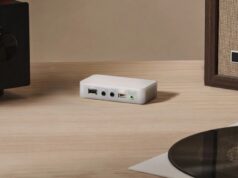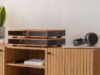

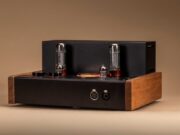


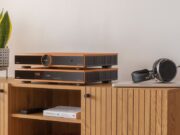
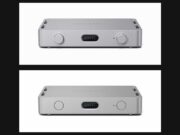
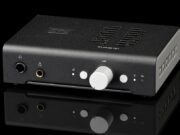
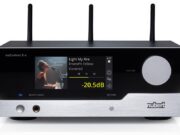
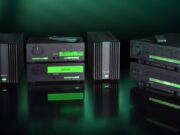
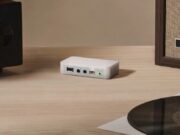
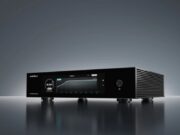
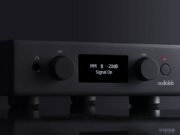
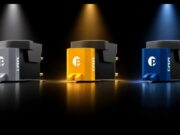
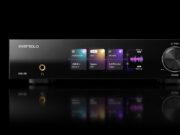
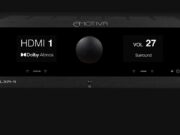


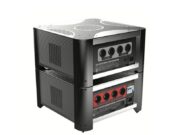


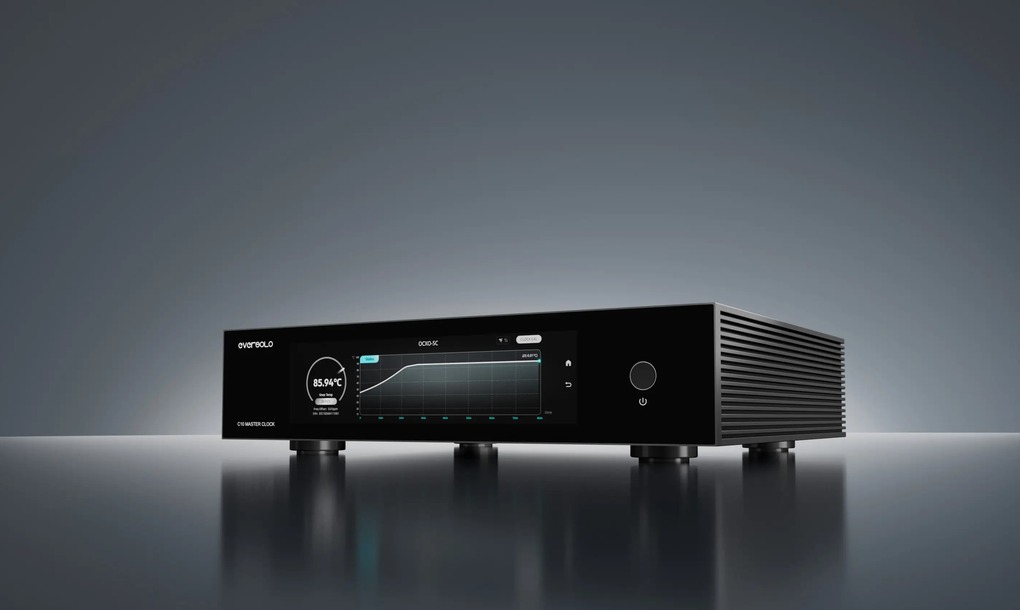
Eversolo’s flagship source system is now complete — at least on paper. The C10 Precision Master Clock, first shown at HIGH END Vienna in June, is open for pre-order in the US at $1,880 through Forté Distribution, with no ship date announced. It is the fourth box in a line-up that already includes the T10, the DAC-Z10 and the DAC-R8 — and the only one that makes no sound at all. A master clock does one job: it hands every digital component the same timing reference.
What’s New
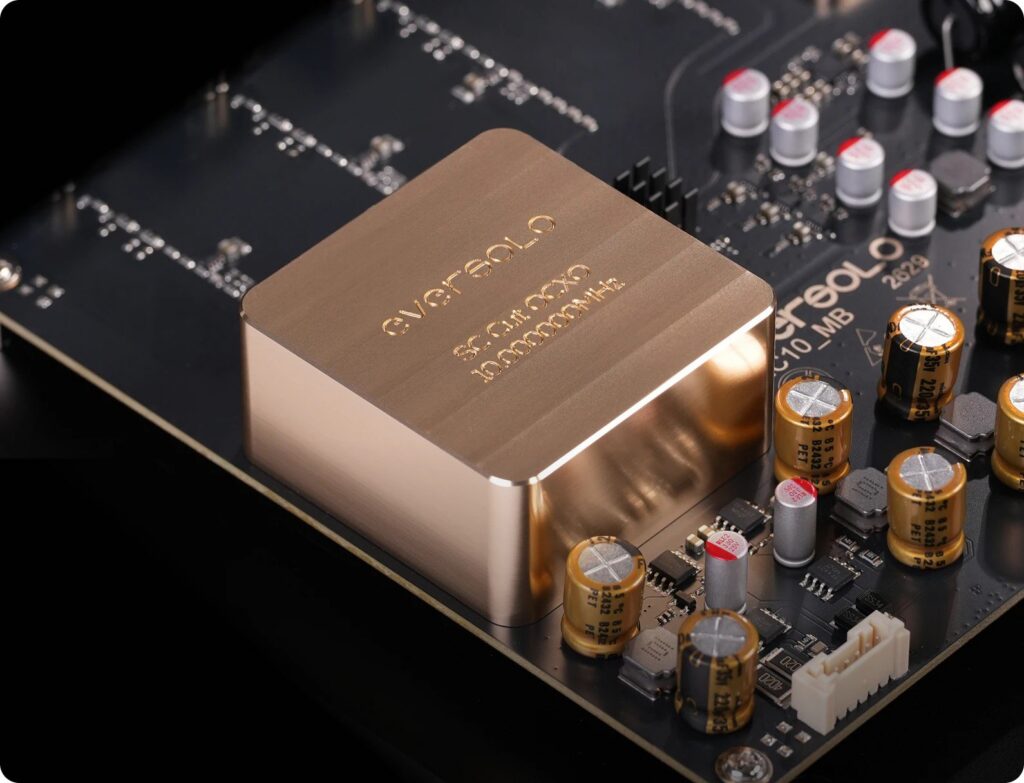
At the heart of the C10 is a 10 MHz SC-cut OCXO — an oven-controlled crystal oscillator built around a stress-compensated crystal cut, held at a steady temperature. Eversolo publishes the full set: phase noise no more than −115 dBc/Hz at a 1 Hz offset, −129 at 10 Hz, −139 at 100 Hz and −145 at 1 kHz, with a noise floor of −170 dBc/Hz. Factory offset is under ±0.01 ppm at 10 MHz and 25°C, stability across −20°C to +60°C under 0.003 ppm, short-term stability under 9E-13 at Tau = 1 s. All Eversolo’s own figures — nobody outside the company has measured one yet.
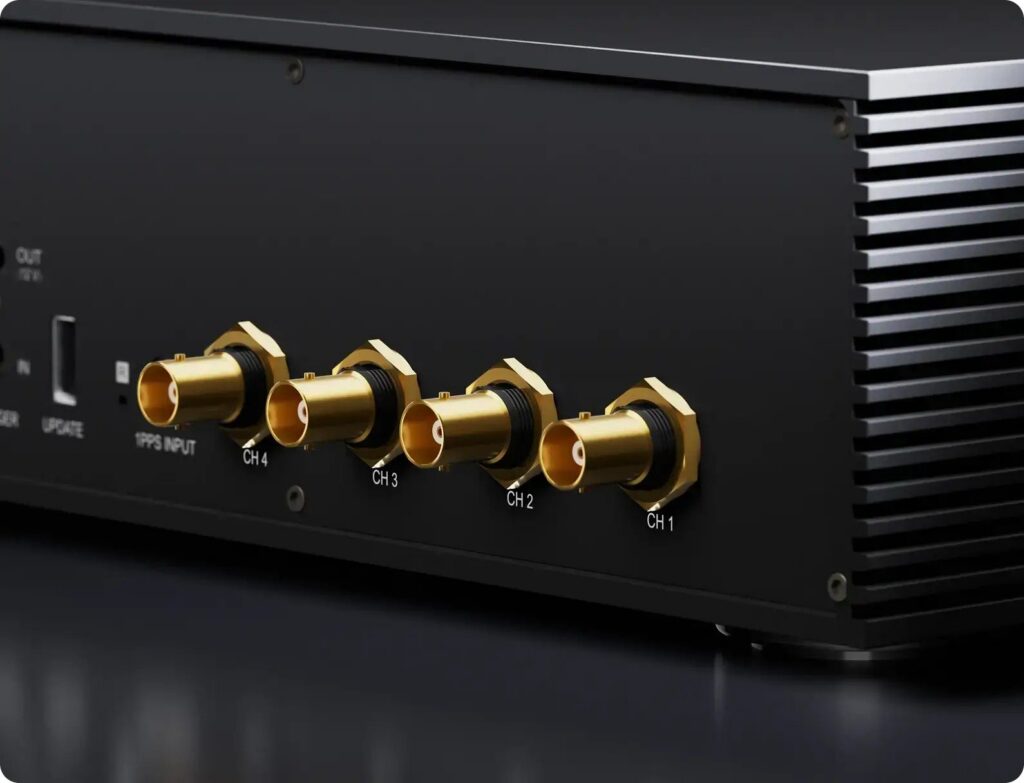
Four independently buffered BNC outputs at 50 ohms put out a 1.8 Vrms square wave, and each can be set on its own: 10, 25 or 100 MHz, or one of six audio-derived frequencies — 11.2896, 22.5792 and 45.1584 MHz from the 44.1 kHz family, and 12.288, 24.576 and 49.152 MHz from the 48 kHz family. One box can clock a transport at 10 MHz and a DAC at 45.1584 MHz at the same time.
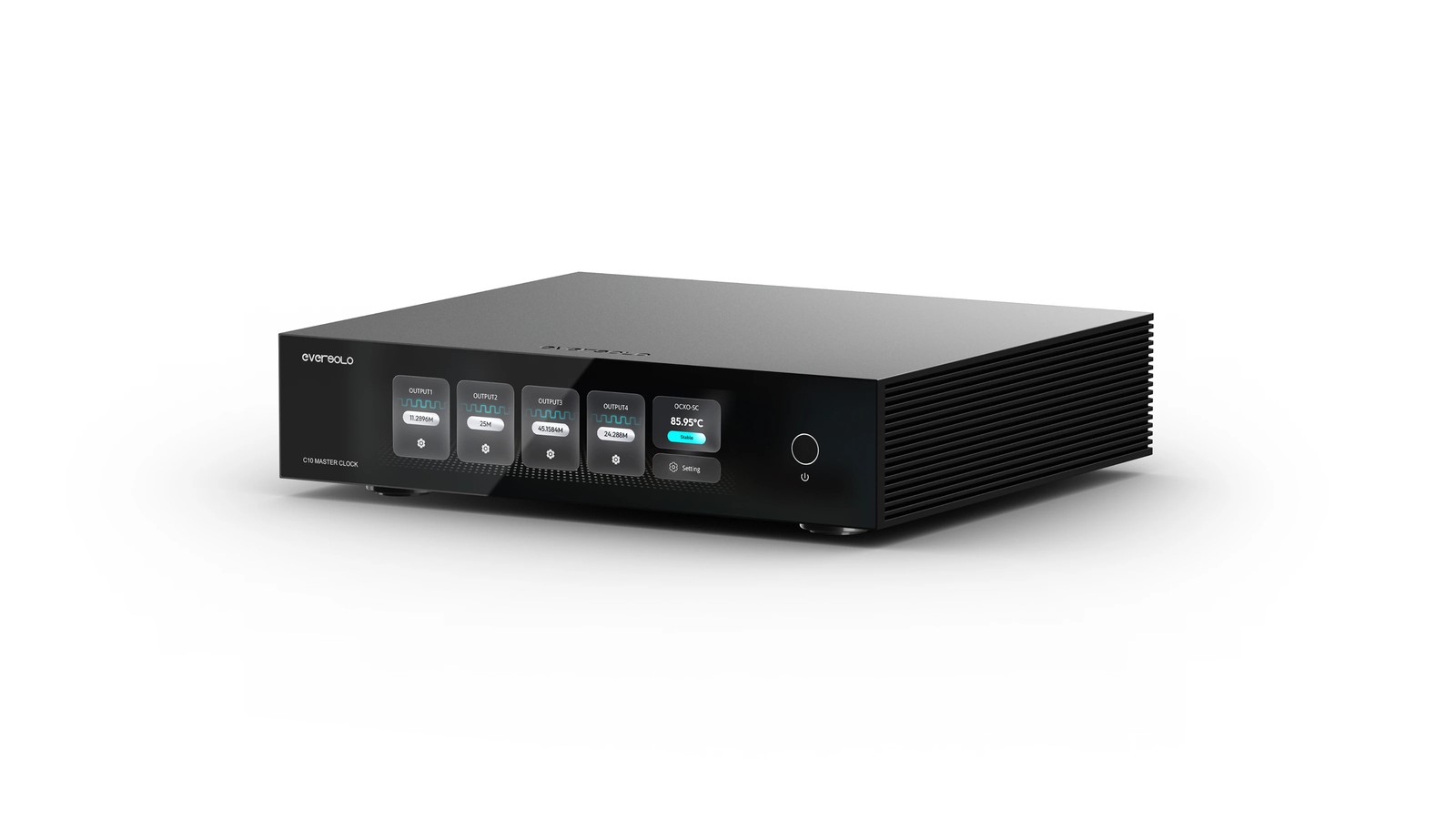
The 8.8-inch IPS touchscreen is the other thing rivals at this price do not offer. It shows the warm-up curve, the oven temperature — around 85.9°C once stable — the frequency offset and the calibration status. Eversolo says the oscillator reaches its inflection point in about five minutes at 25°C and its best conditions in 15 to 20.
Around the back: a 1PPS input on an SMB connector for a satellite timing reference, 12V trigger in and out, a USB 2.0 port for firmware updates only, and a ground terminal. The aluminium chassis is 365 × 310 × 88 mm including feet, 5.85 kg, auto-adaptive 100–120V / 220–240V supply. Maximum draw is 20W, standby 0.8W; two clock cables come in the box.
Context
The C10 first appeared in June, in Eversolo’s HIGH END Vienna line-up alongside the T10 transport and the DMP-A8 Gen 2. It stayed quiet for five months, then surfaced again this week as US pre-orders opened through Forté Distribution, also taking pre-orders for the DAC-R8 at $1,280. Together they complete Eversolo’s flagship source system: T10, DAC-Z10, DAC-R8 and now the C10.
The idea is simple: every DAC already has a clock inside it, and an external master clock replaces that reference with a steadier one shared across the transport and the DAC. The honest part is that the size of the improvement is contested: StereoNET’s T10 review tried an external clock, an LHY OCK-2S, and came away unconvinced the difference was worth the money. That settles nothing, but it is the only listening evidence so far.
One practical point: the C10 only helps components that accept an external clock. If your DAC has no clock input, this box does nothing for you. It has no DAC, no streaming, no preamp and no analogue output.
Compared
| Clock | Price | Outputs | Frequencies | Phase noise |
|---|---|---|---|---|
| Eversolo C10 | $1,880 | 4× BNC, independently buffered | 10 / 25 / 100 MHz + six audio frequencies | ≤ −115 dBc/Hz @ 1 Hz |
| TEAC CG-10M-X | $1,999.99 | 4× BNC | 10 MHz only | Not published (accuracy ±3 ppb) |
| LHY OCK-2P | $1,998 | Not specified | 10 MHz | Not published |
| Mutec REF10 | $3,599 | 8 isolated outputs | 10 MHz | −145 dBc/Hz @ 10 Hz offset |
The CG-10M-X costs about $120 more and does 10 MHz and nothing else; the LHY OCK-2P sits at $1,998 and is also 10 MHz-only; the Mutec REF10 is nearly twice the price with a better 10 Hz phase-noise figure on paper, but still 10 MHz-only, with no screen. The C10 alone clocks a transport and a DAC at different frequencies from one chassis, with a display showing what the oscillator is doing. I would not hang a buying decision on any single phase-noise number here.
My Take
This is a paper analysis. No independent review or measurement of the C10 exists yet, and I have not heard it.
The C10’s real pitch is flexibility, not raw numbers. Most clocks in the $1,800–$2,000 band do one thing — 10 MHz out — and the C10 does that plus the audio frequencies DACs run on, per output. If you own one Eversolo flagship box, the case is thin; if you own the stack, it starts to make sense — one reference, one warm-up, one display.
The caveats are real: the phase-noise figures are Eversolo’s own, the Vienna showing was a static display, and the only outside listening evidence anywhere near this product found the benefit debatable. $1,880 also buys a lot of DAC, and I would want an independent measurement before calling the C10 a must-have. As a launch, though, it is the most interesting clock at this price I have seen this year — the first that behaves like hi-fi rather than lab equipment.
Who Should Watch
Owners of Eversolo’s flagship separates should watch this first: the C10 is built for the T10, DAC-Z10 and DAC-R8. Anyone building a clocked digital front end should put it on the shortlist against the TEAC and the LHY.
Everyone else should pause. If your DAC has no clock input, the C10 cannot help you, and if the DAC is the weak link, the money goes further there, and for most systems a better DAC beats a better clock. US pre-orders are open now through Forté at $1,880, with no ship date and no UK, EU or Australian pricing yet.