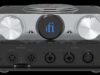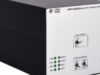




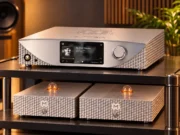
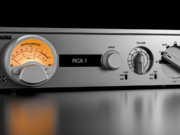

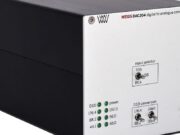

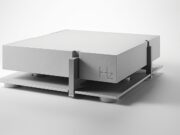





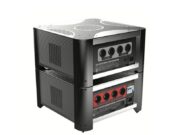


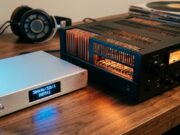
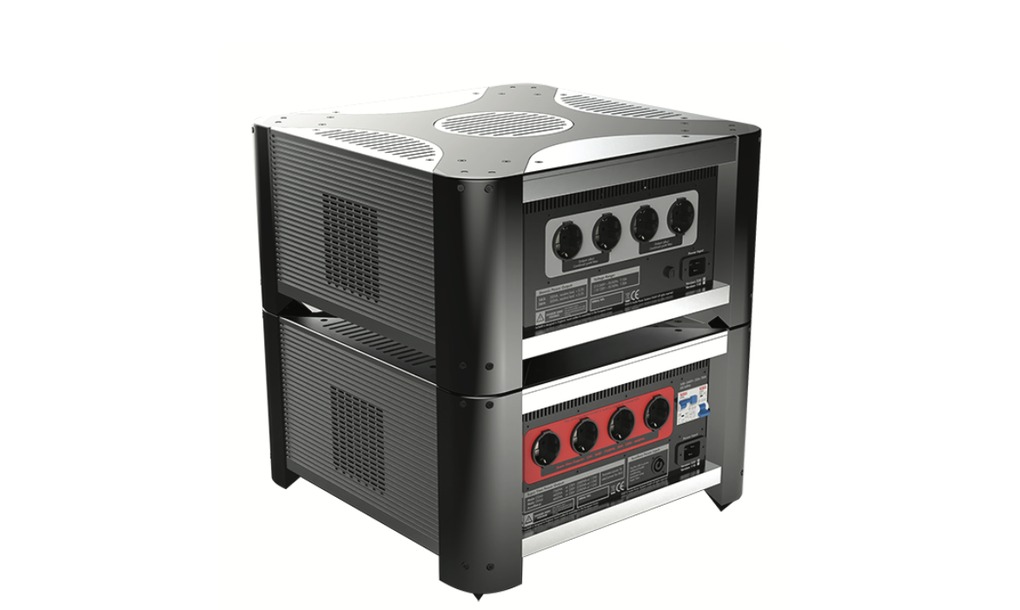
IsoTek has split its flagship power system in two. The V5 Genesis ($34,995) regenerates power for sources and preamplifiers, while the V5 Super Titan ($24,995) conditions high current for power amplifiers. Together they form the Ultimate Series reference system at $59,990, reaching US dealers this month after a June debut at High End Vienna.
What’s New: Two Machines, Two Jobs
The idea is simple enough to state and hard enough to build: the components most sensitive to distortion should not share a power architecture with the components that draw the most current. IsoTek’s answer is not a bigger universal conditioner. It is two purpose-built machines.
The V5 Genesis makes new power instead of cleaning up the old kind. Two identical 300W generation cells produce 600W of continuous, newly generated power, each cell built around a synchronous sine-wave generator, a Class A/B amplification engine, and an output transformer with copper foil shielding between its windings. IsoTek specifies output distortion of 0.05%, rising to about 0.17% under typical load and staying below 0.3% with demanding components. Its four outlets are independently isolated, so digital, analog, and control components do not contaminate each other, and a front-panel OLED display reports input and output voltage, distortion, power consumption, and generator status in real time. Six years of research and development went into it. “We looked at existing regeneration systems and thought, ‘We can build something better,'” says IsoTek founder Keith Martin.

The V5 Super Titan takes the other half of the job: the power amplifier, the part of the system many listeners are reluctant to condition at all. Its Direct-Coupled circuit runs four seven-stage filter networks in a series-parallel arrangement, with specialist chokes addressing line anomalies down to 5Hz and claimed RFI reduction of approximately 85dB. Current delivery is doubled versus its predecessor, resistance is reduced, and copper loading on the circuit board is tripled. The circuit runs continuously at 32A, delivers close to 8,000W of continuous power, and carries 153,000A of instantaneous protection. IsoTek’s KERP system gives each of its four outlets an equal resistance path.

Both units share IsoTek’s ISIS chassis, developed with acoustic-materials specialist Kurt Olbert of Clearlight Audio, and each measures 500 x 300 x 500mm. The Genesis weighs 45kg; the Super Titan weighs 35kg. They stack into a single footprint, an Auxiliary System Link lets the Super Titan power the Genesis directly, and an IsoTek Optimum power cable ships with each unit.

Context: Twenty-Five Years In, Still Arguing About the Wall
IsoTek has spent 25 years making the case that power conditioning belongs in a reference system at all, and the V5 pair is its most ambitious statement of that case. The two boxes replace the EVO3 Genesis and EVO3 Super Titan at the top of the range, and they arrive as the company’s 25th-anniversary flagships. They made their world debut at High End Vienna in June 2026; the US launch, with US pricing, follows now. UK pricing is £26,995 for the Genesis and £17,995 for the Super Titan, and the pair has been on sale there since September. In the US, MoFi Distribution handles the brand, and the system goes on display at Capital Audio Fest, November 13–15, in the Plaza Ballroom III at the Hilton Rockville.

Compared to Predecessors and Rivals
Against the EVO3 models, the V5 pair is a ground-up redesign rather than a refresh: new generation cells in the Genesis, doubled current delivery in the Super Titan, and a shared chassis system built to be stacked and linked. Against the wider market, the contrast is architectural. PS Audio’s PowerPlant regenerators and AudioQuest’s Niagara conditioners each ask one box to serve the whole system; IsoTek splits the work and charges for the privilege. Whether that split is worth $59,990 is the question the company itself invites. “Products at this level should invite scrutiny,” says Jonathan Derda, VP of Sales & Marketing at MoFi Distribution. “The relevant question is not whether $59,990 is a lot to spend on power — it is. The question is whether, in a truly reference-level system, Genesis and Super Titan produce a more meaningful improvement than spending the same amount on another component.”
My Take: Paper Analysis, Not a Listening Report
On paper, the split makes engineering sense, and it is the part of this launch I find easiest to defend. Regeneration is at its best feeding steady, low-current loads, and it is at its worst when a power amplifier asks it for sudden current. Conditioning is the reverse. Putting each job in its own box, with its own circuit, removes the compromise that single-box designs have to manage. That much I buy without hearing a note.
What concerns me is the distance between claimed numbers and demonstrated ones. A 0.05% distortion figure and an 85dB RFI reduction are manufacturer claims until an independent bench confirms them, and power products have a long history of measurements that look better than the listening. IsoTek has put review systems out for long-term evaluation since September, so independent verdicts should start landing soon. Until they do, this is theoretical, but the theory is sound and the price forces the comparison Derda names: $59,990 buys a serious component upgrade in any system, and the V5 pair has to beat that alternative, not just the wall socket.
Who Should Watch This
If you run a reference system with big power amplifiers and sensitive front-end components on dedicated circuits, and you still hear mains-related limits, this is the launch to follow — Capital Audio Fest this weekend is the first chance to see the pair in the US. If your system sits below that level, the money buys more elsewhere, and you should wait for independent measurements and listening reports before taking the $59,990 question seriously.