












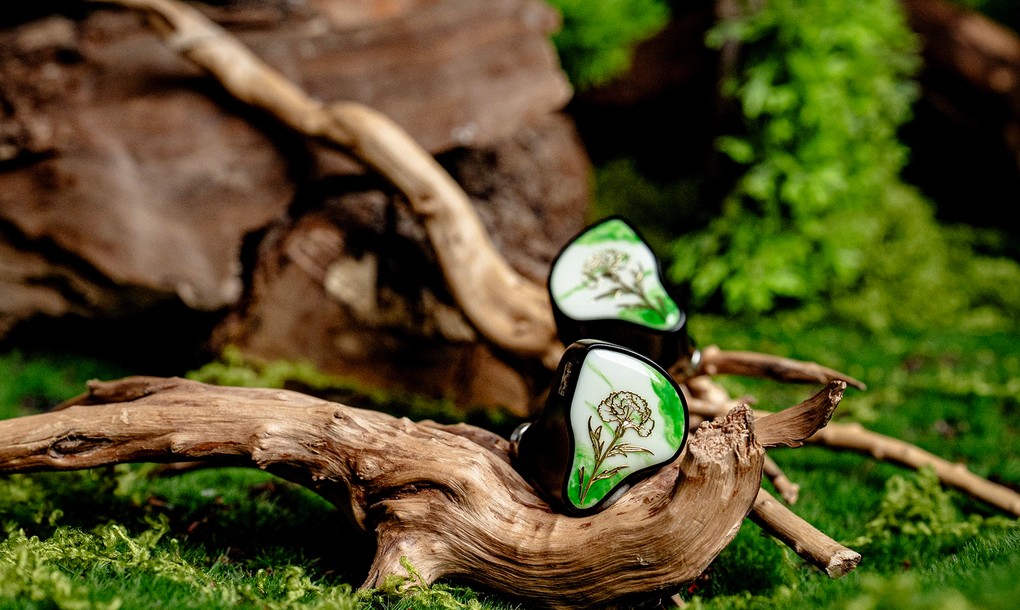
ZiiGaat’s most ambitious earphone yet is also its most collaborative. The Jade, announced November 16, is a $299 wired in-ear monitor built with reviewer Axel Bostrom of B_Media, packing four driver technologies into each earpiece: a 10mm dynamic for the sub-bass, two balanced armatures for the mids, two micro planars for the treble, and a MEMS driver for transients. Six drivers, four designs, one 4-way crossover — and a cable with both 3.5mm and 4.4mm plugs in the box.
What’s New
The mix is what matters. ZiiGaat calls this its first quadbrid: the 10mm dynamic handles the low end, the dual BAs cover the midrange, the two micro planars take the top end, and the MEMS driver adds transient speed. A 4-way passive crossover and three independent sound tubes split the work — each driver type doing the job it is best at.
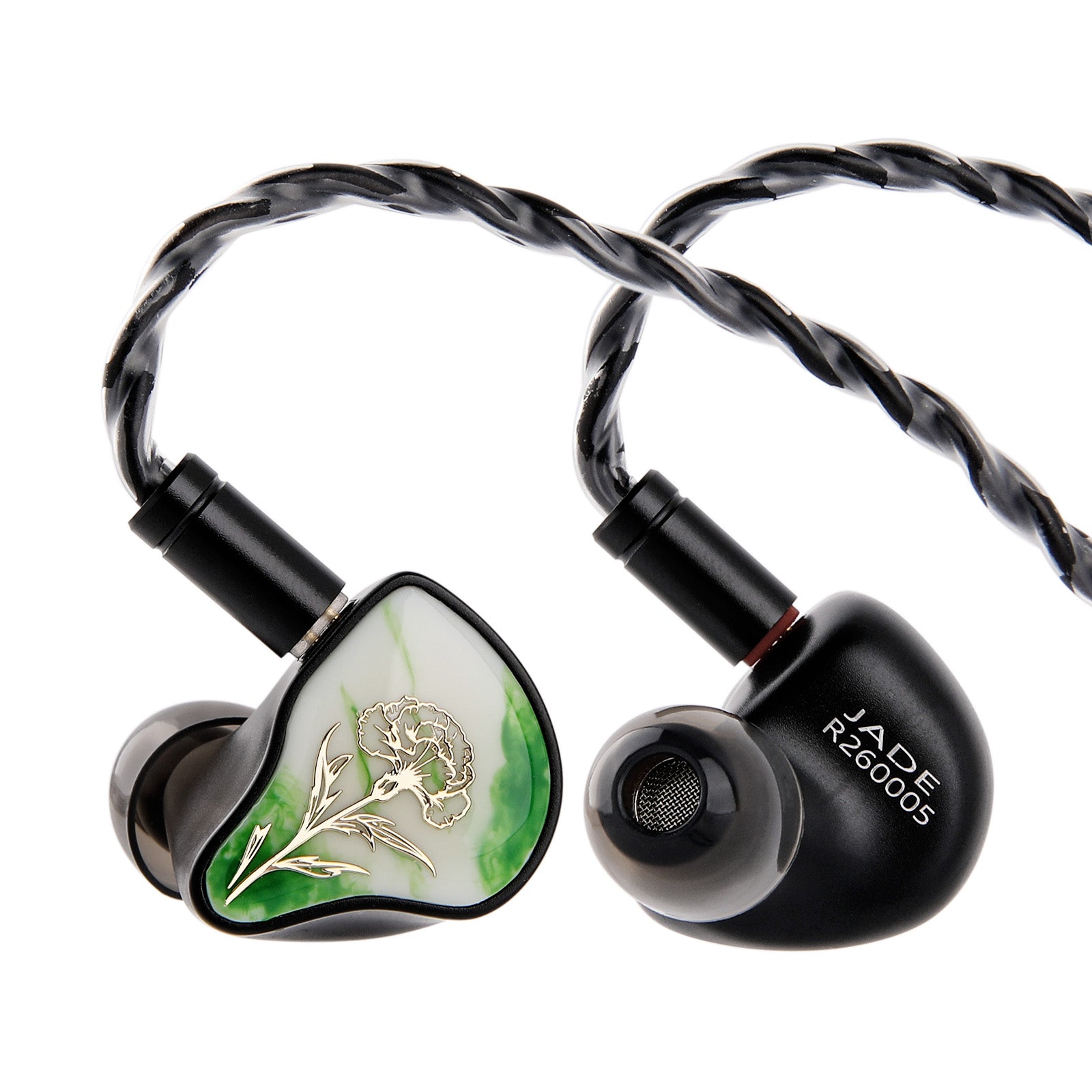
The numbers suit almost any source: 20 ohms, 104 dB sensitivity, 20 Hz to 35 kHz, 0.3% distortion. A phone dongle or portable player drives it without strain. The cable is detachable on 0.78mm 2-pin connectors, 1.2 metres long, and the modular plug system is the practical win: 3.5mm and 4.4mm terminations come in the box, so one cable covers a laptop jack and a balanced DAP output.
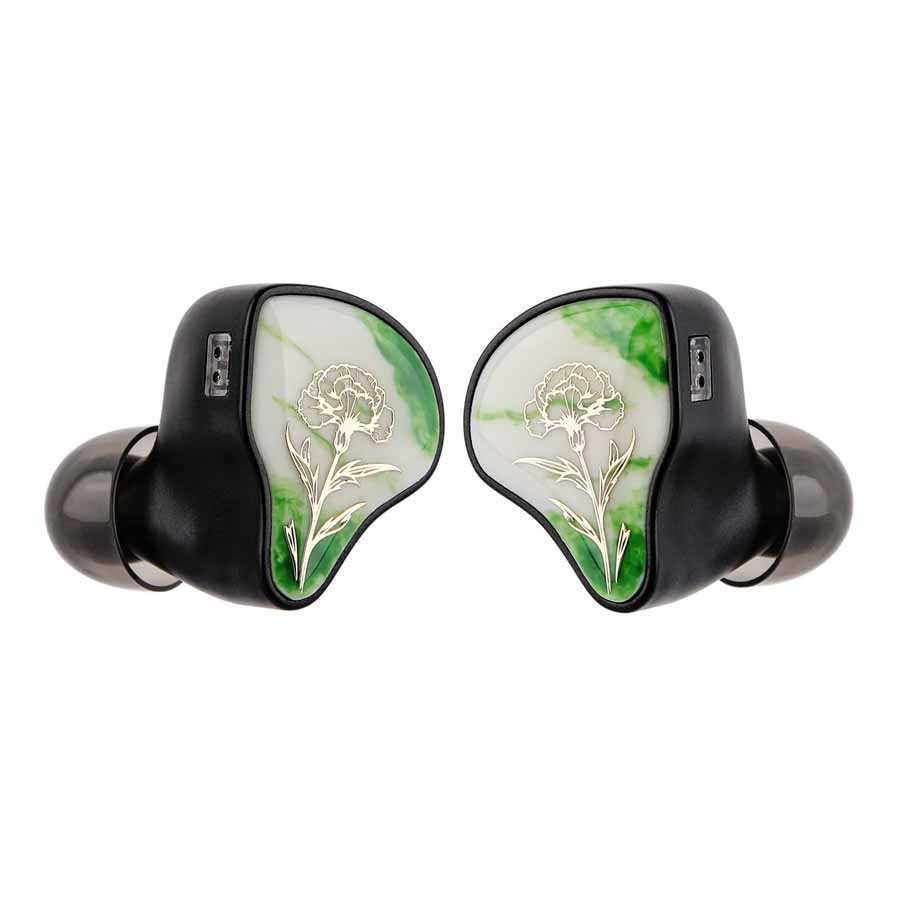
The faceplates do the talking visually. Black shells carry green-and-white marbled faceplates — a jade-stone look — with a gold floral motif inlaid on each side. It stands out in a market where most $300 IEMs settle for plain resin or metal.
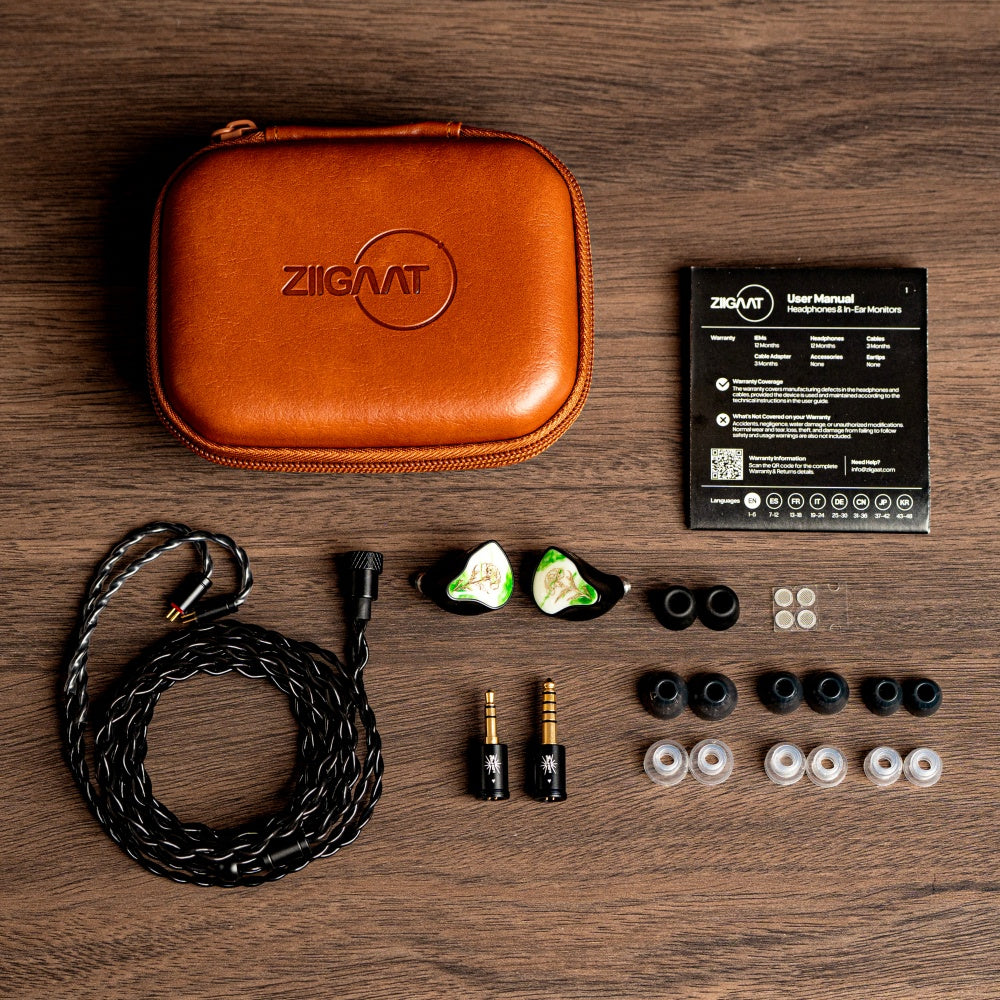
The box adds a leather carry case, ear tips in several sizes and a user manual. The earphones are on pre-order at $299, with no firm ship date published yet.
Context
ZiiGaat is a young brand that has moved fast. It appeared at the end of 2023 under the Linsoul banner, starting with budget sets like the Nuo and Cinno, then building a reputation on isobaric dual-dynamic hybrids — the Doscinco and Cincotres — praised for bass texture and tuning at their prices. Collaborations have been the brand’s shortcut to credibility — the Estrella with Jays Audio at $299, the Arcadia with HBB at $199, the Seraphim with Jay Audio at $259 in October — and the Jade is the fourth and most ambitious, the first time ZiiGaat has put four driver types in one shell.
Bostrom’s B_Media channel has over 200,000 followers, built on blunt, real-world listening judgements rather than spec-sheet praise. That fits a tuning-first collaboration: the Jade aims for a relaxed, balanced signature for daily listening and gaming, not a technical showcase. Whether a reviewer’s ear makes a better-tuned earphone is the question every collaboration has to answer — and it is only answered when independent listeners get a set.
Compared
At $299 the Jade sits at the top of ZiiGaat’s own range and in the thick of the mid-tier IEM market.
| Model | What it is | Key points | Price |
|---|---|---|---|
| ZiiGaat Jade | 1DD + 2BA + 2 planar + 1 MEMS quadbrid | 4-way crossover; both plugs included | $299 |
| ZiiGaat Doscinco | 2DD + 3BA hybrid | Isobaric dual DDs; praised for bass texture | $228.65 |
| Simgot EA1000 Fermat | Single 10mm DD + passive radiator | Three tuning nozzles; simpler, proven design | $219.99 |
| Kiwi Ears Aether | Single 15.3mm planar | Wide stage; fixed 3.5mm cable | $169.99 |
The table makes the Jade’s problem plain: it costs more than three well-regarded rivals, and its advantage is complexity. The Doscinco is the in-family alternative — $70 less, with the isobaric bass ZiiGaat is known for. The EA1000 launched at $219.99 (now around $250 street) and does more with one driver and a passive radiator than most multi-driver sets manage. The Aether is $130 cheaper, with a single planar known for soundstage and gaming. What the Jade offers that none of them does is the quadbrid spread — four driver types, each working a narrow band — plus a dual-plug cable in the box. Whether that spread sounds more coherent than a well-tuned single driver is exactly what no one can answer yet.
My Take
Paper analysis — I have not heard the Jade; no independent listening tests or measurements exist yet.
What I like most is the restraint in the tuning brief. A relaxed, balanced signature is a harder sell than a bass-heavy crowd-pleaser, and it suggests Bostrom tuned for long sessions rather than first impressions. The dual-plug cable is genuinely useful — that accessory usually costs $30–50 on its own. What gives me pause is the driver count. Six drivers across four technologies, joined by a 4-way crossover, is a lot to keep coherent, and multi-driver history is full of sets that measured impressively and sounded disjointed. The MEMS driver is the wildcard: it promises transient speed, but MEMS in IEMs is still new enough that its contribution is unproven. At $299, the Jade has to beat the Doscinco and the EA1000 on musicality, not on a spec sheet — and until someone measures and listens to it, the value argument is theoretical. The design, at least, is a statement: those green marbled faceplates will not be mistaken for anything else in a drawer.
Who Should Watch
Listeners who already own a ZiiGaat set and want the brand’s most ambitious tuning — the Jade is the natural step up from the Doscinco. Gamers and daily listeners who want one IEM for music and play and will use both plugs. Anyone curious about quadbrid designs and MEMS drivers without spending four figures. Not for anyone who wants a proven quantity at this price — the EA1000 and the Doscinco have independent measurements behind them, the Jade does not. If your listening is mostly at a desk with open-backs, the Sennheiser HD 660S2 remains the safer $599 spend.