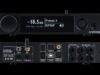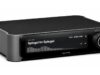






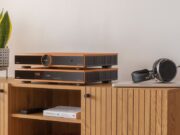
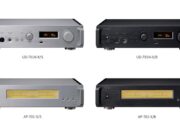




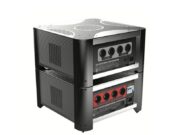


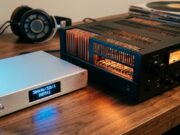
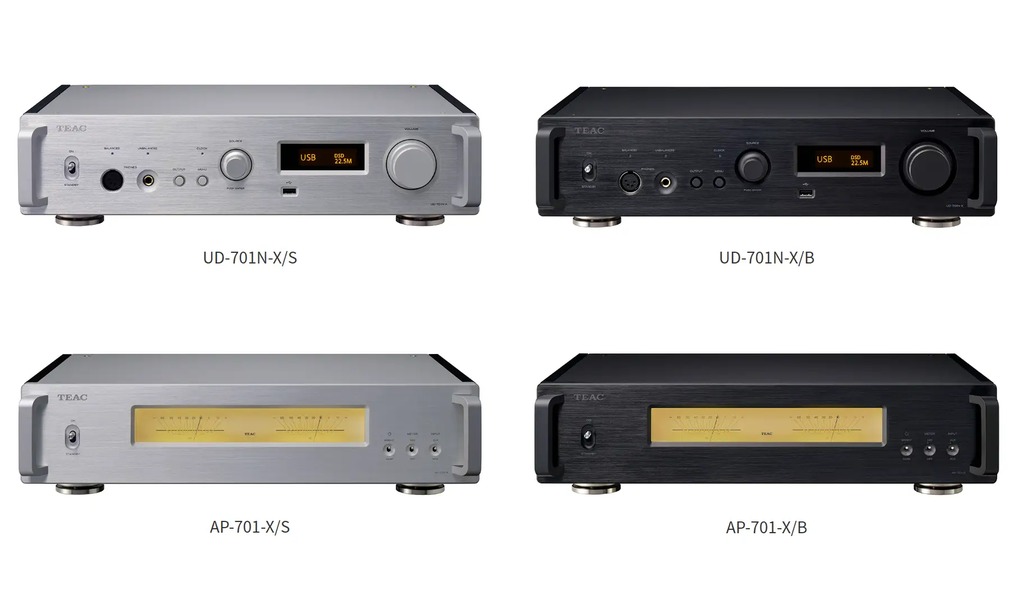
TEAC has updated the top of its Reference 700 line. Announced on November 18, the UD-701N-X network DAC preamplifier and the AP-701-X stereo power amplifier replace the 2021 UD-701N and AP-701 as the company’s flagship two-box system. Both go on sale in Japan on January 30, 2027, in silver or black: the UD-701N-X at ¥638,000 and the AP-701-X at ¥528,000, tax included. That is roughly $4,100 and $3,400 at current exchange rates, though TEAC has announced no US or European pricing or dates yet, so treat those conversions as a guide only.
What’s New
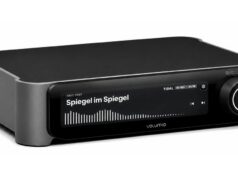
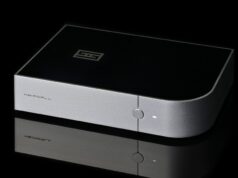
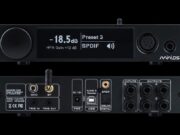
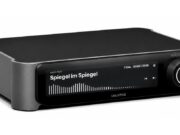
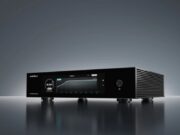
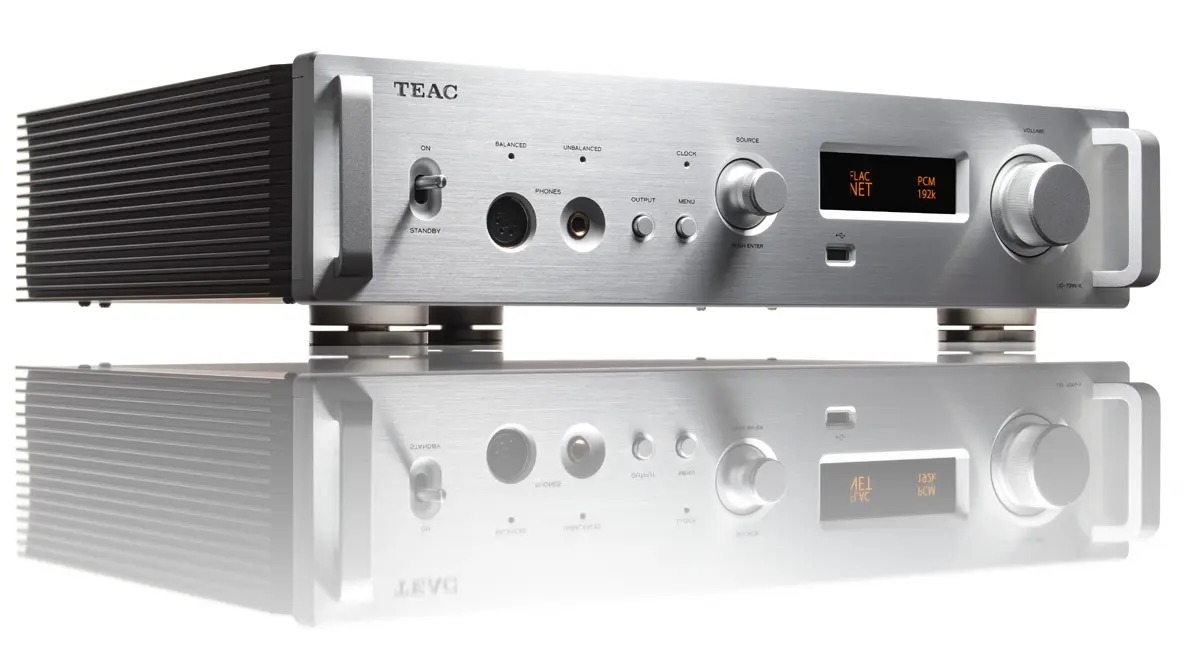
The UD-701N-X carries most of the change. At its centre is the second version of TEAC’s own discrete DAC, the TRDD7 V2: an FPGA running a custom algorithm through a multi-level delta-sigma circuit, with no off-the-shelf DAC chip in the path. TEAC says the revised circuit, a new 64-bit/512Fs modulator and fresh custom capacitors sharpen low-level detail and the sense of space, with switchable oversampling frequency and operating mode. Streaming moves to a fourth-generation network engine, TEAC Network Engine G4, which adds an SFP optical port beside the RJ45 socket, running on its own large linear supply with no switching parts. It covers Qobuz Connect, TIDAL Connect, Spotify Connect, Roon Ready, QQ Music and KKBOX, and works with TEAC’s HR Streamer app and OpenHome apps. Connectivity grows too: a new AES/EBU balanced digital input joins two coaxial and two optical inputs, Bluetooth gains multipoint for two devices, with LDAC, LHDC and aptX HD, and USB still handles PCM to 384 kHz/32-bit and DSD to 22.5 MHz, with Bulk Pet transfer, a 10 MHz clock input and an MQA full decoder. Inside, separate toroidal transformers feed the left and right channels, with two more for the network and digital control sections, four in total. Volume is TEAC’s quad control, TEAC-QVCS, in 0.5 dB steps, into a reworked high-current line buffer, and the headphone section runs a four-circuit diamond buffer to a 6.3 mm jack and a 4-pin XLR output, switchable between balanced and active-ground drive, at a claimed 700 mW plus 700 mW into 32 ohms balanced.
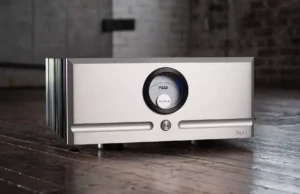
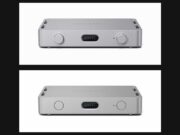
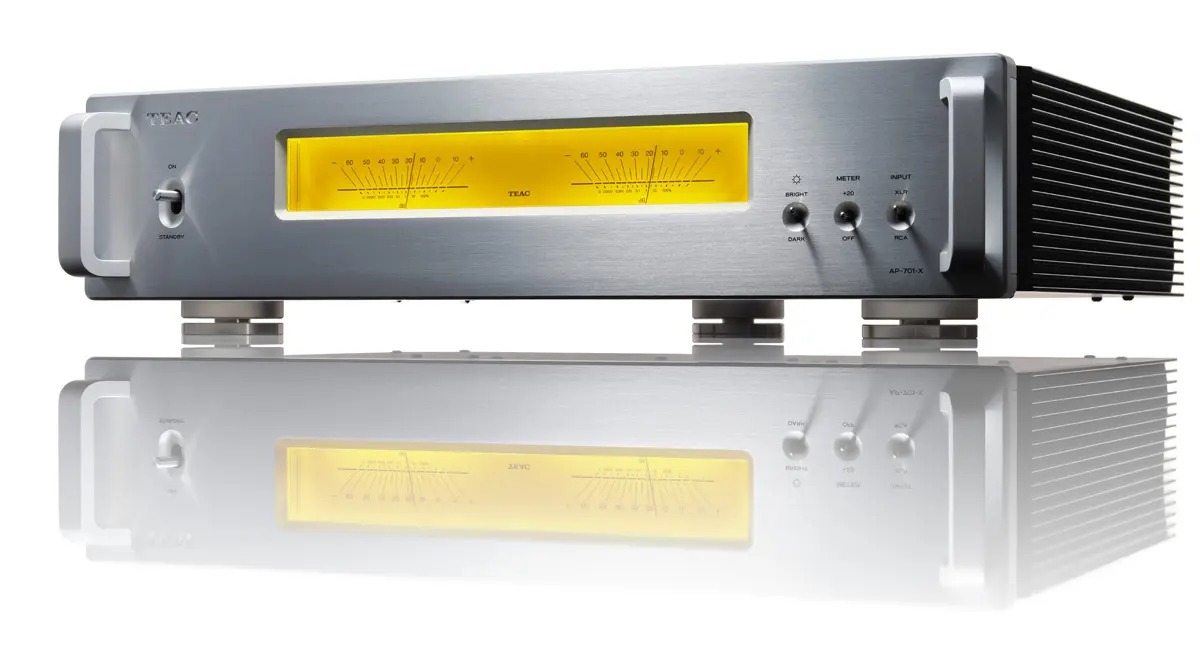
The AP-701-X is a more measured update. The dual-mono layout, the two custom-tuned Hypex Ncore modules and the 260 W plus 260 W into 4 ohms (170 W plus 170 W into 8 ohms) carry over from the AP-701. What changes is the tuning around them: the discrete buffer amplifier has been reworked, the ground pattern optimized, the meter circuit given a higher input impedance and the control and power circuits redesigned, for a fresher sound and a firmer grip on the bass. The chassis keeps its 3 mm thick base plate and suspension joints, stays fanless, and still offers dual-needle level meters, a stereo/bi-amp switch for monoblock use, and a 12 V trigger.
| Specification | UD-701N-X | AP-701-X |
|---|---|---|
| Role | Network DAC / preamp / headphone amp | Stereo power amplifier |
| DAC / power | TRDD7 V2 discrete DAC (FPGA, multi-level delta-sigma) | 2x Hypex Ncore modules, dual-mono |
| Digital inputs | USB, AES/EBU, coaxial x2, optical x2, Ethernet (SFP + RJ45), USB flash x2, Bluetooth | — |
| Max output | Headphone 700 mW + 700 mW (32 ohms, balanced) | 260 W + 260 W (4 ohms) / 170 W + 170 W (8 ohms) |
| Network | TEAC Network Engine G4, SFP + RJ45 | — |
| Analog inputs / outputs | XLR x1, RCA x1 in / XLR x1, RCA x1 out | XLR x1, RCA x1 in |
| Dimensions / weight | 444 x 111 x 334 mm / 11.8 kg | 444 x 111.3 x 348.2 mm / 9.9 kg |
| Price (Japan, tax incl.) | ¥638,000 | ¥528,000 |
| On sale (Japan) | January 30, 2027 | January 30, 2027 |
Context
The pair replaces a well-regarded 2021 original. The UD-701N arrived as TEAC’s statement network DAC, built around the first TRDD7 discrete DAC, dual-mono, with DSD to 22.5 MHz, PCM to 384 kHz/32-bit, MQA and Roon Ready, at $4,299.99 in the US. The AP-701 matched it with Hypex Ncore power and the same 260 W into 4 ohms. Four years on, TEAC says it revised the pair in four areas: sound, network, connectivity and chassis. The chassis work is easy to miss: screw types and tightening torque were reviewed from scratch, and the transformer mountings redesigned, to control the vibration reaching the circuits. The dimensions barely move — the UD-701N-X is 444 by 111 by 334 mm at 11.8 kg, the AP-701-X 444 by 111 by 348 mm at 9.9 kg — so the new pair would look familiar to owners of the originals. The differences are inside: a new DAC generation, a new network engine, an optical network port and a balanced digital input the originals lacked.
Compared
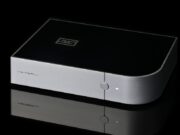
Against the 2021 pair, the upgrade case is clearest on the DAC side: the streaming hardware and the headphone output have moved on most, while the amplifier is a refinement rather than a rebuild. The more telling comparison is another two-box flagship system that also chose Japan first. CANOR’s 4 Series — the VIRTUS I4S amplifier and VERTO D4S DAC — debuts in Japan on November 20 at ¥770,000 and ¥682,000, or ¥1,452,000 for the pair against ¥1,166,000 for the TEAC pair. The CANOR set is a tube-hybrid amplifier with a separate DAC; the TEAC set is a discrete-DAC preamp with a Class D power amp. Different engineering, similar money, the same Japan-first launch.
My Take
My take — paper analysis, no hands-on yet. The UD-701N-X is the real news here. A new discrete DAC generation and a new network engine with an SFP port give a flagship a longer life, and the optical network connection is a genuine nod to how serious streaming setups are built now. The headphone output, at a claimed 700 mW balanced, also makes the UD-701N-X a credible single box for listeners who want no separate headphone amp. The AP-701-X reads as careful housekeeping: the same power, the same meters, the same chassis idea, with the circuits around the Ncore modules retuned. That is fine — the original AP-701 was never short of power — but the amplifier alone is no reason to trade up. The wait is the other factor: January 30 is more than two months away, and with no US or European pricing yet, most readers outside Japan will watch from a distance for a while.
Who Should Watch
Owners of the original UD-701N who stream heavily and want the new network engine and the AES/EBU input; headphone listeners looking for a DAC and preamp that can drive demanding headphones; and anyone building a two-box TEAC system who would rather buy the current generation than the outgoing one. If you already own the AP-701, the -X looks like a sideways move — the DAC is the upgrade that matters. I will update this piece when TEAC announces pricing beyond Japan.