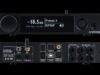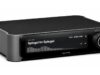






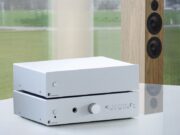
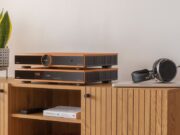
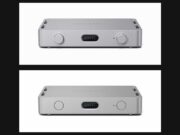
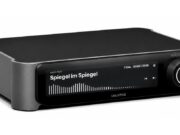

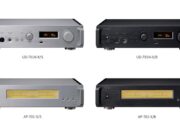

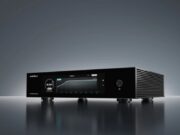






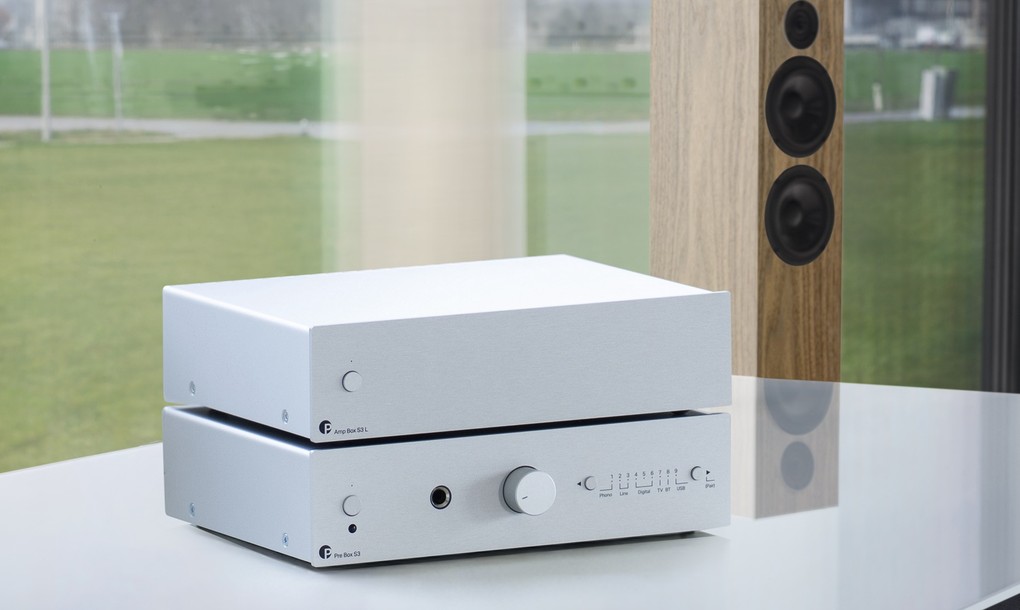
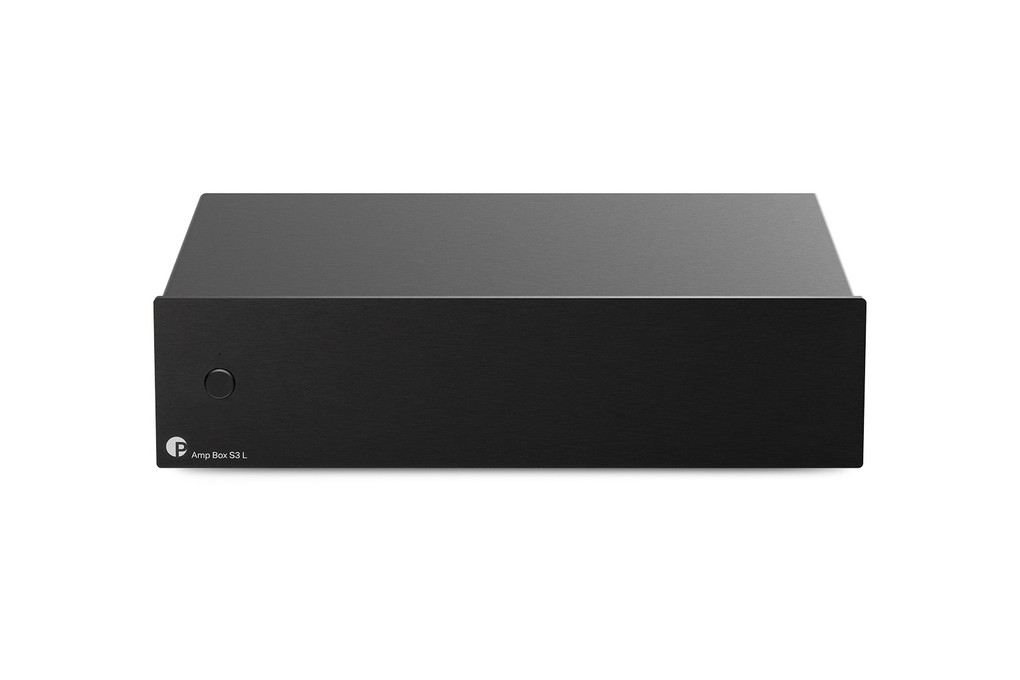
Pro-Ject announced the Amp Box S3 L on 17 November 2026, and the name says most of it: the Amp Box S3, larger. The power amplifier keeps the half-width idea of the 2022 original but doubles the chassis width to 206 mm and more than triples the power, to 80 watts per channel into 8 ohms and 140 watts into 4. It costs £449 (€499), arrives in December in black or silver, and Pro-Ject pitches it as the power amp for its Pre Box S3 preamplifier.
What’s New
The power jump is the story. The original Amp Box S3 delivered 23 watts per channel into 8 ohms and 40 into 4 — enough for efficient speakers in a small room and not much more. The S3 L delivers 80 and 140 watts at the same 1% THD, and Pro-Ject says the headroom suits harder-to-drive speakers and larger rooms. Behind it is a bigger outboard supply, 36V/5.5A against the original’s 20V/3A, in a heavier box: 1.1 kg without the supply, against 385 g.
The dual-mono layout carries over from the smaller sibling, each channel amplified independently to keep crosstalk down and the stereo image clean. The measurement sheet improves across the board: separation better than −82 dB at 10 kHz, THD+N under 0.005% at 10 watts, signal-to-noise above 97 dB — all better than the original’s figures. Pro-Ject also claims a new amplifier module tuned for tube-like sound: valve warmth with digital efficiency. One number moves the other way and matters for matching: gain is 26 dB, down from 31 dB, and the RCA input now wants 1.25 V instead of 360 mV, so the partnering preamp needs a healthy output — the Pre Box S3 is the obvious match.
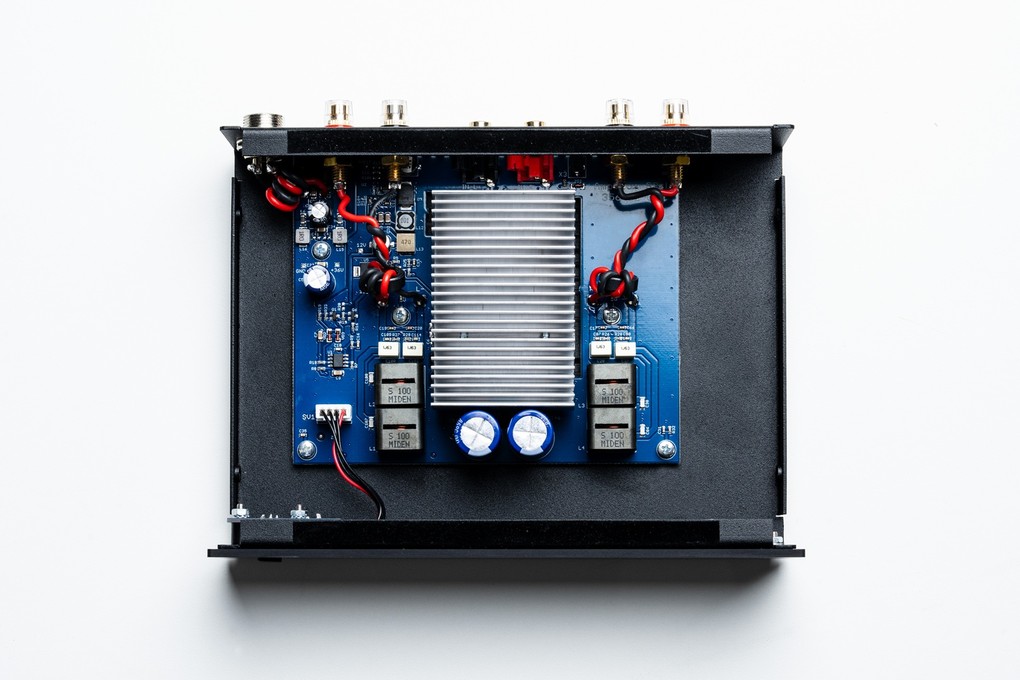
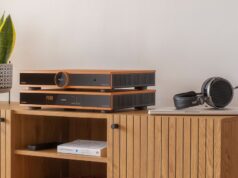
Connections stay minimal, as they should on a power amp: one pair of RCA inputs for the preamplifier or any line-level source, isolated speaker binding posts that accept banana plugs, spades, pins or bare wire, and a 12V trigger input so a preamp can switch the amp with the system. The aluminium case measures 206 by 55 by 153 mm (163 mm with sockets), still less than half the width of a typical full-size component, in black or silver. It reaches the UK in December through Henley Audio at £449 (€499); no US price has been announced yet.
Context
The original Amp Box S3 arrived in 2022 as the smallest power amp in Pro-Ject’s Box Design range: a 103 mm wide box that followed a preamplifier, a streamer or a DAC with variable output and drove a pair of speakers from a shelf. The range is built to stack — same footprint, same finishes, one small box per job — and the S3 L stretches that formula rather than breaking it: twice as wide as the original, still half-width.
The partner Pro-Ject has in mind is the Pre Box S3, launched in February 2026 at £499: a moving-magnet phono stage, DAC, Bluetooth with aptX HD, HDMI eARC, a headphone amplifier and motor-driven volume, with a variable RCA output to feed a power amp. Together they make a separates system — phono, digital, TV and streaming in, 80 watts a channel out — for £948.
Compared
| Model | What it is | Price | Power (8Ω / 4Ω) |
|---|---|---|---|
| Pro-Ject Amp Box S3 L | Stereo power amp | £449 / €499 | 80W / 140W |
| Pro-Ject Amp Box S3 | Stereo power amp | £269 | 23W / 40W |
| Pro-Ject Uni Box S3 | Streaming integrated amp | £699 / €799 | 23W / 40W |
| Pro-Ject Amp Box RS2 | Stereo power amp | £1,549 | Not stated |
Against the original S3, the S3 L costs £180 more — about two-thirds again — and gives back roughly three and a half times the power into 8 ohms, plus a quieter measurement sheet. If your speakers are efficient and your room is small, the original stays the cheaper answer; if the S3 ever ran out of breath, the L is the fix. The Uni Box S3 costs £250 more and adds WiiM streaming, a phono stage and a DAC but keeps the old 23/40-watt amplifier. Buy the Uni Box if you want one box that does everything; buy the S3 L with a Pre Box S3 if you want separates and the power to match. The Amp Box RS2 at £1,549 is the step up for bigger budgets.
My Take
Paper analysis — no independent listening or measurements exist yet, and I have not heard this unit.
The power increase is real, and it fixes the one thing that limited the original S3. Twenty-three watts suits efficient bookshelf speakers at a desk; it does not suit a living room with a demanding load. Eighty watts changes the conversation, and 140 into 4 ohms means the amp will not flinch at speakers that dip low. The measured improvements point the same way.
I am more cautious about the tube-like sound claim. Pro-Ject’s digital amplifiers have always measured clean rather than warm, and “warmth and musicality traditionally associated with valve amplification” belongs in a press release until a listening test says otherwise. Two things to confirm: the spec sheet lists a trigger input only, with no trigger output shown; and the lower gain and 1.25 V sensitivity mean a weak source will leave power on the table — pair it with a proper preamp, as Pro-Ject intends.
What I want before recommending it is an independent measurement and a listen against the original S3, to hear whether the extra power brings extra control or just extra volume. Until then, this is a sensible launch, not a verdict — but if you liked the S3 idea and hit its ceiling, this is the version to wait for.
Who Should Watch
Owners of the original Amp Box S3 whose speakers ask for more than 23 watts should look first — the direct upgrade, same idea, more muscle. Pre Box S3 owners should look next: the S3 L is the power amp that box was waiting for, and the £948 pair is a complete separates system for under a grand. Vinyl-first listeners building around a Pro-Ject turntable should look too: the Pre Box S3 covers the phono stage, the S3 L covers the speakers. Skip it if you want streaming and a DAC built in — that is the Uni Box S3 — or if your speakers need more than 80 watts.