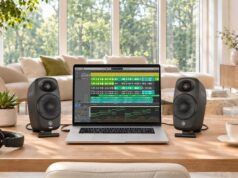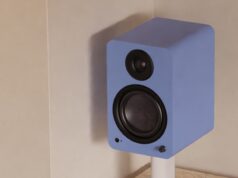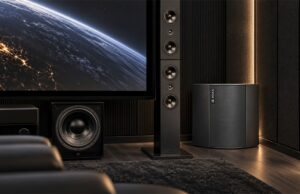






Short answer: yes — a good two-way can match a three-way for sound and bass, but the match depends on the room as much as the speaker. The third driver is not a magic upgrade; it is a division of labour: it pays off in some jobs and costs you in others.
The question keeps coming up because the two designs look so different on paper. A two-way asks one mid/bass driver to cover everything from the lowest bass to the tweeter handover near 2 kHz. A three-way hands the middle to a dedicated midrange driver and leaves the bass driver to bass only. That sounds like an obvious win for the three-way — until you look at what each driver actually has to do, and what a subwoofer does to the argument.
How a Two-Way and a Three-Way Actually Work
Start with the crossover, because that is where the designs diverge. In a two-way, a single crossover — usually between 2 and 3 kHz — splits the signal between the tweeter and the mid/bass driver. That one driver has to reproduce a kick drum at 50 Hz and a female vocal at 1 kHz at the same time — its cone moving a long way for the bass while staying precise for the voice. In a three-way there are two crossovers, one low and one high: bass driver on the bottom, midrange in the middle, tweeter on top.
The midrange driver’s freedom is the whole point of the three-way. Voices live between roughly 300 Hz and 3 kHz, and a driver working only in that band moves less, distorts less and disperses more evenly. The trade is complexity: two crossovers mean two handover points to get right, more components, a bigger cabinet, and a higher price. A cheap three-way is often worse than a good two-way at the same money — the budget spreads across three drivers and a more complicated crossover instead of two drivers done properly.
The Cleanest Comparison I Could Find: LS50 Meta vs R3 Meta
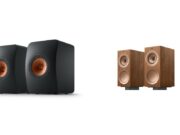
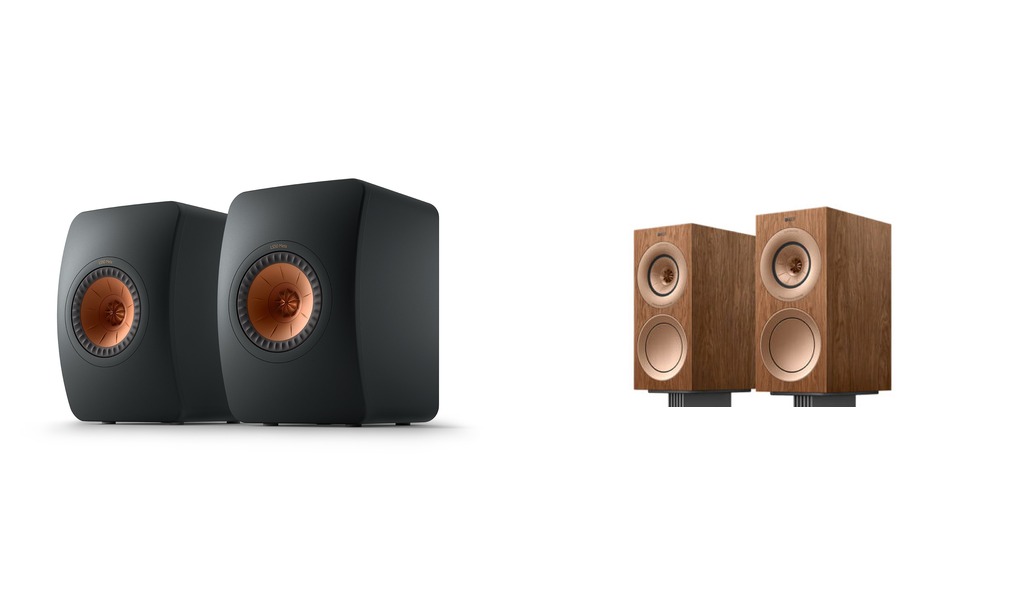
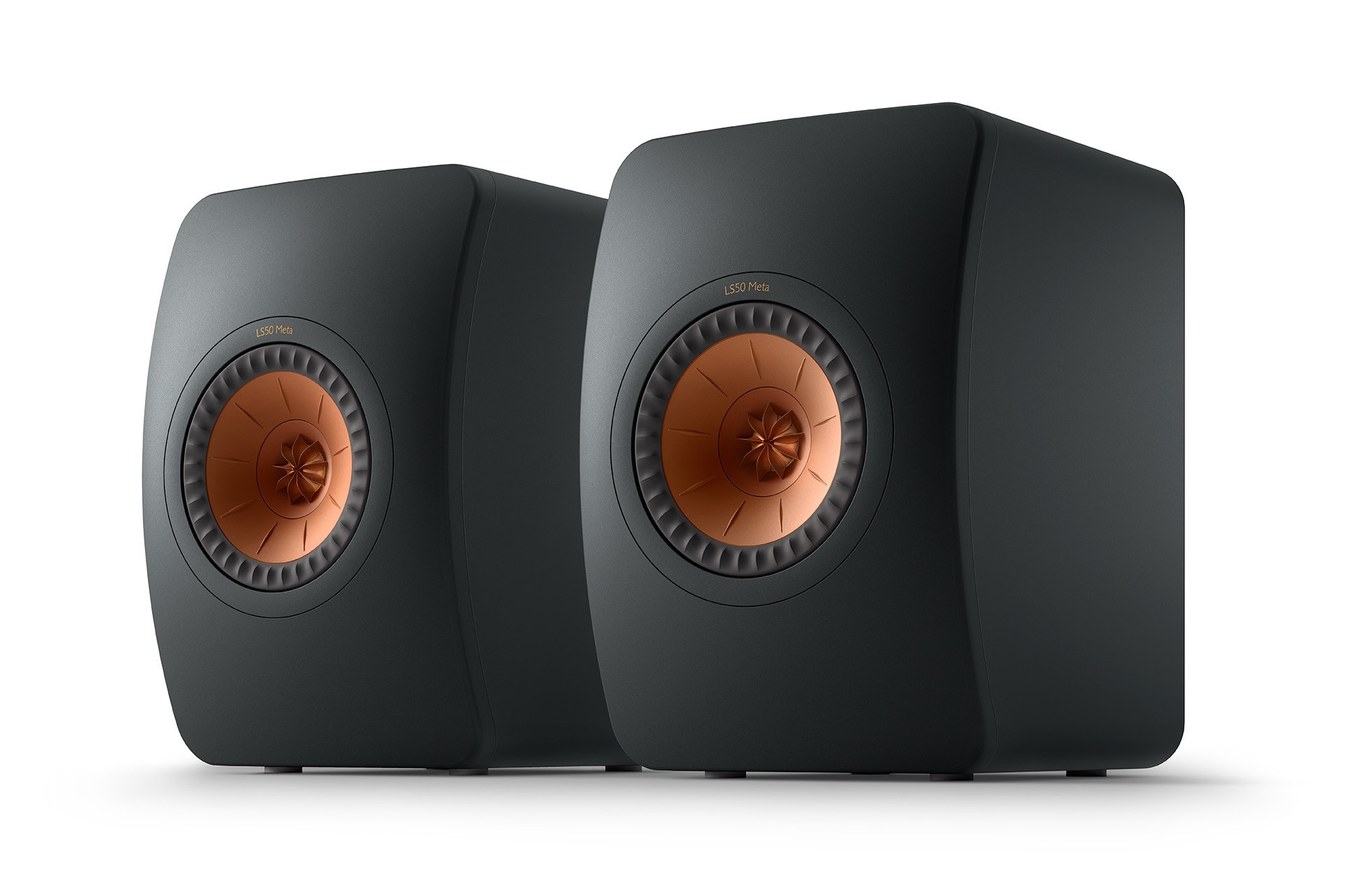
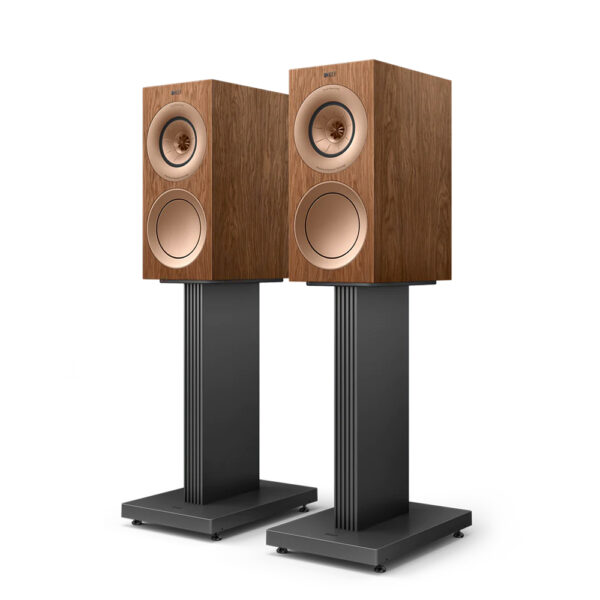
The cleanest comparison uses the same tweeter in both designs. KEF’s LS50 Meta is a two-way built around a single 130 mm Uni-Q driver, tweeter at the centre of the mid/bass cone, crossed over at 2.1 kHz. The R3 Meta uses the same 12th-generation Uni-Q array, but adds a dedicated 165 mm bass driver underneath and splits the work at 420 Hz and 2.3 kHz. Same tweeter, same technology, one extra driver. The price gap is $600: $1,600 a pair for the LS50 Meta, $2,200 for the R3 Meta.
| Specification | KEF LS50 Meta (2-way) | KEF R3 Meta (3-way) |
|---|---|---|
| Design | Two-way bass reflex | Three-way bass reflex |
| Drivers | 25 mm tweeter + 130 mm (5.25 in.) Uni-Q mid/bass | 25 mm tweeter + 125 mm (5 in.) midrange + 165 mm (6.5 in.) bass |
| Crossover | 2.1 kHz | 420 Hz, 2.3 kHz |
| Frequency response (±3 dB) | 79 Hz – 28 kHz | 58 Hz – 28 kHz |
| Frequency range (-6 dB) | 47 Hz – 45 kHz | 38 Hz – 50 kHz |
| Typical in-room bass (-6 dB) | 26 Hz | 30 Hz |
| Sensitivity | 85 dB (2.83 V / 1 m) | 87 dB (2.83 V / 1 m) |
| Nominal impedance | 8 ohms (min. 3.5) | 4 ohms (min. 3.2) |
| Maximum output | 106 dB | 110 dB |
| Amplifier power | 40 – 100 W | 15 – 180 W |
| Price (pair) | $1,599.99 | $2,200 |
On paper the R3 Meta is the more capable speaker. Its ±3 dB response starts at 58 Hz against the LS50 Meta’s 79 Hz — a full third of an octave lower. It plays 4 dB louder at maximum output — 110 dB against 106 — and its 87 dB sensitivity is 2 dB higher, so it needs less amplifier. The dedicated midrange is the reason: with the bass driver handling everything below 420 Hz, the midrange cone barely moves, and owners who have heard both say the R3 sounds bigger and more relaxed at volume, voices staying put instead of hardening. I put the R3 Meta through its paces in my full R3 Meta review — the third driver is doing real work, not decoration.
But read the bass figures twice — they tell a subtler story. The LS50 Meta’s frequency range is quoted to 47 Hz at -6 dB, and its typical in-room bass response reaches 26 Hz — lower than the R3 Meta’s 30 Hz in-room figure. That does not make the LS50 the deeper speaker. The -6 dB figure is the quiet tail; the ±3 dB window is where the speaker actually plays flat, and there the R3 wins by 21 Hz. What the LS50’s numbers really say is that a small, well-engineered two-way can surprise you in a small room — and that one bass number on a spec sheet tells you almost nothing on its own.
Where the Third Driver Earns Its Money
Where does the third driver actually earn its money? First, in the midrange at volume. A two-way’s mid/bass driver is doing two jobs, and when a big bass transient arrives, the cone excursion modulates the midrange — the classic Doppler effect. Owners who listen loud notice it first in voices and piano. A dedicated midrange driver does not have that problem — the bass never reaches it.
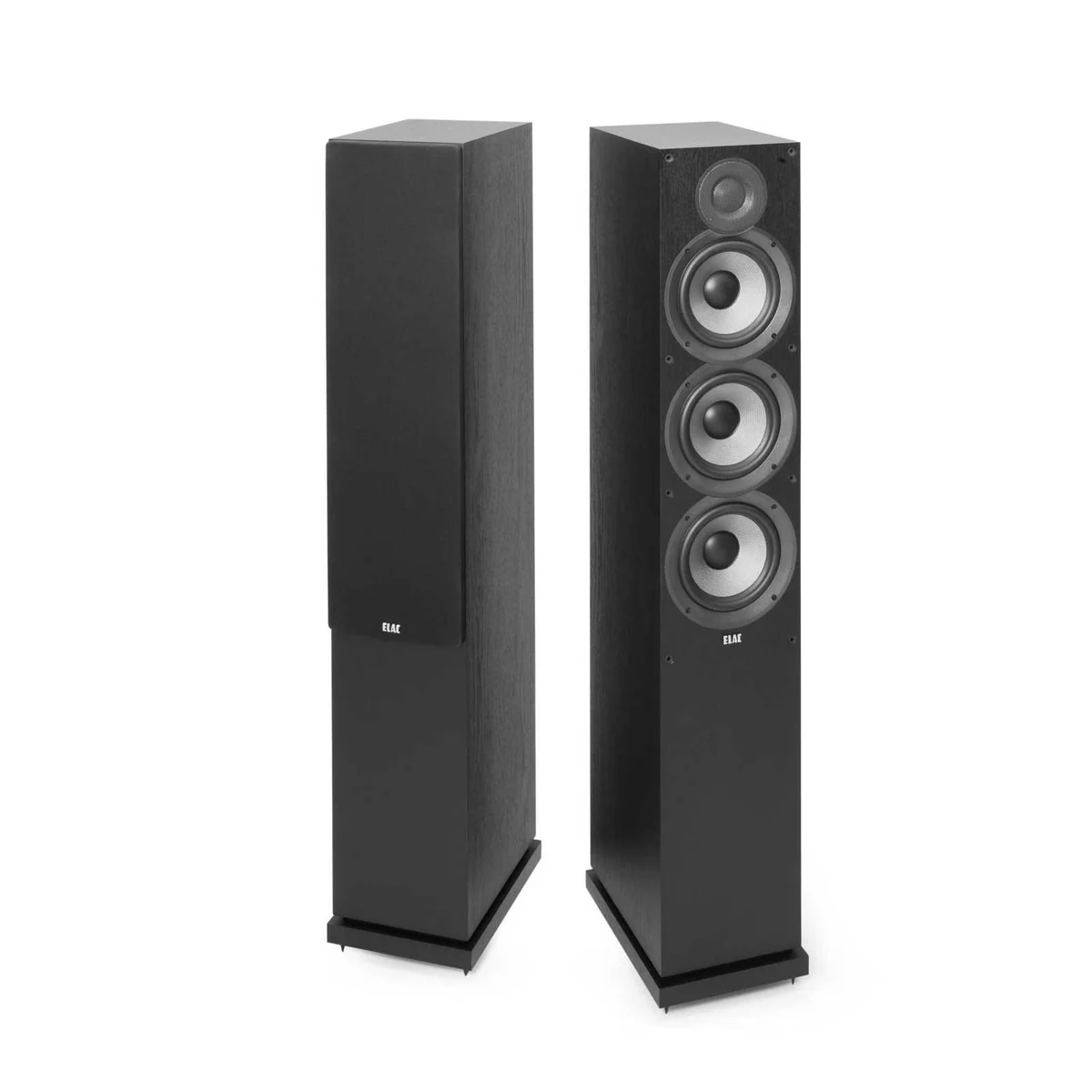
Second, in scale: a floorstanding three-way moves more air, and that matters in a big room. Take ELAC’s Debut 2.0 line: the B6.2 bookshelf is a two-way with one 6.5-inch woofer, 44 Hz to 35 kHz, $479 a pair. The F6.2 floorstander from the same series is a three-way — one 6.5-inch midrange and two 6.5-inch woofers, crossing over at 90 Hz and 2,200 Hz, reaching 39 Hz. Same drivers, same tweeter, same 87 dB sensitivity — but three cones in a taller cabinet, filling a large room the bookshelf cannot.
The 2-Way Plus Sub Answer
Here is where the argument turns: a subwoofer takes the bass job away from the main speakers entirely, and the two-way’s biggest weakness disappears. Cross a pair of LS50 Metas over to a sub at 80 Hz and the 5.25-inch driver no longer moves for the kick drum — it handles the midrange and up, which is exactly what it does best. The sub, placed where the room wants it rather than where the speakers have to stand, handles the bottom two octaves better.
The catch is cost and complexity: KEF’s own KC62 subwoofer reaches 11 Hz at ±3 dB with 105 dB of output from two 6.5-inch force-cancelling drivers and 1,000 watts, and it costs $1,700. Add it to the LS50 Meta and the system is $3,300, against $2,200 for the R3 Meta pair alone. The 2-way-plus-sub system goes deeper and lets you place the bass separately — but it costs $1,100 more and needs setting up. At the budget end the maths is friendlier: a $479 pair of ELAC B6.2s plus a $600 SVS SB-1000 Pro — 12-inch driver, 325 watts, 20–270 Hz ±3 dB — lands at $1,079, deeper than any floorstander in that price range. If you want more ideas in that price band, I put together a guide to the best bookshelf speakers under $1000 for small rooms.
What Your Room Decides
The room decides more than the spec sheet does. In a small room or on a desk, a two-way is usually the better buy: the bass has nowhere to go wrong, the imaging is precise, and the speaker disappears. In a large room, or if you listen loud, the three-way floorstander earns its keep: more output, more scale, no extra boxes. Nearfield listening favours the two-way as well — a single point source, especially a coaxial driver like KEF’s Uni-Q, images better at arm’s length than three drivers on a tall baffle.
Verdict: The Matrix
| Your situation | Buy | Why |
|---|---|---|
| Small room, music first | 2-way bookshelf | Imaging, coherence, no overload |
| Desk or nearfield | 2-way (coaxial if possible) | Point source images best up close |
| Large room, loud listening | 3-way floorstander | Output, scale, no sub needed |
| Movies + music, one system | 2-way + sub | Deepest bass, best placement, costs more |
| Simple setup, no extra boxes | 3-way floorstander | One purchase, nothing to tune |
Bottom Line
My answer: yes, a two-way can match a three-way for sound and bass — if you let it. On its own, a good two-way matches a three-way through the midrange and treble and loses on bass extension and output — the LS50 Meta against the R3 Meta shows the gap plainly, 79 Hz against 58 Hz flat and 106 dB against 110 dB maximum. Add a subwoofer and the two-way stops losing: the bass goes deeper than the three-way’s and the midrange cleans up — the only price is the extra cost and the extra box. If you want one purchase and a big room, buy the three-way. If you want the best sound per dollar in a normal room, buy the two-way and a sub, and spend the difference on music.