




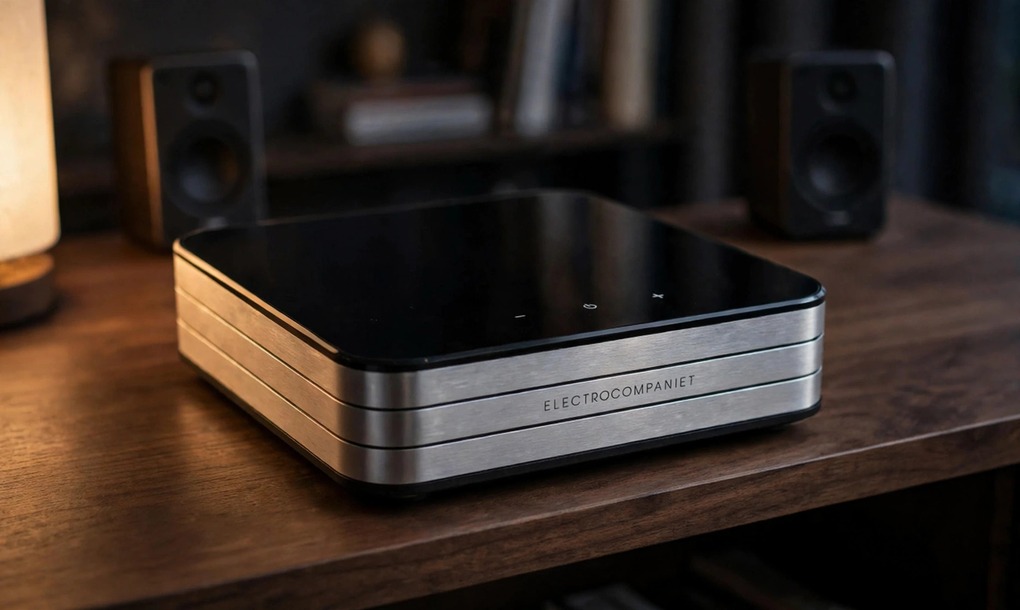
Some hi-fi boxes want to be the centre of your living room. The Electrocompaniet Rena SA2 wants to disappear into it. It is 18 centimetres square, 49 millimetres high, and it holds a streamer, a DAC, a 75-watt-per-channel amplifier and a 32-bit DSP in a single metal box. You put it on a shelf, point it at a pair of speakers, and it plays everything from your network, your phone, or a USB stick.
The SA2 is not new. Electrocompaniet launched it in March 2024, in the company’s 50th anniversary year, as the second generation of its EC Living range. Two years on, three independent reviews have put it through its paces, and a clear picture has formed: a small box with proper hi-fi ambitions, a handful of real annoyances, and a price that undercuts most of what it competes with. This review is my synthesis of those three reviews, cross-checked against Electrocompaniet’s own specifications and owner’s manual.
Quick Specs
| Power output | 2 × 75 W, Class D |
|---|---|
| DAC | 192 kHz / 24-bit |
| DSP | 32-bit floating point |
| Formats | Up to 192 kHz / 24-bit; DSD up to DSD128 (5.6 MHz) |
| Digital inputs | 2 × optical, 1 × coaxial, 1 × USB-A (external storage) |
| Network | Gigabit Ethernet, 802.11ac Wi-Fi with MIMO, Bluetooth (SBC/AAC) |
| Outputs | Phoenix speaker terminals, combined minijack line out + optical out, WiSA 96 kHz / 24-bit wireless speaker/sub |
| Streaming | AirPlay 2, Spotify Connect, TIDAL Connect, Qobuz, Roon Ready, DLNA/UPnP/SMB/NFS, internet radio, Audirvana, JPLAY Certified |
| Dimensions | 180 × 180 × 49 mm |
| Weight | 1.8 kg |
| Price | £1,250 / €1,249 / $1,800 |
| Made in | Assembled in Norway |
Two things the table leaves out matter as much as anything in it. The SA2 has no analogue input of any kind, and no HDMI ARC. Everything it plays is digital, and the signal stays digital all the way through the DSP to the amplifier. If your system still has a turntable or a TV you want to connect by HDMI, this is not the box for it.
Design, Build & Industrial Design
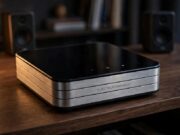
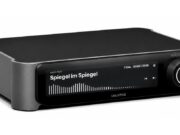
The SA2 is a small square of brushed silver and black glass. Three curved, textured stripes of silver run across its 18 cm width, with glossy black top pieces between them. The top carries three touch icons — volume down, power, volume up — that fade away when the unit is not in use. It looks like a piece of Norwegian furniture that happens to play music.
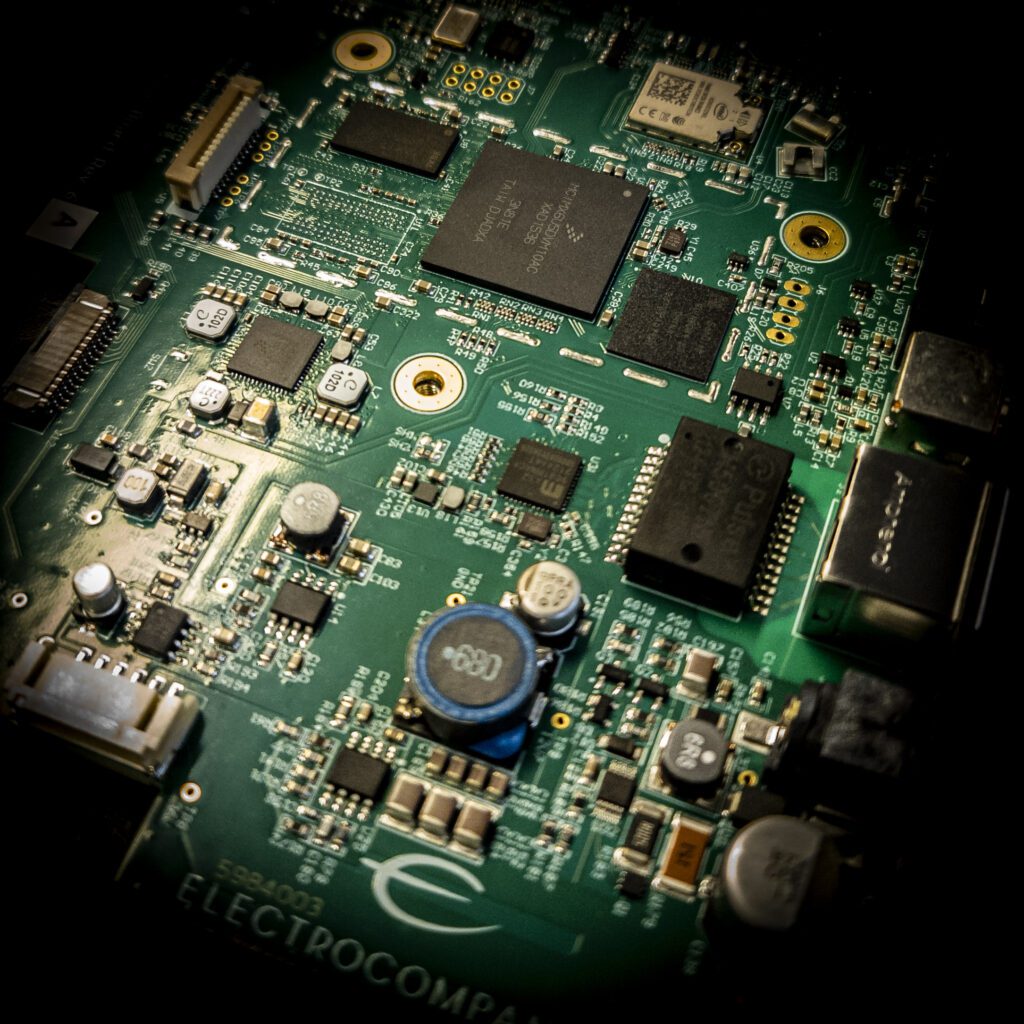
At 1.8 kg it has real heft for its size, and the enclosure is solid metal. The board inside is Electrocompaniet’s own work, laid out and assembled in Norway, and the finish is a step above the plastic multi-room boxes this price usually buys. The remote is a slim black Bluetooth wand with volume, mute, input and three favourite buttons you assign in the app. It runs on a single CR2032 battery.
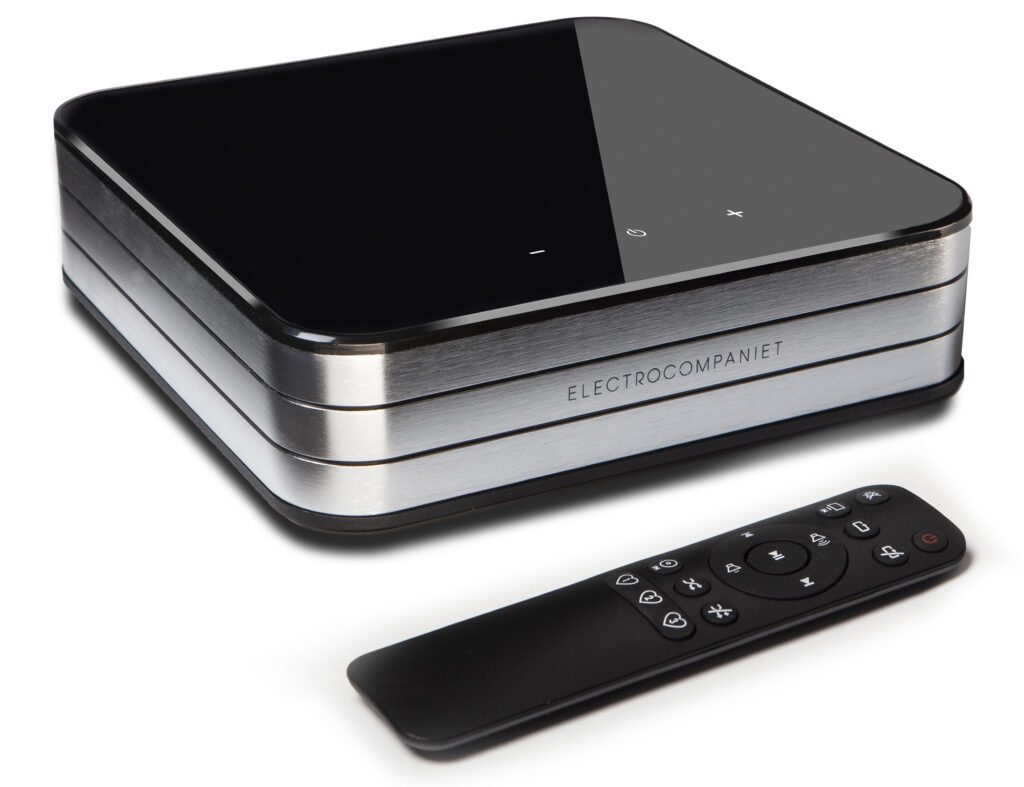
The remote and the top touch buttons share one bad habit: they click. Every volume notch on the remote sends an audible click through the audio channel by default, and the touch buttons on the top click loudly too. Both can be switched off in the app — the remote click lives in the Bluetooth options menu — but the default behaviour is the kind of thing that makes you reach for the manual on day one. The rear panel is partly overhung by the black top, which makes plugging things in slightly fiddly, and the unit gives no clear indication of whether it is on or off. It drops into standby after 20 seconds with no signal and wakes from the remote, the app, or the top buttons.
Connections: what you get, and what you don’t
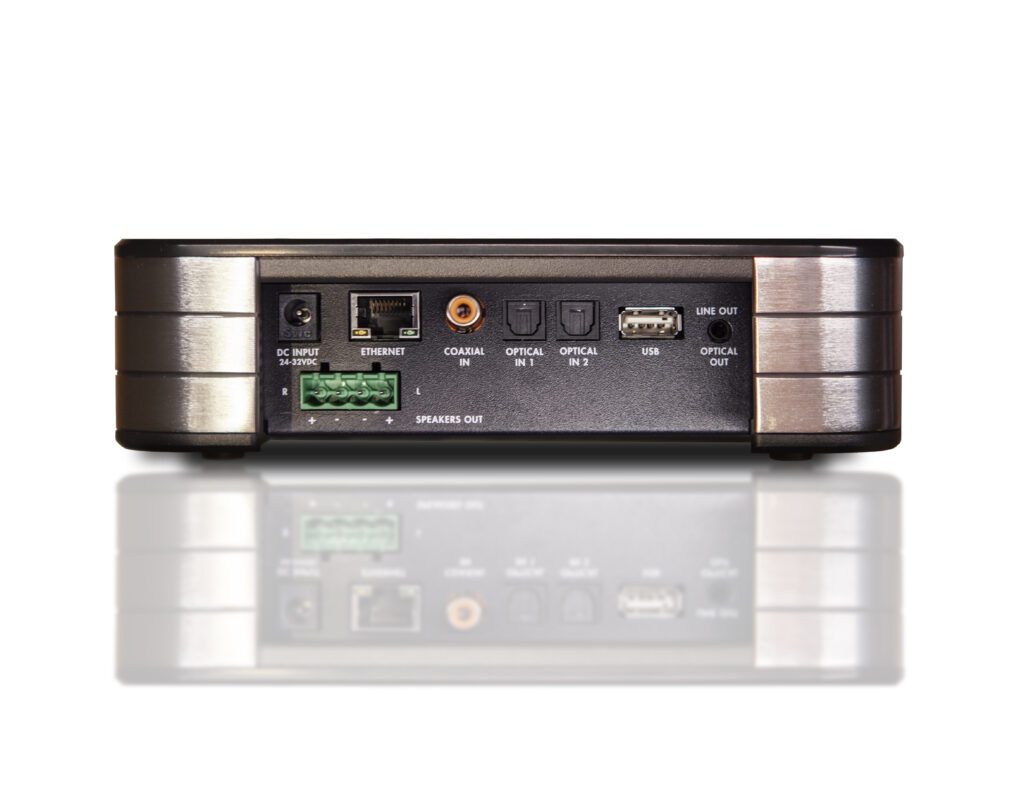
Round the back there are two optical inputs, one coaxial input, a USB-A socket for a drive full of music, gigabit Ethernet, and a combined minijack that serves as both a line output and an optical output. Speakers connect through a green Phoenix terminal block — bare wire only, no binding posts, no banana sockets. It is the same style of terminal Electrocompaniet uses in its reference power amplifiers, and an improvement on the spring clips of the first-generation SA1, but it is still the least friendly speaker connection at this price. You will want a small screwdriver and a bit of patience.
Wireless connections are generous: Wi-Fi with MIMO, Bluetooth, and a WiSA link that sends 96 kHz / 24-bit audio to Electrocompaniet’s own wireless TANA speakers and SIRA subwoofer. The SA2 is the amplifier half of the EC Living system; the streamer-only Rena S2 is its sibling, half the height, for anyone who already owns an amplifier.
The Sound
All three reviews agree on the SA2’s character: controlled, balanced, punchy, and neutral. The bass is deep and well controlled rather than big. The midrange is largely uncoloured. The treble is crisp and detailed without turning hard. Nothing about the sound jumps out at you, which is the point — this is an amplifier that stays out of the way of the music and lets the recording do the work.
Bass
Put on 50 Cent’s “In da Club” and the bass lands deep and controlled, with real detail and separation between the low notes rather than a single woolly thump. CHVRCHES’ “He Said She Said” shows the same thing from a different angle: bass with depth, body and extension, tight enough to keep the synths and the vocal in separate lanes. The DSP helps. Switch the speaker processing to the bookshelf setting and the low end fills out without bloating, which matters for the small speakers this box will most often drive. The standing-speaker preset tightens the sound further, with a touch more reserve in the treble.
Midrange
The midrange is where the SA2 earns its keep. Vocals sit clean and uncoloured — AFI’s “No Resurrection” keeps its bite without the midrange hardening, and the acoustic guitars on The Scene Aesthetic’s “8 Years of Silence” sound natural rather than etched. Nick Cave’s “Wild God” holds its scale and its menace. This is not a warm, romantic midrange, and it is not a forward, analytical one either. It is balanced, and it rewards well-made recordings.
Treble
Treble is crisp and detailed. The hi-hats and cymbals on “He Said She Said” have real sparkle, and the guitar work on Antonio Forcione’s “Night Train” at 24-bit/192 kHz comes through with clean transient edges. The SA2 never tips into brightness on its own, though the “Brightness” slider in the app is there if your speakers need taming. One reviewer found the sound a little too controlled at times, but never dull — a fair summary of the whole amplifier.
Soundstage & Imaging
Here is the one real caveat on the sound. Width and imaging are good — “Night Train” places instruments with clear space between them, and “Wild God” has genuine stage width — but depth is limited. The soundstage can feel a little flat, a touch two-dimensional, where a better amp would give you a sense of the room behind the performers. It is not a deal-breaker, and it is the kind of thing you notice on a good recording and forget about on an average one. It is also why the SA2 pairs better with warmer, more generous speakers than with lean, analytical ones. The neutral tuning needs a partner that brings some body of its own, or a few minutes with the DSP.
Streaming, DSP & the App
The companion app is not optional. Setup and day-to-day control run through it, and without it the SA2 does not play anything at all — not even from an external source. The remote handles volume, mute and input, but the app is where the box lives: Spotify, TIDAL and Qobuz directly, your own library from network shares or a USB drive, internet radio, and the speaker processing. The app is smooth and stable in use, and there is a web interface through the unit’s IP address for anyone who prefers a browser.
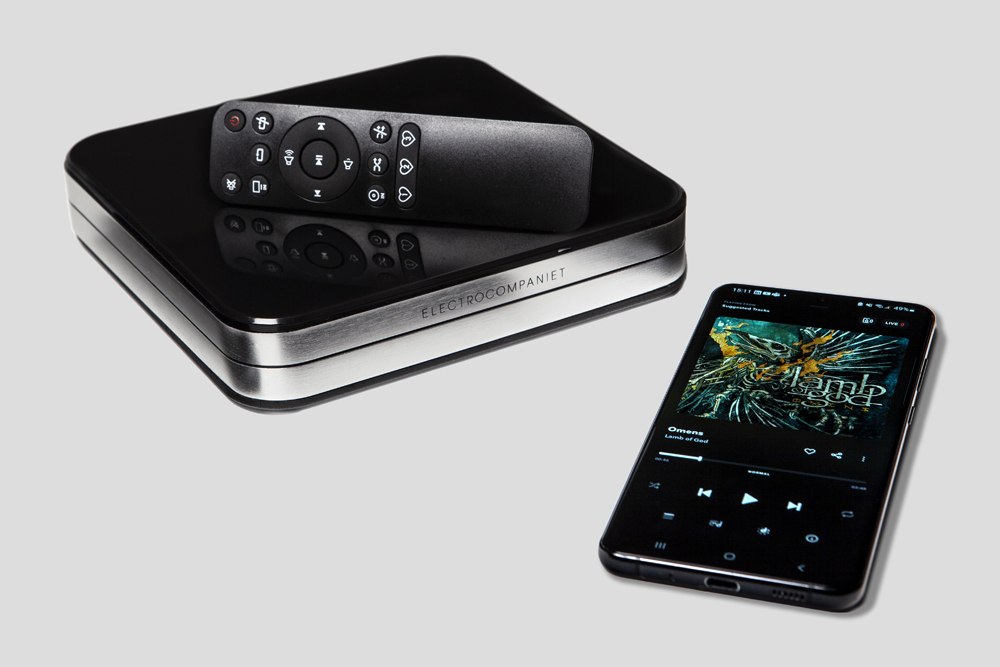
Streaming support is broad and current: AirPlay 2, Spotify Connect, TIDAL Connect, Qobuz, Roon Ready, DLNA and UPnP, SMB and NFS network shares, Audirvana and JPLAY certification, and internet radio — which the earliest reviews caught before it arrived, and which is fully supported now. One reviewer had Wi-Fi dropouts that killed internet radio until a wired Ethernet connection fixed it, so if your router is two rooms away, run the cable.
The DSP is the SA2’s quiet advantage. The app offers speaker-size presets — small, bookshelf, standing — plus a custom crossover point and bass gain, and a Brightness slider. Used with a little care, it makes a real difference to small speakers in a real room, and it separates the SA2 from streaming amps that just pass the signal through. Auto input switching is handled well too: a new signal takes over automatically, and you can set it per input in the app. The library browser is the weak spot — no alphabetical jumps, no folder navigation, and stray system files can pollute the album list. It is usable, but it is the one part of the software that feels unfinished.
Test Setup
A word on how this verdict was reached: I have not had the SA2 in my own room. This review is a synthesis of three independent published reviews, each with its own system, cross-checked against Electrocompaniet’s own specifications and owner’s manual.
The systems behind it: B&W CM8 floorstanders on a wired Ethernet connection, with a TV fed in over optical; DALI Ikon 5 Mk2 and DeVore O/Baby speakers; and a pair of German standmounts. Sources were Tidal and Qobuz streams from 24-bit/48 kHz up to 24-bit/192 kHz, plus Roon. The agreement across those three rooms is what this review rests on.
The Competition
| Amplifier | Price | Power | Platform | What sets it apart |
|---|---|---|---|---|
| Electrocompaniet Rena SA2 | £1,250 | 75 Wpc, Class D | EC Living app, Roon Ready | Speaker DSP; no analogue input, no HDMI ARC |
| NAD C 700 | £1,299 | 80 Wpc, Class D | BluOS | HDMI eARC and MM phono — the analogue-friendly pick |
| Bluesound Powernode (2025) | £899 | 80 Wpc, Class D | BluOS | HDMI eARC and sub out for £351 less |
| Marantz Model M1 | £899 | 100 Wpc, Class D | HEOS | Most power here, made in Japan, HDMI eARC |
| Marantz Model 60n | £1,399 | 60 Wpc, Class A/B | HEOS | Class A/B warmth, MM phono, HDMI ARC — my Marantz Model 60n review |
The NAD C 700 is the closest direct rival: same price, same compact brief, same Class D power, and a BluOS platform that is arguably the best multi-room system going. It also has the two inputs the SA2 lacks — HDMI eARC and a moving-magnet phono stage. If your system has a TV or a turntable in it, the C 700 is the safer buy.
The Bluesound Powernode and the Marantz Model M1 both undercut the SA2 by £351, and both bring HDMI eARC and a subwoofer output the SA2 lacks. The Powernode’s BluOS platform is a genuine advantage, and the M1 brings 100 watts per channel and a made-in-Japan build. Neither offers the SA2’s speaker DSP, or its build quality — the SA2 feels like a more expensive box than either, and it sounds like one too.
The Marantz Model 60n is the interesting alternative at the top of the price band: a Class A/B amplifier with a phono stage, HDMI ARC and an ESS Sabre DAC, trading the SA2’s neutrality for a warmer, more analogue character. It costs £149 more. Read my Marantz Model 60n review if that sounds like your kind of amplifier.
Verdict
Score: 8.5 / 10 — Buy.
The Rena SA2 is the small streaming amplifier I would buy if my system were entirely digital. It sounds controlled and honest, it drives small speakers with real authority, its app and streaming support are genuinely broad, and its speaker DSP is a feature you will actually use. The build is a class above its price, and at £1,250 it is hard to match with separates.
The caveats are real and specific. No analogue input and no HDMI ARC means the SA2 is for digital-only systems — full stop. The Phoenix speaker terminals are fiddly. The remote clicks, the top buttons click, and there is no clear sign the unit is on. The soundstage is wide but shallow. None of those is fatal, and three of them are fixed in the app. The one that matters is the input list: buy this box for the system you have, not the system you wish you had.
One thing to be clear about: this is a paper analysis, not a listening verdict from my own room. I have not auditioned the SA2 myself. This verdict is my synthesis of three independent published reviews, checked against Electrocompaniet’s own specifications and manual, and where those reviews disagreed I have said so rather than smoothing it over. Two years after launch, the consensus is unusually consistent, and that consistency is the best recommendation the SA2 has.
Pros & Cons
Pros:
- Controlled, balanced, punchy sound with deep, well-judged bass
- Speaker DSP that genuinely improves small speakers in real rooms
- Broad streaming support: Roon Ready, AirPlay 2, Spotify/TIDAL/Qobuz Connect, DLNA
- Excellent companion app and web interface
- Build and finish a class above the price; assembled in Norway
- Compact 18 cm footprint and a price that undercuts most rivals
Cons:
- No analogue input, no HDMI ARC, no phono stage
- Phoenix speaker terminals — bare wire only, fiddly to connect
- Remote and top buttons click audibly by default (switchable off in the app)
- No clear on/off indication
- Soundstage is wide but shallow on depth
- Library browsing is weak: no alphabetical jumps, no folder navigation
Who Should Buy / Who Should Skip
Buy it if: your music is entirely digital — streaming, a NAS, a USB drive — and you want a small, beautifully made amplifier that sounds like proper hi-fi rather than a multi-room gadget. Buy it if you have small or bookshelf speakers that could use the DSP, and if you run Roon. Buy it if you want a second-room system that does not look or sound like an afterthought.
Skip it if: you have a turntable, a CD player with analogue outputs, or a TV you want on HDMI ARC — the SA2 has nowhere to plug them in. Skip it if you want binding posts and banana plugs, or if your speakers are lean and analytical and you do not want to spend time with the DSP. If any of that applies, the NAD C 700 or the Marantz Model 60n will suit you better.
As an Amazon Associate and affiliate partner, OHHIFI may earn a commission from qualifying purchases made through links on this page, at no extra cost to you.