






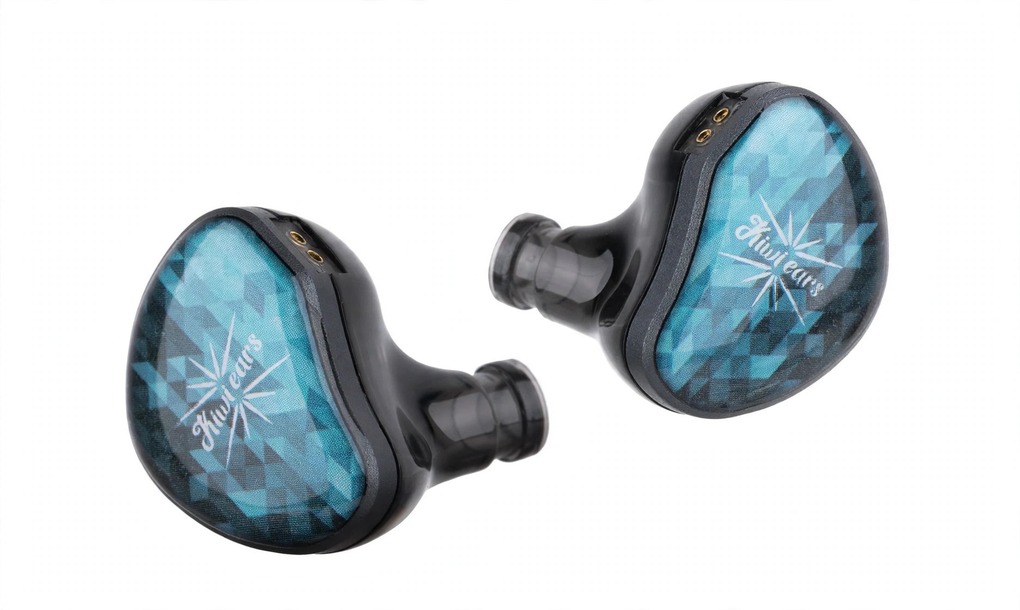
Five drivers for $77. A 10 mm dynamic driver and four balanced armatures in a shell that weighs 4.4 grams — on paper, the Kiwi Ears Stardust reads like another spec-sheet ambush from the budget IEM market, the kind of parts list that would have cost three times as much two years ago. The interesting part is not the driver count. It is that the people who have actually heard the Stardust cannot agree on what it sounds like.
One camp calls it warm, musical and deeply comfortable, an easy all-day listen with bass that embarrasses pricier sets. The other hears a thick, congested midrange and a low end that disappears when the music gets demanding. Both camps listened to the same earphone, and the measurements back both of them up. After going through everything published on the Stardust since its late-August launch — full reviews, user impressions, and fourteen independent measurement rigs — I think both camps are right. Which one you join comes down to what you listen to, how loud you listen, and whether the seal is right.
Quick Specs
| Specification | Details |
| Drivers | 1 × 10 mm PU+LCP dynamic + 4 × balanced armature (1DD+4BA) |
| Impedance | 13 Ω |
| Sensitivity | 107 dB (±3 dB) |
| Frequency response | 20 Hz – 40 kHz |
| Channel balance | ≤ 1.5 dB |
| Shell | Resin polymer, anodized aluminum faceplate |
| Cable | Detachable 0.78 mm 2-pin, 1.2 m two-core silver Litz OFC |
| Cable options | 3.5 mm, 3.5 mm with mic, Type-C with mic (no 4.4 mm) |
| Weight | 4.4 g per side |
| In the box | 6 pairs of eartips, grey zip case, manual, warranty card |
| Price | $76.99–$79.99 (SRP); $65.44 promo seen Nov 24, 2026 |
| Release | Late August 2026 |
Design, Build & Industrial Design
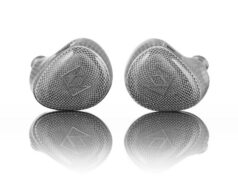
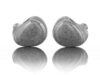
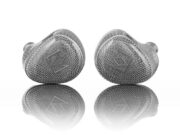
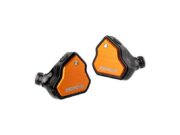
The Stardust is a small, light earphone that disappears in the ear. The shell is black resin polymer with an anodized aluminum faceplate printed in a teal geometric mosaic, the white Kiwi Ears script and starburst logo sitting on top. It looks sharp in photos. In person the print reads a little flatter — a printed pattern rather than a gemstone — but at $77 the finish is honest, and the metal ring around the faceplate is a nicer touch than the price suggests.
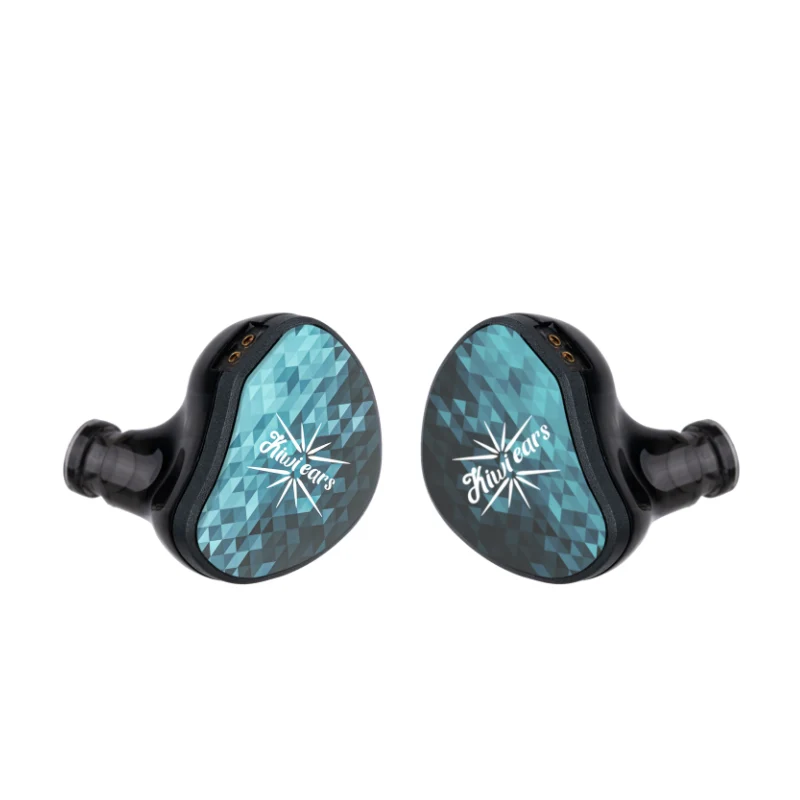
At 4.4 grams per side, the Stardust is one of the lightest hybrids at this price, and the small shells suit smaller ears — a point that comes up again and again in the listening record. The fit is secure with no pressure points over long sessions, helped by a single inner vent. Isolation is average rather than total, which I count as a plus for an everyday earphone: you can still hear the world when the music stops.
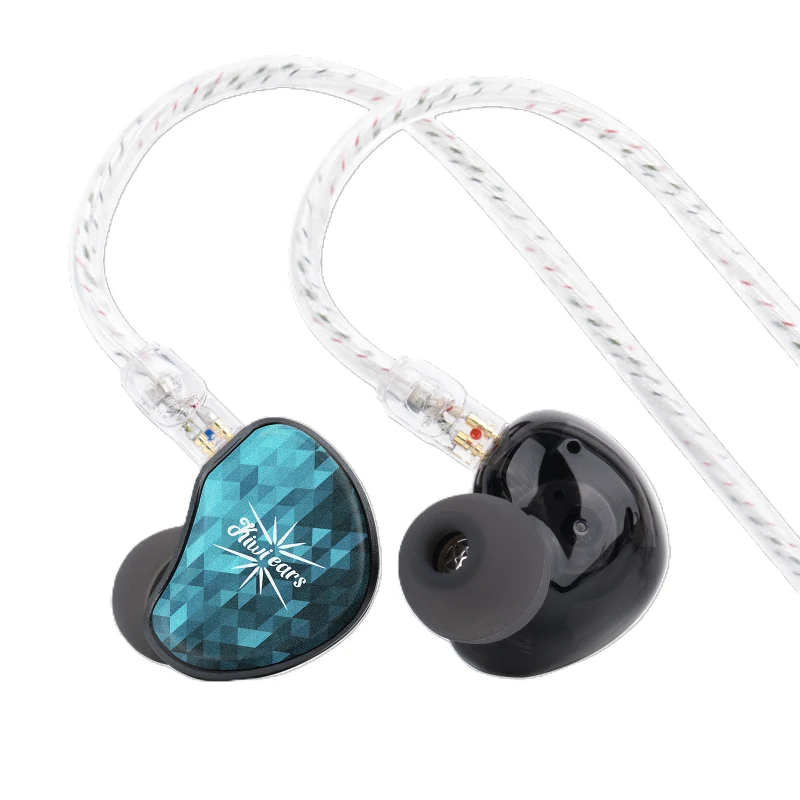
The cable is the pleasant surprise. It is a detachable two-core silver Litz oxygen-free copper cable, 1.2 meters, on flush 0.78 mm 2-pin connectors with red and blue left/right markers. It is thicker and better finished than the cables that usually ship at this price, soft enough to stay out of the way, and it does not tangle. The options are 3.5 mm, 3.5 mm with a microphone, or Type-C with a microphone. There is no 4.4 mm balanced option, which is the one real omission — if you run a balanced source, plan on an aftermarket cable. One practical note: if you do not need the microphone, buy the mic-less cable; the inline remote on the mic version can interact with the Stardust’s low 13-ohm impedance.
The box is basic, and nobody pretends otherwise. A compact green box holds the earphones, the cable, six pairs of eartips in two bore types — white standard-bore and black narrow-bore, small, medium and large — a grey fabric zip case with a mesh pocket, a manual and a warranty card. Everything you need, nothing you do not.

The Sound: Warm, Musical, and Arguing With Itself
The Stardust’s tuning is warm-neutral with a mild V-shape: a moderate sub-bass shelf, a forward upper midrange, and a smooth top end. It is musical and coherent rather than analytical, and it stays relaxed at volume where sharper-tuned rivals start to bite. The tuning’s center of gravity is the midrange, and that is where the argument lives.
Bass
The low end is the most argued-about part of this earphone, so start with what the measurements say. Fourteen independent coupler rigs agree the Stardust carries a moderate sub-bass shelf — 30 Hz sits roughly 6 to 9 dB above the midrange — which puts it close to the Harman in-ear target, not above it. That is the whole story in one graph: the bass is real, but it is not exaggerated.
In practice, most listeners hear clean, textured bass with proper rhythm — the 10 mm dynamic driver gives the low end a physicality that balanced armatures alone rarely manage. Put on Marvin Gaye’s “What’s Going On” and the upright bass has genuine weight and shape. The disagreement starts with quantity. Some hear deep, dynamic bass with real impact; others find it short on the sub-bass rumble that electronic and hip-hop demand; a small minority hears almost no bass at all. The measurements point to the likely culprit: seal. A shallow fit or the wrong tip size collapses the shelf, and the Stardust’s small shells and short nozzle make tip selection matter more than usual. With a good seal, the bass is there. Without one, it is not — and no amount of driver count fixes that. One more thing the graph shows: the bass starts rising from around 300 Hz, which thickens the lower midrange and sets up the Stardust’s biggest argument.
Midrange
Vocals sit forward in the mix, warm and present, and female voices are the Stardust’s most consistent strength — smooth, natural, and easy to follow. Norah Jones on “Come Away With Me” keeps all of its intimacy and breath detail. The trouble starts lower down. The region between 800 Hz and 1.5 kHz runs hotter than on Kiwi Ears’ earlier tunings, and the ear-gain peak arrives early, around 2 kHz. On male vocals that combination turns chesty and honky — Dire Straits’ “Brothers in Arms” shows it plainly, Mark Knopfler’s baritone picking up a boxy edge that is not on the recording. Push the volume and the effect gets worse; the forwardness that sounds natural at moderate levels starts to shout. This is the single most divisive thing about the Stardust: half the listening record calls the midrange natural and engaging, the other half calls it congested. Both are describing the same peak. Whether it bothers you will depend on your library and your volume knob.
Treble
If the midrange is where the Stardust argues with itself, the treble is where it agrees. Smooth, sibilance-free, and never harsh — that is the one judgment every listener shares. The only disagreement is about air. Some hear a clean, extended top end with a mild peak around 8 kHz that adds a little energy; others find it soft and reserved, missing the sparkle and gloss that make cymbals shimmer. Either way, nothing up top bites. This is an earphone you can wear for hours without fatigue, and for treble-sensitive listeners that alone is worth the price of admission.
Soundstage & Imaging
The stage splits opinion too, though less fiercely. Some hear a spacious presentation, wider than it is deep, with distinct left-right placement. Others find it intimate, even narrow, with the center of the image crowded. What holds across the record is imaging: placement is precise and easy to follow, which is why several listeners reach for the Stardust for gaming as well as music. Separation is good on most material — Tool’s “Fear Inoculum” keeps its percussion layered and locatable — but on very dense, busy passages the image can blur and the center can feel congested, the same thickness that colors the midrange showing up in the staging.
Measured Performance
Fourteen independent measurement rigs agree on the shape of this earphone, which is rare enough to be worth stating plainly. There is a moderate sub-bass shelf, an early ear-gain peak around 2 kHz, and a deep dip through 4 to 6 kHz. Normalized at 500 Hz, 30 Hz sits 6.3 to 9.3 dB above the midrange — level with to 3 dB under the Harman IE 2019 shelf — and 200 Hz runs 1.3 to 2.3 dB above target. Channel matching is essentially perfect, which matches the official ≤1.5 dB channel-balance spec and speaks well of the production quality. A mild peak around 8 kHz is audible but gentle.
The graph explains both sides of every argument above. The bass shelf is real, so reports of missing bass point to seal rather than tuning. The early 2 kHz rise is real, so the honk reports are not imagination. The 4 to 6 kHz dip is why the treble never bites, and also why it can sound soft on recordings that need air. Nothing here was invented or smoothed over — this is what the couplers show.
Test Setup — Associated Equipment
One honest note before the setup: the listening behind this review comes from the published record — full reviews, user impressions, and measurement data — rather than a single unit on my own desk. The Stardust is one of the easiest earphones in this price band to drive at 13 ohms and 107 dB, and the sources behind the record ranged from USB-C dongles to desktop chains and tube amplifiers. The consistent finding is that the source matters less here than the seal and the volume. One practical warning does recur: use a low-output-impedance source, because a 13-ohm load will show frequency-response shifts on a high-impedance output.
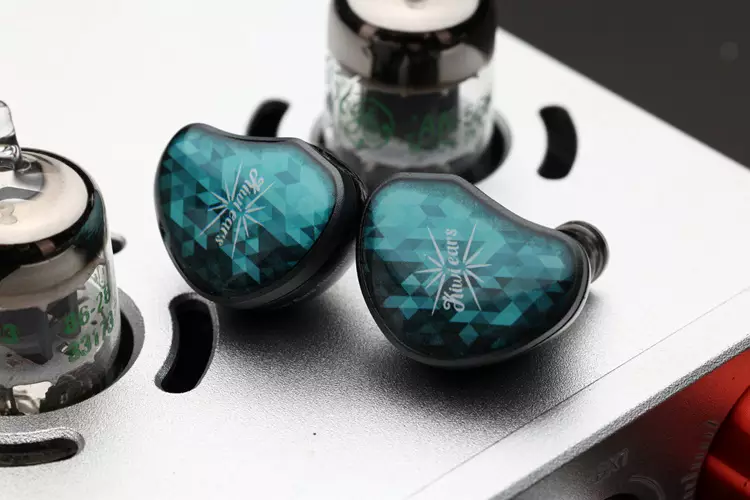
The comparisons below are judged against the same reference context I use for every IEM in this price band — a solid-state DAC feeding an OTL tube amp — with test tracks spanning vocal jazz, soul, dense rock and electronic.
The Competition
Seventy-seven dollars is the most crowded price in the IEM market, and the Stardust’s rivals are not hypothetical. Four of them were compared head-to-head in the published record.
| Rival | Price | vs Stardust | Verdict |
| Kiwi Ears Cadenza II | $49.99 | Single 10 mm titanium driver; fuller bass and better midrange timbre; the Stardust has cleaner, more shimmery treble | The safer all-rounder — buy it if the midrange is your priority |
| FiiO SNOWSKY FH3 LUMI | $99.99 | 1DD+2BA; bassier and less neutral; the Stardust is smoother up top, more detailed, wider staged | Stardust for neutrality; LUMI for bass weight |
| Hidizs MS2 PRO | $99.99 | DD+1BA; livelier and more immediate with better vocal presence; the Stardust has smoother treble, more resolution and a wider stage | A genuine toss-up — pick on tuning taste |
| Juzear Defiant | $99 | 1DD+3BA; the closest direct rival on paper; the listening record splits evenly between the two | Try both if you can; buy on fit and tuning preference |
If you want the wider sub-$100 field mapped out — the Hexa, Pure, EW300 and Aria 2 at verified prices — my guide to the best IEMs under $100 covers it. And if your budget stretches to $119, the TinHiFi T6 is the honest step up: a micro-planar treble that resolves more and stages wider, though it costs roughly 50% more than the Stardust.
Verdict — 7.5/10: Buy, With One Condition
Let me be direct about what this verdict is. I have not spent weeks with the Stardust on my own desk; this is a synthesis of the published reviews, user impressions and measurements, and the score below reflects the weight of that record, not a personal listening log. On that record, the Stardust earns a 7.5 out of 10 — a buy, with one condition attached.
The case for it is straightforward: five drivers that sound like one, a treble that never offends, shells you forget you are wearing, and a price that undercuts every direct rival with this driver count. The case against it is equally specific: a midrange that can turn honky on male vocals, bass that depends on your seal, and technical performance that is good rather than great. None of those flaws is hidden — they are the same ones the measurements predict — and none of them is fatal unless your library lives where the Stardust is weakest. Buy it if you want a warm, musical, fatigue-free daily listen. Skip it if you need air, micro-detail, or bass slam. For most people shopping at $77, the Stardust is the interesting choice rather than the safe one — and I would rather recommend the interesting one, with its flaws stated plainly, than the safe one that bores you in a month.
Pros / Cons
Pros
- Warm, musical, coherent tuning that is easy to listen to for hours
- Smooth, sibilance-free treble — the safest top end at this price
- Small, light shells (4.4 g) — genuinely comfortable, including smaller ears
- Clean, textured bass from the 10 mm dynamic driver when the seal is right
- Five drivers, a detachable cable and a complete accessory set for $77
Cons
- Upper midrange can sound honky or congested on male vocals, worse at higher volume
- Bass divides opinion — some hear it as light, and it lacks real sub-bass rumble for bass-heavy genres
- Treble trades air and sparkle for smoothness; not for treble lovers
- Technical performance is average — micro-detail and busy-passage separation are merely decent
- No 4.4 mm balanced option; the faceplate print looks flatter in person than in photos
Who Should Buy / Who Should Skip
This is for you if you are treble-sensitive and want an earphone that never bites; if you listen for hours at a stretch and comfort matters as much as sound; if you like a warm, vocal-forward signature and your library leans on pop, soul, R&B and acoustic; if you want your first hybrid and do not want to spend three figures to try one; or if you game and want precise imaging in a shell that disappears.
Look elsewhere if you chase micro-detail and air — the Stardust trades both for smoothness; if your library is EDM and hip-hop and you need sub-bass rumble; if you listen loud, where the upper-midrange peak gets pushy; or if you already own the Cadenza II and only want more of the same — the Stardust is a different flavor, not a straight upgrade.
Disclosure: OHHIFI may earn affiliate commissions from product links. My verdicts are never influenced by such arrangements.