


















ELAC’s Debut Reference 3.0 family is going on sale. The DBR63 bookshelf leads the range at $899 a pair, with US pre-orders open now and shipping from December 26, 2026. The DFR53 floorstander is $999 each and the DCR53 center channel $549 each. Previewed at HIGH END Vienna in June; now it is something you can buy.
What’s New
The DBR63 replaces the DBR62. The new 6.5-inch aramid-fiber woofer uses a single-piece cone with no conventional dust cap, a design ELAC says makes the diaphragm more rigid and better controlled, for tighter bass and clearer midrange. The crossover is revised to 2,500 Hz, and the bass-reflex port moves to the rear — the DBR62 breathed through a front slot — so placement near a wall will matter more than before.

The bigger shift is at the top. The DBR63 drops the DBR62’s soft dome for a 1-inch aluminum dome with an integrated phase plug and an optimized waveguide, the same tweeter technology ELAC introduced with the standard Debut 3.0 series in 2024. ELAC rates the DBR63 at 49 Hz to 34 kHz (-3 dB), 86.5 dB sensitivity and a nominal 6-ohm impedance, dipping to 4.5 ohms at 230 Hz. Recommended amplifier power is 20 to 140 watts, and the cabinet measures 14.1 by 8.7 by 10.8 inches.
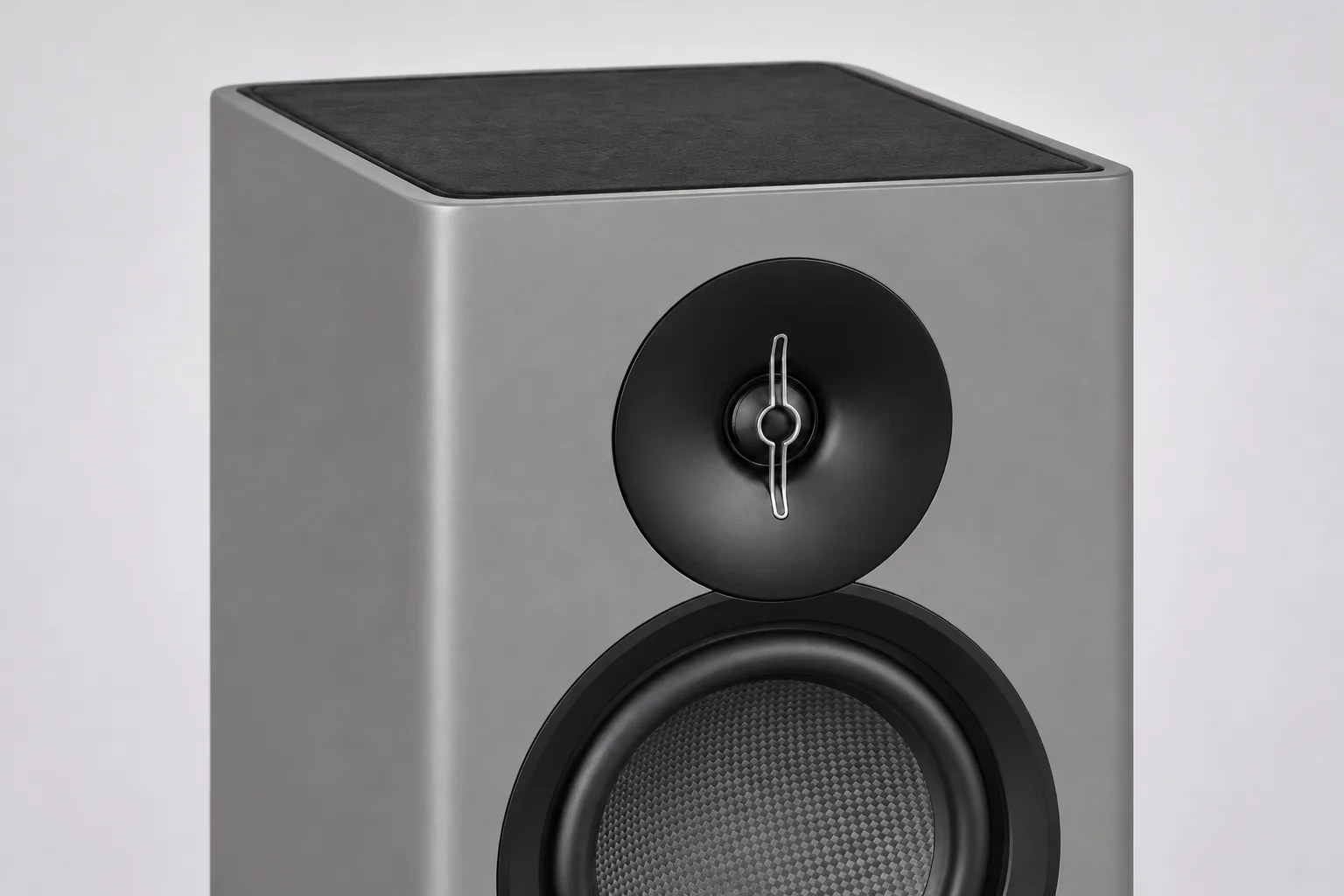
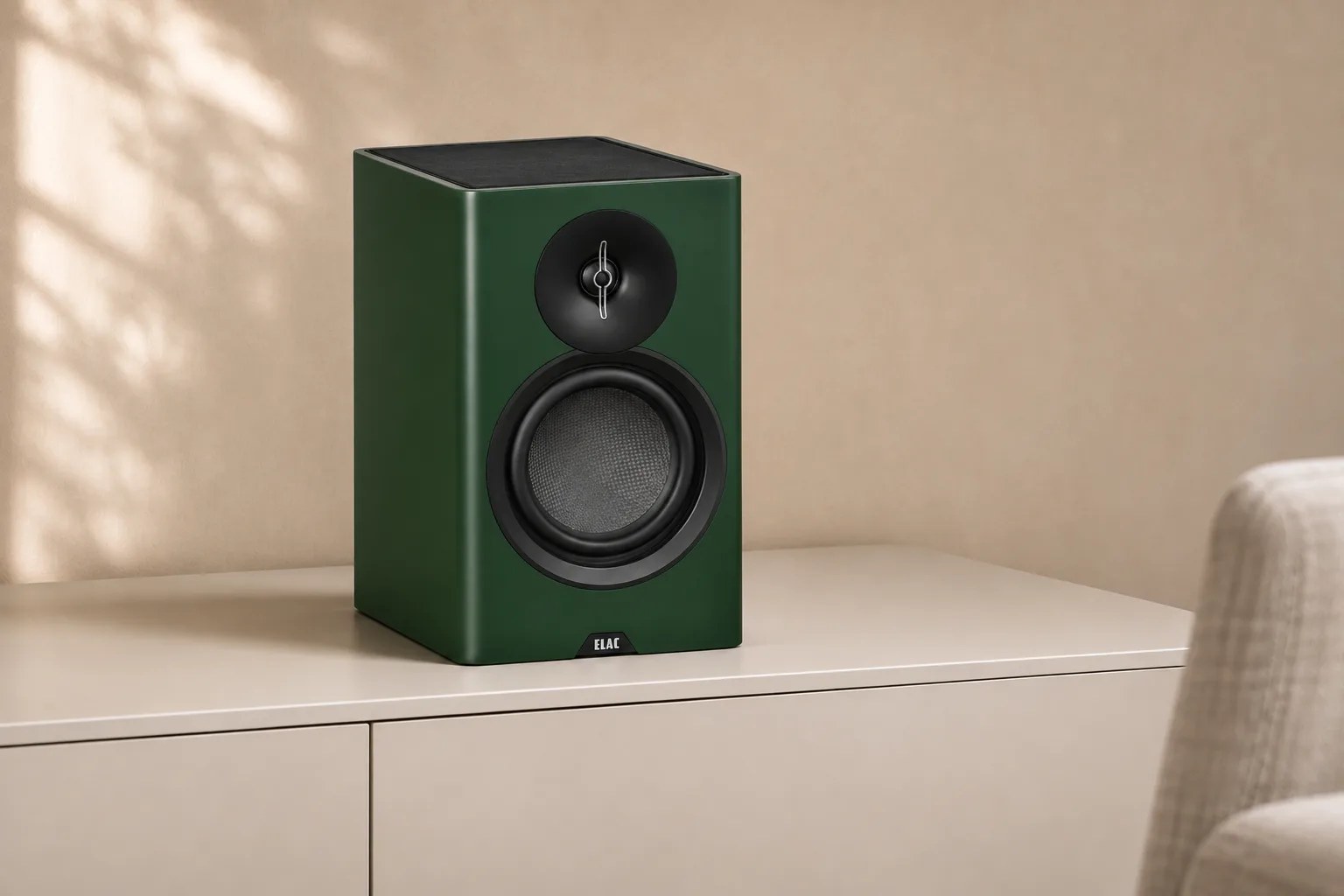
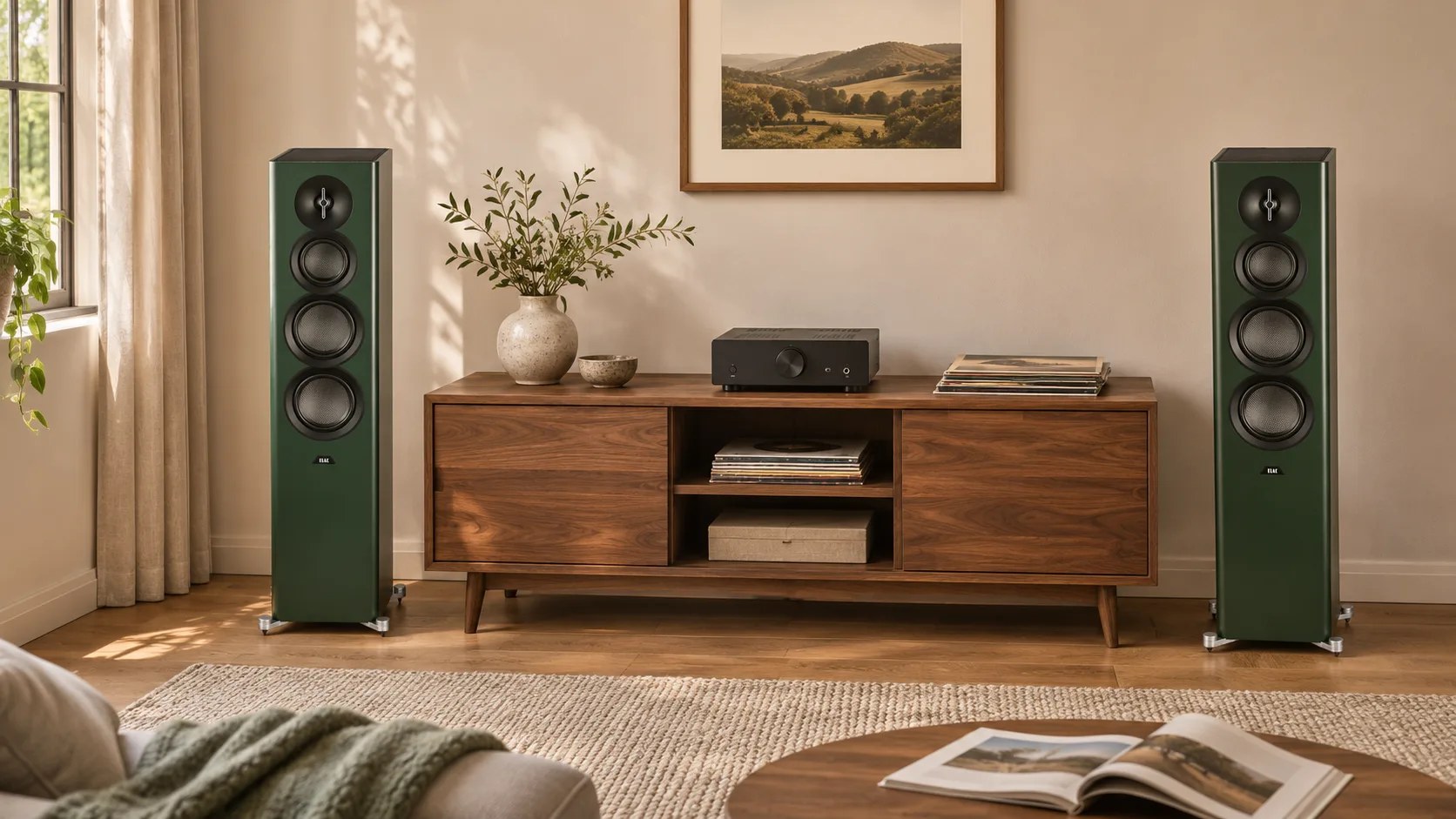
The cabinet gets as much attention as the drivers. It is a rigid MDF enclosure with softly rounded edges, a stitched synthetic-leather top panel, and five finishes — Black, White, Green, Titanium and Walnut — each with contrasting trim; Walnut pairs with a Champagne ring around the woofer. This is a deliberate step away from the Debut line’s usual black-box pragmatism: the range has always competed on performance and affordability, not on how it looks in a living room.
The DFR53 floorstander is a three-way design with two 133 mm aramid-fiber bass drivers, a dedicated 102 mm aramid midrange and the same aluminum tweeter, with two rear-facing ports; ELAC specifies 43 Hz to 34 kHz (-3 dB) and 87 dB sensitivity. The DCR53 center channel pairs two 133 mm aramid mid/bass drivers with the same tweeter in a sealed enclosure, which should make it easier to place close to a wall or inside cabinetry.
Context
The Debut Reference name first appeared in 2020, as a more upmarket take on ELAC’s affordable Debut loudspeakers, and this generation builds on the Debut 3.0 platform introduced in 2024. The Reference models have always been for buyers who want that engineering dressed a little better, and the 3.0 generation pushes the idea further — the aluminum tweeter, the dust-cap-free woofer and the furniture finishes are for a buyer who is no longer shopping purely on price.
Pricing tells the same story in different regions. European pricing, announced at the Vienna preview, started at €429 each for the DBR63, €799 each for the DFR53 and €499 each for the DCR53, with Walnut carrying a premium. In Japan, distributor Yukim lists the DBR63 at ¥198,000 a pair in Black and ¥231,000 in Walnut, with a December release.
Compared to the DBR62 and the Competition
Against the DBR62 it replaces, the DBR63 is a $100 step up — the outgoing model is still listed at $799 a pair. For that premium you get a different tweeter material, a redesigned woofer, a rear port instead of a front slot, and a cabinet that belongs in a furnished room. The front slot was the DBR62’s practical advantage: it could sit close to a wall. The DBR63 trades that convenience for the rear port and the new drivers, so buyers with tight rooms should think about placement before they pre-order.
The $899 bracket is crowded. The Q Acoustics 3020c sells for $649 a pair with a smaller 4.75-inch driver, while the Paradigm Premier 220B v2 costs $1,099 a pair with a 6-inch aluminum-magnesium mid/bass driver and a ceramic-dome tweeter. The ELAC sits between them on price and bets on its larger woofer and new tweeter to justify the middle ground. For a wider view of this price band, I put together a guide to the best bookshelf speakers under $1,000 for small rooms, where the DBR62 still holds a place as the neutral reference.
My Take
I have not heard the DBR63, and no independent measurements or reviews exist yet. What follows is a paper analysis, not a listening verdict.
On paper, this looks promising because the changes are engineering, not decoration. A dust-cap-free aramid cone and an aluminum dome with a phase plug are real revisions to the two drivers that define a two-way speaker’s character, and the $100 premium over the DBR62 is modest for that much hardware. The five finishes are the more interesting signal: ELAC clearly believes the Debut buyer has grown up and now cares what the speaker looks like next to the sofa.
What concerns me is the 86.5 dB sensitivity and a 6-ohm nominal impedance with a 4.5-ohm minimum. That is not a difficult load, but a small, cheap amplifier will run out of headroom in a larger room, and the rear port means the speaker needs breathing space the DBR62 never asked for. The aluminum tweeter is the other open question: ELAC already uses it in the standard Debut 3.0 models, so it is proven hardware, but its integration with the new woofer and revised crossover is untested by anyone outside ELAC. Until independent listening tests emerge, the DBR63 is a well-priced promise, not a proven performer.
Who Should Watch This
Pre-order if you want the first batch and you already trust the Debut line — the DBR63 is the most complete expression of ELAC’s affordable engineering, and it lands just after Christmas. Wait if you want independent measurements first, which is my position: the numbers ELAC publishes are a starting point, not a verdict. Home cinema builders should watch the DFR53 and DCR53 as a matched set — a three-model family with shared drivers and finishes is rare at this price.