

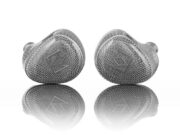








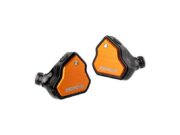

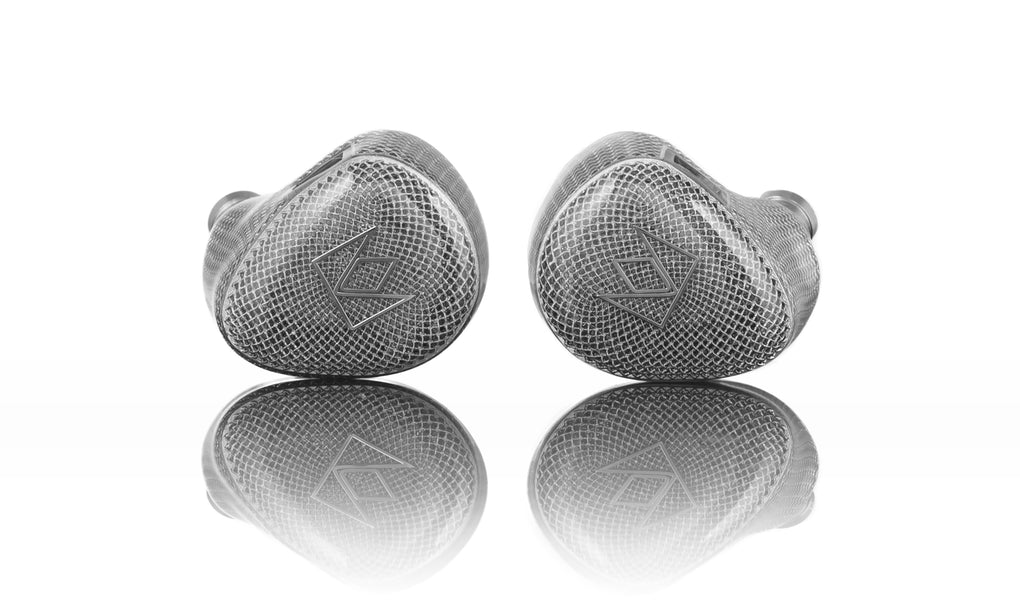
Noble Audio announced the Paladin on November 24, 2026: a $3,500 wired in-ear monitor built around a 12-driver tribrid array — eight balanced armatures, two Sonion bone conduction drivers, and two Super-Magnetic planar drivers — in silver resin shells patterned after medieval chainmail. Pre-orders are open, with stock expected to ship in early December 2026. The stated mission is unusual for a flagship at this price: neutrality, not spectacle.
What’s New
The driver configuration is the story: eight balanced armatures, two Sonion bone conduction drivers, and two Super-Magnetic planar drivers per earpiece, joined by a multi-way passive crossover. Noble has not disclosed the crossover points.
What stands out is what is missing: no conventional dynamic driver. Most luxury hybrids lean on a dynamic woofer for bass; Noble has handed low-frequency duties to the armatures and the bone conduction pair, which transmit vibration through contact with the ear — and how well that works depends entirely on fit and coupling.
Noble rates the response at 12 Hz to 45 kHz, with no tolerance or measurement graph provided — that number alone says little about the actual tonal balance. At 21 ohms and 117 dB SPL/mW, it is an easy load for any dongle DAC or desktop amp, where the source’s noise floor matters more than raw power.
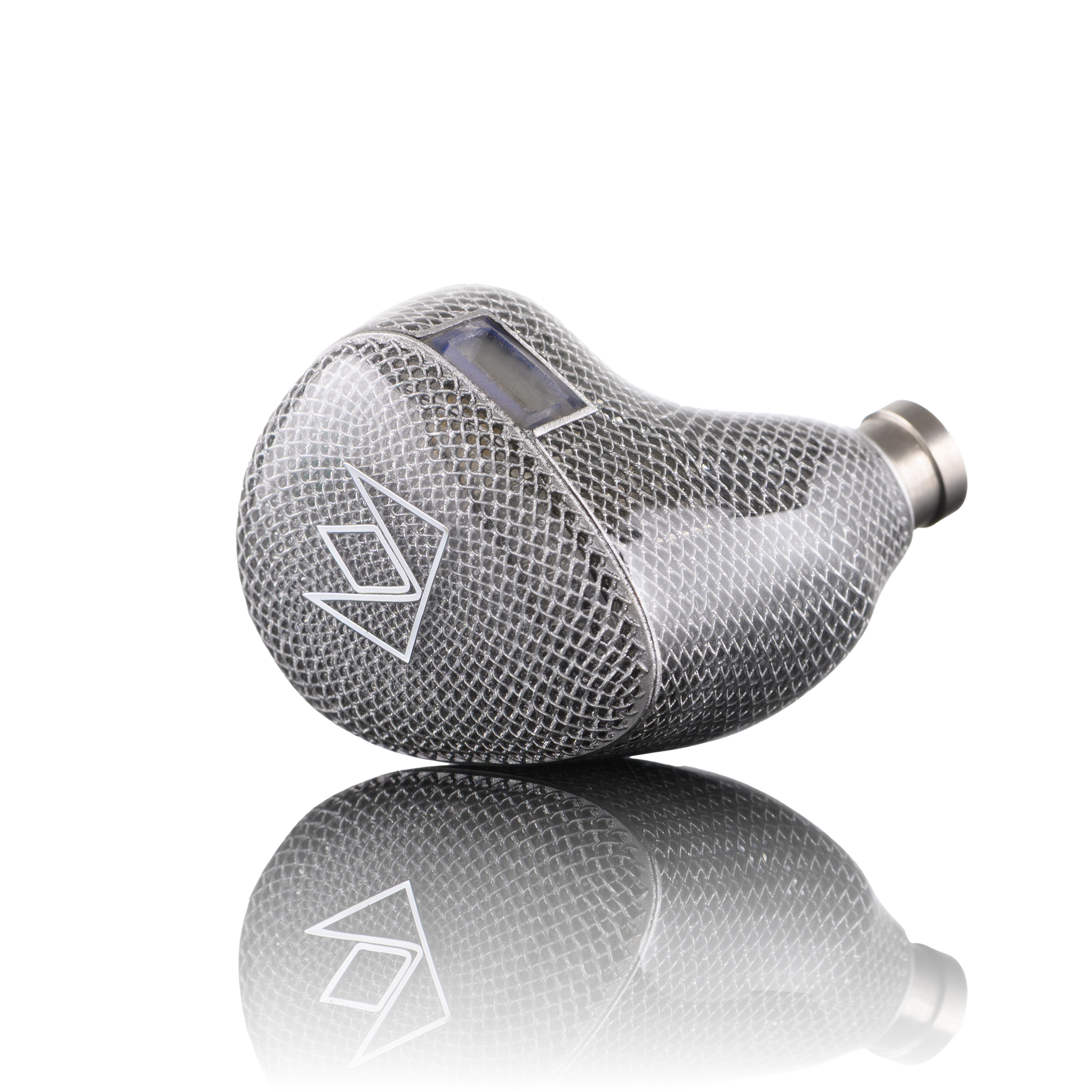
The shells are silver-finished resin, the chainmail weave carried across the faceplates and around the shell’s curves, Noble’s emblem set into each faceplate, with integrated stainless steel wax guards at the nozzles. Ear tips are included; weight is undisclosed.
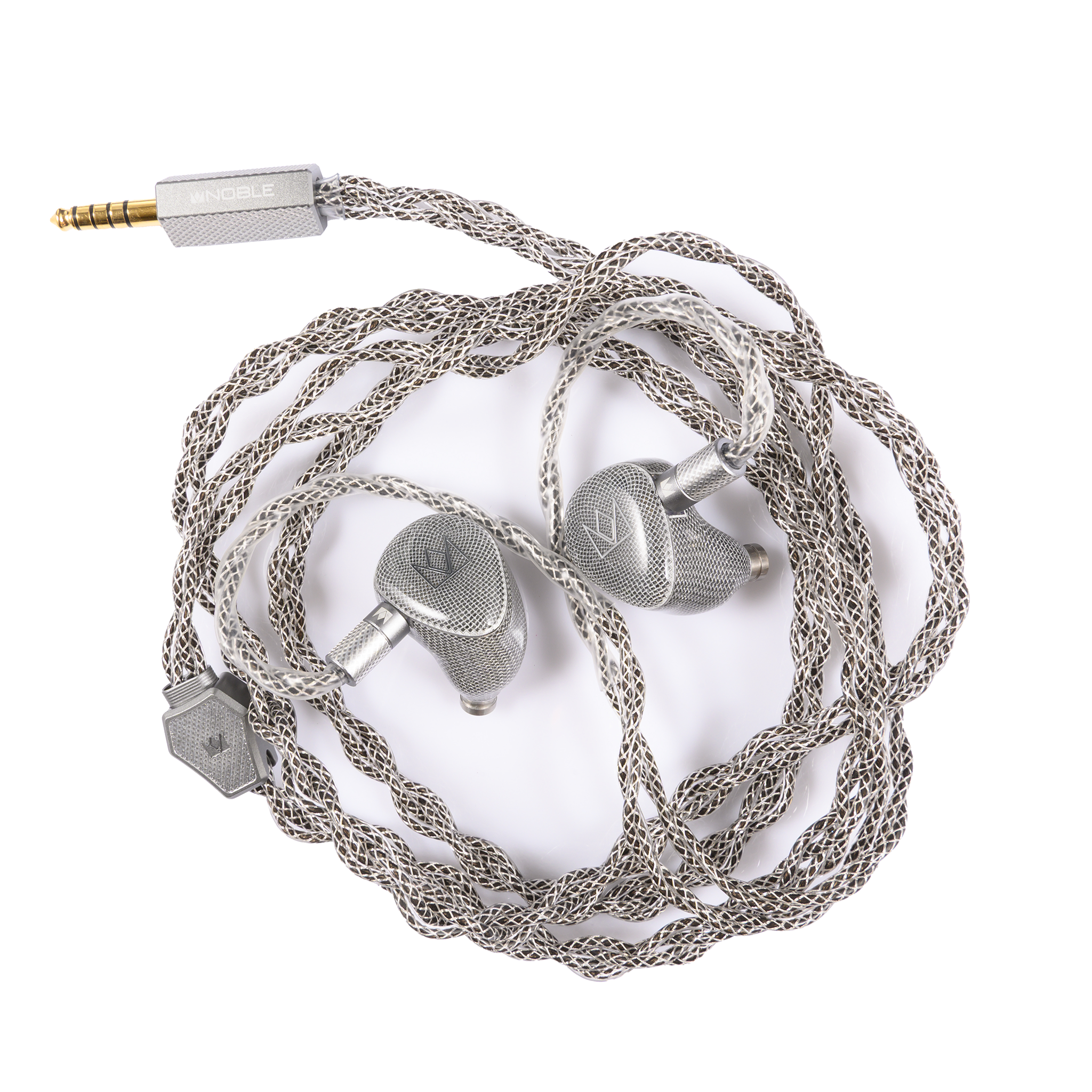
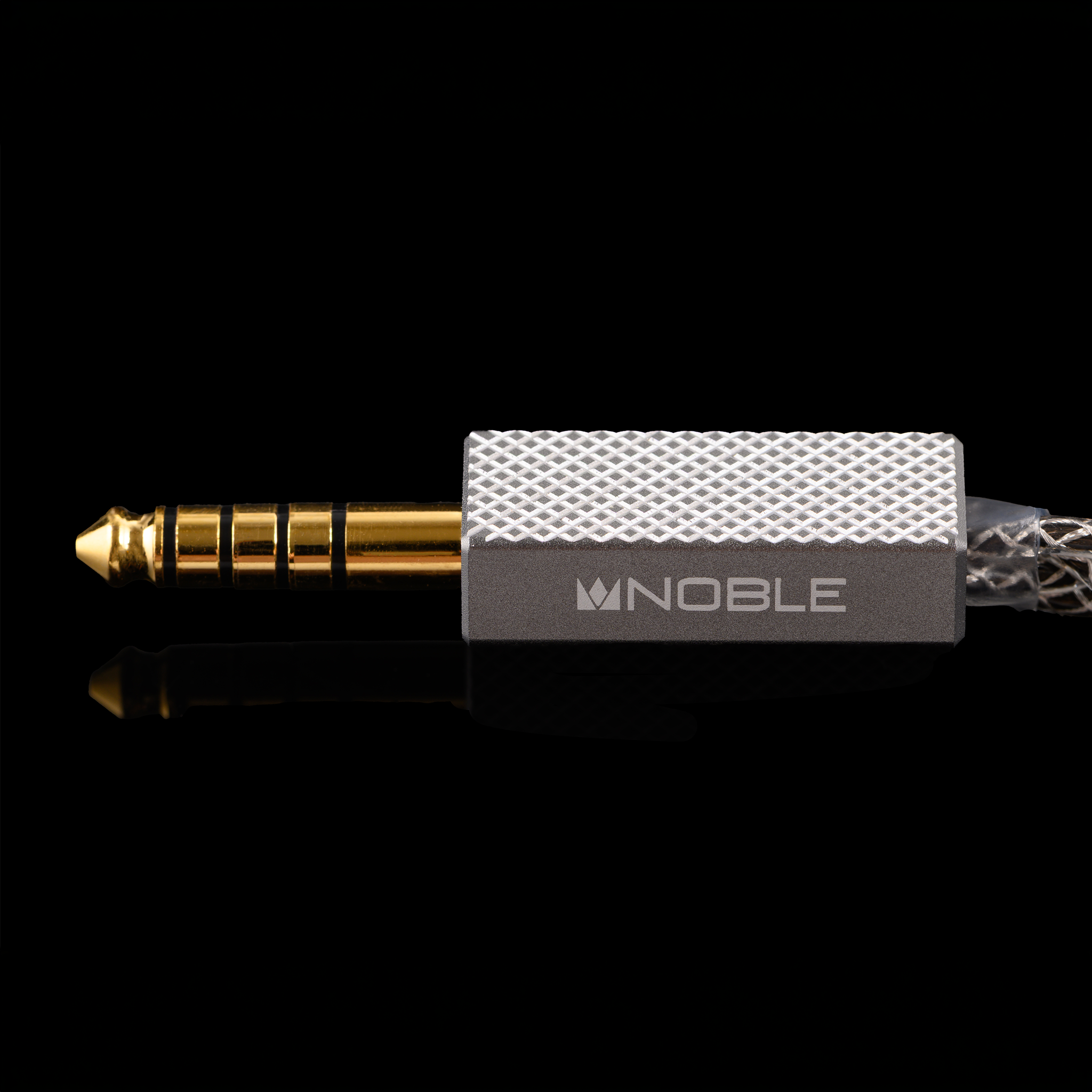
The cable is a custom job: a 1.3-meter Litz Type 4S with 3D shielding, its conductors mixing OCC silver, palladium-plated silver, and a gold-silver-copper-palladium alloy, on standard 0.78 mm two-pin connectors ending in a 4.4 mm balanced plug. No 3.5 mm adapter is listed, so single-ended listeners need their own arrangements. In the box: a leather pouch, ear tips, a warranty card, and a Noble sticker.
Context
Noble Audio was founded in 2013 by Dr. John Moulton, known in Head-Fi circles as the Wizard, and has built its name on complex driver configurations and ambitious industrial design. The Paladin was first previewed at CanJam Dallas, arriving at the end of a year in which the wired IEM category has seen a genuine resurgence.
Within Noble’s lineup, the Paladin sits below the $4,500 Kronos flagship — a titanium-bodied design pairing dynamic, balanced armature, electrostatic, and bone conduction drivers with a V-shaped presentation. The Paladin is a different proposition: resin instead of titanium, three driver families instead of four, tuned to preserve the balance of the recording. At the other end, the $699 Iris uses a single custom 10.2 mm dynamic driver and the Vanguard competes below $500 — the Paladin is the middle ground: flagship ambition with a reference brief.
Compared to Predecessors and Current Rivals
Against the Kronos, the Paladin is the more restrained sibling — $1,000 cheaper, resin instead of CNC-machined titanium, tuned for neutrality where the Kronos leans into energy and a pronounced V-shape.
The 64 Audio Ocean, at $3,999, takes the opposite approach: six drivers with dual isobaric dynamic woofers and 32 acoustic tuning combinations without EQ, for listeners who want control over a fixed interpretation of neutral. The Hercules Audio Moses, around $4,200, pairs a dynamic driver with four balanced armatures and four electrostatic tweeters in titanium shells, tuned gently U-shaped. The Campfire Audio Andromeda 10, at $1,799, is the value counterpoint — less than half the price. I recently reviewed the Astell&Kern Stella, a $3,900 flagship IEM with a 12-driver quadbrid array — a reminder of how crowded, and expensive, this summit has become.
My Take (Paper Analysis)
On paper, this is promising but genuinely risky. Twelve drivers from three families through one passive crossover is an integration problem first, a driver-count story second. The hard part is getting them to behave as one coherent transducer rather than three systems arguing over the same recording. Noble’s track record earns it the benefit of the doubt, but until independent measurements emerge, coherence is a claim, not a fact.
What concerns me is the bass. Armatures can resolve beautifully, but convincing low-frequency weight from armatures alone is one of the hardest problems in IEM design — it is why most flagships keep a dynamic woofer around. The bone conduction pair is supposed to supply the physicality, but it only works as well as the coupling allows, and that varies ear to ear. If the fit is not right, the bass foundation goes first.
The other open question is the treble. A slightly forward top end would not surprise me from planar drivers and armatures on the upper frequencies, and at $3,500, treble that calls attention to itself is a problem for long sessions. The 12 Hz to 45 kHz figure, quoted without tolerance, is marketing shorthand — it says nothing about what the Paladin does between 20 Hz and 20 kHz, where the money is.
Practically, the easy 21-ohm, 117 dB load is welcome — but the 4.4 mm-only termination means anyone on a single-ended source needs a different cable or an adapter, an extra purchase on top of an already serious price.
Who Should Watch This
If you are chasing a reference-tuned flagship and already own a 4.4 mm balanced source, the Paladin is worth watching closely — the neutral brief, the bone conduction experiment, and the chainmail build make it one of the year’s more distinctive launches. Pre-order only if you trust Noble’s house tuning and accept buying before any independent measurements exist.
For everyone else, wait. The first reviews and response graphs will answer the two questions that matter — bass weight without a dynamic driver, and coherence across three driver families — and decide whether the Paladin is a new reference point or an expensive experiment. Bass-forward listeners, and anyone on a single-ended source, should look elsewhere for now.