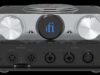








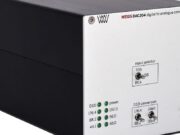








Weiss Engineering has given its compact reference DAC a new heart. The DAC204-MK2 — on sale in North America since the summer — is now reaching European dealers, and the story is a focused one: a new ESS ES9028PRO converter, a redesigned analogue output stage with near-zero output impedance, and everything else left exactly where it was, including the $3,990 price. It is available now from Weiss dealers, at $3,990 in the US and roughly €3,390 to €3,800 in Europe depending on country and distributor.
What’s New
The change that matters most is the DAC board. Out goes the original’s ESS ES9018, in comes the ES9028PRO, with four oversampling sigma-delta converters per channel working in parallel. Weiss says the redesign sets a new standard in signal fidelity — manufacturer language, but the chip change is real, and so is the engineering around it: an advanced PLL clock circuit for jitter suppression, and distortion figures and reconstruction filters fine-tuned by ear.
The analogue output stage has been redesigned alongside it, and this is the change most likely to be audible. Output impedance drops from 44 ohms balanced and 22 ohms unbalanced on the original to close to zero on the MK2, which Weiss says gives exceptionally stable interaction with high-end equipment — and, per the operating manual, better performance with difficult cables or low-impedance loads. The company also claims every component has been optimised toward a fuller, rounder tonal balance, from the clocking to the tuning. That last part is a claim about taste, not a measurement, and I will come back to it.
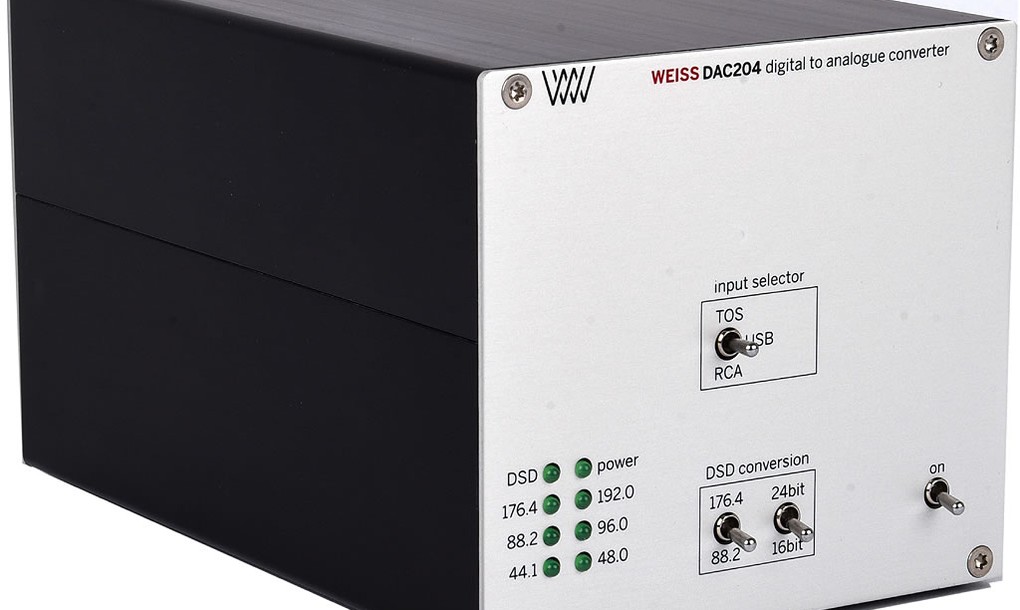
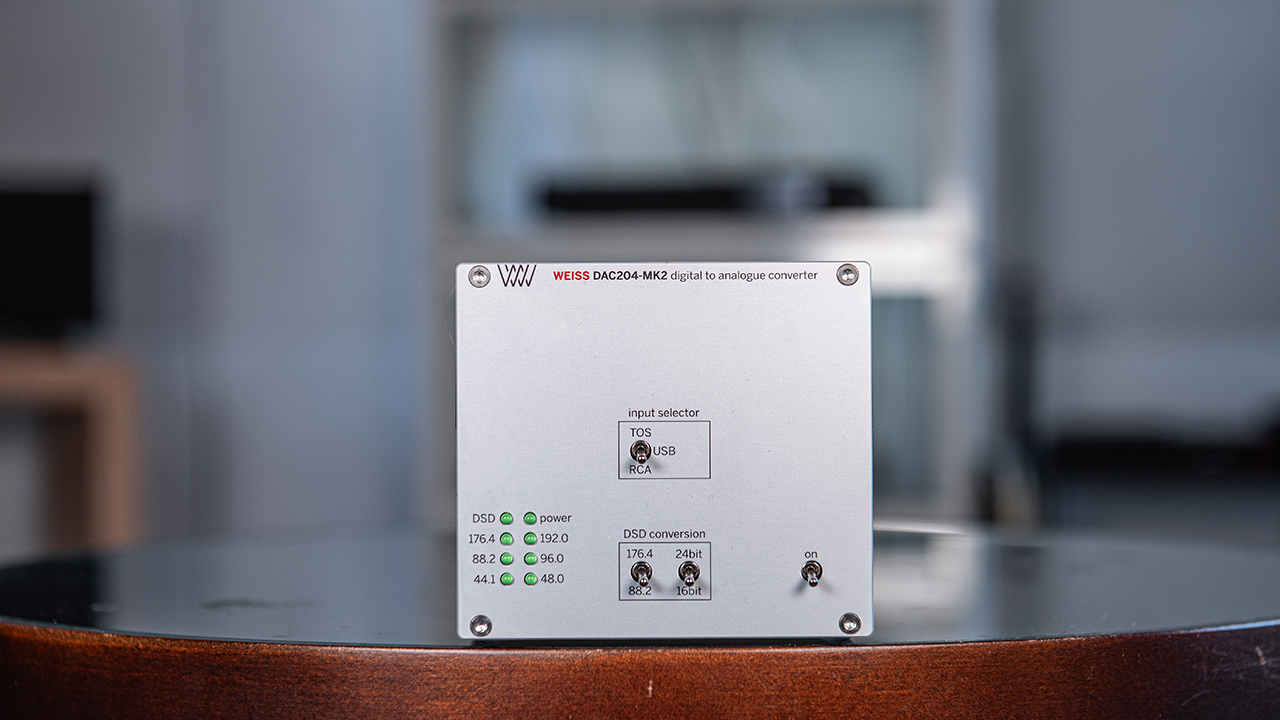
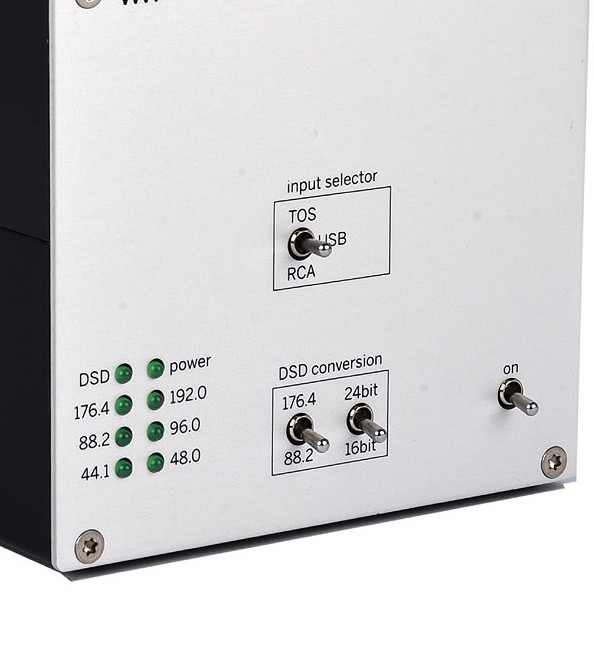
The front panel is unchanged, and deliberately so: a three-position input selector (TOS, USB, RCA), green LEDs for DSD and power sample rates, two DSD conversion toggles, and a power switch. No display, no menu, no streaming — this is a converter, not a hub.
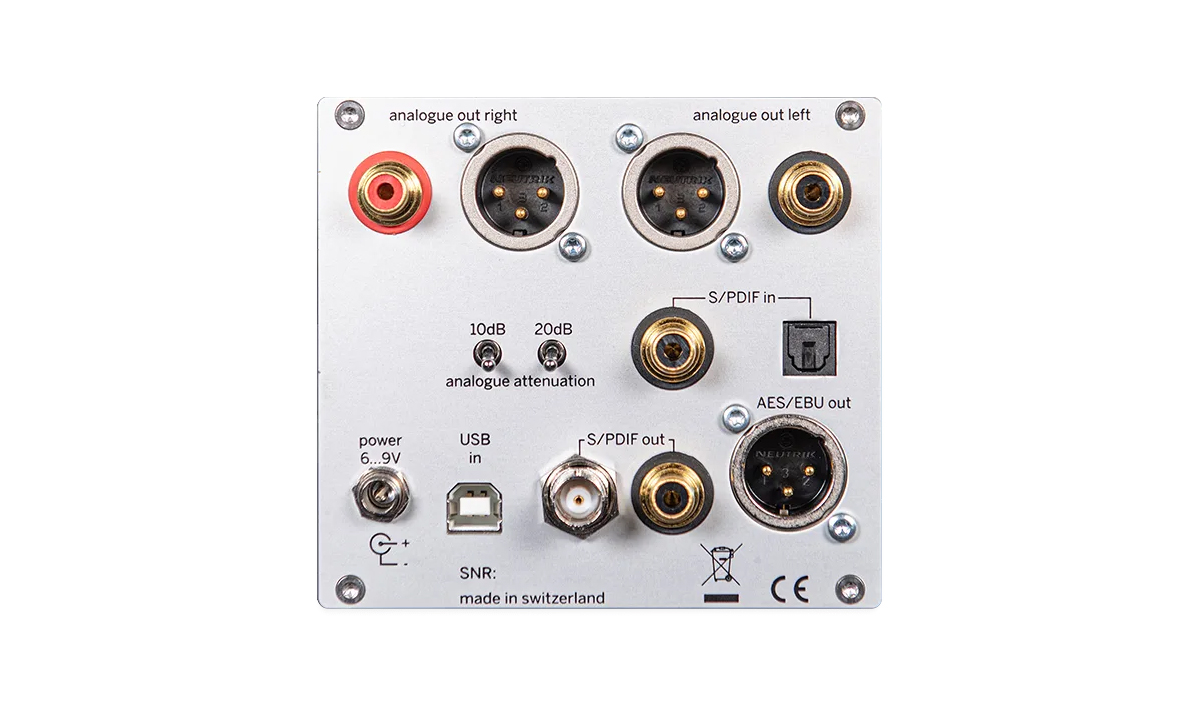
Connectivity is the same as the original, which is part of the point. Digital inputs are USB-B, two AES/EBU or S/PDIF inputs on RCA and Toslink. Over USB it takes PCM up to 384kHz and DSD64 and DSD128; coaxial RCA handles PCM up to 192kHz, Toslink up to 96kHz. Analogue outputs are balanced XLR and unbalanced RCA, both active at the same time, with output level selectable in four steps. It also works as a digital-to-digital converter, taking USB in and putting AES/EBU or S/PDIF out through XLR, RCA and BNC connectors. Casework, dimensions and file support are all carried over — the box is still 16.5 cm deep.
Context
Weiss is a mastering-house name, and the DAC204 is the compact, DAC-only box in its line — the pure converter for people who already own a streamer or transport and want Weiss conversion without paying for features they will not use. The MK2 has been on sale in North America since June; the November coverage marks its European arrival, which is why it is in the news now rather than in the summer. Existing DAC204 owners are not left behind: the dealer-installed upgrade — a new DAC board plus firmware — costs $1,395 and brings an original up to full MK2 specification.
Compared to Predecessors and Current Rivals
| DAC204-MK2 | DAC204 (original) | |
|---|---|---|
| DAC chip | ESS ES9028PRO | ESS ES9018 |
| Output impedance | Close to zero | 44Ω XLR / 22Ω RCA |
| Jitter / clocking | Redesigned PLL, enhanced suppression | Standard |
| Reconstruction filters | Fine-tuned by ear | Standard |
| Casework, I/O, formats | Unchanged | Unchanged |
| Price | $3,990 | $3,990 at launch; ~$2,230 used median |
| Upgrade path | — | $1,395 board swap to MK2 spec |
The economics are unusually fair. A used original trades around a $2,230 median, and the $1,395 upgrade lands within a few hundred dollars of a new MK2 — so the choice is between a fresh unit with a warranty and a converted one, not between a bargain and a rip-off. Against other DACs at this price, the MK2 competes on conversion quality alone: no streaming, no DSP, no display. That is the whole pitch, and it only works if the DAC itself is the priority.
My Take (Paper Analysis)
On paper, this is the most honest kind of MK2: a new DAC board and a better output stage, nothing else touched, price untouched. The near-zero output impedance is the change that matters most in practice — the original’s 44-ohm balanced output was already low, but near-zero removes the last excuse for cable and load interactions. The ES9028PRO is a known quantity, and four converters per channel in parallel is a real, if familiar, way to buy down noise. What concerns me is the tonal claim: Weiss talks about a fuller, rounder balance, while the one independent review so far — The Music Room, in March — describes the sound as precise, structured and neutral, with clean, well-controlled transients and no digital edge. The two accounts are not contradictory — a DAC can be neutral and still sound fuller than its predecessor — but until more ears weigh in, treat the rounder-balance line as marketing. The upgrade path is the smartest part of the whole launch: it keeps used originals valuable and gives owners a real choice instead of a forced replacement.
Who Should Watch This
Owners of the original DAC204 should look at the $1,395 upgrade first — same box, new board, full MK2 specification, installed by the dealer. Anyone building a separates system around a streamer or transport should look at the MK2 itself: a pure, Swiss-made converter with mastering heritage and a digital-converter mode thrown in. Skip it if you want streaming, a display or DSP in the box — Weiss sells bigger boxes for that, and this one deliberately has none of it. Buyers in Europe should expect €3,390 to €3,800 depending on country and distributor; the US price is $3,990.