
















Why the RT87 Matters
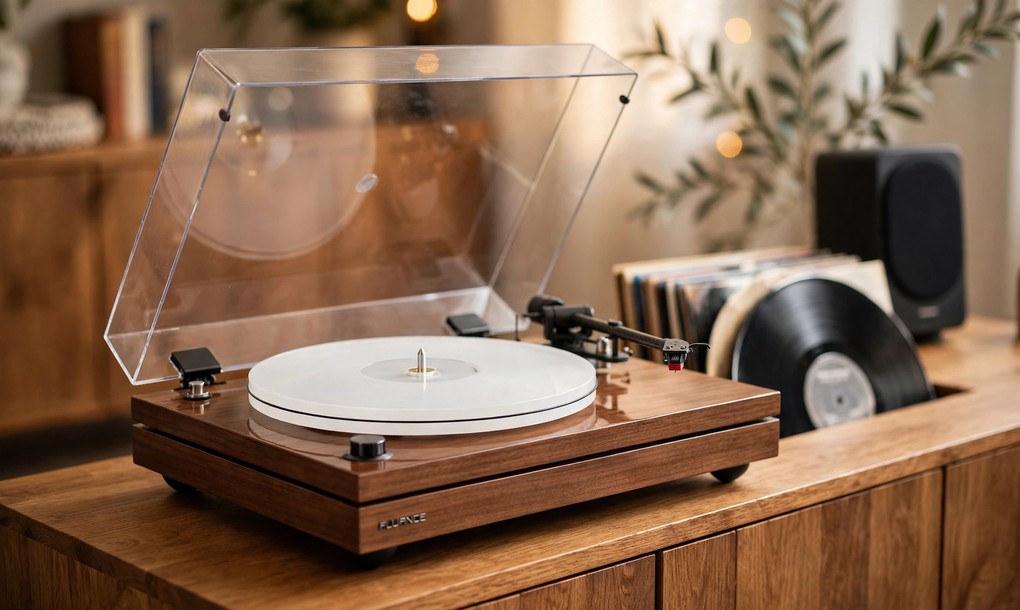
Fluance has never sold a turntable like this before. The RT87, launched on June 15, 2026, is the company’s flagship deck: a dual-plinth belt-drive turntable with a carbon fiber tonearm, a heavy acrylic platter and a choice of two respected cartridges, all for $799.99. It sits above the $549.99 RT85N, aimed at the listener who wants a serious, upgradeable deck without crossing the $1,000 line. I covered the launch when it reached Europe at £699; this is the follow-up that matters more, the review.
One thing to get straight before anything else: I have not heard the RT87 in my own system, and this article does not pretend otherwise. What follows is a synthesis of four full independent reviews and two shorter hands-on verdicts, checked against Fluance’s own specifications. I read them all and put the agreements and the disagreements side by side. The picture that emerges is unusually consistent: this is a composed, quiet, well-built turntable with one real weakness, and it is not the sound.
Design and Build: Two Plinths, One Idea
The RT87’s headline feature is its dual-plinth construction: an upper MDF slab 0.83 inches (21 mm) thick carrying the tonearm, spindle and platter, and a lower slab 1.42 inches (36 mm) thick carrying the motor, separated by conical isolators. The idea is simple: keep the motor’s vibration on one layer and the record on the other. Fluance adds a 7-point silicone isolation system with a decoupling ring around the bottom-mounted motor, so the motor is isolated twice over.
It shows in use. One reviewer tapped the lower plinth during playback and heard barely anything through the speakers, and footfalls on a wooden floor were largely inconsequential. Another found the isolation handled footfalls, room vibrations and energy from nearby speakers. That is the dual plinth earning its keep, and the single biggest structural difference from the RT85N below it.
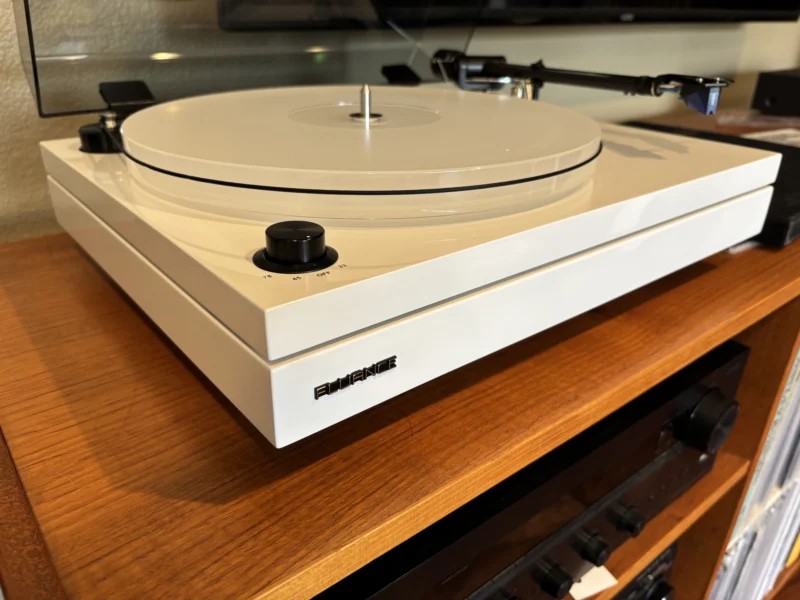
The deck comes in Piano Black, Piano White and Natural Walnut. At 6.3 x 16.5 x 14.25 inches and 21 lb (9.5 kg) it has real presence on a shelf. The 12-inch acrylic platter weighs 4.1 lb (1.85 kg) and stands 0.86 inches (22 mm) tall; no mat is required. Conical feet adjust easily for levelling, and a tinted dust cover with hinges is included. The one build complaint is the cover: it opens and closes smoothly, but the hinges lack the slow glide of costlier decks and let the lid drop — a small thing you notice every day.
Tonearm and Cartridge: The Upgrade That Counts
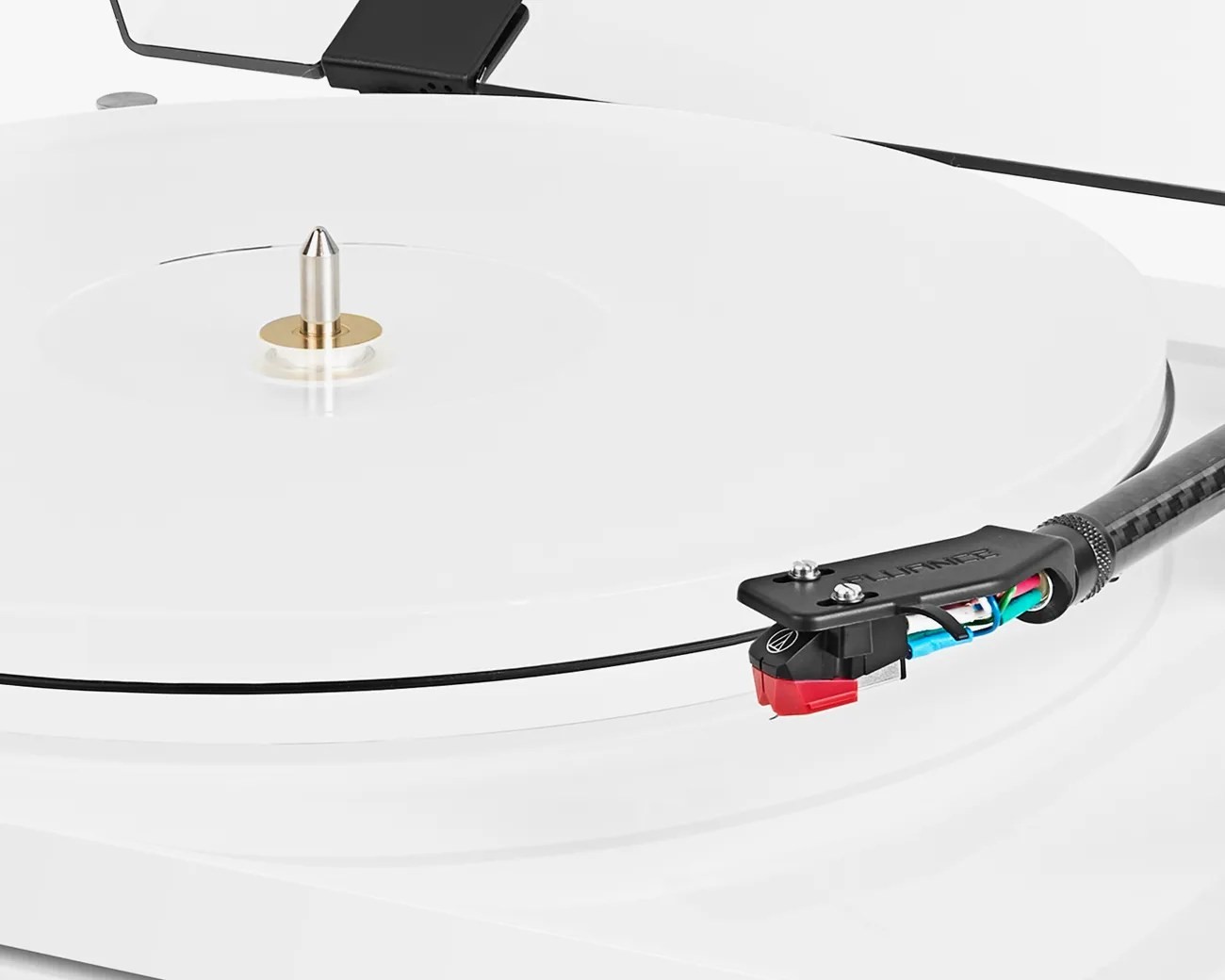
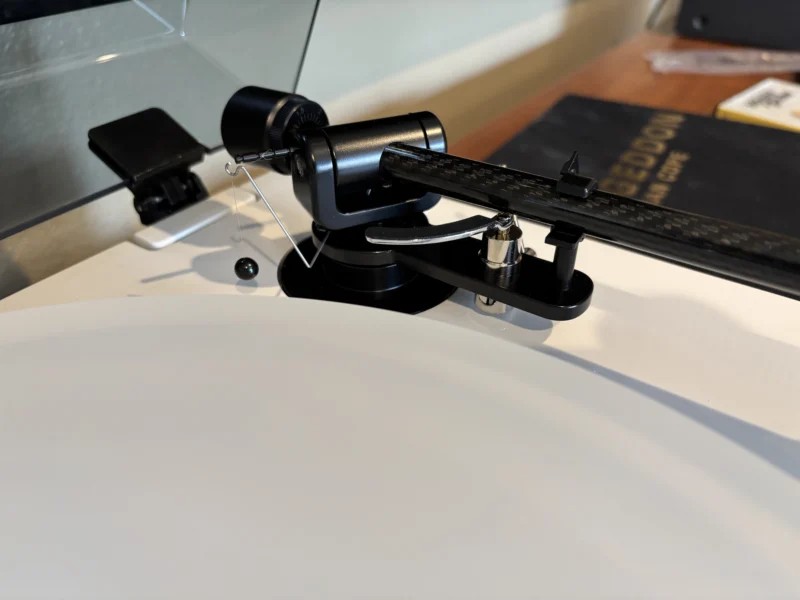
If the plinth is the RT87’s headline, the tonearm is its heart. It is a static-balanced, straight, one-piece carbon fiber tube, 9 inches long with a 230 mm effective length — the change the RT85 owners who tested this deck kept coming back to. One long-time RT85 owner called it the greatest improvement over his old deck, and the listening notes back that up: a quieter background between notes, better separation in busy passages, a more solid center image, tighter and more impactful bass, and a touch more high-frequency detail.
The arm is built to be adjusted. Vertical tracking angle moves over 6 mm. The headshell is a removable H-4 bayonet type, so cartridge swaps take minutes. The supplied 106 g counterweight suits cartridges from 5.0 to 9.5 g, with 86 g and 134 g weights available outside that range. Inside the arm, the signal travels on P Triple C 36 AWG Litz wire in 7-strand twisted pairs. Anti-skate is a hanging weight on a thread, set over one of four notches per a table in the manual — old-school, and fiddly to thread the first time.
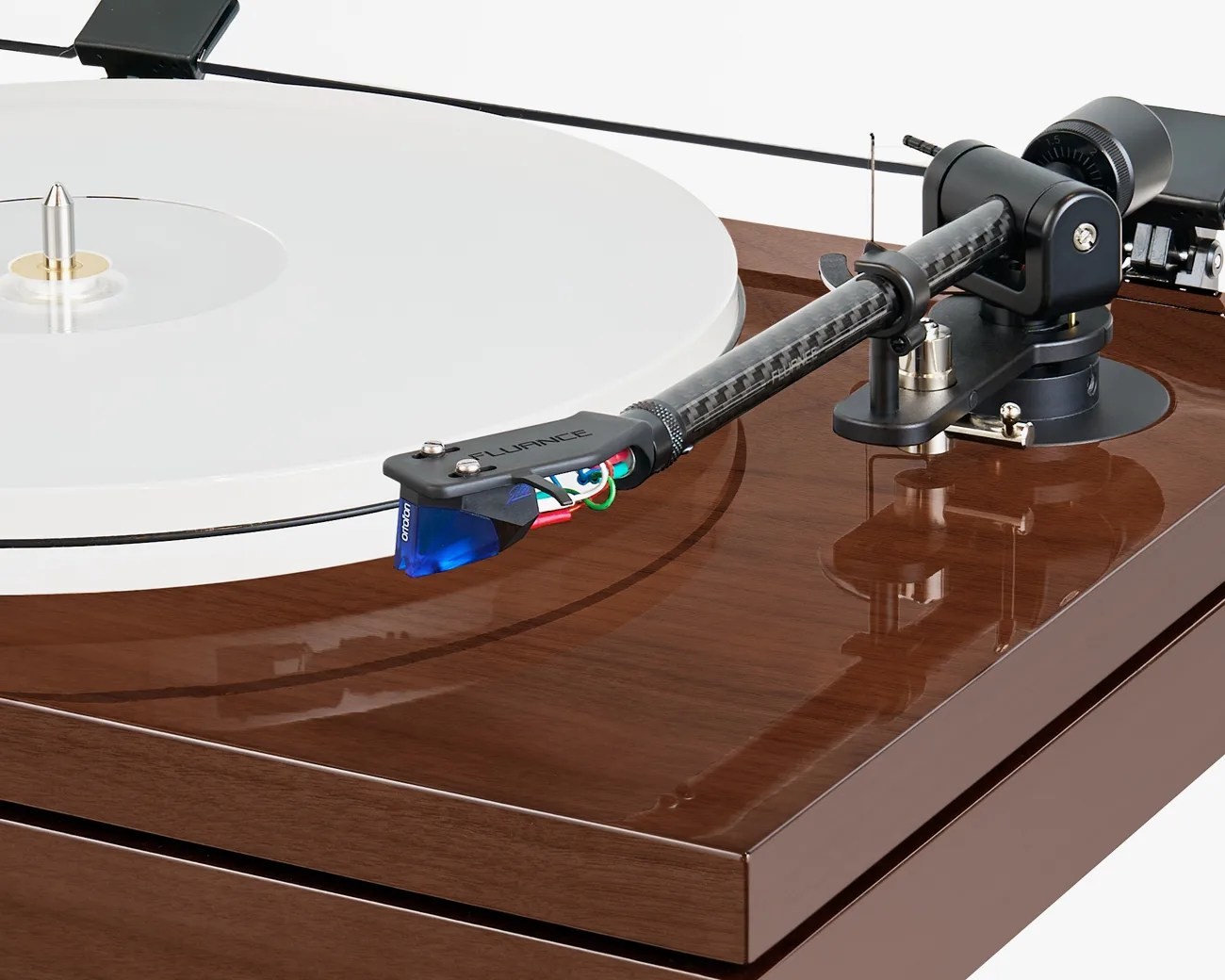
Then there is the cartridge choice, which is unusual at this price: Fluance lets you pick the Ortofon 2M Blue or the Audio-Technica AT-VM95ML at the same $799.99. The 2M Blue carries a nude elliptical stylus (0.71 x 0.31 mil) on an aluminum cantilever, with 5.5 mV output and a 20–20,000 Hz response. The VM95ML carries a nude square-shank Microlinear stylus (2.2 x 0.12 mil), also on aluminum, with 3.5 mV output, a 20–25,000 Hz response and 23 dB separation at 1 kHz. The 2M Blue alone sells for about $220, so a large share of the price is sitting at the end of the tonearm. My reading is straightforward: take the 2M Blue for the warmer, more forgiving all-rounder, and the VM95ML for fine detail retrieval and the Microlinear profile’s long stylus life. Either way, you pay nothing extra for the choice.
Motor, Speed and Isolation
The RT87 is a belt-drive deck with a DC servo motor that checks its speed 500 times per second. It plays 33⅓, 45 and 78 RPM — the 78 speed matters, because most decks under $1,000 skip it. Fluance specifies speed variation of 0.08% / 0.06% / 0.01% across the three speeds, wow and flutter of 0.06%, a weighted signal-to-noise ratio of 71 dB with the 2M Blue (69.5 dB with the VM95ML) and rumble below −58 dBA.
An independent lab check tells a slightly different story, and it is worth reporting plainly. Measured with an RPM app on a phone, the deck ran 33.50 rpm at the 33⅓ setting (+0.50%), 45.23 rpm at 45 (+0.51%) and 78.36 rpm at 78 (+0.47%), with wow of ±0.21%, ±0.10% and ±0.07% respectively. Two things matter. First, the error is consistent — about half a percent fast at every speed — which points to a systematic offset rather than instability. Second, the reviewer who measured it judged the result not bad against other turntables tested the same way. The wow figures run higher than Fluance’s 0.06% claim. Speed performance is good, not class-leading: a pitch-sensitive listener may notice the half-percent lift, and everyone else will hear a stable, quiet deck.
How It Sounds
Across all six reviews, the same words keep appearing: composed, balanced, quiet, spacious. No reviewer called the RT87 bright, warm, or colored in any strong direction. Vocals sit naturally in the center, bass is tight and controlled rather than big, and the soundstage is wide and stable. Imaging on jazz and classical was called precise and stable, and the background between notes genuinely quiet — the dual plinth and the heavy platter doing their job.
The listening notes are specific enough to trust. On Steely Dan’s “Hey Nineteen,” one reviewer heard dynamic punch with crisp staccato guitar, bass and keyboard across a wide soundstage. On Crosby, Stills & Nash’s “Guinnevere,” crisp guitars and a well-rounded tone left the vocal floating in three dimensions. Talking Heads’ “Crosseyed and Painless” delivered a visceral, centered snare and deep, clean bass. Pantha du Prince’s “Lay in a Shimmer” sounded spacious, with a sense of height the reviewer called unusual for stereo.
Against the RT85, the improvement is real but measured. The owner who compared them directly found the RT87 quieter, better separated, more solidly centered and tighter in the bass — then added that the dual-plinth difference is a refinement, not a night-and-day change. The RT87 is the better deck, and the RT85 is not suddenly a bad one.
Setup: The One Place It Asks for Patience
Every review agrees: setting the RT87 up takes longer than you expect, and the manual’s own sequence is part of the reason. Fluance asks you to balance the tonearm before installing the platter, and one reviewer found that took an unreasonable amount of time, with very fine counterweight adjustments and tracking-force markings that were hard to read even with a phone magnifier. Looping the round belt onto the pulley takes patience, and the supplied bubble level was called mediocre. The round belt drew the sharpest complaint of any review: it feels cheap and flimsy, does not grip as well as a flat belt, and often pulls off with the record when you lift an LP — every few albums, by one owner’s count. That is genuinely annoying on an $800 deck, and the one flaw I would fix first if I were Fluance.
Setup’s kinder side: conical feet adjust easily, instructions are clear, startup is fast and the metal cueing lever moves smoothly. Fluance recommends a 24-hour turntable and 20-hour cartridge break-in before judging the sound. My advice to a first-time buyer is simple: budget an unhurried hour, do it on a clear table in good light, and have a cheap digital tracking-force gauge on hand.
Connections and What’s in the Box
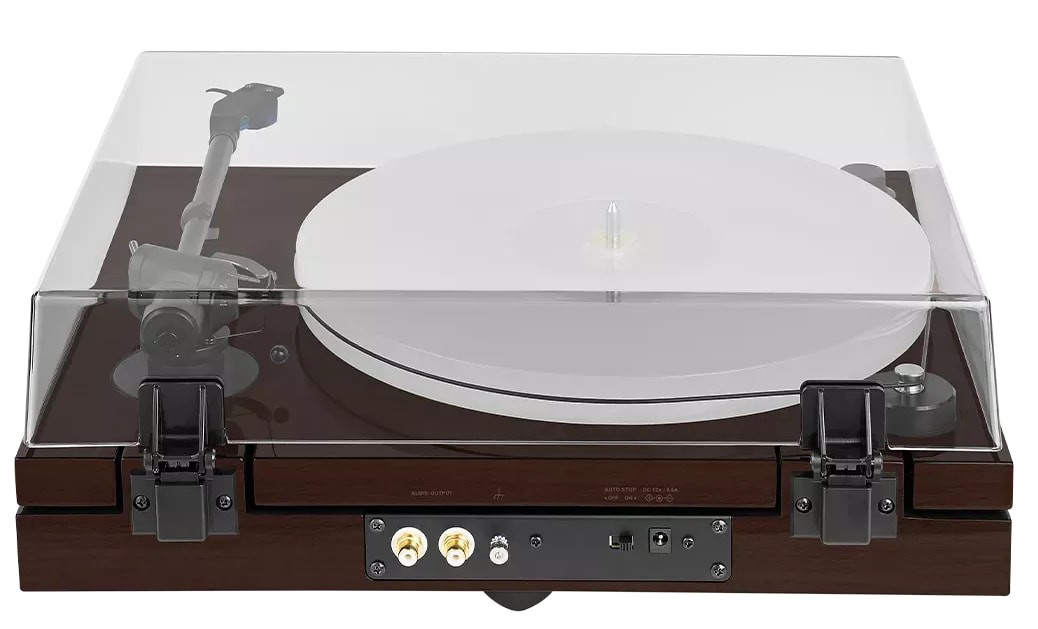
There is no built-in phono preamp, no Bluetooth and no USB. What you get is a gold-plated RCA phono output and a ground terminal on the rear panel, alongside an auto-stop switch and a 12 V DC power input. The RT87 needs a phono input on your amplifier or a separate phono stage; Fluance’s own PA10 costs $99.99 and is the obvious partner. The auto-stop is a motor stop only: 40 seconds after the stylus reaches the run-out groove, the platter stops. The arm does not lift or return, so this is a manual deck in daily use, not a semi-automatic one.
The box is complete: turntable, tinted dust cover and hinges, acrylic platter, round belt, headshell with your chosen cartridge fitted, anti-skate weight, counterweight, 5 ft AC adapter, 3 ft 90 pF RCA cable, 3 ft ground wire, bubble level, 2 mm VTA hex wrench, transit screw hole covers, manual, a 2-year warranty and lifetime customer support. Power is 100–240 V AC through a 12 V / 500 mA supply, drawing 1.5 W. Nothing essential is missing — except the phono stage, which you may still need to buy.
Against the Competition
| Turntable | Price | Drive | Cartridge | Phono stage | Speeds |
|---|---|---|---|---|---|
| Fluance RT87 | $799.99 | Belt | Ortofon 2M Blue or AT-VM95ML | None | 33⅓ / 45 / 78 |
| Technics SL-50C | $899.99 | Direct | Ortofon 2M Red | Built-in, switchable | 33⅓ / 45 / 78 |
| Pro-Ject Debut PRO | $999 | Belt | Sumiko Rainier | None | 33⅓ / 45 (78 with round belt) |
| Audio-Technica AT-LP7X | $999 | Belt | AT-VM95E | Built-in MM/MC | 33⅓ / 45 |
| Fluance RT85N | $549.99 | Belt | Ortofon 2M Blue | None | 33⅓ / 45 |
The closest rival is the Technics SL-50C at $899.99, compared directly by one reviewer. The Technics matched the RT87 for dynamics and drive, but its soundstage was less open, it gave up some detail, and its vocals had a slight edge the Fluance did not. The SL-50C answers with a coreless direct-drive motor, a built-in phono stage and push-button speed change, for $100 more. One catch: the SL-50C plays 78 RPM, but its included 2M Red cartridge does not support 78 records. The same applies to the RT87 — neither the 2M Blue nor the VM95ML is a 78 stylus — so shellac collectors will still need a dedicated one. The spec sheet alone makes both decks look more 78-ready than they are.
The Pro-Ject Debut PRO, at $999, is the other natural comparison: belt drive, a one-piece carbon-aluminum tonearm, a Sumiko Rainier cartridge and no built-in phono stage. One reviewer also compared the RT87 with Pro-Ject’s $1,499 Debut Reference 10 and found the Fluance reminded him of it — balanced, full-bodied and spatial — calling the RT87 tremendous value at nearly half the price. Note the original Debut PRO is being replaced by the PRO B and PRO S variants, so check which version a dealer is selling at $999.
The Audio-Technica AT-LP7X, also $999, takes the opposite approach: a fully manual belt-drive deck with a built-in switchable MM/MC phono stage, a J-shaped aluminum tonearm and a 20 mm acrylic platter — but only two speeds and the entry-level AT-VM95E cartridge. It is the better pick if you need a phono stage built in; the RT87 wins if you already own one and want the better arm and cartridge.
Then there is the RT85N at $549.99 — the same 2M Blue, a single plinth, $250 less. The owner who upgraded put it plainly: the RT87 is worth it, absolutely, but the RT85 is not made obsolete. The $250 buys a more refined, more dialed-in, more future-proof platform. If your budget stops at $550, buy the RT85N without regret; if it stretches to $800, the RT87 is the better deck.
Who Should Buy It — and Who Shouldn’t
Buy the RT87 if you are stepping up from an entry-level deck and want a turntable you can grow with: the VTA adjustment, the removable headshell, the counterweight options and the cartridge choice all point the same way. Buy it if you play 78s, or think you might. Buy it if you already own a phono stage, or are happy to add a $100 one like the PA10. And buy it if a quiet background and a wide, stable soundstage matter more than push-button convenience.
Do not buy it if you want plug-and-play. There is no built-in preamp, no Bluetooth, no automation, and setup asks for an hour of your attention. If this is your first turntable and balancing a tonearm sounds like a chore rather than a pleasure, the Technics SL-50C — or the simpler RT85N — will make you happier. And if your budget is truly $550, do not stretch for the RT87 on credit; the RT85N gives you most of the sound for $250 less.
My Take
Let me be clear about what this verdict is. I have not listened to the Fluance RT87. This is a paper analysis — a synthesis of six independent reviews and Fluance’s own specifications — not a listening verdict from my own system.
The RT87 is the strongest all-round manual turntable under $1,000 in the current reviews. Its case rests on four things every reviewer agreed on: a quiet, composed sound with a wide soundstage; a dual-plinth build that genuinely isolates the record from the motor and the room; a carbon fiber tonearm with real adjustment range; and a cartridge choice that costs nothing extra. 78 RPM support and the upgrade path are real bonuses.
Its weaknesses are consistent across the reviews. Setup takes patience, and the manual’s sequence makes it slower. The round belt feels cheap and can lift off with a record. The dust-cover hinges let the lid drop. There is no built-in phono stage, so budget $100 more if your amplifier has no phono input. And the measured speed runs about half a percent fast, even if it is stable.
None of those flaws changes the conclusion. At $799.99, with your choice of a 2M Blue or a VM95ML fitted, the RT87 gives you the sound and build of decks that cost half as much again. One review gave it a perfect 10/10 and an Editors’ Choice award, calling it the best table it had tested in years. I would not go that far on paper alone — but on this evidence, if you want the best-sounding manual turntable under $1,000 and you do not mind an hour of setup, this is the one to buy.