






















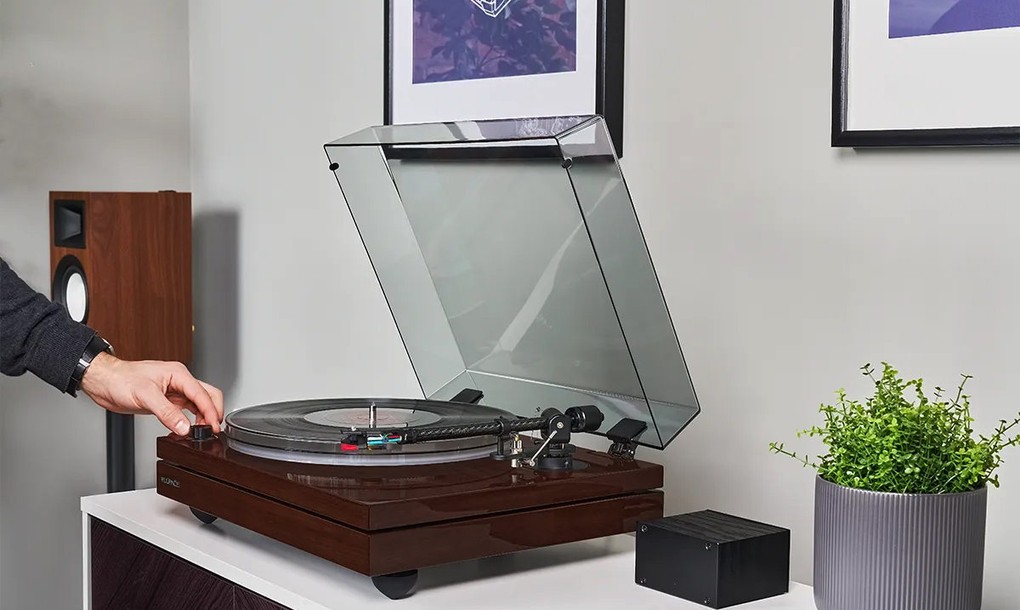
Fluance’s flagship turntable has crossed the Atlantic. The RT87, the Canadian company’s reference dual-plinth deck, is now on sale in Europe at £699 or €699, five months after its June 2026 US launch at $799. It arrives as the most serious turntable Fluance has built: a two-layer MDF plinth, motor isolated below, a one-piece carbon fibre tonearm, a 22mm acrylic platter, and a choice of two moving-magnet cartridges — the Audio-Technica AT-VM95ML or the Ortofon 2M Blue — fitted at the factory. Finishes: natural walnut, piano black and piano white. It has no phono preamp, so a separate stage or an amplifier with a phono input is part of the deal.
What’s New
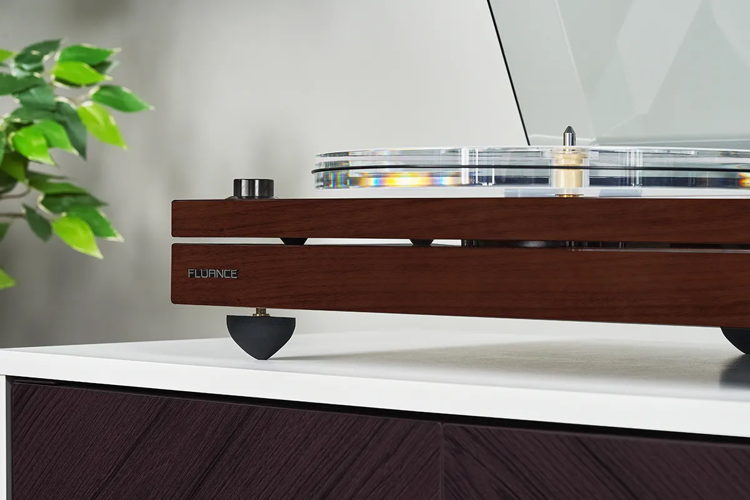
The headline is the cabinet. The RT87 splits its MDF plinth into two layers — a 36mm lower plinth and a 21mm upper layer — separated by conical isolators. The motor sits on the lower section while the spindle, platter and tonearm ride above it, so motor vibration must cross the isolation layer to reach the stylus. The motor itself gets seven-point silicone isolation and a decoupling ring. The published numbers point that way: weighted signal-to-noise of 69.5dB with the Audio-Technica and 71dB with the Ortofon, rumble below −58dBA, and wow and flutter of 0.06%.
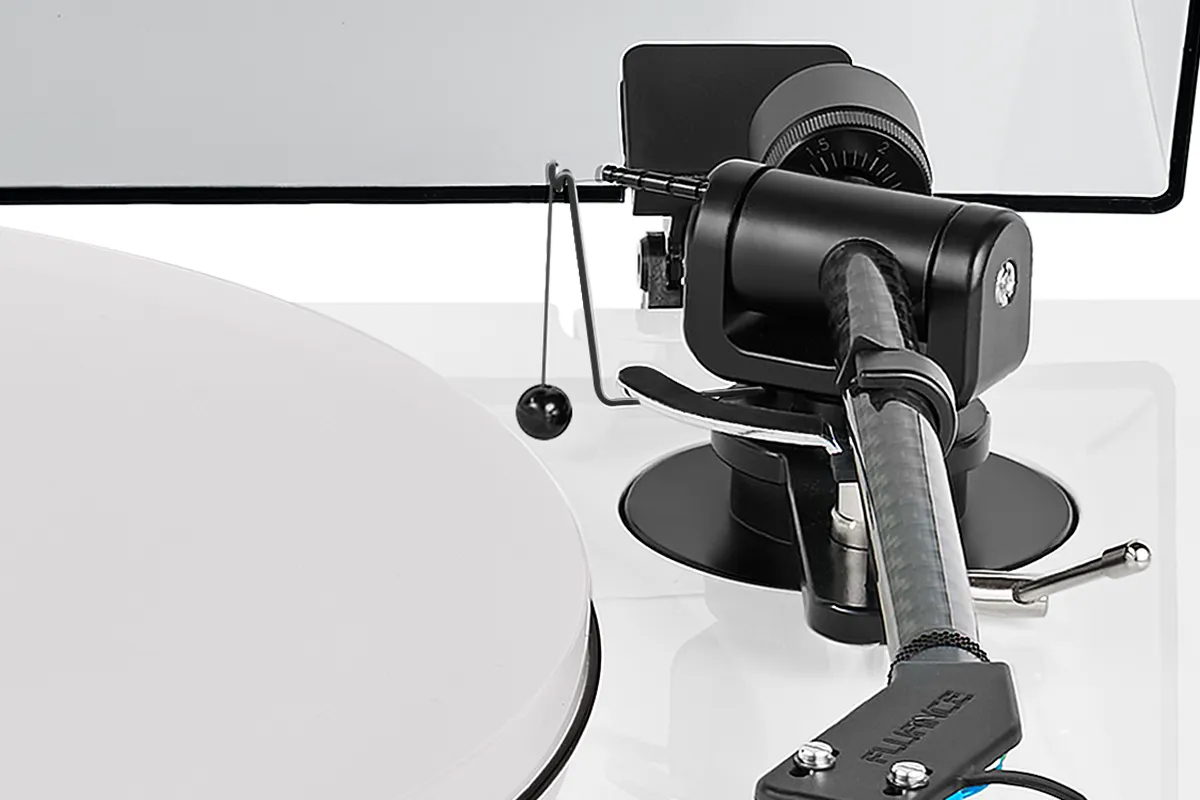
The arm is a straight, one-piece carbon fibre tube with a 230mm effective length, chosen for low mass and rigidity. It carries a removable H-4 bayonet headshell and offers adjustment usually found a price band higher: vertical tracking angle adjustable over 6mm, and anti-skating by a hanging weight on a thread, so the stylus tracks both groove walls evenly. Cartridges from 5g to 9.5g fit, leaving room to upgrade later. The whole deck measures 42.0 by 36.2 by 16.0cm and weighs 9.5kg, with a tinted dust cover, RCA cable, ground wire, bubble level and VTA tool in the box.
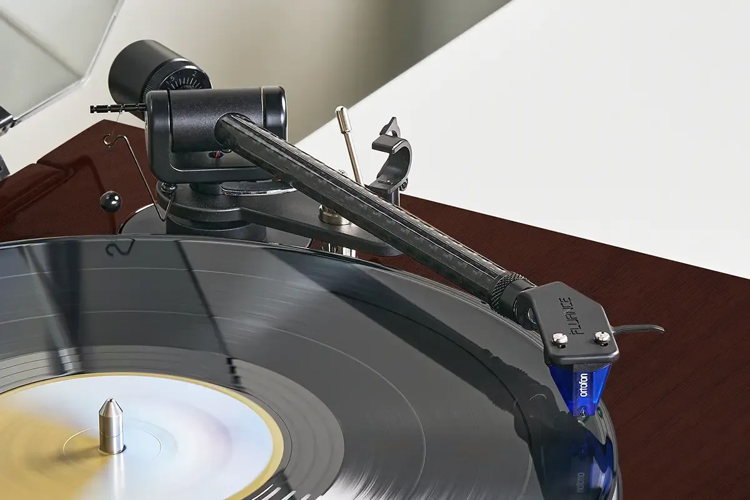
The two cartridge choices are different. The Audio-Technica AT-VM95ML uses a Microlinear stylus with a 20Hz–25kHz response and 3.5mV output, while the Ortofon 2M Blue pairs a nude elliptical stylus with a 20Hz–20kHz response and a hotter 5.5mV output. Both are moving-magnet designs with aluminium cantilevers, and both ship pre-installed. Under the record sits the 22mm acrylic platter, weighing 1.85kg — heavy enough to hold rotational inertia, and damps vibration so no slipmat is needed. A servo-controlled DC motor checks speed 500 times a second, with 33⅓, 45 and 78rpm from a front selector. Operation is fully manual: CNC metal cueing lever, auto-stop that halts the platter only, no arm lift or return. Connections are gold-plated RCA sockets with a ground terminal.
Context
Fluance launched the RT87 in the US in mid-June 2026 as its Reference-series flagship, above the RT85N at $549.99. Early verdicts arrived over the summer: TechRadar gave its sound quality 5 out of 5, calling it glorious once set up, while marking setup down as finicky — the anti-skate weight and the belt need patience. Tom’s Guide reached a similar conclusion in August, judging it a strong-value contender among turntables under $1,000. The European debut closes a five-month gap; at the time of the US launch, UK availability was listed only as coming soon. Do not confuse it with the RT86, a cheaper model at £599, €719 and $699, launching in the US on November 20 and in Europe on December 10.
Compared
Inside Fluance’s own range, the step down is the RT85N at $549.99 — a belt-drive deck with an acrylic platter and the Ortofon 2M Blue, but without the dual-plinth cabinet, the carbon fibre arm or the cartridge choice. The $250 gap buys the isolation and the arm. Outside the brand, eCoustics lines the RT87 up against Denon’s DP-500BT at $899.99, a $100-more deck from a bigger name. The RT87’s case rests on its build: a heavier plinth, a heavier platter and a more adjustable arm for less money, provided you already own a phono stage. Neither changes the RT87’s main trade-off, the one TechRadar flagged: this is a manual deck that asks for setup time in exchange for sound.
My Take
Paper analysis — I have not heard the RT87, and my judgement here rests on the published specifications and the two independent reviews, not on a listening session. The engineering budget went into vibration control: the dual plinth, the isolated motor, the heavy acrylic platter and the rigid carbon arm are a coherent story, and TechRadar’s 5-out-of-5 sound score suggests the story holds up in a real room. The caveats are the setup — the hanging-weight anti-skate and the belt are fiddly by every account — and the missing phono stage, which adds roughly $100 for Fluance’s own PA10 if you do not already own one. At £699, European buyers pay noticeably more than the US $799 sticker once converted, but it remains the cheapest way into this level of build. Worth an audition if you already have a phono stage and a steady hand; wait if you want plug-and-play.
Who Should Watch
Vinyl listeners stepping up from an entry-level deck should look first — the RT87 is built for exactly that move, provided a phono stage is already in the rack. Owners of Fluance’s RT85 or RT82 who want a sturdier, more adjustable deck have a clear upgrade here. If your system is built around streaming, or you want Bluetooth, automatic operation or a built-in phono stage, this is not your turntable — the RT87 is manual in every sense. And if setup patience is in short supply, know about the fiddly anti-skate weight before the box arrives.