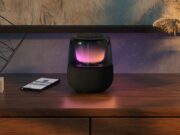



















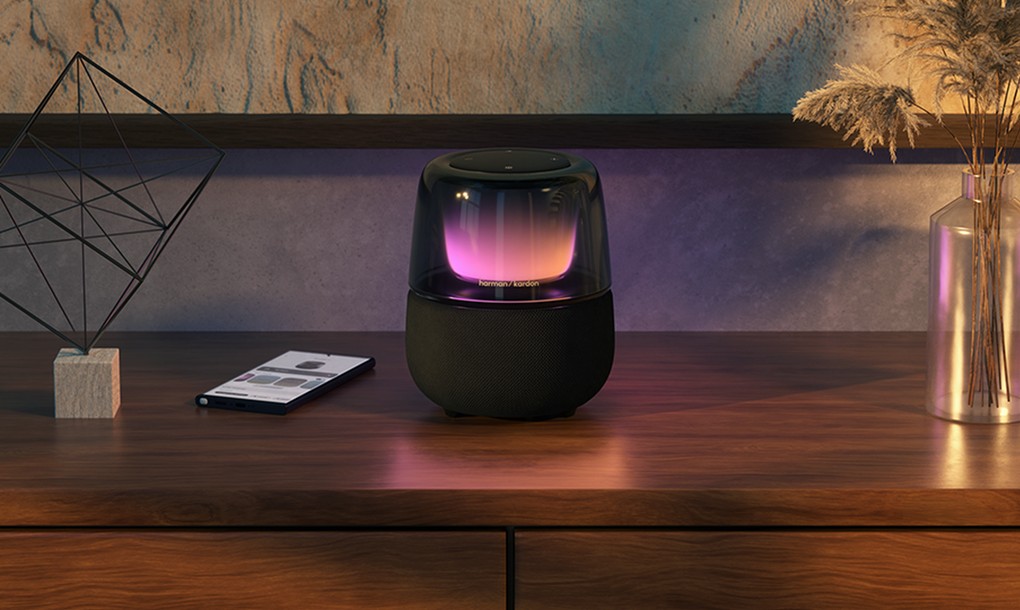
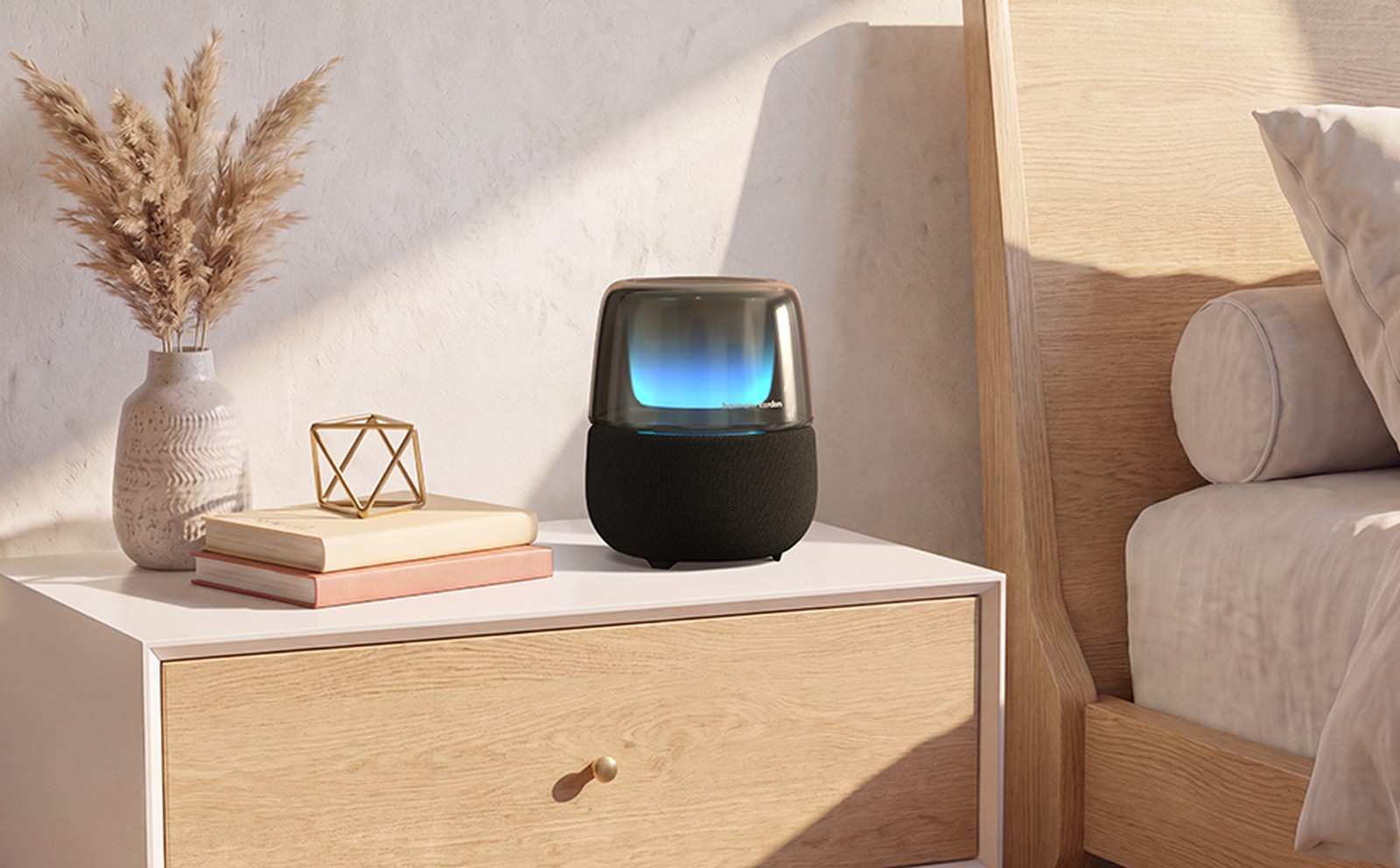
Harman Kardon has a new Allure, and the name is about the only thing it kept from the original. Unveiled in Japan on 19 November 2026, the Allure 2 is a compact home speaker built around the transparent dome that made the SoundSticks famous, shrunk into a single 20 cm tall unit. It costs 34,100 yen (about $215), ships in Japan from 26 November, and for now Japan is the only place you can buy one — Harman Kardon has said nothing about the rest of the world.
What’s New
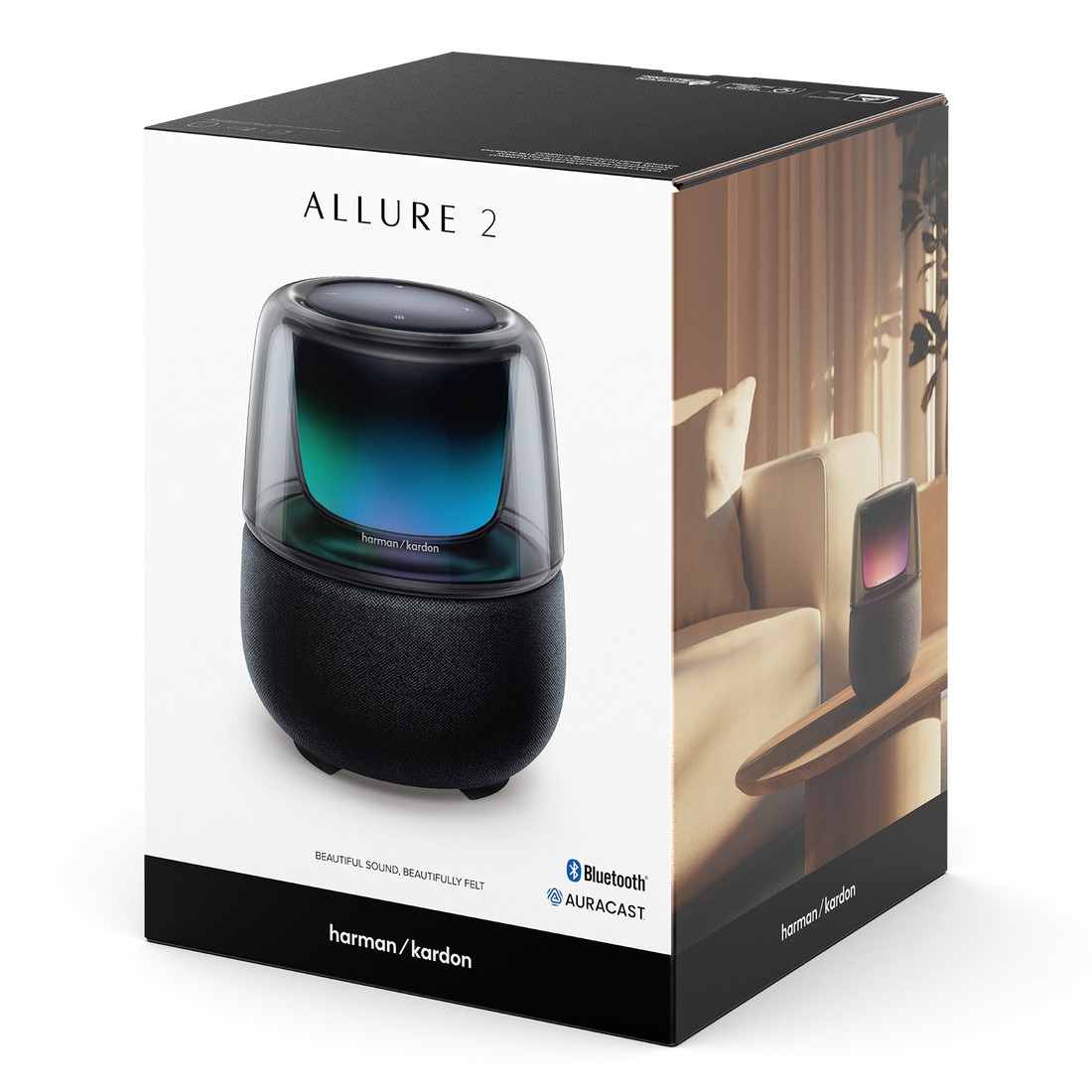
The hardware is straightforward. Three 1.5-inch full-range drivers and one 3.5-inch woofer share 60 watts — 30 watts for the full-range array, 30 for the woofer — with a rated response of 40 Hz to 20 kHz (-6 dB) and an 80 dB signal-to-noise ratio. The box is 16.6 by 16.6 by 20.3 cm, weighs 2.2 kg, and runs on mains power. A USB-C port is listed in the spec sheet, though Harman Kardon does not say what it is for. The box holds the speaker, a power cable, a quick start guide and a safety sheet — nothing else, which fits a product that needs no setup beyond plugging in and pairing a phone.
The features around that hardware are where the Allure 2 earns its name. AI Sound Boost analyzes the music in real time and adjusts the output for deeper bass and richer dynamics while keeping distortion down, or so Harman Kardon claims. Bluetooth 5.4 connects to two devices at once, so a second phone can take over without re-pairing. Two Allure 2s pair for stereo, and Auracast lets a network of them play the same music in sync around the house, all managed from the Harman Kardon One app.
Then there is the light. A 360-degree ambient ring inside the transparent dome glows in time with the music, and the app controls its brightness, color and effects, plus the EQ. Harman Kardon pitches the whole thing as relaxation as much as sound — a speaker that sets a mood, not just plays into a room. The drivers use recycled plastic, recycled aluminum and recycled neodymium magnets, and the packaging is FSC-certified paper printed with soy ink.
Context
The first Allure arrived in 2017, and it belonged to a different era: a voice-activated speaker built around Amazon Alexa, with Wi-Fi, a four-microphone array and Bluetooth 4.2. It sold until 2021. The Allure 2 drops the voice assistant and the Wi-Fi entirely. It is a Bluetooth speaker now, and a simpler product for it — no account, no network setup, no microphone listening from across the room.
That is a telling shift. In 2017 every home speaker needed a voice assistant to justify itself; in 2026 Harman Kardon is betting the design and the light are enough. The transparent dome itself goes back further, to the SoundSticks of 2000, and it has been the company’s visual signature ever since — through the Aura Studio line and now the Soundsticks 5, reviewed here last December. The Allure 2 is the smallest, cheapest member of that family: a single dome instead of a system, at about $135 less than a Soundsticks 5 set.
One curiosity: the headline numbers are unchanged from the original. The 2017 Allure was also rated 60 watts with a 40 Hz to 20 kHz response. The difference is everything around those numbers — the drivers, the Bluetooth, the lighting, the app — not the numbers themselves. At ¥34,100 the Allure 2 also undercuts most of Harman Kardon’s own home line, which makes the Japan-only decision harder to understand from the outside: this is the cheapest way into the company’s current design language, and the one market that cannot buy it yet is everyone else.
Compared
| Model | What it is | Price | Power |
|---|---|---|---|
| Harman Kardon Allure 2 | Compact home speaker | ¥34,100 (~$215, Japan only) | 60W |
| Harman Kardon Soundsticks 5 | 2.1 desktop system | $349.95 | 190W |
| Harman Kardon Aura Studio 5 | Home speaker | $295.55 (Amazon US) | 160W |
The Soundsticks 5 is the obvious comparison and the one I reviewed: same transparent design language, same Bluetooth 5.4 and Auracast, same music-synced light show, but a full 2.1 system with a down-firing subwoofer, HDMI ARC for the TV and nearly three times the power. It costs about $135 more and does considerably more. The Aura Studio 5 sits between them on power and price, and it is the one Notebookcheck points readers outside Japan toward while the Allure 2 stays a Japan exclusive. If you want a speaker for the TV as well as the phone, the Soundsticks 5 is the better buy. If you want one small object on a shelf that looks good and sounds decent, the Allure 2 is the one built for that job.
My Take
Paper analysis — no independent listening or measurements exist yet, and I have not heard this unit.
I like the restraint. The original Allure tried to be a smart home hub and ended up a discontinued Alexa speaker; this one knows what it is — a good-looking Bluetooth speaker with a light show — and does not pretend otherwise. The 360-degree lighting is the point of the product, and Harman Kardon has at least made it a real feature rather than a gimmick: app control, music sync, and a dome big enough to make the glow the room’s main light source. Auracast plus stereo pairing gives a single small speaker a path to becoming a system, which matters at this price.
I have three reservations. First, Bluetooth-only means no Wi-Fi and no native streaming services — everything comes through your phone, and the original’s Alexa is gone without replacement. Second, 60 watts and a single 3.5-inch woofer will not fill a large room the way the Soundsticks 5’s 190 watts will; the 40 Hz floor is a -6 dB rating, so expect usable bass to start higher. Third, AI Sound Boost is a claim in a press release until someone measures it — every maker promises real-time optimization now, and most of it is EQ with a fancier name.
The Japan-only launch is the practical problem. There is no US or European price, no date, and no guarantee it ever leaves Japan — the original Allure did reach the West, but plenty of Harman Kardon’s Japan-first products have not.
Who Should Watch
Buyers in Japan who want a design-led speaker for a bedroom or a small living room should look first — at ¥34,100 it undercuts the Soundsticks 5 by a wide margin and the light is genuinely part of the appeal, not an afterthought. Anyone already running Auracast Harman Kardon speakers should look next: a second Allure 2 makes a stereo pair, and more of them make a synced multi-room setup for little money. Skip it if you are outside Japan — there is nothing to buy yet — or if you want a speaker that also serves the TV, in which case the Soundsticks 5 with HDMI ARC is the better spend. And skip it if you need voice control or built-in streaming: this Allure left all of that behind.