















Opening Hook
Bowers & Wilkins kept the 801 D4 Signature’s drivers and changed the box around them. At £43,000 a pair, that is still a lot of money for a cabinet revision. It is also £2,000 less than the D4 Signature cost at launch.
The 801 D5 is the kind of upgrade audiophiles argue about. Skeptics say the drivers carry the sound. B&W’s bet is that a quieter enclosure makes the same drivers sound better. The measurements and the published listening sessions I’ve reviewed lean toward B&W.
This is a desk-based assessment of the 801 D5 built from independent lab data, a detailed published listening session and design analysis. It is not an in-room review. I’ve marked where reported impressions end and my own judgment begins.
Quick Specs
| Type | Three-way vented-box floorstander |
| Tweeter | 25 mm Diamond dome, Tweeter-on-Top |
| Midrange | 150 mm Continuum FST, Turbine Head enclosure |
| Woofers | Dual 250 mm Aerofoil cone, downward-firing port above the plinth |
| Claimed response | 15 Hz – 28 kHz |
| Sensitivity | 90 dB (rated) |
| Weight | 106.4 kg each (about 6 kg more than the D4 Signature) |
| Finishes | Stealth Black, Warm White, Light Walnut, Dark Walnut |
| Price | £43,000/pair (UK); $65,000/pair (US, verify) |
Design & Build: Heavier, Stiffer, Quieter
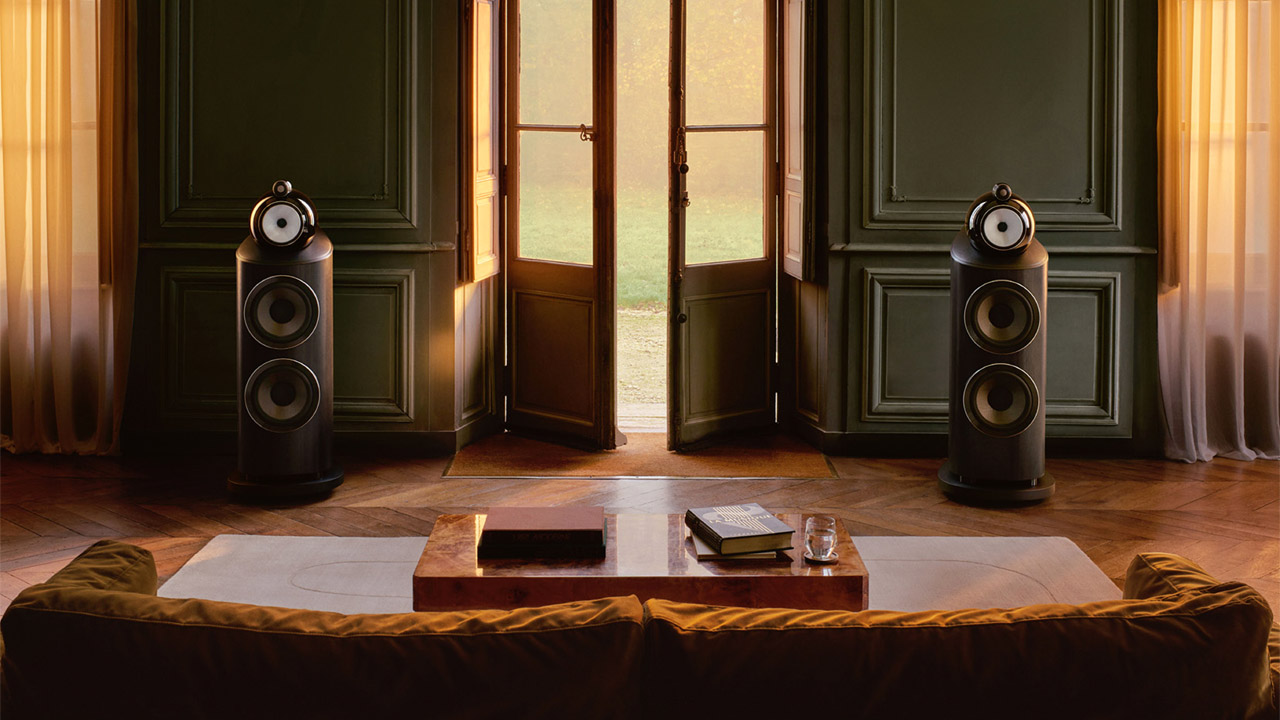
The drivers are all carried over: the Diamond tweeter, the Continuum midrange and the paired Aerofoil woofers. The changes are in the structure. B&W stiffened the internal Matrix construction with an aluminium space frame (a part-alloy, part-wood skeleton), added an upgraded rear spine and fitted extra alloy braces to deal with remaining cabinet modes. That work accounts for much of the extra 6 kg.
The crossover also got attention, though the cabinet was clearly the priority. The spine hosts the split crossover network, and the bi-wire terminal layout has been reordered. Behind it sits an all-alloy mounting plate that acts as a heatsink and damps vibration reaching the air-cored inductors.
The Turbine Head returns on the 801, 802 and 803 D5. It is a dedicated, damped pod for the midrange, mounted on an aluminium plate that forms the top of the one-piece, reverse-wrapped cabinet. The tapered, milled-aluminium Tweeter-on-Top housing sits above it, shaped to attenuate the tweeter’s rearward radiation.
The look is more subdued than before. The plinth is slimmer, with a tuned mass damper under the front edge. The chamfer at the top of the cabinet is smaller, which makes the Leather by Connolly trim stand out more. There are four finishes: Stealth Black, Warm White, Light Walnut and Dark Walnut, which replaces Satin Rosenut and first appeared on the limited 801 Abbey Road. Even the white and light walnut versions get all-black woofers. Retractable wheels remain, which matters at 106 kg. The published review also noted tighter panel tolerances and smoother transitions between surfaces.
The Listening Experience (As Reported)
What follows comes from a published listening session in a purpose-built room, not from my own ears. That session used a Constellation Revelation 2 preamp, a Gryphon Apex power amp (the amplifier B&W uses during speaker development) and a dCS Varèse source. A/B comparisons against the D4 Signature were also made in that room.
Bass
On Moderat’s “Eating Hooks” and “Running”, the lows were reported as deep and weighty without bleeding into the midrange. The vocals stayed clear while synth sweeps filled the room. The reviewer described the drum thump at the end of “Running” as large but defined, and said the room’s acoustic treatment helped. Hans Zimmer’s Dune material reportedly showed deep, proportionate bass.
Midrange
Loire Cotler’s vocals on Zimmer’s “Paul’s Dream” had strong presence, and the percussion kept pace. The reviewer found no band over-emphasised or under-played. On the Tony Allen and Hugh Masekela album Rejoice, a forceful edge on some brass textures showed up. The reviewer’s point was that a speaker this resolving exposes imperfect recordings, yet the performance stayed engaging.
Treble and Soundstage
On Adam Ben Ezra’s “Flamenco”, the room ambience, double-bass tone and long note decay were reportedly rendered with precision. The soundstage appeared detached from the cabinets, which the reviewer said took B&W’s usual strength in broad, cohesive staging to a new level.
Against the D4 Signature
In the same room, the D5 was described as cleaner, with less cabinet imprint and finer low-level dynamics. Tambourine on Melanie De Biasio’s “Gold Junkies” sounded more authentic on the D5, though the D4 Signature was more explicit.
My Read
I can’t tell you how it sounds in a room. My judgment from the architecture and data: a quieter cabinet should give lower coloration and more convincing low-level detail, which is what these reports describe. The brass-edge comment is the one I’d watch. If your music library skews toward bright or compressed recordings, expect this speaker to show that.
Assessment Basis
No in-room testing was done for this piece. It draws on published independent lab measurements, a published listening session and the speaker’s design documentation.
Measured Performance
Per independent lab testing published by Hi-Fi News:
- Sensitivity of 89.8 dB (1 kHz) and 89.5 dB (500 Hz–8 kHz), against a 90 dB rating.
- The familiar B&W four-hump response, with a roughly +2 dB step between 100 Hz and 1 kHz. On-axis error is ±4.1 dB (200 Hz–20 kHz), falling to ±3.3 dB at ±15° off-axis and ±2.1 dB over 500 Hz–8 kHz.
- Distortion below 0.1% from 80 Hz to 8 kHz (re. 90 dB SPL/1 m), mostly second harmonic.
- Distortion below 200 Hz is roughly halved versus the D4 Signature.
- Diamond tweeter resonance at 47 kHz, with response to 60 kHz (−6 dB re. 10 kHz) and better ultrasonic damping than before.
- Port output shows far fewer cabinet-mode spikes. The lab suggested this is the likely main reason for the cleaner, “blacker” sound.
- Magnetic grilles cost at most 0.8 dB between 1 and 3 kHz.
- Minimum impedance of 3.5 Ω at 100 Hz and 3.6 Ω at 740 Hz, with phase swings of −69°/+43°. Minimum EPDR is 1.29 Ω at 70 Hz, slightly easier than the D4 Signature’s 1.2 Ω.
The speaker keeps the B&W response shape and fixes what the box does underneath it. The cost is a demanding load, so amplifier choice matters.
The Competition
| Rival | Comparison | Verdict |
|---|---|---|
| Focal Scala Utopia Evo | Beryllium tweeter and a different dynamic character on paper. | Audition if you favour immediacy over B&W’s studio-reference balance. |
| Wilson Audio Sasha V | Different driver technology and a time-aligned design. | Compare in person; a close match for scale and image focus. |
| KEF Blade One Meta | Coaxial single-point-source design with different dispersion. | Better for imaging purists, less bass scale. |
At this level the room and the amplifier decide more than spec sheets. Treat the table as a starting list for auditions.
The Verdict
Provisional paper score: 9/10.
The 801 D5 is evolutionary, but the evolution fixes a real problem. The lab shows halved low-frequency distortion and a calmer port. The published listening session reports better precision, control and enjoyment. The caveats are a heavy price (especially outside the UK), a tough load and a resolving presentation that shows up weak recordings.
Pros / Cons
Pros
- Low-frequency distortion roughly halved versus the D4 Signature
- Cleaner port output and reduced cabinet resonances
- High sensitivity and a smoother in-band response off-axis
- Excellent build quality and a refined plinth
- UK price below the D4 Signature’s launch price
Cons
- Demanding impedance and phase behaviour
- Very high price, particularly in the US
- 106.4 kg each and room-dependent
- Same drivers as the D4 Signature, so owners may see an incremental gain
- Resolving enough to expose poor recordings
Who Should Buy / Who Should Skip
This is for you if you have a large, treated room, a powerful and stable amplifier, and you want studio-reference control and scale from a floorstander.
Look elsewhere if your room is modest, your amp is modest or your library leans on rough recordings. D4 Signature owners should audition before upgrading.